
Direct Answer: Cleanings, fillings, whitening and most crowns fit inside a four-month stay. Implants run on months of healing, so those get staged across two seasons around your departure date.
You land in Scottsdale the first week of November. Somewhere over New Mexico you run your tongue over the tooth that has been bugging you since July, and you promise yourself you will finally get it handled this winter.
Then March shows up and you are packing again. The tooth is still there.
I hear this every season. And the worry is almost never money. It is starting treatment you cannot finish before you fly home. This article walks through what genuinely fits in a four to six month stay, what has to be staged across two winters, and the two things to handle before you even get on the plane.
The Question Seasonal Residents in Scottsdale Actually Ask
Estimates put the Phoenix metro’s winter population gain somewhere in the range of 300,000 to 400,000 seasonal residents, with arrivals picking up in late October and most people settled by mid-November. North Scottsdale takes a big share of that, from the Shea Corridor up through McCormick Ranch and Scottsdale Mountain.
Our phones reflect it. In one recent month, roughly one in twelve callers told us they had just moved to the area or were arriving for the season and needed to find a dentist.
What they ask is rarely “what does it cost.” It is closer to:
- “Can you finish this before April?”
- “I leave in March, is that enough time?”
- “If we start now, am I stuck with a temporary all summer?”
That is a fair thing to worry about. A dentist who does not know your departure date will plan treatment on a normal year-round schedule. A dentist who does know it will sequence things differently. So say the date out loud at the first visit, before anything gets scheduled.
What Genuinely Fits Inside a Four-Month Stay
Most of what people put off actually fits, and comfortably. Here is how I think about the short end of the scale.
- Exam, X-rays and a cleaning: one visit. If your gums need more attention, that may mean a follow-up a few weeks later, still well inside a season.
- Tooth-colored fillings: typically one visit per area.
- Professional whitening: in-office whitening is a single appointment. Take-home trays run over a few weeks, which is fine if you start in November rather than late February.
- Small cosmetic repairs: bonding on a chipped front tooth is usually one appointment.
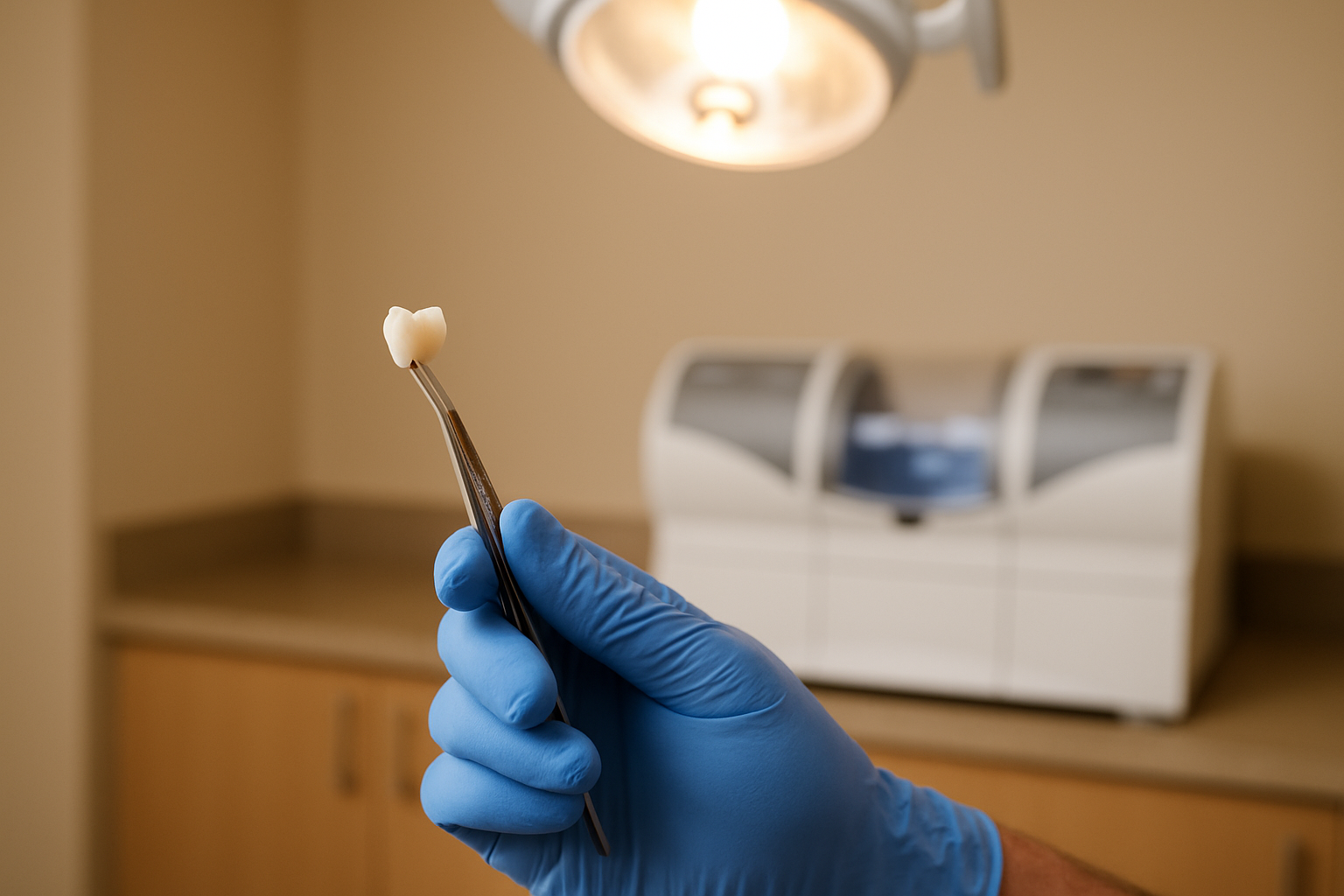
- Crowns: this is the one that surprises people. In many cases a cracked or worn tooth can be restored with a same-day crown, finished in a single appointment with no temporary and no second trip. Candidacy is always decided at the exam, not over the phone.
- Veneers and smile makeover work: multi-visit by nature, but often doable in one season if planning starts in the first month you are here.
The practical move is to front-load. Get the exam done in your first two or three weeks, not in January. That leaves room to finish anything the exam turns up before your flight out.
Treatment Timelines Against a Four to Six Month Stay
This is the rough shape of how long common treatments take. Your own timeline depends on what the exam finds.
| Treatment | Typical Visits | Fits in One Season? |
|---|---|---|
| Exam, X-rays, cleaning | 1 visit | Yes |
| Tooth-colored filling | 1 visit | Yes |
| In-office whitening | 1 visit | Yes |
| Take-home whitening trays | Fitting, then a few weeks of wear | Yes, if started early |
| Dental crown | 1 visit for patients who qualify, otherwise 2 visits a few weeks apart | Usually |
| Veneers or a staged smile makeover | Several visits over weeks to months | Often, if planning starts in month one |
| Single dental implant | Staged, with months of healing between stages | Partly, plan across two seasons |
| All-on-4 full-arch restoration | Surgical and restorative stages with healing between | Plan across two seasons or a longer stay |
Implants Are the Honest Exception
Implant treatment does not run on appointment length. It runs on bone healing, and healing does not care about your travel calendar. That is usually several months between the implant being placed and the final tooth going on top.
So the real question is not whether an implant can be done during a seasonal stay. It is which stages get completed before you leave and which ones wait.
A reasonable two-season plan often looks like this:
- Season one: exam, imaging, treatment planning, and the surgical stage if you are a candidate and there is enough runway before departure.
- Summer at home: healing happens on its own. Your home dentist can handle a routine cleaning if one comes due.
- Season two: the restorative stage, the final crown, and follow-up.
I would rather tell someone in February that we are planning around next November than rush a stage to beat a flight. If you want the full picture of the stages, we walk through how long a dental implant takes from start to finish and what the week-by-week healing actually feels like.
A Simple Order of Operations for Your Season
If you do these five things in this order, almost nothing gets left half finished.
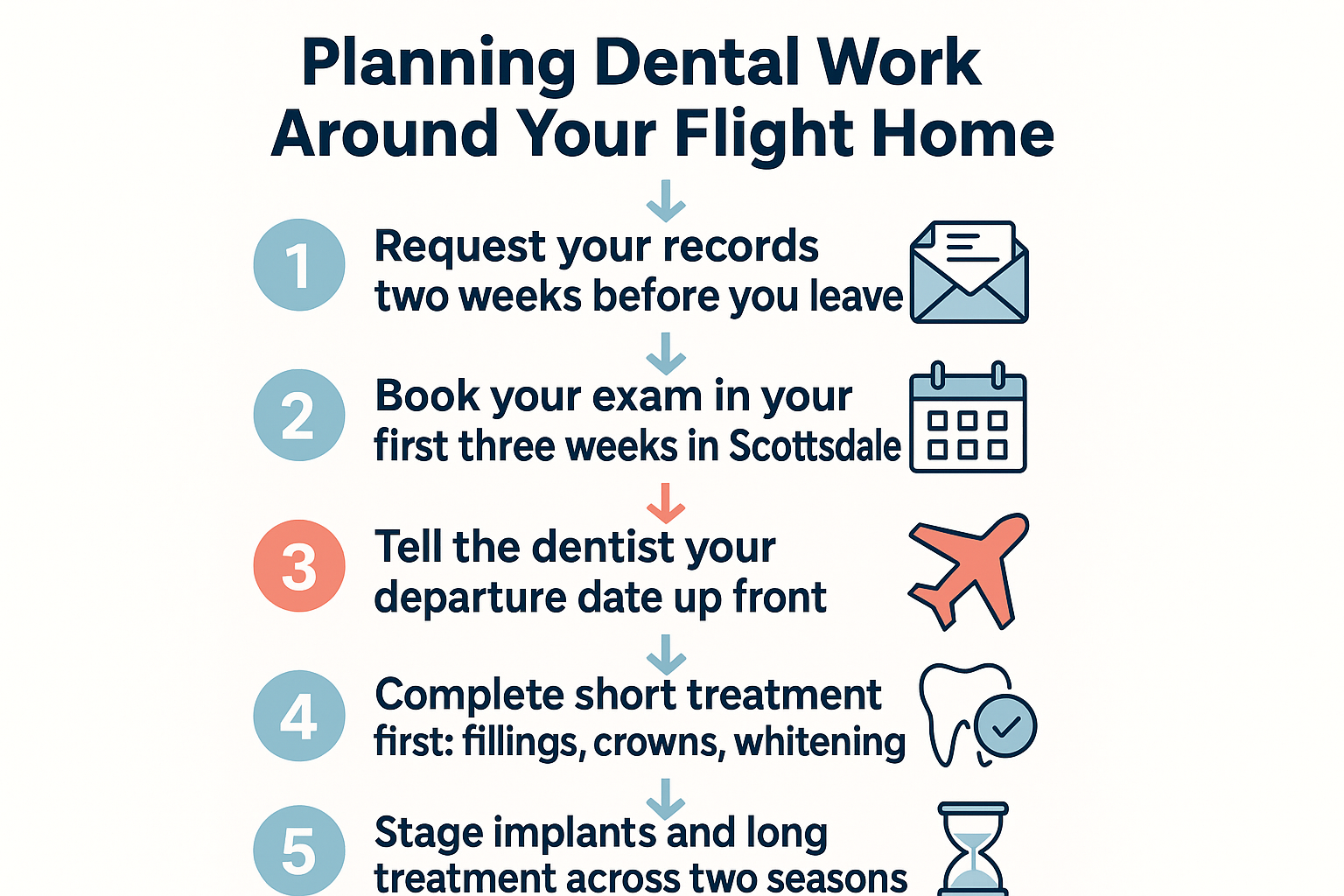
Bring Your Records and X-Rays. Almost Nobody Does.
A real slice of our incoming phone volume is offices trading charts and images back and forth. Patients are often surprised to hear they can just request their own records and bring them along.
You can. The American Dental Association confirms patients have the right to copies of their dental records, including radiographs and photographs, from the practice that took them.
Why it is worth ten minutes of your time:
- It avoids duplicate imaging. No reason to re-shoot a full series taken four months ago.
- It gives context. A new dentist can see what that molar looked like a year ago instead of guessing whether the crack is new.
- It can matter for insurance. Many plans cover a given X-ray series only once a year, so a duplicate set may land on you.
Request them a couple of weeks before you leave for Arizona, not after you arrive. Records requests move slowly in both directions, and chasing paperwork from 2,000 miles away wastes half your season.
Insurance Is Where These Conversations Usually Stall
Callers name their plan first thing. Delta Dental, Cigna, MetLife, Humana and BCBS Federal come up over and over. And an “out of network” answer ends the call far more often than it should.
Two things worth understanding before you let that happen:
- Out of network is not the same as no coverage. On many PPO plans, an out-of-network office still gets partial reimbursement. What changes is how much and how it is billed, which we break down in what changes when your dentist is out of network.
- Most dental plans cap what they pay each year, commonly somewhere in the $1,000 to $2,000 range as general market context. Unused benefits do not roll over. Specifics vary by plan, so verify your own.
Here is the part seasonal residents almost never use on purpose. A stay that spans December and January straddles two benefit years. Treatment sequenced across that line can draw on two annual maximums instead of one. If you are looking at a crown plus other work, that timing is worth a conversation in November, not in March. We cover the calendar side in what happens to benefits you don’t use by December 31.
If you are uninsured or paying cash, our office keeps an annual membership plan for patients without insurance. Pricing changes, so ask the front desk for current numbers rather than trusting a figure you read somewhere. There is also a plain walk-through of paying out of pocket in Scottsdale.
The Dry Air Nobody Warns You About
First-season residents notice it within a few weeks. Scottsdale’s winter air is far drier than what most people arrive from, and a dry mouth is not just an annoyance.
Saliva is part of how your mouth protects itself. Less of it can mean less natural defense against decay and more gum irritation. The effect tends to stack with medications that are common in this age group, including some blood pressure, allergy and antidepressant prescriptions.
Which is why a mid-season checkup is reasonable even when nothing hurts, especially if your mouth started feeling different after you got here. This is a conversation for your dentist and your hygienist, not something to sort out with a drugstore rinse and guesswork. Bring your medication list to the appointment and ask directly.
Why Seeing the Same Dentist in March Matters
When treatment is staged across visits, or across seasons, continuity does most of the quiet work. Someone who saw your tooth in November remembers the conversation you had about it.
Ours is a single-dentist practice led by Dr. Christine Fink, so a seasonal patient sees the same dentist in March that they saw in November. That is a different experience from a rotating roster at a larger corporate group, where the person finishing your crown may have never met you.
Patients tell us they will drive for that. One review put it simply: “Even if you don’t live in North Scottsdale, it’s worth the drive.” Another patient wrote that their family has followed the same dentist around the valley, passing plenty of offices on the way.
If you are still comparing options, here is what patients who research a dentist actually look at.
Frequently Asked Questions About Dental Care for Seasonal Residents in Scottsdale
I leave in six weeks. Is it too late to start anything?
Usually not. A cleaning, a filling, whitening and in many cases a crown can all be handled in that window. What I would not start in six weeks is implant treatment, because the healing stages will not cooperate.
Will my home dentist mind if I get work done in Arizona?
In my experience, no. Most home dentists just want the records afterward so the chart stays accurate. Ask for a copy of your X-rays and treatment notes before you fly back and hand them over at your next visit.
Can I split treatment between my home dentist and a Scottsdale dentist?
Yes, and seasonal patients do it all the time. It works best when the split falls on a natural break, like the healing gap in implant treatment, rather than mid-crown with a temporary in place. Tell both offices what the plan is.
What should I bring to a first appointment as a seasonal resident?
Your recent X-rays and records, your insurance card, your medication list, and your departure date. That last one changes how the treatment plan gets sequenced more than anything else on the list.
My crown came off and I am only here until April. What now?
A crown that comes off is often reattached or replaced quickly, sometimes the same day. Call rather than wait it out, since an exposed tooth can get worse fast. Here is how to tell whether your tooth situation is actually an emergency.
Planning Your Season in North Scottsdale
If you spend your winters here and have something you would rather not fly home with again, the useful first step is an exam early in your stay with your departure date on the table. Our office sits on N. Frank Lloyd Wright Blvd, a short drive from the Shea Corridor and McCormick Ranch, and we see seasonal patients across North Scottsdale every winter. You can reach us at 480-621-4040 or at trinitydentalcares.com whenever you are ready to talk it through.