
Direct Answer: Placement itself is usually not painful because the area is fully numb. Most people feel pressure and vibration, then mild soreness for a few days that fades with over the counter medication.
I talk with a lot of Scottsdale adults who have been thinking about replacing a missing tooth for months, sometimes years. They can tell me the success rates, the materials, and roughly how long the whole process takes. What stops them is a question they usually do not say out loud: is this going to hurt?
So let me answer it straight instead of handing you reassurance. Cost matters, insurance matters, but in my experience the fear of what the appointment will feel like is the real reason people stall.
This article stays on one subject: sensation and comfort. What placement feels like, what the first few days feel like, what counts as normal soreness, and how much your own nerves change the experience.
What Dental Implant Pain Actually Feels Like During Placement
Here is the part most people get wrong. They picture the implant appointment as something far bigger than what actually happens in the chair.
With the area fully numb, you should not feel sharpness. What patients describe to me afterward is usually some version of:
- Pressure, like something firm is being pushed against the jaw
- Vibration and a low hum you feel more than hear
- Awareness that work is happening, without the pain they braced for
- A stretched or tired feeling in the jaw from holding open
Many of the people I see have already been through an extraction, sometimes a rough one. They arrive expecting a repeat of that day. More often they tell me the visit felt closer to getting a routine filling than to having a tooth pulled.
I am not going to promise you feel nothing. Everyone’s nerves, anatomy, and tolerance are different, and a molar site in dense bone is not the same as a front tooth. But the honest version is that the sensation during placement is usually far duller and far less dramatic than what people imagine on the drive over.
The Part That Actually Stings Is Short
If something is going to pinch, it is the numbing. That is a few seconds of sting, and then it is over.
A slower approach makes a real difference here. Warming the anesthetic, going gently, and giving it enough time to take full hold before anything else starts changes the whole appointment. Rushing the numbing is how people end up with a bad memory of dental work.
The other thing that matters is checking in. I want to know before you feel something, not after. A dentist who pauses, asks how you are doing, and watches your hands and shoulders instead of only your tooth can stop discomfort before it builds.
One of our patients put it simply in a review: “I could feel Dr. Fink truly cares and watched closely for my comfort.” That is not a technique you can list on a website. It is pacing, and it is the difference between an appointment you tolerate and one you barely think about afterward.
If you are also trying to figure out how many visits this all takes, that is a separate question and worth reading about on its own. Here is the full timeline from consultation to finished tooth.
What the First Week Usually Feels Like
Here is the pattern I describe to patients before they leave. Research on patient reported recovery after implant placement found that most measures, including pain and limits on daily routine, came back down to minimal levels in about four days, with swelling taking closer to five. You can read that patient recovery study here. That lines up closely with what I hear from our own patients.
| Timeframe | What Is Typical | What Tends to Help |
|---|---|---|
| Day of surgery | Numbness for a few hours, then a dull ache as it wears off | Rest, cold compress, soft food, no driving until numbness fades |
| Day 1 after | Often the sorest day, worse than the day of | Over the counter medication as directed, cold compress, taking it easy |
| Days 2 to 3 | Swelling usually peaks, then starts to settle | Continued cold compress, soft foods, plenty of water |
| Day 4 | Most people notice a clear turn toward normal | Back to light routine, still gentle around the site |
| Days 5 to 7 | Swelling fading, soreness mostly gone or occasional | Normal routine for most people, follow the care instructions you were given |
Normal Soreness or Time to Call?
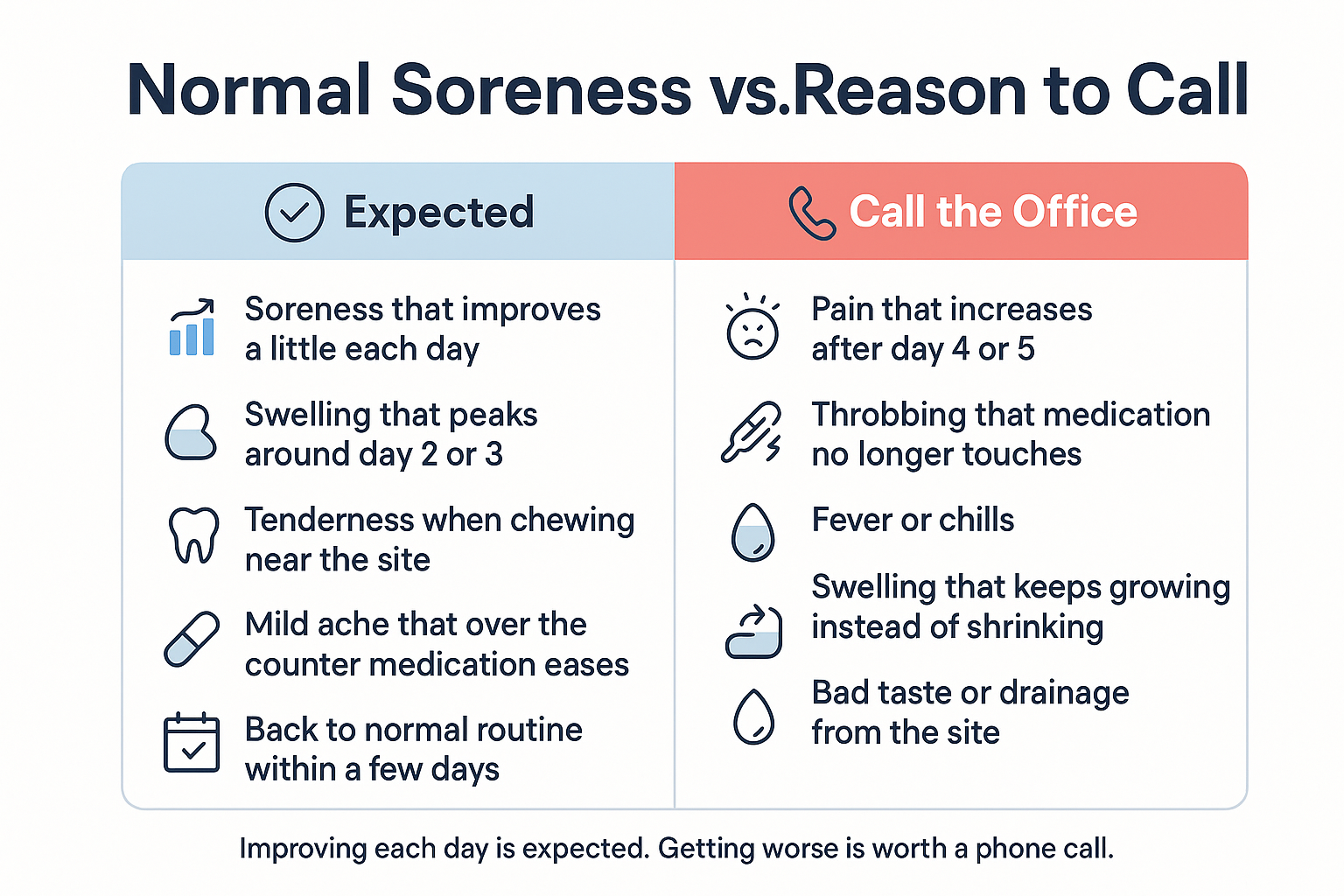
The line I want every patient to understand is the direction things are moving. Discomfort that gets a little better each day is expected. Discomfort that climbs is a reason to pick up the phone.
When Soreness Stops Being Normal
I will not tell you what to take or how much. That is a conversation for your own dentist, based on your health history and what was done.
What I will tell you is what to watch for. The shape of a normal recovery is downhill, a bit better every day.
These are the signs that deserve a phone call instead of another night of waiting:
- Pain that climbs after day four or five instead of easing
- Throbbing that your usual medication no longer touches
- A fever, or feeling generally unwell
- Swelling that keeps growing past day three
- A bad taste, unusual drainage, or numbness that has not returned to normal
None of these mean something has gone wrong for certain. They mean the situation needs eyes on it. Calling early almost always means a smaller fix than calling a week later, and no one at a dental office thinks you are overreacting for asking.
And if you want the longer arc of how the implant settles into the bone over the following months, we covered healing week by week separately so this page can stay focused on comfort.
Your Anxiety Is Part of the Pain Equation
This is not a soft add-on to the conversation. Patients who walk in tense, shoulders up, jaw clenched, consistently report more discomfort than patients who walk in knowing what is about to happen.
Telling an anxious person to relax does nothing. What helps is getting specific before the appointment starts. These are questions worth bringing to a consultation:
- Can I tell you upfront that I am nervous? Say it out loud. It changes how the whole visit is run.
- Can you walk me through each step before you do it? Some people want narration, others want none. Both are fine, but you have to say which.
- Can we agree on a hand signal to pause? Knowing you can stop things at any moment removes the feeling of being trapped.
- What comfort and sedation options does the practice offer, and what do you recommend for me? Candidacy depends on your health history, so ask rather than assume.
- What does the first 48 hours look like for someone like me? Uncertainty is its own kind of pain.
I have seen this play out in the chair over and over. The patient who asks all five of those questions has a different appointment than the patient who says nothing and white knuckles it. If nerves are your main barrier, we wrote a full piece on what you can do before an appointment.
A Few Things That Matter Specifically Here in North Scottsdale
Implant questions come in waves around here. Fall and early spring are the busiest, once seasonal residents are settled in and working professionals are planning around travel and time off.
That makes the practical question less about pain and more about the calendar. Most of our patients plan on taking it easy for two or three days and being back to a normal week after that, but the honest answer depends on the site, your health, and how much work is done at once. It is worth asking at the exam rather than guessing.
The desert air deserves a mention too. Our dry climate, especially with the air conditioning running most of the year, leaves a lot of people with a parched mouth by the end of the day.
Staying well hydrated makes those first few days noticeably more comfortable. That goes double if you are on blood pressure medication, antidepressants, or anything else that already causes dry mouth. Mention your full medication list at the consultation, since it affects comfort and healing more than most people expect. Candidacy itself comes down to what the exam shows, and we explained what a dentist is actually looking for if you want to know what happens at that first visit.
Why Who Does the Work Changes How It Feels
Two dentists can place the same implant with the same equipment, and patients can walk out with completely different memories of the day. Pacing, communication, and attention to your comfort are not extras. They are the experience.
That is the piece I think gets lost at larger group practices where you see a different face each visit. When one dentist knows your history, your anxiety, and how you responded to numbing last time, the second appointment goes better than the first.
Our patients tend to describe the same things in reviews: gentle, unhurried, watching for signs of discomfort. One patient mentioned getting a personal phone call the next day to talk through the plan, which tells you more about a practice than any list of technology does.
One review I think about often when this topic comes up: “The dentist can give me anxiety, but everyone here made sure I was comfortable, and went above and beyond!” That is from Bartek L., and it is the kind of outcome I want for every nervous patient who has been putting this off.
Frequently Asked Questions About Dental Implant Pain
Does getting a dental implant hurt more than having a tooth pulled?
For most people, no. Patients who have already been through an extraction often tell me the implant appointment felt milder, because the work is more controlled and there is no twisting or pulling. Pressure and vibration are the usual descriptions, not pain.
How long will I be sore afterward?
Most people find day one after is worse than the day of, swelling peaks around day two or three, and things feel close to normal by day four or five. Some tenderness at the site can linger a bit longer, but it should keep improving.
Will I be awake during the procedure?
Usually yes, with the area fully numb. Comfort and sedation options vary by patient and by health history, so it is a question to ask at your consultation rather than something to assume one way or the other.
What if I am too anxious to even sit through the appointment?
Say that out loud at the consultation. Knowing you are nervous changes how the visit is paced, whether we narrate each step, and what comfort options get discussed. In my experience, the people who name their fear early have the easiest appointments.
Can I go back to work the next day?
Plenty of people do, especially with a desk job. I still suggest building in a day or two of light activity if your schedule allows, since the day after tends to be the sorest. Heavy lifting and hard workouts are usually worth postponing briefly.
Is throbbing pain a week later normal?
Not really. Discomfort that is still climbing, or throbbing that medication no longer helps, is a reason to call rather than wait. It may turn out to be minor, but it should be looked at instead of guessed at.
Questions About Comfort Are Welcome at a Consultation
If the pain question is the thing that has kept you from replacing a tooth, bring it up first. At Trinity Dental Care in North Scottsdale, comfort and sedation options are part of the same conversation as the treatment plan, not an afterthought. You are welcome to call 480-621-4040 or visit trinitydentalcares.com whenever you want to talk it through.