
Direct Answer: In most calendar-year dental plans, whatever is left of your annual maximum on December 31 disappears. It does not roll into January, and neither do unused cleanings.
About one in eight calls that come into our office is someone asking whether we take their plan. They know the name by heart. Delta Dental, Cigna DPPO, MetLife, Humana, BCBS Federal, they rattle it off without pausing.
Then I ask how much of their annual maximum they have left for the year, and the line goes quiet. That is the pattern I see over and over with Scottsdale patients: total confidence about the plan name, near total blank on how the plan actually spends.
So let’s fix the blank. I want to walk you through what your maximum is, what happens to it on January 1, and why the smart time to sort this out in North Scottsdale is late summer and fall, not the week before Christmas.
Your annual maximum is a ceiling, not a bank account
Here is the plainest way I know to explain it. Your annual maximum is the most your dental plan will pay toward your care during one benefit year. Once the plan hits that ceiling, it stops paying and the rest is on you.
Across the industry, those ceilings commonly land somewhere in the $1,000 to $2,000 neighborhood, and that figure has barely moved in decades. But general numbers do not help you. The only number that matters is the one printed on your plan, and it can sit above or below that range depending on how your employer built the benefit.
Two things confuse people constantly at our front desk:
- Your deductible does not count toward the maximum. Money you pay out of pocket to satisfy the deductible is your money, not the plan’s.
- Your copay does not count either. Only the insurer’s share counts against the ceiling.
- Preventive visits often do not eat much of it. Many plans cover cleanings and exams at a high percentage, so your maximum can stay mostly intact even if you have been in twice.
That last point catches people. Patients assume two cleanings burned through their benefits, then find out most of the ceiling is still sitting there unused.

What actually resets on January 1
For most calendar-year plans, the reset is clean and unsentimental. Whatever portion of your maximum you did not use is gone. It does not carry forward, and no one calls to tell you.
Three things flip over at once:
- The unused maximum disappears. You start January with a fresh ceiling and no credit for last year.
- The deductible starts over. If you paid it in October, you pay it again in the new year.
- Frequency limits reset. Two cleanings per benefit year means two, and unused ones do not stack.
A minority of plans do offer limited carryover, where a small unused amount rolls into the next year. It exists, but it is the exception. Confirm it rather than assuming it, because I have seen patients bank on carryover that was never in their contract.
Also worth checking: not every plan runs on the calendar. Some benefit years start in July or on your hire date anniversary. Call your carrier or ask us and get three answers in writing:
- How much of my annual maximum has been used so far?
- What is my exact benefit year end date?
- Have I used both of my cleanings for this benefit year?
Those three questions take about five minutes and they change the math more often than you would think.
What carries over and what does not
This is the quick reference I wish every patient had taped inside a kitchen cabinet. Confirm each line against your own plan documents.
| Plan feature | What typically happens at year end | What to verify |
|---|---|---|
| Unused annual maximum | Usually forfeited, does not roll forward | Whether your plan has any limited carryover |
| Deductible already paid | Resets, you pay it again next year | Individual vs family deductible amount |
| Cleanings and exams | Frequency count resets, unused visits are lost | How many are allowed per benefit year |
| Treatment already approved | Pre-authorizations can expire | Expiration date on your pre-treatment estimate |
| Network participation | Can change with the new plan year | That your dentist is still in network for next year |
The money hiding in details nobody asks about
Some of the best outcomes I have seen came from a phone call that was about something else entirely.
One of our patients called only to move her cleaning up a couple of weeks. While the front desk pulled up her benefits, they found her plan covered additional cleanings during pregnancy, a benefit she had no idea she qualified for. She had been sitting on coverage she would never have found on her own.
Another caller phoned in genuinely worried about a charge she spotted on her card. It turned out to be a payment posted from her insurance company, not a bill. Ten seconds of looking, and her whole afternoon got better.
Things like that almost never surface inside a carrier portal. The portals are built to display claims, not to point out benefits you have not claimed. That is why a live benefits review with someone who reads these plans daily is worth the call, even when nothing feels wrong.
The realistic year-end dental timeline in Scottsdale
Here is how the fall calendar actually plays out for adults in North Scottsdale, and where the useful window sits.
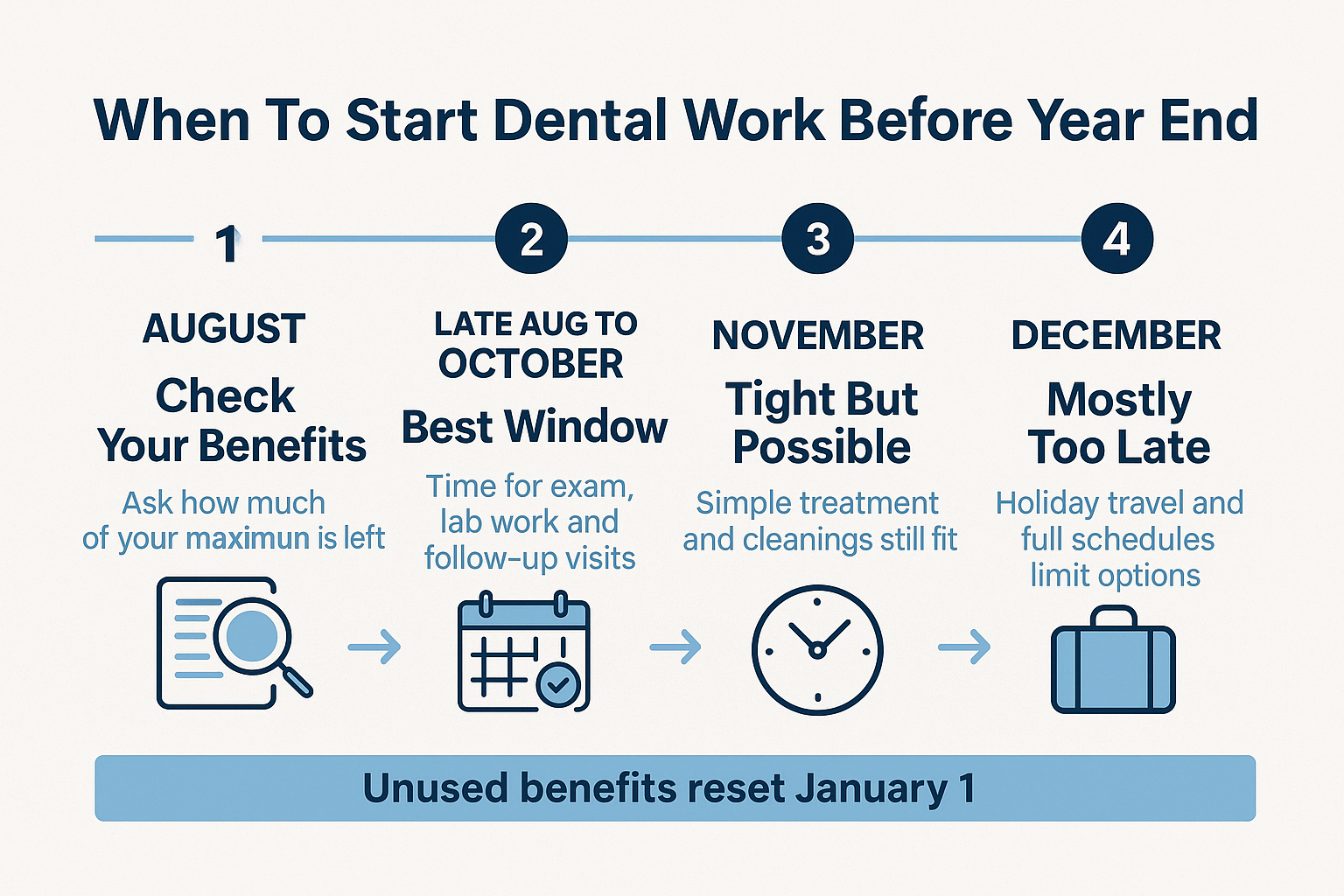
Timing is the part nobody plans for
Adults put their own care last. I watch it happen every single year in Scottsdale. Summer is packed, then the school year starts, and by the time the household routine settles, it is already October.
With Scottsdale Unified back on August 10 and Paradise Valley Unified on August 12, that stretch from late August through October is the realistic window to begin anything that takes more than one appointment. Restorative work often involves an exam, imaging, sometimes lab time, and a follow-up visit.
By mid-December, the schedule is fighting two things at once: holiday travel and the seasonal population swell that fills North Scottsdale offices from Thanksgiving onward. Someone who calls on December 20 hoping to spend a remaining maximum is usually too late for anything but a cleaning.
Crowns are the clearest example. Same-day crowns are available in many cases for patients who qualify, which removes the temporary crown and the second visit. But candidacy gets determined at the exam, not over the phone, so the exam still needs to happen with time to spare. If you are curious what that first visit actually involves, we broke down what happens at a dental exam and cleaning in detail.
Splitting a treatment plan across two benefit years
This is the conversation I have in the chair most often in the fall, and it is genuinely useful.
When a treatment plan is bigger than one year of coverage, part of the work can sometimes be completed before December 31 and the rest scheduled after the maximum resets in January. That spreads your out-of-pocket cost across two years of benefits instead of stacking it into one.
A few honest guardrails on that approach:
- Clinical need beats the calendar every time. A cracked tooth, an active infection, or a failing crown gets treated on its own timeline, not the insurance company’s.
- Ask for a pre-treatment estimate. Submitting the plan to your carrier in advance shows you the expected split before you agree to anything.
- Sequence matters. Some work has to be done in a certain order for the result to hold, which can limit how the plan gets divided.
If you are weighing something larger like implants, the coverage picture has its own quirks. We wrote about what dental insurance actually covers for implants in Arizona because the assumptions people bring in are usually off.
Do not assume last year’s network status still holds
Quick but important. Network participation is not permanent, and it has been shifting.
The American Dental Association’s Health Policy Institute found in its fourth quarter 2025 dental economy update that about 35% of dentists said they intended to leave at least some insurance networks in 2026. Its first quarter 2026 update showed roughly 22% had already done so.
Verify participation for the current year before you do benefit math on it. And know that out of network does not mean uncovered, it usually just means your plan pays a different share of the cost.
If you have no dental coverage at all
The whole year-end reset conversation is irrelevant to you, and something else applies instead.
We get this call directly. One person phoned asking on behalf of an uninsured family member whether we had “a savings plan.” Many practices, including ours, offer an in-office annual membership plan that bundles routine care for one flat yearly fee.
These plans typically include:
- Routine cleanings for the year
- Exams and necessary X-rays
- Often a percentage discount on other treatment
The structure is different from insurance in two ways that matter. There is no annual maximum to run out of, and there is no claims process, so nothing gets denied or delayed by a carrier. Ask exactly what is included before you compare it against an insurance premium, because the two products are not measuring the same thing.
Frequently Asked Questions About Unused Dental Benefits
Can I get money back for benefits I did not use?
No. Your annual maximum is a spending ceiling the plan will pay toward care, not a balance you own. If you do not use it, it simply expires.
Does every dental plan reset on January 1?
Most do, but not all. Some plans run on a fiscal year or start on your employment anniversary. Ask your carrier for your exact benefit year end date rather than assuming December 31.
How late in the year can I still start treatment and have it count?
It depends on the treatment. A cleaning can often be squeezed in. Anything involving lab work or a follow-up visit really needs to start by late October or early November in Scottsdale, because December schedules fill fast with holiday travel and seasonal visitors.
Should I rush treatment just because my benefits are about to reset?
No, and I say that plainly. Insurance timing is a nice tiebreaker when two options are clinically reasonable, but it should never be the reason you have work done. If a problem is stable, waiting into January to use fresh benefits can be the better call.
What if I have been avoiding the dentist for years and I am nervous about what they will find?
That is one of the most common things I hear, and nobody here is going to lecture you. We start with an exam, explain what we see, and give you options in writing. If the nerves are the real obstacle, we put together some things you can do before your appointment that genuinely help.
Want to know what is actually left on your plan?
We verify benefits live during the first phone call and get written estimates into patients’ hands quickly, which is not how the larger corporate groups around the Phoenix metro tend to handle it. One patient put it simply in a review: “They were timely at giving my estimate to me as promised.” That kind of clarity is the point.
If you are in North Scottsdale, Paradise Valley, or anywhere along the Shea Corridor and you would like someone to check your remaining benefits and talk through realistic timing, our team is glad to do that. You can reach us at 480-621-4040 or at trinitydentalcares.com.