
Direct Answer: A straightforward single dental implant usually takes about three to six months from placement to final crown. Bone grafting, gum treatment, or extra healing time can push that to nine months or longer.
Once someone decides they want a dental implant, the first question they ask me usually is not about cost. It is “how long is this going to take?” That question comes up on our phone line constantly, from patients all over North Scottsdale, from the Shea Corridor to McCormick Ranch.
And it is a fair question, because most people have no frame of reference. An implant is not like a filling you knock out over a lunch break from an office near Frank Lloyd Wright Blvd.
So here is an honest walk through the dental implant timeline a Scottsdale patient can expect, what stretches it out, and what your dentist is actually measuring before anyone touches a drill.
The Realistic Dental Implant Timeline in Scottsdale
For a healthy adult with enough bone and no active gum disease, the whole process usually runs three to six months from implant placement to the final crown.
That breaks down into a few distinct phases:
- Consultation and imaging: one visit, usually about an hour, including 3D imaging and a review of your medical history
- Any prep work: extraction, gum treatment, or bone grafting if needed, which is where timelines start to stretch
- Implant placement: a single appointment, often 60 to 90 minutes for one tooth
- Healing and integration: typically two to four months with no active treatment
- Abutment and impressions: a short visit once the implant is stable
- Final crown placement: one visit, and you are done
The part that surprises people is how much of that timeline is just waiting. The actual chair time for a single implant might total four or five hours spread across the whole process.
I have had patients drive in from Paradise Valley expecting three appointments in three weeks. The math does not work that way, and there is a good reason for it.
The Healing Phase Is the Part Patients Underestimate
After the titanium post goes into your jaw, nothing visible happens for a while. Underneath, your bone is growing directly onto the surface of the post in a process called osseointegration.
That takes two to four months for most healthy adults. There is no shortcut, no supplement, and no way to talk your dentist into speeding it up.
Rushing this step or disturbing the implant during it raises the risk of failure, which means starting over. The American Dental Association describes the same integration period as the foundation the whole restoration depends on.
A few things affect how long integration takes:
- Bone quality and density at the implant site
- Smoking, which slows healing measurably
- Diabetes or other conditions that affect circulation and healing
- Which jaw the implant is in, since the lower jaw is generally denser and often integrates faster
- Whether a graft was placed at the same time
You are not walking around with a gap the whole time in most cases. A temporary tooth is often an option, depending on the site.
If you want a closer look at what those months actually feel like day to day, we broke it down in what dental implant healing actually looks like, week by week.
Phase by Phase: What Each Step Typically Takes
Here is a rough reference for a single implant in a straightforward case. Your own schedule is set at the exam, not from a chart.
| Phase | Typical Time | What Is Happening |
|---|---|---|
| Consultation and 3D imaging | 1 visit, about 1 hour | Bone, gums, medical history, and neighboring teeth are evaluated |
| Extraction and site healing (if needed) | 2 to 3 months | The socket fills in and stabilizes before placement |
| Bone graft (if needed) | 3 to 6 months added | Graft material matures into bone strong enough to hold an implant |
| Implant placement | 1 visit, 60 to 90 minutes | The titanium post is set into the jawbone |
| Osseointegration | 2 to 4 months | Bone fuses to the implant surface |
| Abutment and impressions | 1 short visit | The connector is attached and the crown is designed |
| Final crown placement | 1 visit | The permanent crown is seated and adjusted |
What Adds Months, and Why Waiting Costs You Time
Three things stretch a timeline more than anything else, and all of them stack.
- Bone grafting. If there is not enough bone to anchor the post, a graft has to mature first. That alone can add three to six months.
- Active gum disease. We treat the infection before placing anything. Healthy gums are not optional for an implant that lasts.
- A recent extraction. The socket usually needs a couple of months to fill in before the site is ready.
Here is the part I wish more people knew. When a tooth comes out and nothing replaces it, the jawbone at that site starts shrinking within the first few months. Bone needs stimulation from a root to hold its volume.
So a patient who loses a molar in February and calls us in November may now need a graft they would not have needed in the spring. Waiting does not just delay the implant, it can add an entire phase to it.
We hear from Scottsdale callers with broken teeth and bridges that came off implants all the time. Those situations are urgent for other reasons, but the bone clock is part of why we would rather see you soon. If you are unsure whether your situation qualifies, this breakdown of what counts as a dental emergency is a good place to start.
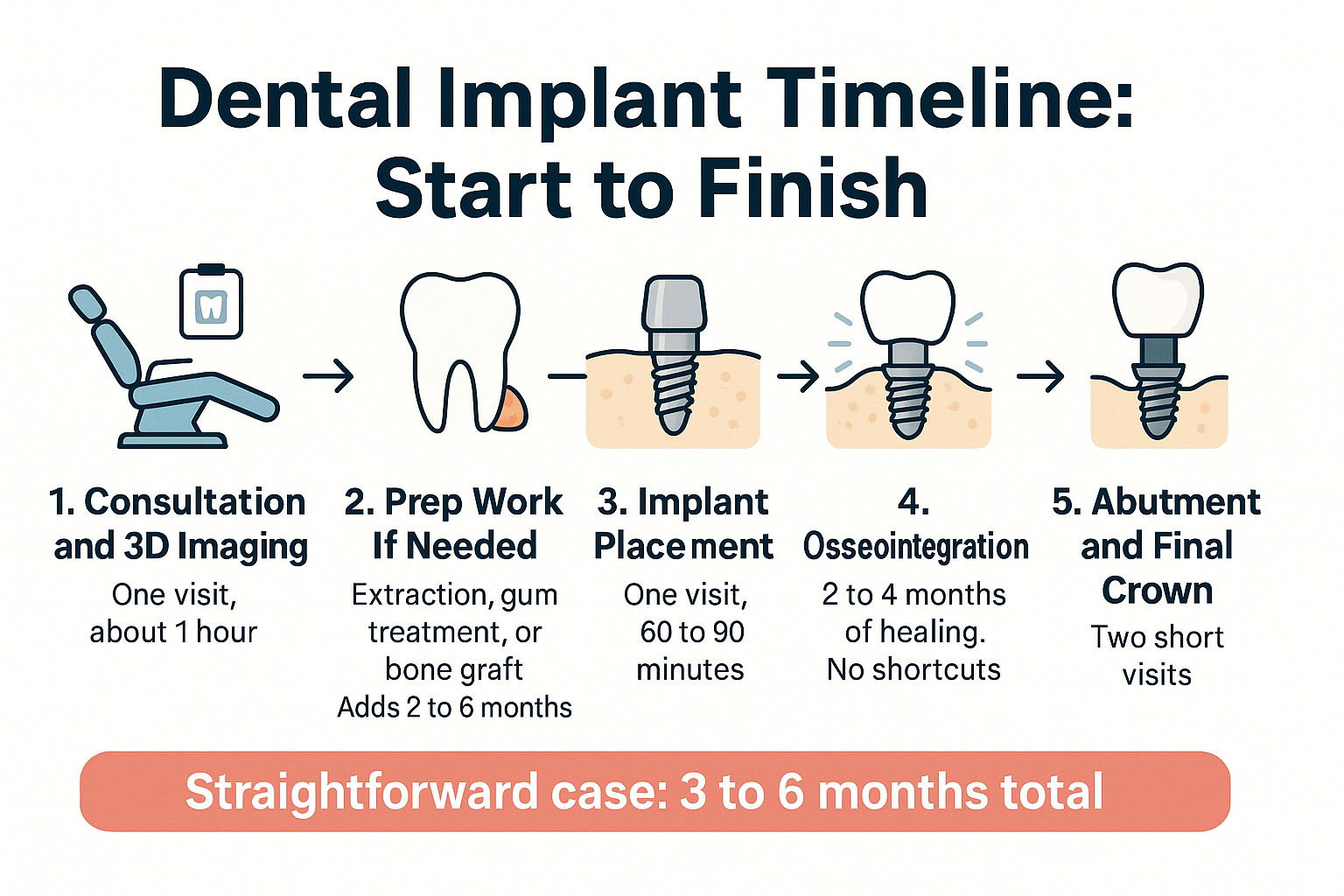
The Implant Timeline at a Glance
This is the same sequence in visual form, from first consultation to final crown.
What I Am Actually Evaluating at an Implant Consultation
We see a steady number of patients who come in for a second opinion on an implant recommendation from somewhere else. I think that is a smart move, and I would rather you understand what is being assessed than take anyone’s word for it.
At the consultation, these are the factors that set your timeline:
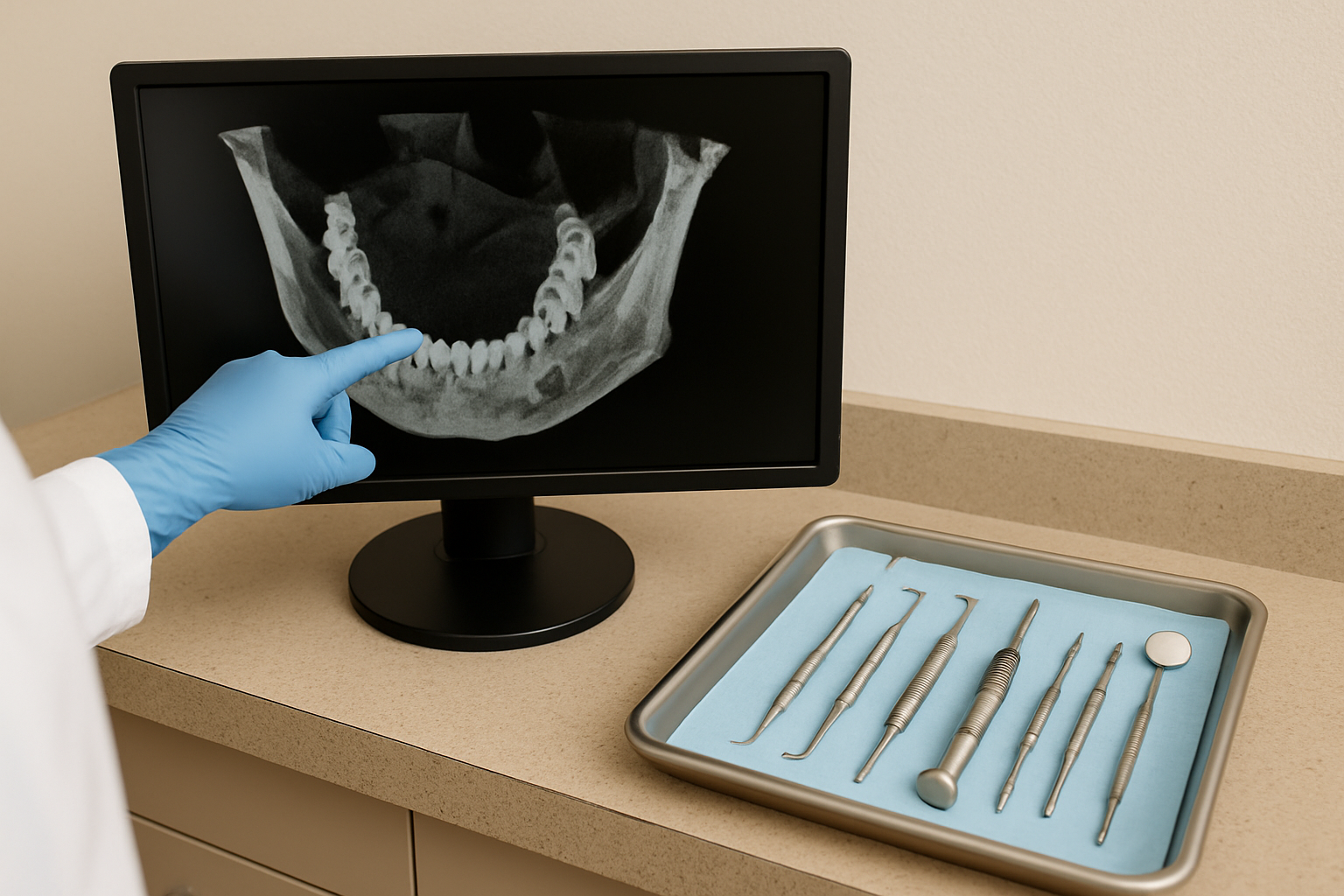
- Bone volume and density at the site, measured on 3D imaging rather than guessed from a flat X-ray
- Gum health, including pocket depths and any signs of active infection
- Medical history, including diabetes, medications that affect bone, and smoking
- The neighboring teeth, since a cracked tooth next door changes the plan
- Your bite and how you chew, which affects the crown design and long-term wear
If a dentist gives you a firm timeline before looking at 3D imaging, that is worth asking about. The honest answer at a first visit is often a range, not a date.
It is also worth asking whether an implant is even the right call for your situation versus a bridge. We compared the two in implant or bridge: how do you actually choose between them, and coverage questions are covered in does dental insurance cover implants in Arizona.
Why Summer Is a Reasonable Time to Start the Clock
A lot of Scottsdale patients think about dental work the same way they think about home projects. Something has been bothering them for a year, and then a deadline shows up.
We hear it every June through August. People want it handled before fall, whether that means before the school calendar takes over, before holiday photos, or before a trip.
Run the math. A patient who has their consultation in July, in a straightforward case with no graft needed, can realistically be wearing a final crown by late fall. Start that same process in October and you are looking at spring.
That is not a reason to rush a decision. It is just useful context if you have been putting off the call. The consultation itself costs you one appointment and gives you an actual timeline instead of a guess.
Summer also tends to be when North Scottsdale schedules loosen up a bit, before the winter residents return to Scottsdale Mountain and the DC Ranch area and the whole valley gets busy again.
Frequently Asked Questions About Dental Implant Timelines
Will I have a gap in my smile the whole time?
Usually not. Depending on the location and how the site is healing, a temporary tooth or a removable option is often possible during the integration months. For a front tooth especially, we plan for that from the start.
What about “teeth in a day” that I keep seeing advertised?
That language usually refers to certain full-arch cases, like All-on-4, where a temporary bridge can be attached to the implants the same day they are placed. It does not mean the bone integration is finished. Even in those cases, the final restoration comes months later, and candidacy is determined at the exam.
Can I speed up the healing phase?
No, and you should not try. What you can do is protect it: avoid smoking, keep the area clean, keep your follow-up visits, and do not chew hard food on that side until you are cleared.
How long does the implant itself last once it is done?
With good hygiene and regular checkups, the implant post is designed to be a long-lasting solution. The crown on top is the part that may need replacing eventually, on a schedule closer to a regular crown.
I lost a tooth several years ago. Is it too late?
Not usually. The bone has likely shrunk at that site, which often means a graft is part of the plan and the timeline is longer. But plenty of patients who waited years still end up with a good outcome. The only way to know is imaging.
Want a Real Timeline for Your Own Situation?
Every implant timeline comes down to your bone, your gums, and your health history, and none of that can be sorted out over the phone. If you are in Scottsdale, Paradise Valley, or anywhere across North Scottsdale and you have been sitting on this decision, a consultation is the step that turns a guess into a plan. Our team at Trinity Dental Care is taking new patients at the Frank Lloyd Wright Blvd office, and you can reach us at 480-621-4040 or at trinitydentalcares.com whenever you are ready.