
Direct Answer: Same-day crowns work when a tooth has enough healthy structure, stable gums, and no need for a specialty material. Deep decay, gumline fractures, or a fresh root canal usually mean two visits.
Most people who ask me about same-day crowns are really asking about one thing: do I have to come back? They have heard a friend in McCormick Ranch or along the Shea Corridor walked out with a finished crown in a single morning, and they want that same deal.
I understand the appeal. Nobody wants to wear a temporary crown for two weeks, then come back for a second shot of anesthetic.
But here is the honest part that patients rarely hear upfront: same-day dental crown candidacy is decided by your tooth, not by the equipment in the room. Below I’ll walk through what actually makes a tooth a good fit, when I would slow down on purpose, and what you genuinely gain when the answer is yes.
What Same-Day Crown Candidacy Actually Depends On
A same-day crown is designed, milled, and cemented in one appointment. Instead of taking a physical impression and mailing it to a lab, I scan the tooth digitally and mill the crown in the office while you wait.
That only works when the tooth is ready to accept a permanent restoration that same day. Here is what I’m checking during the exam:
- Remaining tooth structure. There needs to be enough solid tooth left to hold a crown without a separate buildup step.
- Gum health and margin position. I need a clean, visible edge to scan. Bleeding or swollen tissue makes an accurate scan unreliable.
- How deep the damage goes. Decay or a crack that runs toward the nerve changes the plan entirely.
- Bite forces on that tooth. A back molar takes far more load than a front tooth.
- Which material the tooth needs. Not every material can be milled chairside.
When all of those line up, one visit is realistic. When even one is off, I would rather take two visits and get it right. If you’re still sorting out why a crown was recommended in the first place, this walkthrough of what a crown recommendation really means covers the basics.
The Teeth Where I Slow Down on Purpose
These are the cases I see most often in North Scottsdale where a single visit is not the right call, even though the technology is sitting right there in the operatory.
Very deep decay. If the cavity reaches close to the nerve, I need to see how the tooth responds before sealing it under a permanent crown. Cementing too early can mean drilling that crown off later.
Fractures at or below the gumline. I cannot scan what I cannot see. Sometimes the gum tissue needs to be reshaped and given time to settle before there is a clean margin to work with.
A tooth that just had a root canal. Many of these need a post-and-core buildup first, and I want to confirm the tooth is comfortable and stable before the permanent crown goes on.
Teeth with active gum inflammation. Healthy tissue holds its position. Inflamed tissue moves, and a crown that fit on Tuesday can feel wrong by the following month.
One thing I’ve learned from patients calling for second opinions on crown work: the frustration is almost never about needing two visits. It’s about not being told ahead of time. So I say it plainly at the exam.
Same-Day Crown vs Lab-Made Crown: How I Decide
This is the comparison I sketch out for patients in the chair. Neither column is the better crown. They just fit different teeth.
| Factor | Points Toward Same-Day | Points Toward Lab-Made |
|---|---|---|
| Tooth condition | Solid structure, shallow to moderate damage | Deep decay, gumline fracture, fresh root canal |
| Gum tissue | Healthy, stable, clean margin | Inflamed or recently reshaped |
| Location in mouth | Premolars and many molars with normal bite load | Heavy grinding, high-force molars |
| Material needed | Millable ceramic or zirconia block | Layered porcelain or porcelain-fused-to-metal |
| Front-tooth shade match | Workable for many cases | Better for complex, multi-shade blending |
| Visits | One appointment, no temporary | Two appointments with a temporary in between |
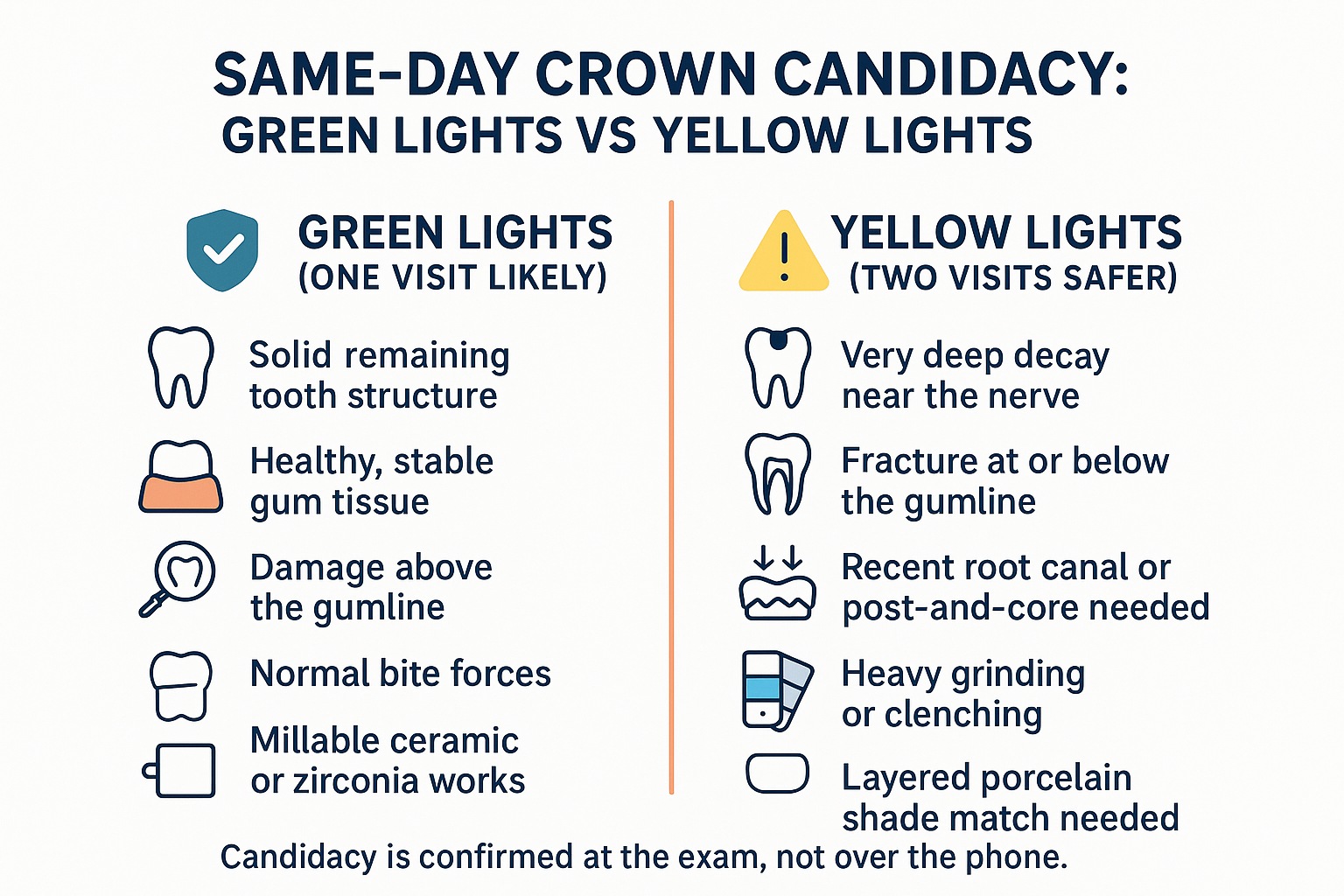
The Same-Day Crown Decision at a Glance
Here’s a simple side-by-side of the green lights and the yellow lights I look for during a crown exam.
Material, Not Just the Machine, Drives the Answer
This is the part that surprises people. Chairside milling uses solid blocks of ceramic or zirconia. Those are strong and they look good, and for most single crowns they are an excellent choice.
But some teeth call for something a milling unit cannot produce. A lab technician can hand-layer porcelain for a front tooth that needs three different shades blended across it. A lab can also fabricate porcelain-fused-to-metal when a tooth needs that specific combination of strength and fit.
And bite force matters more than most patients expect. If you clench or grind, which I see plenty of in stressed-out professionals across Paradise Valley and Scottsdale Mountain, the crown material has to survive years of that load. The American Dental Association’s patient guide to crowns covers the general material categories if you want background reading.
My rule is simple: I pick the material the tooth needs, then see whether that material can be made in one visit. Not the other way around. If you want a deeper look at that decision, I wrote about how crown material gets matched to a specific tooth and about the differences between crown types.
What You Actually Gain When You Do Qualify
For patients who are good candidates, the benefit is concrete and worth spelling out:
- No temporary crown. No two weeks of avoiding pistachios, ice, and anything chewy.
- No second anesthetic appointment. One numbing, one session, done.
- No temporary coming loose on a Friday night before a weekend in Sedona.
- No second trip to Frank Lloyd Wright Blvd during a workday.
That last one matters more than it sounds. Two hours in one visit beats two separate hours plus two drives, two parking runs, and two blocks of time off work.
Same-day crowns are available in many cases at our practice, and candidacy gets confirmed at the exam once I’ve seen the tooth and the X-rays. A crown that fits and lasts is worth more than a crown that was fast. If you’re curious about longevity, here’s what affects how long a crown holds up.
Frequently Asked Questions About Same-Day Crown Candidacy
Can you tell me over the phone if I qualify for a same-day crown?
Honestly, no. I need to see the tooth and current X-rays. Candidacy is decided at the exam, because the things that rule a tooth out, like a fracture below the gumline or decay near the nerve, are not visible or describable from your side of the phone.
Does a same-day crown last as long as a lab crown?
When the tooth is a good fit for it, yes. Well-made crowns of either kind commonly last 10 to 15 years or more with good home care and regular checkups. Longevity has far more to do with your bite, your hygiene, and how much healthy tooth was underneath than with where the crown was made.
Is a same-day crown more expensive?
Costs vary by material, tooth, and your plan, so I won’t quote a number here. In general, the fee tracks the crown itself rather than the speed. Our front desk verifies insurance on the first call and can walk you through what your specific plan covers before you commit to anything.
What if I show up expecting one visit and end up needing two?
Then I explain exactly why, before we start. That transparency is something patients mention often about how we practice, and it’s deliberate. Finding out mid-appointment feels like a bait and switch. Hearing the reasoning first feels like a plan.
My crown fell off. Can that be replaced same-day?
Sometimes the original crown can be cleaned and re-cemented, which is quick. Other times the tooth underneath has new decay and needs a fresh crown, and that resets the candidacy question. Either way, don’t wait on it.
Wondering Whether Your Tooth Is a Same-Day Candidate?
The only way to know is an exam with current X-rays, and that’s a conversation, not a commitment. Our North Scottsdale office on Frank Lloyd Wright Blvd is currently taking new patients from across Scottsdale, Paradise Valley, and the surrounding communities. You can reach us at 480-621-4040 or at trinitydentalcares.com when you’re ready to talk it through.