
Direct Answer: No insurance does not mean no treatment. Most Scottsdale offices set cash fees, offer an in-house savings plan with a flat annual fee, and provide a written estimate before any work starts.
You finally decide you are done putting it off. You pick up the phone, call a dental office in Scottsdale, and the very first question back is: which insurance plan do you have?
If the honest answer is “none,” a lot of people say thanks and hang up. I hear that hesitation on our phone line all the time, and it always stings a little, because having no dental benefits is a pricing and planning question, not a verdict on whether you can get treated.
So let’s walk through what paying out of pocket actually looks like here in North Scottsdale. What an in-house savings plan really is, what to ask before you book, and how to get a number in writing before anyone touches your teeth.
Does having no dental insurance mean I can’t get seen?
No. It means you pay the office directly instead of a plan paying part of the bill. That is the whole difference.
Roughly one in eight calls we get is an insurance question. Callers name plans like Delta Dental, Cigna DPPO, Humana, BCBS Federal, and MetLife. When the answer is that a particular plan is not accepted, a lot of those calls just end right there, and that is the part I wish I could change.
Because the follow-up question almost always has a real answer. Most offices in the Shea Corridor and around the Village at Frank Lloyd Wright have some version of a cash fee schedule, a membership plan, or a financing option. It is just rarely posted on the website, so you have to ask for it.
A few things worth knowing before you dial:
- Cash patients are normal. You are not a special case or a problem to solve.
- Fees are set per office, not by a national chart, so two practices a mile apart can quote differently.
- An exam comes first for a reason. Nobody can price a crown or an implant off a phone description.
If you want a sense of what that first visit involves before you commit, here is what actually happens at a dental exam and cleaning.
What is an in-house savings plan, and is it the same as insurance?
This is the question people are usually circling without knowing the words for it. One family member called on behalf of a relative and just asked it flat out: “He’s uninsured, do you have a savings plan?”
I love that call, because it shows there is no embarrassment in asking. And the answer, at most offices, is yes.
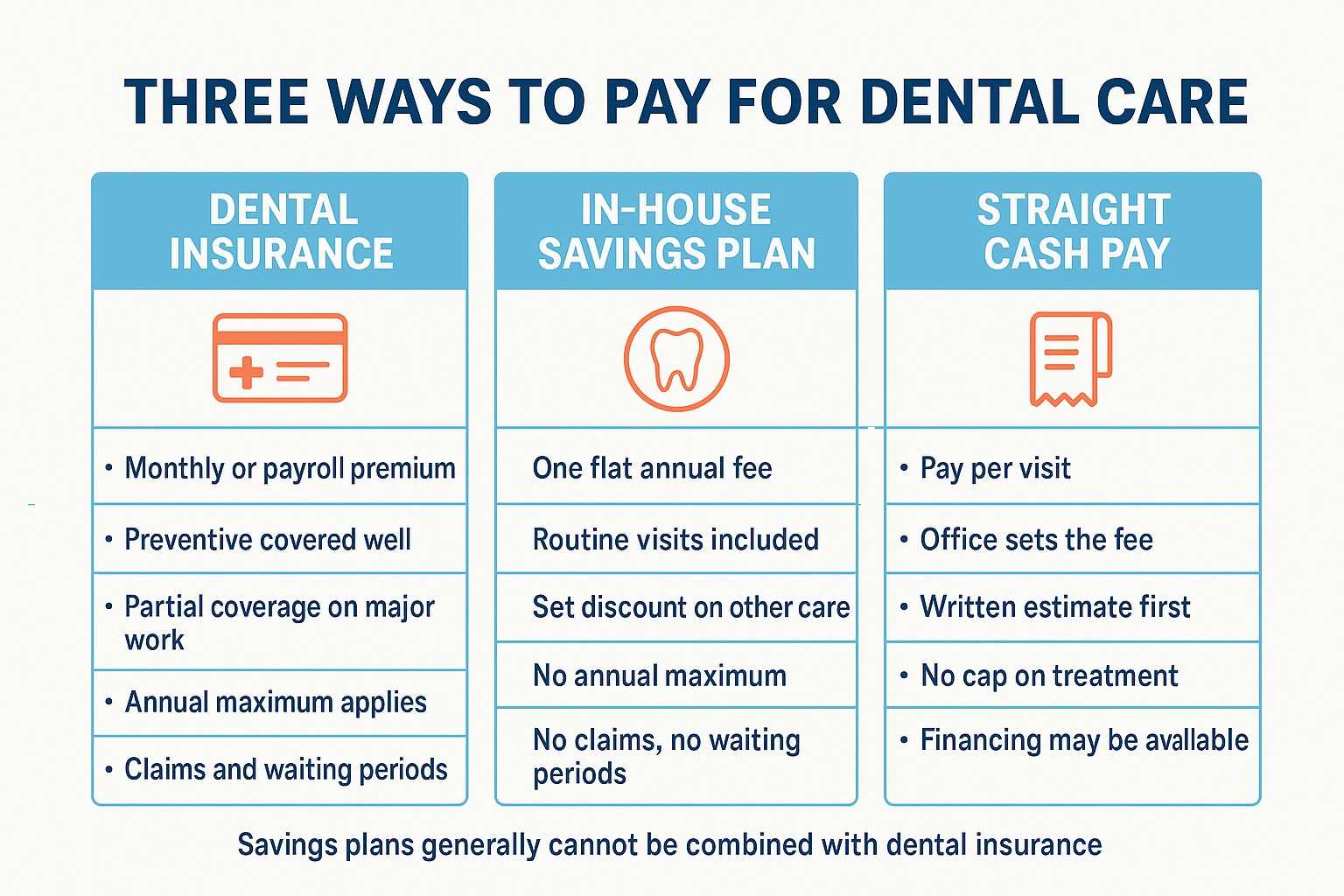
An in-house membership or savings plan is not insurance. You pay the dental office one flat annual fee directly. In exchange, the plan typically covers your routine care for the year and gives you a set percentage off other treatment.
Here is how the structure usually breaks down:
- A single annual fee paid to the office, not to an insurance company
- Routine visits included, usually your exams, cleanings, and needed X-rays for the year
- A member discount on other treatment like fillings, crowns, or whitening
- No claim forms, no pre-authorizations, no waiting periods
- No annual maximum, so a big treatment year does not hit a ceiling
The catch is that these plans generally cannot be stacked on top of an existing dental plan. You use one or the other.
We run our own in-house plan on a single annual fee, and the fee gets reviewed periodically, so I would rather you call and hear the current number than read an outdated one here. The important part is the shape of it: pay once, cover your preventive care, get a discount on the rest.
What should I ask when I call to price an office?
Most of the time, the gap between a fair cash fee and an unpleasant surprise is just which questions got asked on the phone.
Our cash-pay callers ask three things over and over: what a cleaning runs, what a new patient exam with X-rays runs, and whether that exam fee counts toward treatment if they move forward. I have seen people decline an exam entirely because nobody thought to explain that last part to them.
So ask directly. A good front desk will not flinch:
- What is the fee for a new patient exam and X-rays?
- Does that exam fee apply toward treatment if I go ahead with a plan?
- What does a standard adult cleaning cost?
- Does that number change if I need a deeper cleaning after the gum measurements are taken?
- Will I get a written estimate before any treatment starts?
- What payment or financing options do you accept?
That fourth one matters more than people expect. A routine cleaning and a deeper periodontal cleaning are different procedures at different fees, and which one you need is decided by measurements taken at the visit, not guessed at over the phone. If your gums have been bleeding, that is worth reading up on first.
A short script for pricing any Scottsdale dental office
Print this or keep it on your phone. It takes about four minutes on a call and saves a lot of second-guessing later.
| Ask this | Why it matters | What a clear answer sounds like |
|---|---|---|
| Fee for a new patient exam and X-rays | This is your entry cost before any treatment is even discussed | A specific number, plus what imaging is included |
| Does the exam fee credit toward treatment | Some offices apply it, some do not. It changes the math | A straight yes or no, not a maybe |
| Fee for a standard adult cleaning | The most common recurring cost you will have | A flat number for a routine prophy |
| Does a deeper cleaning change that fee | Gum measurements can move you to a different procedure | An explanation of when and why, with a fee range |
| Do I get a written estimate first | Protects you from surprises after the fact | Yes, before treatment is scheduled |
| Payment and financing options | Spreads a larger case over months instead of one hit | Cards, third party financing, or phased treatment |
Insurance vs. in-house savings plan vs. straight cash
Three different ways to pay, three different sets of rules. This is the comparison I end up drawing on paper for patients almost every week.
I do have insurance. Why am I still paying so much out of pocket?
This is the other half of the same conversation, and honestly it catches more people off guard than having no plan at all.
Most dental plans are generous on preventive care. Exams, cleanings, X-rays, often covered at or near full. Then coverage drops to partial on major work, and the whole year is capped by an annual maximum that commonly sits somewhere in the one to two thousand dollar range.
One crown can eat a meaningful chunk of that. An implant case can run through it entirely before you have finished the treatment plan.
If that is where you are, there are two practical moves:
- Ask the office to sequence treatment across benefit years, so part of the work falls into next year’s maximum
- Compare what your plan actually pays against a membership plan plus cash fees, side by side, in writing
Do that comparison before treatment starts, not after the first statement shows up. And if you have benefits sitting unused, it is worth understanding what happens to that money on December 31.
Why are more Scottsdale patients paying cash in 2026?
Two things are converging, and neither is really about any one office.
First, insurance networks are shifting. After roughly a third of dentists said in late 2025 that they intended to leave some insurance networks, the American Dental Association’s Health Policy Institute reported that about 22 percent had already done so by the first quarter of 2026. The driver is reimbursement rates that have not kept pace with lab, supply, and staffing costs.
Second, Scottsdale skews older than most of the Valley. Roughly a quarter of residents are 65 or older, and Medicare does not include routine dental. So a lot of retirees around McCormick Ranch, Scottsdale Mountain, and Paradise Heights are shopping for dental care with no benefit card at all and no intention of getting one.
Which means knowing how to pay for care outside of insurance is turning into a normal skill, not a fallback plan. If your longtime dentist recently changed network status, that is a slightly different situation worth reading about separately.
Frequently Asked Questions About Dental Care Without Insurance in Scottsdale
Does having no dental insurance mean I can’t get treated?
Not at all. It just means you pay the office directly. Ask about cash fees, an in-house savings plan, and financing, and you will almost always find a workable path.
Is an in-house dental savings plan the same thing as insurance?
No. You pay the dental office one flat annual fee instead of paying premiums to an insurance company. The plan typically covers your routine exams, cleanings, and needed X-rays for the year, plus a set percentage off other treatment. There are no claim forms, no waiting periods, and no annual maximum, but it generally cannot be combined with an existing dental plan.
Does the new patient exam fee count toward my treatment?
It depends on the office, so ask. Some apply it toward your treatment plan if you move forward and some do not. I have watched people skip an exam entirely over this exact question when a ten second answer would have settled it.
How much does a cleaning cost without insurance in Scottsdale?
Fees vary by office and by what your gums actually need, so I would rather give you the factors than a number that may not apply to you. A routine adult cleaning is one fee. A deeper periodontal cleaning is a different procedure at a different fee, and which one you need is determined by measurements taken at the exam. Call and ask for both numbers up front.
Will I get a price in writing before work starts?
You should, and you should ask for it directly if it is not offered. A written estimate before treatment is standard practice and it is the single best protection against surprises. One of our patients put it simply in a review: “They were timely at giving my estimate to me as promised.”
What if I need a crown or an implant and I’m paying cash?
Bigger cases are where sequencing and financing matter most. Ask whether the treatment can be phased over months, whether a savings plan discount applies, and what payment options the office allows. For larger cosmetic or restorative plans, understanding what drives the number helps you compare quotes honestly.
Want to know what care would actually cost you?
If you are in Scottsdale or Paradise Valley without dental benefits, or your plan ran out partway through the year, you are welcome to call and just ask the pricing questions. Our team can walk through cash fees, how our in-house plan is structured, and what payment options exist, all over the phone at 480-621-4040 or through trinitydentalcares.com. No appointment required to get those answers, and no pressure to book one.