
Direct Answer: Out of network means your dentist has no contract with your insurer. Most PPO plans still pay something, but the deductible, percentage, annual maximum, and who gets the check can change.
You finally found a dentist you want to see. Maybe a neighbor in McCormick Ranch recommended them, maybe you read through a hundred reviews before you picked up the phone. Then you give your plan name and hear four words that end the call: we’re out of network.
I hear that moment play out constantly. Insurance questions make up roughly one in eight calls that come into our North Scottsdale office, and callers name plans like Delta Dental, Cigna DPPO, MetLife, Humana and BCBS Federal. An out of network answer is one of the most common reasons a call ends before anything gets scheduled.
Most people hang up without ever asking the question underneath it, which is whether being out of network actually costs them more. So this is the plain English version of what those words change about a dental bill, and what they do not.
What does “out of network” actually mean?
It is a contract question, not a quality question.
An in network dentist has signed an agreement with a specific insurance company. That contract sets a fee schedule, meaning the office agrees to charge no more than a set amount for each procedure, whatever their normal fee happens to be.
An out of network dentist has not signed that agreement with your carrier. The office sets its own fees, and your insurance company has no say in them. That single difference is why the math on your plan looks different from one office to the next.
A few things that surprise people:
- A dentist can be in network with some plans and out of network with others. It is plan by plan, not all or nothing.
- Being out of network says nothing about credentials, training, or the materials used in your crown.
- The same dentist can be in network for a Delta PPO and out of network for the Delta plan your employer switched to in January.
Across the Shea Corridor and the Village at Frank Lloyd Wright, plenty of practices carry a mix. If you are still comparing offices, the things research-minded patients actually weigh usually go well beyond the network list.
Does out of network mean my insurance pays nothing?
Usually not. Most PPO plans still pay toward care at an out of network office. The check just gets calculated differently, and sometimes it gets mailed differently too.
Here is what a plan can change when the dentist is nonparticipating:
- A higher deductible before benefits kick in
- A lower coinsurance percentage on the same procedure
- A lower annual maximum for the year
- Reimbursement sent to you instead of directly to the dental office
That last one trips people up more than any other. You may pay the office at the visit and receive a check in the mail a few weeks later.
I am not going to print percentages or dollar figures here, because every employer writes its plan differently. Two people who both say “I have Cigna” can have completely different out of network benefits.
The American Dental Association has addressed this directly, including the fact that plans commonly apply higher deductibles and lower maximums for nonparticipating dentists. What matters for you is knowing where to look on your own benefits summary, which is the next section.
In network vs. out of network: what actually shifts
This is the short version of what changes on your side of the bill. Your specific plan document is the final word.
| What it affects | In network dentist | Out of network dentist |
|---|---|---|
| Who sets the fee | Insurance contract fee schedule | The dental office sets its own fees |
| Deductible | Standard plan deductible | May be higher |
| Coinsurance percentage | Standard plan percentage | May be lower |
| Annual maximum | Standard plan maximum | May be reduced |
| Who receives payment | Usually the dental office | Often the patient directly |
| Cost estimate accuracy | Fee schedule is known | Insurer may not release allowable fees |

My plan says preventive is covered at 100%. Isn’t my cleaning free?
This is the single most expensive misunderstanding I run into, and I understand why. The benefits booklet says preventive at 100%, so people read that as a free cleaning anywhere.
At an out of network office, 100% usually means 100% of what your plan considers an allowable fee, not 100% of what the office charges. If those two numbers are different, the gap is yours.
It gets harder. Many insurers will not release their allowable amounts for a nonparticipating dentist, so even a front desk that does everything right can only give you an estimate. That is not a dodge, it is a limit on what the carrier shares.
So here is what actually protects you:
- Ask for a written treatment estimate with the procedure codes on it, not a verbal ballpark.
- For larger work like a crown or an implant restoration, ask the office to submit a pre-determination. Your plan responds in writing with what it will pay before you sit down.
- Give it time. A pre-determination often takes a few weeks, so start it before you schedule the work.
That one step turns a guess into a number your household can plan around. It is the same reason I encourage patients to ask why a procedure is being recommended in the first place, whether that is a crown or a deep cleaning.
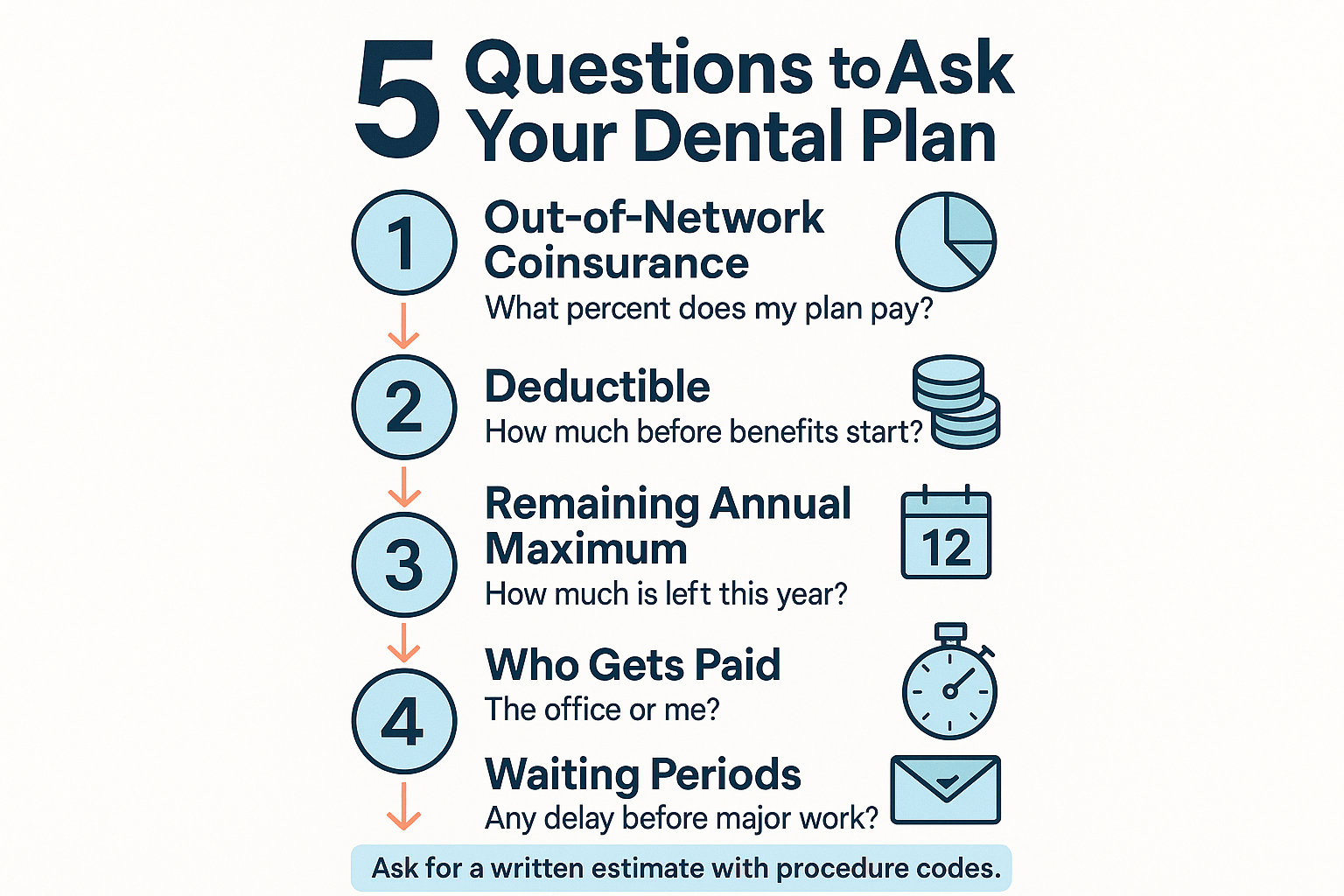
Five questions to ask your plan before you book
Call the number on the back of your insurance card and write down the answers. This takes about ten minutes and saves a lot of surprise.
Why does it feel like more dentists are out of network lately?
Because the networks are genuinely in motion right now.
In the American Dental Association Health Policy Institute’s late 2025 outlook poll, more than half of dentists named insurance problems as a top concern for the year ahead, things like low reimbursement rates and delayed or denied payments. A meaningful share said they planned to leave at least some networks.
Translated for a patient, it cuts two ways:
- The dentist you have trusted for years may not be contracted with your plan next year.
- The plan your employer picks during open enrollment may not include the office you already like.
Neither one is anyone doing anything wrong. Contracts get renegotiated, and employers shop plans on price.
What I would take from it is simple. Verify your benefits fresh each January instead of assuming last year’s answer still holds, especially if your household changed plans.
What about Medicare Advantage dental coverage?
This one deserves a straight answer, because it comes up often here.
Medicare Advantage dental plans are typically network-based, and their networks are usually narrower than a commercial PPO. A practice can accept most major PPOs and still not be contracted with a particular Medicare Advantage plan.
One caller from the area learned that mid-conversation and hung up discouraged, which I understand completely. With roughly a quarter of Scottsdale residents 65 or older, that scenario plays out across North Scottsdale every week.
If that is you, the useful move is to ask your plan two things: what it pays for an out of network dentist, and what your annual dental allowance is. Some Medicare Advantage plans pay a flat allowance you can use anywhere. Others pay nothing outside the network. You cannot tell which one you have without asking.
What are my options if my plan won’t help, or I have no insurance at all?
One caller put it plainly: he’s uninsured, do you have a savings plan? That question comes up constantly.
Most private practices offer some version of an in-office membership or dental club plan. These generally work the same way:
- A flat annual fee paid to the office directly
- Routine exams, cleanings and imaging bundled in
- A set discount on other treatment like fillings, crowns or restorations
- No annual maximum, no deductible, no claim forms
I want to be honest about the tradeoffs. A membership plan is not insurance. It does not cover unlimited treatment, it does not pay a specialist, and it will not reimburse you for anything. It is a discount arrangement, not a benefit.
For some households the math beats out of network coverage. For others it does not. Ask the office what their plan currently costs and exactly what is included before you decide.
There is one more strategy worth knowing for larger cases. If you have a plan with an annual maximum and you need significant work, treatment can often be phased across two benefit years so two maximums apply. Start one phase in the fall, complete the rest after January. That approach shows up a lot in what drives smile makeover costs and in how implant coverage tends to work in Arizona.
What should I ask before I ever sit in the chair?
Call your insurance first, then call the office. Have these five answers written down:
- Your out of network coinsurance percentage by category
- Your deductible, and whether it differs out of network
- Your remaining annual maximum for this calendar year
- Whether the plan pays the office or pays you
- Whether any waiting periods apply to major work
Then ask the office to verify your benefits while you are on the phone. It sounds small. It is not.
A front desk that runs verification live can tell you what your plan shows before you hang up, instead of leaving you to guess for a week. One patient described it this way in a review: “Everything was great. From the first phone call asking questions about insurance coverage, to the online paperwork process, check-in online, the receptionist and the hygienist, to the doctor and how CLEAN and smooth it all went.”
And plenty of people decide the network question is not the deciding one. We have patients who drive to the Frank Lloyd Wright Blvd office from the far side of the Valley, passing contracted offices the whole way, because they already trust who is doing the work. That is a personal call, and there is no wrong answer. But make it with real numbers in front of you, not with a guess.
Frequently Asked Questions About Out of Network Dentist Insurance
Does out of network mean my insurance pays nothing?
Usually not. Most PPO plans still pay something toward out of network care. The plan may apply a higher deductible, a lower percentage, or a reduced annual maximum, and in many cases it sends the reimbursement check to you instead of to the dental office.
My plan covers preventive at 100%. Is my cleaning free at an out of network office?
Not automatically. That 100% typically applies to what your plan considers an allowable fee, not to whatever the office charges. Many insurers will not even release allowable amounts for a nonparticipating dentist, so ask for a written estimate with procedure codes rather than assuming zero cost.
What is a pre-determination and should I ask for one?
It is a request the office submits to your insurer before treatment, and the plan responds in writing with what it expects to pay. I recommend it for anything larger than routine care, like a crown or an implant restoration. Allow a few weeks for the answer to come back.
Is a dental membership plan the same as insurance?
No. A membership plan is a flat annual fee paid directly to the practice that bundles routine visits and discounts other treatment, with no annual maximum and no claim forms. It does not reimburse you and it does not cover unlimited work. Ask the office what theirs currently costs and what it includes.
Why did my dentist stop taking my insurance this year?
Contracts get renegotiated, and reimbursement rates are a real pressure point. In a late 2025 ADA outlook poll, more than half of dentists named insurance issues as a top concern, and a share planned to exit some networks. Employers also switch plans at open enrollment, which changes things from your side too.
Can I split a big treatment plan across two years to use two annual maximums?
Often, yes, if the treatment can be safely staged. Starting one phase late in the year and finishing after January means two benefit years apply. Whether it works depends on the clinical situation, so ask at the exam.
Want your own plan looked at before you decide?
Dr. Fink’s team verifies coverage before treatment and can walk through both your insurance benefits and the in-office plan option so you know the numbers ahead of time. Trinity Dental Care holds a 4.9 star average across more than 100 reviews from patients around McCormick Ranch, the Shea Corridor and Scottsdale Mountain, and is currently accepting new patients. If you would like your plan reviewed, call 480-621-4040 or visit trinitydentalcares.com.