
Direct Answer: Bleeding gums are almost always a sign of gum disease, not just rough brushing. Waiting gives the infection more time to spread — and reverse that damage gets harder the longer you wait.
A little blood in the sink after brushing is easy to dismiss. Maybe you brushed too hard. Maybe it’s been a while since your last cleaning. Whatever the reason, most people rinse, spit, and move on without thinking twice.
But bleeding gums almost always mean the same thing: your gum tissue is inflamed, and inflammation is your body telling you something is wrong. The longer that goes unaddressed, the more ground the infection gains — and the harder it becomes to pull things back.
This isn’t about scaring anyone. It’s about understanding what’s actually happening beneath the gumline so you can make a good decision about your next step.
What Bleeding Gums Are Actually Telling You
Healthy gums don’t bleed. When they do — even occasionally, even just a little — that’s a sign of gingivitis at minimum, and possibly something further along the spectrum.
Gingivitis is the earliest stage of gum disease. At this point, the infection lives only in the soft tissue and hasn’t yet reached the bone that holds your teeth in place. That’s actually good news, because gingivitis is fully reversible with professional treatment and consistent home care.
The problem is that gingivitis doesn’t hurt. There’s no alarm going off. So most people don’t realize it’s happening until a dentist points it out — or until it progresses into periodontitis, which is a different situation entirely.
Periodontitis means the infection has moved below the gumline and started breaking down the bone and connective tissue anchoring your teeth. At that stage, you’re not reversing anything — you’re managing it. Some bone loss is permanent.
A few things that increase your risk of gum disease progressing quickly:
- Skipping routine dental cleanings for more than 12 months
- Smoking or using tobacco in any form
- Uncontrolled blood sugar — diabetes and dry mouth create conditions where bacteria thrive
- Certain medications that reduce saliva flow
- Genetics — some people are simply more susceptible regardless of how well they brush

The Gap Between What You See and What’s Actually Happening
One of the most frustrating things about gum disease is the gap between visible symptoms and actual damage. By the time your gums bleed regularly, look puffy, or pull away from your teeth, the infection has often been active for months — sometimes longer.
That delay trips a lot of people up. They feel fine, so they assume they’re fine.
At our office, we measure pocket depth — the space between your gum and tooth — at every exam. Healthy pockets measure between 1 and 3 millimeters. Anything above 4mm signals active infection. Pockets at 6mm or deeper typically mean the disease has progressed to a point where standard cleaning alone won’t be enough.
This is why the timing of a dental visit matters more than most people realize. A patient who comes in at the gingivitis stage leaves with a cleaning and some targeted home care instructions. A patient who waits until pockets are 6mm or deeper is looking at a more involved treatment — scaling and root planing, sometimes called a deep cleaning — and potentially multiple visits to stabilize things.
If bone loss has already occurred, some of that structure cannot be restored. That’s when conversations about tooth replacement options like dental implants start to come up — not because anyone wants to jump to that, but because advanced gum disease left untreated is a leading cause of tooth loss in adults.
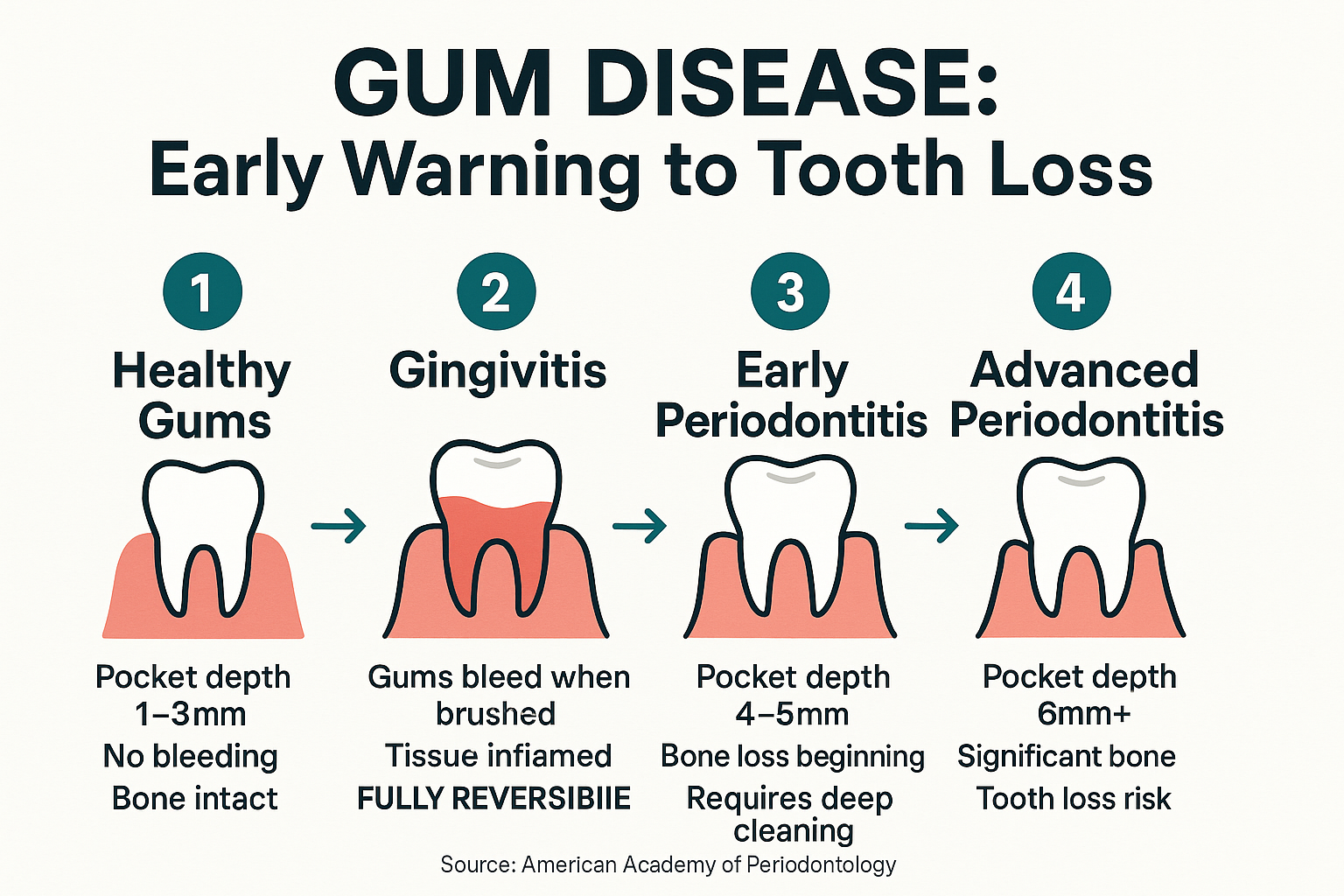
Gum Disease: From Early Warning to Tooth Loss
This infographic shows the progression of gum disease across four stages, and what treatment looks like at each point.
Gingivitis vs. Periodontitis: How They’re Different
Patients often use these terms interchangeably, but they describe very different stages of gum disease — and they require different responses.
| Gingivitis | Periodontitis | |
|---|---|---|
| Stage | Early / Stage 1 | Moderate to Advanced / Stages 2–4 |
| Location of infection | Soft tissue only | Below gumline, affecting bone |
| Common symptoms | Bleeding, puffiness, redness | Bleeding, recession, bad breath, loose teeth |
| Bone loss involved? | No | Yes — often permanent |
| Reversible? | Yes, fully | No — manageable, not reversible |
| Typical treatment | Professional cleaning + home care | Scaling and root planing, ongoing monitoring |
| Urgency of treatment | Soon — before it progresses | As soon as possible |
Why Waiting a Few More Months Is Never Actually Neutral
There’s a common mental frame people use with dental issues: “It’s not getting worse, so I’ll deal with it later.” With gum disease, that logic doesn’t hold.
Bacterial plaque and tartar buildup don’t pause when life gets busy. The infection keeps working even when you’re not paying attention to it. Every month without treatment is another month the bacteria have to deepen those pockets and weaken the surrounding bone.
For patients in North Scottsdale neighborhoods like McCormick Ranch or along the Shea Corridor, we see this pattern regularly — busy professionals who’ve been meaning to get in for over a year, who come in assuming they just need a standard cleaning and leave with a treatment plan they weren’t expecting.
The good news is that early intervention is almost always simpler and less expensive than treatment after the fact. A cleaning and a follow-up appointment is a very different conversation than scaling and root planing across multiple quadrants.
And for patients who are also managing tooth damage alongside gum concerns — like needing to understand what the difference is between a crown and a filling — gum health is always the foundation we address first. No restoration holds up well in a mouth where the gum tissue is actively inflamed.
What Gum Treatment Actually Looks Like at Trinity Dental Care
A lot of people avoid the dentist because they expect to be lectured or pressured. We want to be straightforward about how we actually approach this.
If you come in and your gums are bleeding, here’s what happens:
- We measure pocket depths at every point around every tooth and map them on your chart
- We take any necessary X-rays to check for bone loss below the gumline
- We review your home care routine — not to judge it, but to understand what we’re working with
- We tell you exactly what stage of gum disease we’re seeing and what it means
- We put together a treatment plan based on what you actually need — not a one-size protocol
For patients at the gingivitis stage, a thorough professional cleaning combined with improved home care is often enough to turn things around within 6 to 12 weeks. For patients who need a deep cleaning, we schedule that in stages and make sure you’re comfortable throughout the process.
We also look at the whole picture. If gum disease has affected teeth that may eventually need more work — like understanding when a single procedure stops being enough — we’ll talk through that honestly so nothing comes as a surprise later.
Frequently Asked Questions About Bleeding Gums
Can I fix bleeding gums just by brushing and flossing better at home?
Better home care helps, but it has limits. If tartar has built up below the gumline — which you can’t remove with a toothbrush — no amount of brushing will clear the infection. You need a professional cleaning to get things under control first, and then good home care helps keep them that way. Think of it as a two-part process, not an either/or.
Is it normal for gums to bleed when I start flossing again after a long break?
Some mild bleeding when you restart flossing is common and usually settles down within one to two weeks as your gums firm up. But if it persists beyond that — or if you’re bleeding every time you brush even without flossing — that’s a sign to get checked. Persistent bleeding is not something to normalize.
My gums bleed but I don’t have any pain. Does that mean it’s not serious?
Gum disease is almost entirely painless in its early and middle stages — that’s actually what makes it dangerous. By the time it hurts, significant damage has usually already occurred. Bleeding without pain is still a warning sign worth taking seriously.
How often should I be coming in to keep my gums healthy?
Most adults do well with two cleanings per year. But if you’ve had active gum disease or periodontitis, your dentist may recommend coming in every 3 to 4 months for what’s called periodontal maintenance — more frequent visits that monitor pocket depths and remove buildup before it has time to cause problems again.
If I lose a tooth from gum disease, can I still get an implant?
Possibly, but gum disease has to be fully under control first. Active infection in the gums disqualifies someone from implant placement — the implant won’t integrate properly and the failure rate is much higher. We always address gum health before any restorative work, including implants. Once your mouth is stable, dental implant options become worth discussing.
Ready to Know Exactly Where Your Gum Health Stands?
If your gums have been bleeding — even occasionally — it’s worth getting a clear answer on what’s actually going on. Trinity Dental Care serves patients across North Scottsdale, from Taliesin West to the Shea Corridor, and we’re happy to take a close look and give you an honest picture with no pressure attached. Call us at 480-621-4040 or visit trinitydentalcares.com to schedule an exam and cleaning.