
Direct Answer: A dental exam and cleaning includes a review of your health history, digital X-rays, a full tooth-by-tooth exam, and a professional cleaning that removes buildup brushing can’t reach.
I hear this more than almost any other question from people who are finally ready to come back to the dentist after a long gap: What is actually going to happen when I walk in? It sounds simple, but not knowing what to expect is one of the biggest reasons people in North Scottsdale keep putting off that appointment.
Whether it has been two years or ten, the uncertainty is real. Nobody wants to sit down in the chair and feel surprised. So I want to walk through exactly what a new-patient exam and cleaning looks like at our practice, step by step, so you can show up feeling prepared instead of anxious.
This is not a complicated process. But when you understand each part, the whole visit feels a lot less intimidating.
Step 1: Intake and Health History Review
Before anyone looks at your teeth, we start with paperwork, and it matters more than most patients expect.
We ask about your medical history, current medications, and any health conditions because your overall health and your oral health are closely connected. Certain medications affect saliva production and gum tissue. Conditions like diabetes can increase the risk of gum disease. This background gives Dr. Fink important context before she ever picks up an instrument.
For new patients, this is also when we get to know what brought you in. Are you dealing with tooth pain? Has it been years since your last visit and you are not sure what to expect? Are you coming in because a friend in McCormick Ranch referred you? We want to understand your situation before the clinical part of the visit starts.
Step 2: Digital X-Rays
For most new patients, we take digital X-rays at the first visit. A lot of people are surprised to learn how much radiation exposure has dropped compared to older film X-rays.
According to the American Dental Association’s guidance on dental radiographs, modern digital X-rays expose patients to a fraction of the radiation used in traditional film imaging, and they give us far more detail. We can see decay between teeth, bone levels around the roots, and early signs of problems that are completely invisible to the naked eye.
X-rays are not about finding things to fix. They are about catching small problems while they are still small. A cavity spotted on an X-ray today might be a simple tooth-colored filling. The same cavity ignored for another year might become something that needs a crown or more.
Step 3: The Clinical Exam
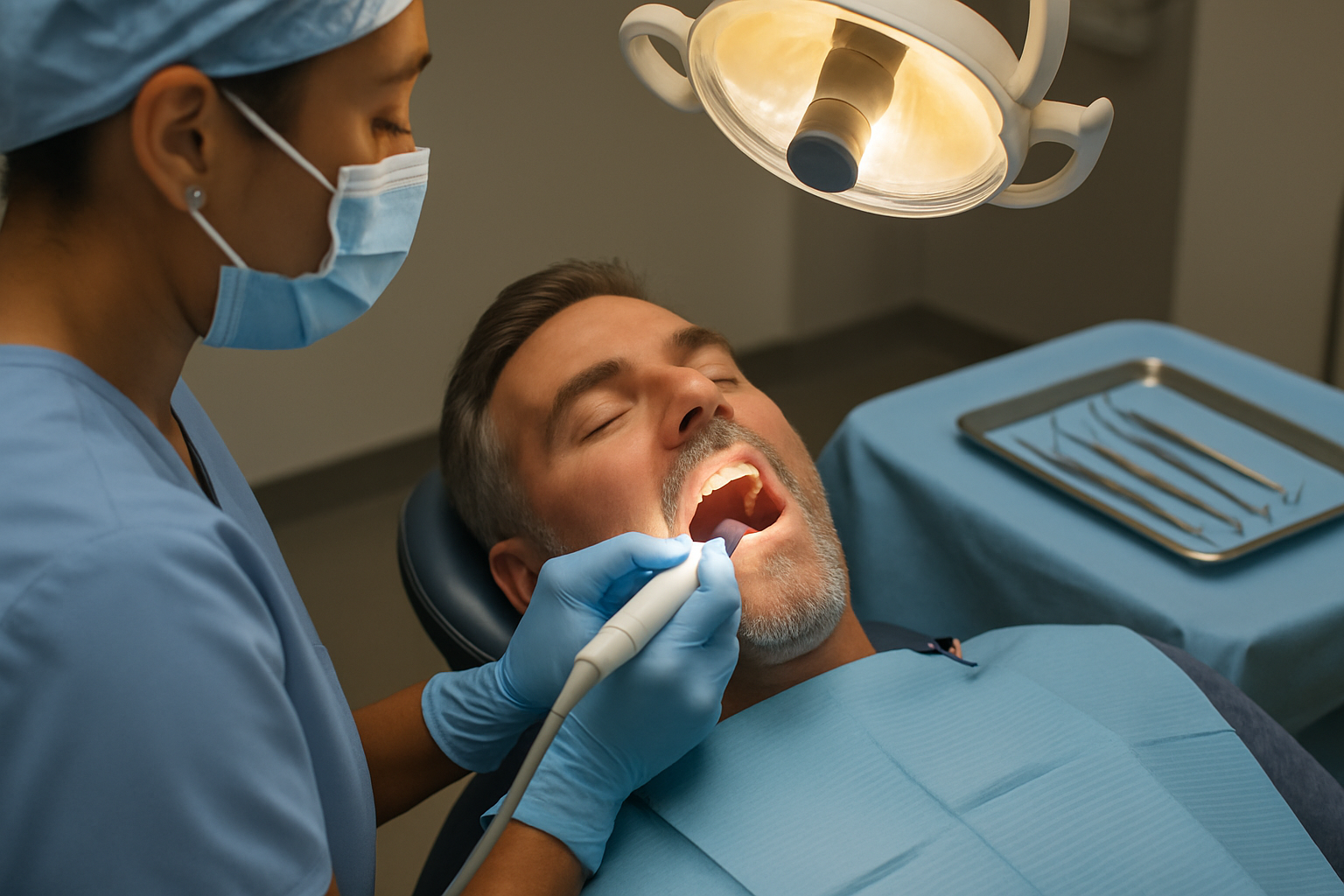
This is the part where Dr. Fink goes through your mouth tooth by tooth. It is more thorough than most patients expect, and that thoroughness is exactly the point.
Here is what she is checking during the exam:
- Each individual tooth for signs of decay, cracks, wear, or existing restorations that may need attention
- Your gum tissue for signs of inflammation, pocketing, or early gum disease
- Bite patterns and wear that might indicate grinding or jaw issues
- Existing dental work like crowns, fillings, or implants to make sure everything is still functioning correctly
- Soft tissue including the cheeks, tongue, and throat as part of a basic oral cancer screening
One reviewer described Dr. Fink as “very thorough” and noted that she found an issue with an existing implant that another practice had missed. That kind of detail-oriented exam is what separates a real clinical evaluation from a quick once-over.
If something comes up during the exam, Dr. Fink will explain it clearly and discuss your options. Finding a small problem early is genuinely good news. A tiny cavity caught now means a filling, not a crown. Early gum inflammation caught now means a conversation about flossing and why bleeding gums are not something to just wait out, not a more involved treatment later.
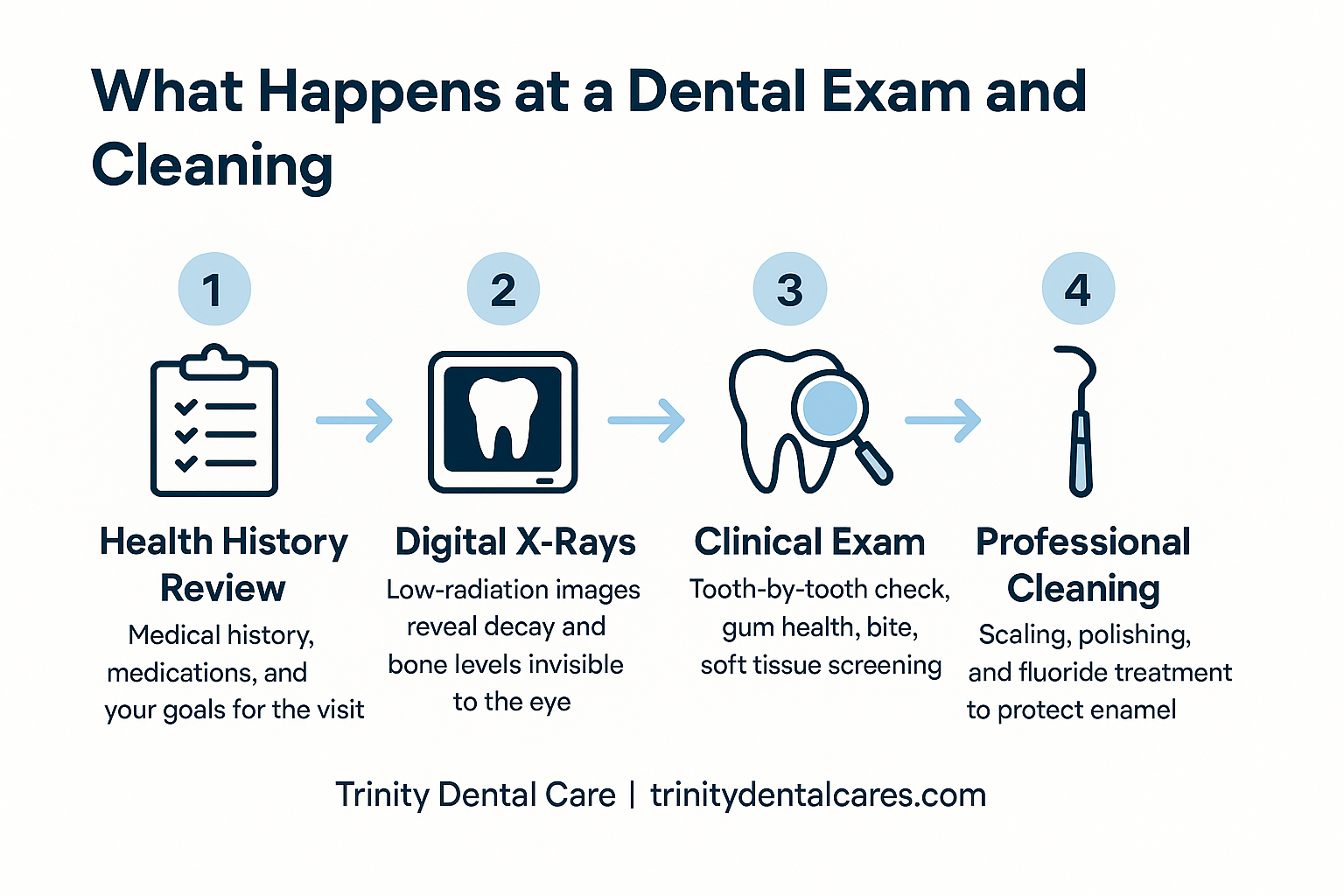
The Four Stages of a Dental Exam and Cleaning
Here is a quick look at how the visit flows from start to finish.
Step 4: The Cleaning Itself
The cleaning is what most people picture when they think about a dental appointment, but it has its own specific sequence that is worth understanding.
First comes scaling, this is where the hygienist uses specialized instruments to remove tartar (calcified buildup) that your toothbrush and floss simply cannot reach. Tartar forms when plaque is left on the teeth long enough to harden, and once it hardens, only a professional can remove it. This is not a sign that you have been brushing badly; it is a normal part of having teeth.
After scaling comes polishing, which removes surface stains and leaves the tooth surface smooth. Then, for many patients, a fluoride treatment is applied to strengthen enamel and help protect against decay, and contrary to what some adults assume, fluoride is just as beneficial for grown adults as it is for kids. You can read more about that in our article on fluoride treatments and sealants for adults in Scottsdale.
One thing I genuinely value about our hygiene appointments is that they are educational, not just procedural. Patients have walked out with real, usable guidance on flossing technique and water pick use, not a generic handout, but a real conversation based on what the hygienist actually observed. One of our reviewers called it out specifically, and it is something our team takes seriously.
What Each Part of the Visit Is Looking For
This table breaks down each component of the visit and what we are actually trying to find or accomplish.
| Visit Component | What We Are Checking | Why It Matters |
|---|---|---|
| Health History Review | Medical conditions, medications, past dental work | Connects your overall health to your oral health |
| Digital X-Rays | Decay between teeth, bone levels, root health | Catches problems invisible to the naked eye |
| Clinical Exam | Individual teeth, gums, bite, soft tissue | Identifies issues while they are still manageable |
| Scaling | Tartar buildup at and below the gumline | Removes hardened deposits that brushing cannot reach |
| Polishing | Surface stains on enamel | Smooths the tooth surface and removes discoloration |
| Fluoride Treatment | Overall enamel strength | Adds a protective layer against decay between visits |
What Happens If the Exam Finds Something
This is the part that makes some patients anxious, and I want to address it directly.
If Dr. Fink finds a small cavity, early gum inflammation, or a crown that is starting to show wear, she will tell you what she found, explain what it means, and give you your options. You will not be pressured into same-day treatment for anything that is not urgent.
Patients who feel caught off guard by a treatment recommendation sometimes leave feeling like the visit went badly. But finding a problem early is the whole point of coming in. A cavity caught at a cleaning appointment is almost always a straightforward fix. The same cavity found a year later, because someone skipped the appointment, often means something more involved, like a dental crown or worse.
If a deeper cleaning is ever recommended, it is worth understanding the difference, our article on whether deep cleaning is really that different from a regular cleaning walks through that clearly so you can make an informed decision.
Frequently Asked Questions About Dental Exams and Cleanings
How long does a new-patient exam and cleaning take?
For most new patients, plan on about 60 to 90 minutes for the full visit. That covers the health history review, X-rays, the clinical exam, and the cleaning. If it has been several years since your last visit, the cleaning portion may take a little longer.
Does the cleaning hurt?
For patients with healthy gums and regular cleanings, the cleaning is usually comfortable. If you have significant buildup or early gum disease, scaling near the gumline can be sensitive. Our hygienists work carefully and check in with patients throughout. If you have had uncomfortable cleanings elsewhere, let us know at the start, we adjust our approach.
Do I really need X-rays at every visit?
Not necessarily every visit. For new patients, a full set of X-rays is standard so we have a baseline. After that, the frequency depends on your individual risk factors. Some patients need annual X-rays; others can go every 18 to 24 months. Dr. Fink makes that call based on your specific history, not a one-size-fits-all schedule.
What if I haven’t been to the dentist in several years?
You are not alone, a surprising number of people coming in as new patients haven’t had a dental visit in three, five, or even ten years. We do not judge that. The exam will give us a clear picture of where things stand, and we will build a realistic plan from there. The first step is just getting in.
What should I tell the dentist before the exam?
Tell us about any current medications, health conditions like diabetes or heart issues, any teeth that have been bothering you, and any dental anxiety you have. All of it is useful. The more context Dr. Fink has going in, the better the exam and the conversation afterward.
Will I get a treatment plan if something needs attention?
Yes, and it will be explained clearly before anything is scheduled. If the exam turns up a cavity, gum concerns, or a restoration that needs updating, Dr. Fink walks you through what she found, why it matters, and what the options are. You leave with a clear picture, not a surprise bill.
Ready to Know Exactly What to Expect?
If you are in North Scottsdale, whether you are in the Shea Corridor, near Taliesin West, or anywhere else in the area, and you have been putting off a dental visit because you were not sure what you were walking into, now you know. Our team at Trinity Dental Care is here to make that first appointment straightforward and comfortable, with no surprises. Give us a call at 480-621-4040 or visit trinitydentalcares.com to request your new-patient exam.