
Direct Answer: As of September 12, 2026, Arizona law bars dental insurers, and holding companies owning 10 percent or more of one, from owning any business offering dental services to the public. Your plan does not change.
If you have PPO dental coverage, you have probably had this thought sitting in the chair: is this crown really necessary, or is somebody’s business model talking? I hear a version of that question almost every week from patients across the Shea Corridor and McCormick Ranch.
Arizona lawmakers just addressed one slice of that worry. House Bill 2308 makes it illegal for a dental insurer to own the dental office that treats you, and it took effect September 12, 2026.
Below I will walk through exactly what the law says, who it covers, and the more useful question underneath it: how you actually judge whether a treatment plan is honest.
What the Arizona law on a dental insurance company owning a dental practice actually says
HB2308 amends section 32-1213 of the Arizona Revised Statutes, the part of the code tied to the state board of dental examiners. The bill summary is short and blunt: it prohibits dental insurers, or holding companies of dental insurers, from owning any business that offers professional dental services to the public.
The ownership threshold matters. A holding company that owns 10 percent or more of a dental insurer is also barred from owning a practice, so a company cannot simply hold a minority stake and call itself a separate entity.
The timeline, according to the bill record on BillTrack50:
- Introduced January 21, 2026
- Crossed over March 11, 2026
- Passed and signed June 4, 2026, chaptered as Chapter 89
- Took effect September 12, 2026, which Arizona Public Media reported as the general effective date the Legislature listed for bills from the 2026 session
This is a statewide rule. It applies to practices in Maricopa County the same way it applies to Tucson or Flagstaff, and that includes every office along Frank Lloyd Wright Boulevard and up through Scottsdale Mountain.
What this does not change about your coverage
I want to be careful here, because I have already had callers assume this law fixed their benefits. It did not.
HB2308 is about who can own a practice, not about what your plan pays. Nothing in it touches:
- Your annual maximum, which for a lot of Arizona PPO plans still lands in the range of a single crown or two
- Whether your dentist is in network or out of network with Delta Dental, Cigna, MetLife, or your employer plan
- Your copays, deductibles, or waiting periods
- What your plan considers cosmetic versus restorative
So if you called an office this year and heard “we are out of network for that plan,” that answer is the same today as it was in August. About one in eight of our inbound calls is somebody asking whether we take their specific plan, and this law does not move that needle at all.
If cost is your real sticking point, the more useful reading is our breakdown of what paying out of pocket looks like in Scottsdale and what dental insurance typically covers on implants in Arizona.
Before and after: what actually shifted
Here is the simplest way I can lay out the practical difference for a patient in North Scottsdale.
| What patients ask | Before September 12, 2026 | Under the new law |
|---|---|---|
| Can a dental insurer own the office treating me? | Allowed under Arizona law | Prohibited statewide |
| Does a partial owner of an insurer count? | Not addressed in this statute | Holding companies at 10 percent or more are also barred |
| Does my annual maximum change? | Set by your plan | Set by your plan, unchanged |
| Does my in-network status change? | Depends on your plan | Depends on your plan, unchanged |
| Where does the rule live in the law? | n/a | A.R.S. 32-1213, tied to the state board of dental examiners |
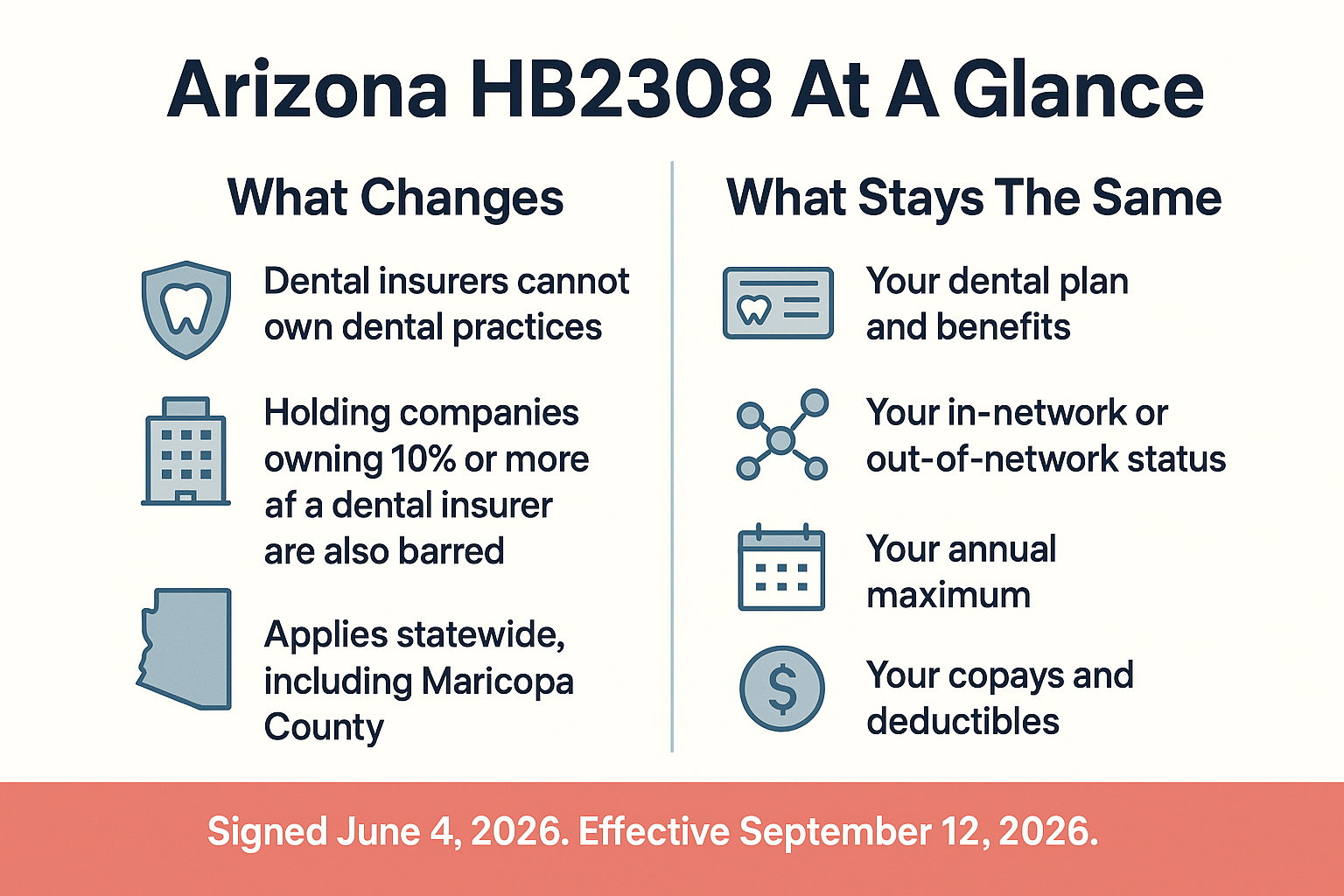
HB2308 at a glance
One side of this is new. The other side is the part people keep expecting to change and it did not.
Why insurer ownership matters when someone says you need a crown
Think about the incentive structure this law removes. If the company paying the claim also owns the office writing the treatment plan, that company controls both sides of the decision.
That does not mean every insurer-owned office was doing something wrong. But it does mean the patient had no way to see the wall between the two, and one conflict of interest is now off the table in Arizona.
Here is the honest part I tell patients: this law does nothing about the far more common situation, which is a practice that is simply busy selling. I have seen the review where a patient felt they were “over selling me,” and I take that seriously, because independent ownership is not a personality test. Ownership structure and treatment philosophy are two different things.
So the law is a floor, not a filter. You still have to evaluate the recommendation in front of you.
What I would actually do with this information
If you are a Paradise Heights or Taliesin West resident sitting on a treatment plan you are unsure about, the new law gives you one clean question to ask and a few better ones to follow it with.
- Ask who owns the practice. A locally owned office should answer in one sentence. Ours is owned by the dentist who treats you.
- Ask for the plan in writing, with an estimate, before you commit. One of my favorite review lines is from a patient who noted we were “timely at giving my estimate to me as promised.” That should be normal, not remarkable.
- Ask what happens if you wait six months. A real answer sounds like specific risk, not pressure.
- Ask to see what the dentist is seeing. X-rays and intraoral photos on the screen, explained in plain English.
- Ask about alternatives. A cracked molar might be a crown, but sometimes it is a filling now and a crown later.
And if the answers still feel off, get a second opinion on the crown or treatment plan. Second-opinion visits are a real and growing part of our schedule, mostly from people who were never told why a procedure was needed. Knowing what a routine exam and cleaning actually includes also helps you spot when a visit has drifted well past routine.
That is the practical takeaway. The Legislature closed one loophole. The rest of the trust still gets built in the chair, one clear explanation at a time.
Frequently Asked Questions About Arizona’s Dental Practice Ownership Law
Does this Arizona law change my dental insurance plan or benefits?
No. HB2308 only restricts ownership. Your plan, your network status, your annual maximum, and your out-of-pocket costs are all set by your insurance contract and were not touched.
When exactly did the law take effect?
It was signed June 4, 2026 and chaptered as Chapter 89. It took effect September 12, 2026, the general effective date the Arizona Legislature listed for bills from the 2026 regular session.
How do I find out who owns my dental office?
Just ask the front desk. In an owner-operated practice the answer is usually the dentist’s own name. If the answer involves a parent company you have never heard of, it is fair to ask whether that company has any relationship to a dental insurer.
I am out of network with my dentist. Does this law help?
Not directly. Out-of-network status is a plan issue, not an ownership issue. What does help is knowing your options ahead of time, including in-house membership plans that some Scottsdale practices offer for patients without coverage. Call and ask for a comparison before you assume the cost is out of reach.
Does the 10 percent rule apply to small investors too?
The prohibition as written covers dental insurers and holding companies of dental insurers, with 10 percent or more ownership of an insurer as the threshold that pulls a holding company in. Questions about a specific corporate structure are worth pointing to the state board of dental examiners.
Want a plain-English read on a treatment plan you are unsure about?
Our office sits at 10697 N. Frank Lloyd Wright Blvd., and we see patients from across North Scottsdale and Paradise Valley who just want someone to explain what is actually going on with their teeth. Trinity Dental Care keeps consultation and second-opinion time on the schedule most weeks. If you would like to talk it through, you can reach us at 480-621-4040 or at trinitydentalcares.com.