
Direct Answer: When your dental insurance annual maximum runs out, the remaining treatment does not disappear. Urgent work gets done now, and stable work is often scheduled into the next benefit year once the cap resets.
You sat through the exam. You looked at the images, agreed to the plan, and got the first tooth taken care of. Then you stopped at the front desk and heard that your plan has paid everything it is going to pay this year.
That moment catches people off guard, and it comes up a lot. Roughly one in twelve calls to our office is some version of a cost question, and people ask it plainly. One caller just wanted to know if we had a savings plan for an uninsured family member.
So let me answer the part nobody says out loud. Running out of benefit is a plan design issue, not a sign you did anything wrong, and there is a normal path for the treatment that is still on the list.
What a Dental Insurance Annual Maximum Actually Is
Your annual maximum is the most your plan will pay toward your care in one benefit year. It is not the most you are allowed to spend, and it is not a budget you get to carry forward. When the number is gone, it is gone until the plan resets.
Most plans land somewhere in the range of $1,000 to $2,000 per benefit year, though yours could sit outside that. The American Dental Association has pointed out that many plans still carry $1,000 caps set decades ago, and National Association of Dental Plans figures put about 32.8% of in network annual maximums between $1,000 and $1,500.
Here is why it empties faster than people expect:
- A single crown appointment, plus the exam and imaging around it, can eat a large share of the year’s cap in one visit.
- Many plans pay restorative work at a percentage, so you are already sharing the cost before the cap is reached.
- Preventive visits often sit outside the maximum on a lot of plans, which is why you can have two cleanings covered and still hit the ceiling on your first crown.
Do not assume a standard number. Pull your plan documents or call the carrier and ask for your annual maximum and your remaining benefit for this year.

Phasing Treatment Across Two Benefit Years
This is the practical answer most patients never hear. When the cap runs out mid plan, the usual move is not to abandon the treatment. It is to split it across two benefit years so the second half lands after your benefits reset.
What drives the order is urgency and structural risk, not the calendar. I look at what is actively breaking down, what is holding your bite together, and what is stable enough to sit safely for a few months under normal checkups.
A few things are almost never candidates for waiting:
- Anything with infection or signs of infection.
- A cracked tooth, because cracks travel and a small crack can become a lost tooth.
- A tooth doing structural work, like the one anchoring how your back teeth come together.
- A temporary or a failing restoration that was never meant to last long.
Sequencing is a clinical judgment made at the exam, not a rule you can apply from a blog post. Two people with the same list of teeth can get two different orders.
One scheduling note for anyone in North Scottsdale. January is a heavy booking month here, because benefits reset at the same time seasonal residents arrive and want work done during their stay. If you are planning a January phase, ask about holding a slot well before the holidays rather than calling the first week of the year.
What Usually Moves Now Versus What Can Often Wait
This is a general pattern, not a diagnosis. Your own sequence gets set at the exam based on what your teeth are actually doing.
| Situation | Typical handling | Why |
|---|---|---|
| Pain, swelling, or signs of infection | Treated now | Infection spreads and gets more expensive, not less |
| Cracked or split tooth | Treated now | Cracks grow and can turn a restorable tooth into a lost one |
| Deep decay close to the nerve | Usually now | Waiting can turn a filling or crown into root canal territory |
| Worn tooth, no pain, stable for now | Often can be phased | Monitored at checkups and treated after benefits reset |
| Missing tooth you have lived with for years | Often can be phased | Timing is flexible, though bone changes over time |
| Cosmetic work such as veneers or whitening | Usually phased last | Elective and rarely benefit covered anyway |
The Path From Maxed Out to Finished
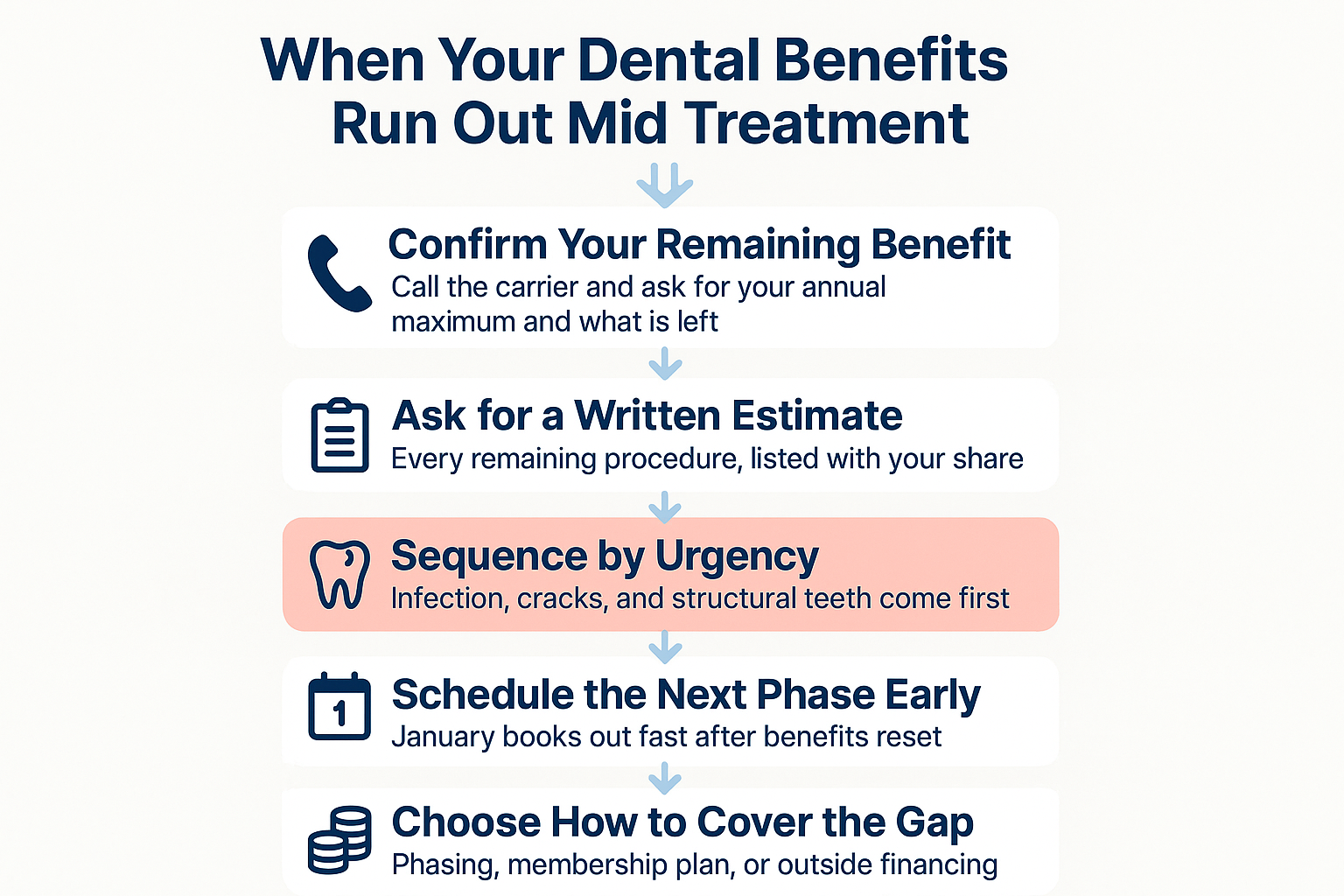
Here is the sequence I walk patients through when the cap runs out before the treatment plan does.
The Paperwork That Removes the Surprise
Most of the shock around cost is not really about the number. It is about finding out the number after the fact. Two pieces of paperwork fix that, and you can ask for both by name anywhere you go.
A written treatment estimate. This lists each remaining procedure, what the office expects the plan to pay, and what your share looks like. Ask for it before work begins, not at checkout.
A predetermination. For larger cases, the office sends the proposed treatment to your carrier ahead of time and the carrier responds with what it will cover. It typically takes a few weeks to come back, which is exactly why you start it before you are standing at the front desk with a decision to make.
Patients notice when an office actually delivers on this. One review put it simply: “Dr. Fink an her staff were very professional and caring about my oral hygiene. They were timely at giving my estimate to me as promised.” That is the standard to hold any practice to.
If you are weighing a big restorative plan and the numbers feel off, getting a second opinion on a crown or treatment plan is a completely normal thing to do before you commit.
How to Read the Mail That Shows Up Afterward
People call us regularly about a charge on a card or a balance on a statement that turns out to be the insurance company’s payment posting, not a new bill. Untangling it takes one phone call. Knowing what you are looking at takes about two minutes.
On your explanation of benefits, the lines that matter most are:
- Amount billed. The full fee before anything is applied.
- Allowed amount or contracted rate. What the plan recognizes for that procedure.
- Write off or adjustment. The difference an in network office absorbs. You do not pay that.
- Plan paid. The carrier’s actual payment.
- Patient responsibility. Your share.
- Remaining benefit or maximum applied. How much of your annual maximum is left.
That last line is the one to watch all year. It tells you where you stand before you schedule the next thing.
And being out of network does not mean your plan pays nothing. Many plans still pay a portion at an out of network rate, and the practical difference is mostly in how the claim is handled and what is written off. If that is your situation, it is worth understanding what changes when your dentist is out of network before you decide to switch offices mid treatment.
What Is Left Once the Cap Is Truly Gone
Say the maximum is spent, the remaining work is not urgent, and you still want it finished. You generally have three paths, and they are not exclusive.
Phase into the next benefit year. The most common answer. The urgent work is done, the rest is scheduled after your plan resets, and you get a fresh maximum to apply to it.
An in house membership plan. Many independent practices offer one for a flat annual fee. These typically bundle preventive visits and include a discount on other treatment. They are not insurance, there is no annual cap to run out of, and pricing varies by office, so ask for current details rather than assuming. This is often the cleanest answer for someone paying out of pocket in Scottsdale.
Outside financing arranged through the office. Third party plans that spread treatment cost over months. Terms vary, so read the interest period carefully.
This comes up constantly here in the fall, when a meaningful share of new patients arrive on Medicare Advantage dental benefits with modest annual caps and no in network dentist lined up yet. If you are only here for part of the year, it is worth thinking through what dental work realistically fits a four month stay before you start.
Frequently Asked Questions About Dental Insurance Annual Maximums
Does my unused annual maximum roll over to next year?
On almost all plans, no. Unused benefit disappears at the end of the benefit year, which is why some people rush work into December. A handful of carriers offer small carryover features, so check your plan documents rather than assuming either way.
Is my benefit year the same as the calendar year?
Usually, but not always. Plans through an employer sometimes run on the company’s plan year instead. Ask your carrier for your exact reset date, because it changes when your next phase should be scheduled.
Is it risky to wait a few months for the rest of my treatment?
It depends entirely on what is left. Stable wear, an older filling that is holding, or a long standing missing tooth can often wait under normal monitoring. Infection, a cracked tooth, or deep decay should not wait, and that call gets made at the exam, not by the calendar.
Why did my card get charged after my insurance already paid?
Nine times out of ten, that is the carrier’s payment posting to your account or a balance adjustment after the claim processed, not a second bill. Call the office and ask them to walk the statement line by line with you.
Should I just skip my cleanings to save my maximum for the crown?
Please do not. On many plans preventive visits sit outside the annual maximum anyway, so skipping them saves nothing and lets small problems grow. Your cleaning schedule is also where a phased plan gets monitored between appointments.
Questions About Your Own Benefit Year?
We are a single dentist practice on Frank Lloyd Wright Boulevard, which means Dr. Fink sequences a full treatment plan herself instead of handing it between providers, and she will tell you what needs attention now versus what can safely wait. If you are somewhere in the middle of a plan and unsure what your remaining benefit covers, you are welcome to call 480-621-4040 or visit trinitydentalcares.com with your questions. Trinity Dental Care is here in North Scottsdale year round, including the January reset rush.