
Direct Answer: The first question is not implant versus bridge. It is whether enough healthy tooth structure, root, and bone remain to hold a crown. If yes, saving the tooth is usually the conservative choice.
You are in the chair, the X-ray is up on the screen, and the dentist pauses on one tooth and says something like “this one is a decision.” Not a cavity to fill. A fork in the road.
I hear this situation on our phone line constantly. A crown that came loose, a molar that cracked on something harmless, a bridge that detached, old work from 20 years ago that finally gave out. The patient walks out holding two very different plans and no real way to judge between them.
This article is not about whether you qualify for an implant, and it is not implants versus bridges. It is about the question that comes first: is the natural tooth still worth keeping?
The question that comes before everything else
Most people jump straight to comparing replacement options. That skips a step.
Before anyone talks about implants, the tooth itself gets judged on its own merits. Can it be restored in a way that will hold up under years of chewing, or has it passed the point where a crown has anything solid to hold onto?
That answer changes everything downstream:
- If the tooth is restorable, the path is usually root canal therapy if the nerve is involved, then a crown
- If it is not restorable, the conversation moves to extraction and replacement
- If it is borderline, we talk honestly about odds, cost, and what happens if the repair does not last
And not every painful tooth needs a root canal at all. Sensitivity from a cracked filling, exposed root surface, or clenching can mimic nerve damage. I go through that in more detail in does tooth pain always mean a root canal.
Only after that first question is settled does it make sense to compare an implant against a bridge. Skipping ahead is how patients in the Shea Corridor and McCormick Ranch end up paying for a plan that never fit their mouth.
What I am actually looking at during the exam
There is a physical checklist here. It is not a judgment call pulled out of thin air, and you deserve to hear it in plain terms.
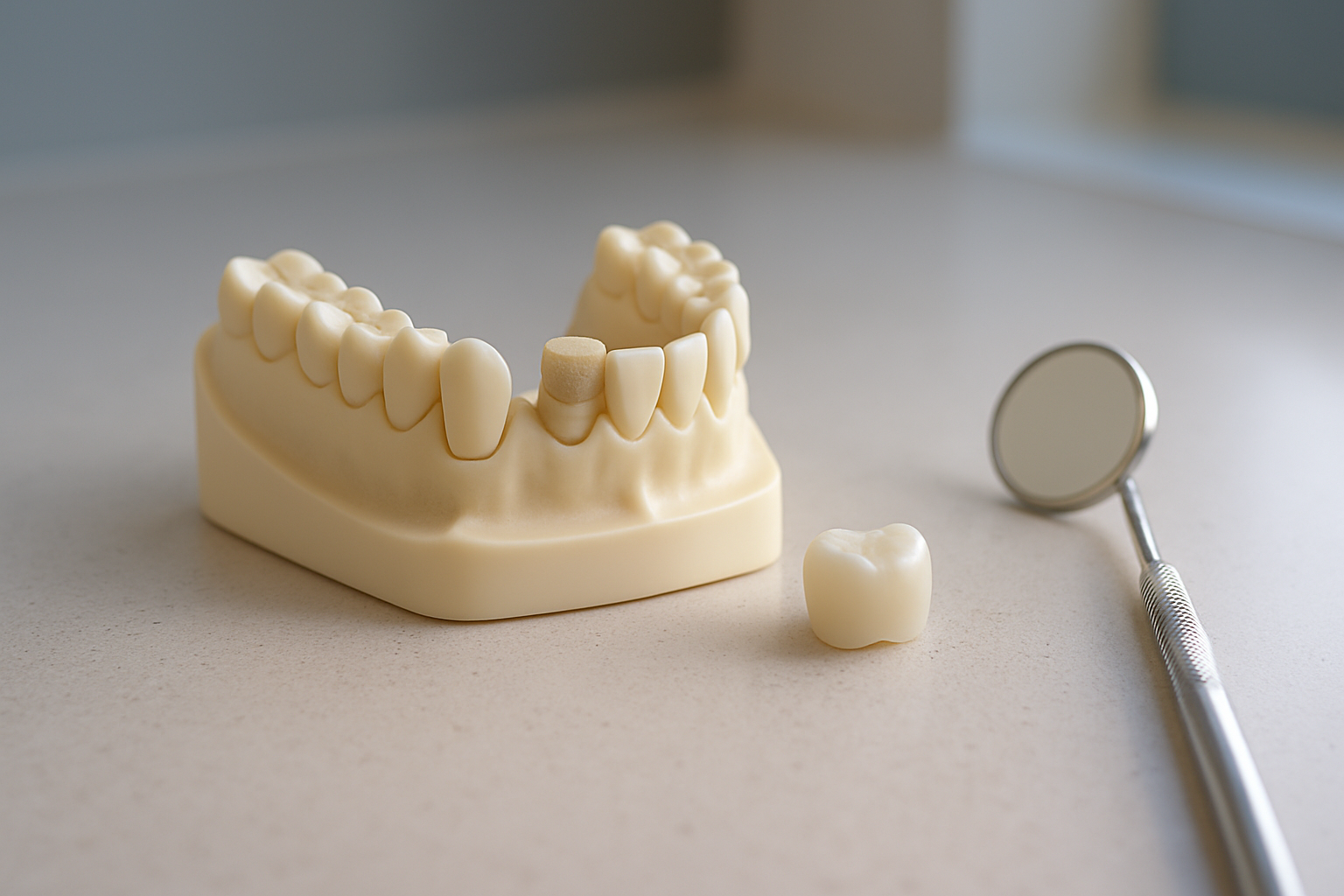
How much solid tooth is left above the gumline. This is usually the make-or-break factor. A crown needs a healthy collar of tooth to grip, sometimes called a ferrule. When decay or a fracture has eaten down to or below the gum, there is nothing for the crown to hold, and it will loosen no matter how well it is made.
Which direction the crack runs. A chipped cusp is usually a fixable problem. A crack running vertically down into the root generally ends the conversation, because that split cannot be sealed and bacteria travel right down it.
The bone and gum around the tooth. A tooth with good bone support has a real future. A tooth already mobile from periodontal bone loss is being asked to carry weight it cannot carry.
Whether a previous root canal failed. Retreatment is possible in plenty of cases. But a tooth that has been treated, crowned, and reinfected is on its second or third repair, and each round removes more structure.
Front tooth or molar. Molars absorb heavy grinding load. Front teeth take a different kind of stress and are more forgiving structurally, though far less forgiving cosmetically.
Your bite habits. A tooth weakened by decay in a calm bite is a different prognosis than the same tooth in a mouth that clenches all night. Grinding shows up on the X-ray and in wear patterns, and it changes my recommendation.
The assumption I push back on most
A lot of patients arrive believing an implant is the permanent, no-more-problems option, and a saved tooth is a stopgap that will fail eventually.
That is not what the evidence shows. A systematic review comparing root canal treated teeth with implant supported restorations found both approaches deliver high survival and success with low failure rates. Broadly similar odds of trouble over the long run.
The honest framing is this:
- Neither path is a lifetime guarantee. Both depend on the specific case and on how well it is maintained
- Both need upkeep. Implants get peri-implant disease, crowns wear, and cleanings still matter
- A natural root does things an implant cannot. It senses pressure through the ligament that holds it, which helps you protect it without thinking, and it keeps the bone around it stimulated
One more thing worth saying out loud. Once a tooth comes out, the bone in that socket starts changing within months. That is why the decision is not easily reversed. You can always extract later. You cannot put the root back.
So when a tooth is genuinely savable, I lean toward saving it. Not out of stubbornness, but because keeping a healthy root buys you options you lose the day it is removed.
What Pushes the Decision Each Direction
Here is a simplified version of what I weigh at the exam. Real cases mix these signals, which is why an X-ray is required to say anything useful.
| Factor | Leans toward saving the tooth | Leans toward replacing it |
|---|---|---|
| Tooth structure above the gum | Solid ring of healthy tooth remains | Decay or fracture extends below the gumline |
| Crack pattern | Chipped cusp or shallow surface crack | Vertical crack running into the root |
| Bone and gum support | Firm tooth, healthy bone levels | Mobility from significant bone loss |
| Root canal history | First treatment, or clean retreatment case | Repeated treatment with ongoing infection |
| Bite load | Front tooth or light chewing load | Molar in a heavy grinding bite |
| Timeline | Needs a stable tooth in weeks | Can commit to a months long process |
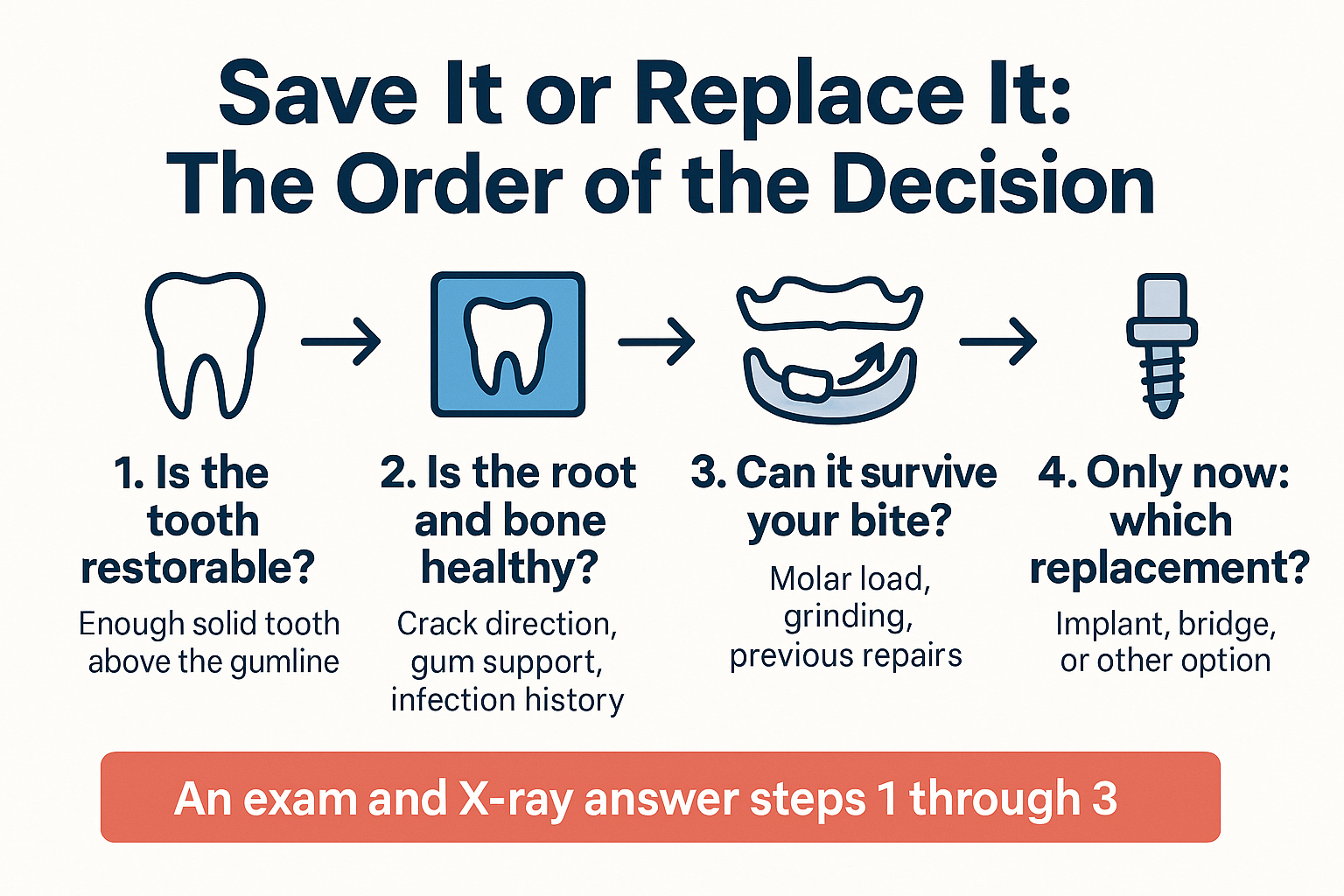
The Order the Decision Gets Made
Patients often start at step four. The exam works through it in order.
The timeline gap patients underestimate
This is the part that surprises people most, and it often matters more than they expect.
Saving a tooth is usually measured in weeks. Treat the tooth, then restore it with a crown. In many cases a crown can be completed in a single appointment for patients who qualify at the exam, with no temporary and no second visit. Candidacy depends on the tooth, so that gets confirmed in the chair, not over the phone. I break down who qualifies in same-day crowns and why not everyone gets one.
Replacement is usually measured in months. Each stage needs its own window:
- Extraction and initial healing
- Bone grafting, if the site needs it
- Integration time while the implant fuses to bone
- Impressions and the final crown
None of that is a problem. It is just a different calendar.
This is why I see a wave of these conversations in late summer around North Scottsdale. Scottsdale Unified is back in session by mid August, family schedules tighten from there, and patients who want a stable tooth before fall routines, holiday meals, or winter travel start asking questions in July and August. If you are hosting Thanksgiving, a weeks long path and a months long path are genuinely different answers.
How to handle the money question without guessing
Cost quietly drives more of these decisions than anyone admits. I would rather you handle it with real numbers than assumptions.
Our callers name specific plans constantly. Delta Dental, Cigna DPPO, MetLife, Humana, BCBS Federal. What they want to know is what their plan will actually do before they commit, and that is a fair thing to ask.
Two things reshape affordability more than the treatment itself: out of network status and a used up annual maximum. A plan that covered a lot in January may have very little left by October, which sometimes makes next year the better year to start. I walk through that dynamic in what changes when your dentist is out of network.
The practical moves:
- Ask for a written pretreatment estimate for both plans, the save path and the replace path
- Ask when your annual maximum resets against your benefit year, not the calendar year
- Ask what happens to the cost if a saved tooth needs more work later, so you are comparing full pictures
- If you have no insurance, ask what in-house membership or cash options exist instead of assuming the door is closed
I will not guess at dollar figures here, because your plan, your tooth, and your history all move the number. Call our office and ask for your own estimate.
And if you want a second set of eyes before choosing, that is normal, not rude. Plenty of people do it, and we treat those visits the same as any other.
What a good version of this conversation sounds like
The tone matters as much as the recommendation. You should leave knowing what was found, what the options are, and why one is being recommended over the other.
Patients tend to describe Dr. Fink’s approach the same way: options laid out in plain terms, a conservative lean when the tooth can be kept, and a referral to a specialist when that is genuinely the better route. One reviewer wrote about being told exactly what was found on her implant and getting a follow up phone call the next day to talk through the plan with the specialist.
Another put it simply: “Dr. Fink is friendly, on time, and does a great job explaining potential issues/concerns and provides options.” That is Mary D., one of the reviews on our profile.
If you already have a crown on the tooth in question, it also helps to know how long a crown should realistically last before assuming it failed early.
Frequently Asked Questions About Saving vs Replacing a Tooth
If my dentist says the tooth is questionable, should I just pull it and get an implant?
Not automatically. Questionable is not the same as hopeless, and the research shows root canal treated teeth restored with crowns hold up comparably to single tooth implants. Ask specifically what makes it questionable, how much solid tooth is left, and what the backup plan is if the repair does not hold.
Does a root canal weaken the tooth permanently?
The treatment itself removes infected tissue from inside the tooth, and the tooth does become more brittle afterward. That is exactly why a crown is recommended after most root canals on back teeth, to hold the remaining structure together under chewing load.
How fast do I have to decide?
It depends on whether there is active infection. An infected tooth needs attention soon. A cracked but symptom free tooth usually gives you a few weeks to think, though cracks tend to get worse, not better, and waiting can turn a savable tooth into an unsavable one.
Can you tell me over the phone which option I need?
No, and I would not trust anyone who could. This decision comes down to how much tooth is above the gumline, which way the crack runs, and what the bone looks like, and none of that is visible without an exam and X-ray.
If I save the tooth now and it fails in a few years, did I waste the money?
Not usually. Those years kept the root and the bone in place, which preserves the site. Extraction remains available later, and the bone you kept in the meantime often makes that path more straightforward when it comes.
Ready to get a clear answer on that one tooth?
An exam and X-ray are what turn this from a coin flip into a straightforward answer, and that visit is usually shorter than people expect. Our office sits on Frank Lloyd Wright Blvd in North Scottsdale, and appointments can be arranged at 480-621-4040 or through trinitydentalcares.com whenever you are ready to talk it through.