
Direct Answer: Most dental plans run on a calendar year. Any unused annual maximum disappears on January 1, so families book in December to use benefits they already paid for.
Every year around the first week of November, our phones start doing the same thing. Patients we have not heard from since spring call and ask if there is anything left in December.
The reason is simple. Most dental insurance plans run on a calendar year, and whatever benefit you did not use disappears on January 1.
I want to walk you through how that actually works, why whole families book together this time of year, and what to do if it has been a long while since your last cleaning. No pressure, just the math and the timing.
Why December Gets Busy at Every Scottsdale Dental Office
Your dental plan is not like a savings account. It does not roll over.
Most PPO plans give you an annual maximum, which is the most the plan will pay toward your care in one benefit year. Amounts vary quite a bit by plan, but many patients we see land somewhere in the $1,000 to $2,000 range. Your plan documents or a quick call to your carrier will tell you the exact figure.
Here is what typically resets when the calendar flips:
- Annual maximum goes back to full, and unused dollars from the old year are gone
- Deductible resets, so you pay it again before the plan starts sharing costs
- Cleaning and exam frequency resets, usually two cleanings per year
- X-ray eligibility often resets on its own schedule, which may not match the calendar
So a patient who had one cleaning in March and nothing else is walking away from most of a benefit they paid premiums on all year.
When people call us, they usually name their plan right away. Delta Dental, Cigna, MetLife, Humana, and BCBS Federal come up constantly. We verify coverage while you are still on the phone so you are not guessing. If your plan turns out to be out of network, that is not automatically a dead end either, and we wrote a whole piece on what actually changes.

Each Person in the House Has Their Own Annual Maximum
This is the part that surprises people most, and it is the reason family group bookings are such a pattern for us in November and December.
On most family plans, every covered person gets their own separate annual maximum. Dad’s crown does not eat into Mom’s cleaning benefit. A teenager’s fillings do not reduce what is available for Grandma.
So a household of four may have four separate pools of benefit money, and every one of them expires on the same date.
We see a wide age range walk through the door in a single afternoon:
- Kids in for a cleaning, exam, and fluoride
- Adults catching up on a filling or a crown they postponed in the summer
- Parents and grandparents handling gum health monitoring and restorative work
- Couples who each want whitening trays before holiday photos and family visits
One family from the Shea Corridor books three or four people back to back most years so it costs them one trip instead of four. Another books the week their college kids are home. That is a real scheduling advantage when you live near the Village at Frank Lloyd Wright and would rather not make four separate drives in December traffic.
What Resets January 1 and What Does Not
Not everything about your dental coverage runs on the calendar year. Here is the general pattern for most PPO plans, though your specific plan is the final word.
| Part of Your Plan | What Usually Happens January 1 | What It Means for You |
|---|---|---|
| Annual maximum | Resets to full, unused dollars are lost | Care completed in December uses this year’s money |
| Deductible | Resets, you pay it again | Finishing work now avoids paying a second deductible |
| Cleanings and exams | Frequency count resets | A second cleaning in December still counts for this year |
| Waiting periods on major work | Do not reset, they keep running | Crowns and implants may become covered on their own timeline |
| Premiums | May change with a new plan year | Worth confirming before you plan next year’s treatment |
The Move Most People Miss: Splitting Treatment Across Two Years
If you need more work than one year of benefits will cover, timing matters more than most patients realize.
When it makes clinical sense, treatment can sometimes be sequenced so part of it happens in late December and the rest happens in January. That way you draw from two benefit years instead of maxing out one and paying the rest yourself.
A few honest caveats:
- Clinical need comes first. We never stretch out care that should be finished now just to chase a benefit calendar.
- Some procedures cannot be split. A same day crown, when you qualify for one, is designed to be finished in a single visit with no temporary and no second appointment.
- Your plan may have rules about how it handles treatment that starts in one year and finishes in the next.
The right move is to get an exam and a written estimate before the year closes. Then you can see the whole picture and decide with real numbers instead of hoping it works out.
And if you do not have insurance at all, ask about the yearly membership plan our office offers. Several callers each month are cash pay or out of network, and that plan often changes the math on preventive visits.
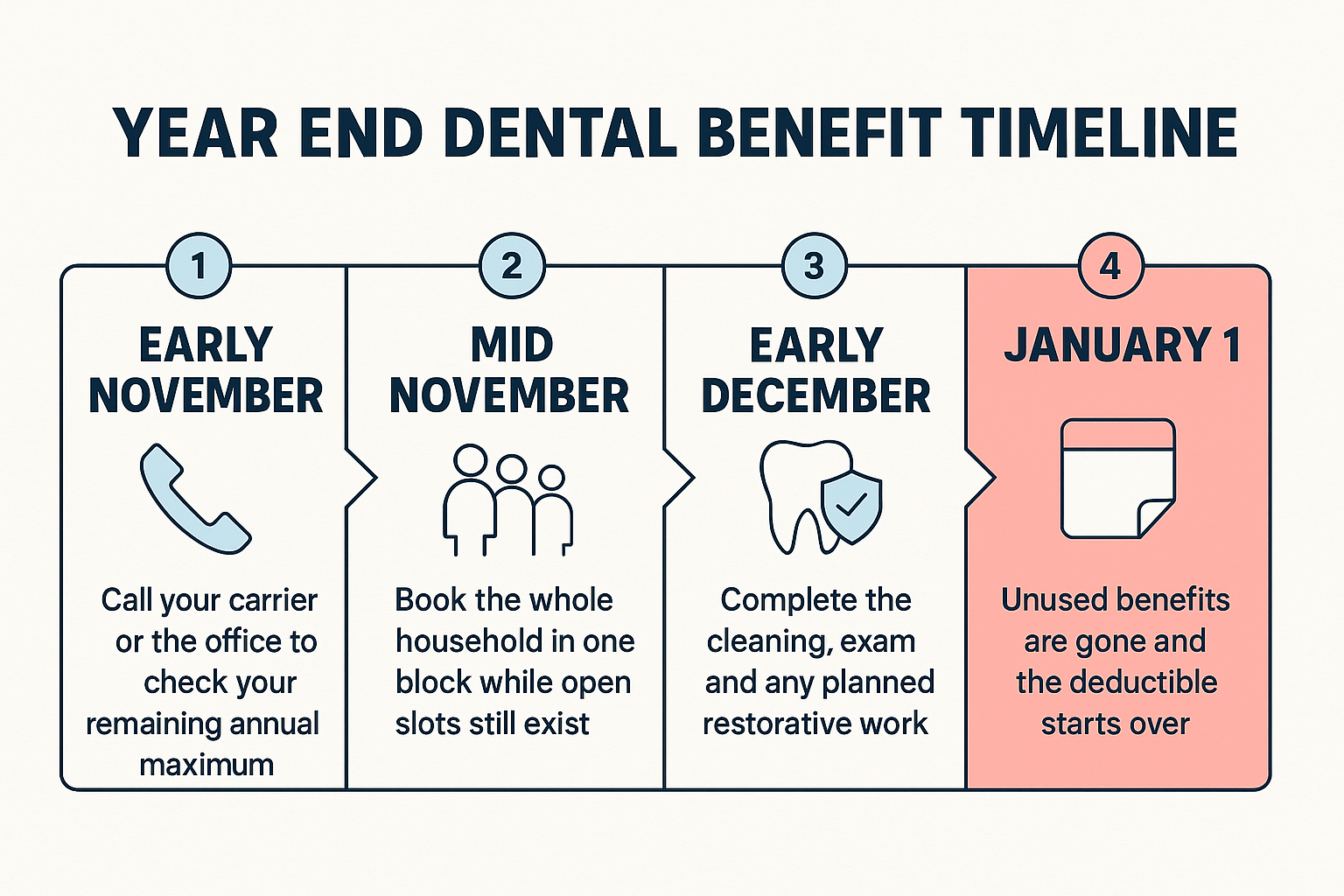
Your Year End Dental Benefit Timeline
Here is the rough calendar I give patients who want to use what is left without scrambling on December 30.
If It Has Been a Year or Three Since Your Last Visit
A good number of the people who call us in December are not new patients. They are returning patients who fell off the schedule and feel a little sheepish about it.
Nobody here is going to lecture you. Life gets busy, dental anxiety is real, and plenty of people put off a visit because they had a bad experience somewhere else years ago.
What I will say is that the gap is the reason to come in, not a reason to keep waiting. Gum disease in particular is quiet in the early stages, and the National Institute of Dental and Craniofacial Research notes that early gum disease often causes little to no discomfort. You can feel completely fine and still have something worth catching.
A year end appointment is a low stakes way back in:
- You get a full exam and digital X-rays so you know exactly where you stand
- Anything that needs attention gets a written estimate before you commit
- A benefit you already paid for helps cover the visit
If a hygienist recommends a deep cleaning after a long gap, that recommendation deserves a clear explanation, not a hard sell. We covered how to tell whether a deep cleaning is genuinely needed in a separate article, because patients ask about it constantly.
How to Actually Get a December Spot in North Scottsdale
Here is the practical problem. Everyone figures this out around the same time.
December in Scottsdale stacks up fast. Winter residents are back, families are traveling, kids are out of school, and offices close for holidays. The number of available chairs shrinks right when demand spikes.
What works:
- Call in early November, not mid December. The first two weeks of November are when the good slots are still open.
- Book the family in one block so you make one trip instead of four.
- Ask about the cancellation list. Holiday travel creates last minute openings and we call that list first.
- Get your insurance verified on that first call so there are no cost surprises when you arrive.
Most of the people who find us this time of year were sent by a friend, a neighbor, or a coworker. Word of mouth and referrals bring in the majority of our new patients, and December is when that referral chatter peaks around McCormick Ranch, Paradise Heights, and Scottsdale Mountain.
If you are still deciding where to go, it is worth reading what research minded patients in North Scottsdale actually compare before they pick a practice.
Frequently Asked Questions About Year End Dental Benefits
Do unused dental benefits really disappear on January 1?
For most plans, yes. Annual maximums do not roll over. A small number of plans have carryover features, so it is worth a two minute call to your carrier to confirm which type you have.
Does my family share one annual maximum?
Usually not. On most family plans each covered person has their own separate annual maximum, which is exactly why booking everyone before year end can make sense. Some plans do have a family maximum on top of individual ones, so check your plan summary.
How late in December can I still book an appointment?
It depends on how full the schedule is, but treatment has to be completed before the year ends to count against this year’s benefit, not just scheduled. Calling in early November gives you real choices. Calling on December 22 usually means taking whatever is left.
I have not been to a dentist in several years. Is a year end visit a bad idea?
It is actually a good one. You get a full picture of where things stand while a benefit is still available to help cover the exam and cleaning, and nothing has to be decided that same day.
What if I do not have dental insurance at all?
Then the calendar reset does not apply to you, which takes some of the pressure off. Ask about our yearly membership plan and cash pricing when you call so you can compare the two before you schedule anything.
Thinking About Getting the Family In Before the Year Closes?
A lot of the households we see have been coming here for years, some across three generations, and December is when they book everyone in one visit. If you want to check what is left on your plan or get a few family members on the schedule together, our team can verify your coverage over the phone. Call 480-621-4040 or visit trinitydentalcares.com when you are ready.