
Direct Answer: No. Tooth pain has many causes — sensitivity, a cracked tooth, a cavity, or gum issues. Whether a root canal is needed depends on the nerve, and only an exam and X-ray can tell you that.
Tooth pain has a way of sending people straight to the internet at 11pm, convinced they’re facing the worst-case scenario. By morning, half of North Scottsdale has already self-diagnosed a root canal before anyone has looked at the tooth.
The truth is, tooth pain is one of the most misread signals in dentistry. A sharp twinge when you sip cold coffee is completely different from a dull throb that wakes you up at 3am — and those two symptoms often point to very different problems.
This article breaks down what different types of tooth pain tend to mean, why no dentist can give you an honest answer over the phone, and what actually happens if real nerve damage goes untreated long enough.
Why No One Can Tell You Over the Phone
We get calls from patients in pain every week, and the first question is almost always the same: “Am I going to need a root canal, or just a filling?” It’s a fair question, and we completely understand why people ask it.
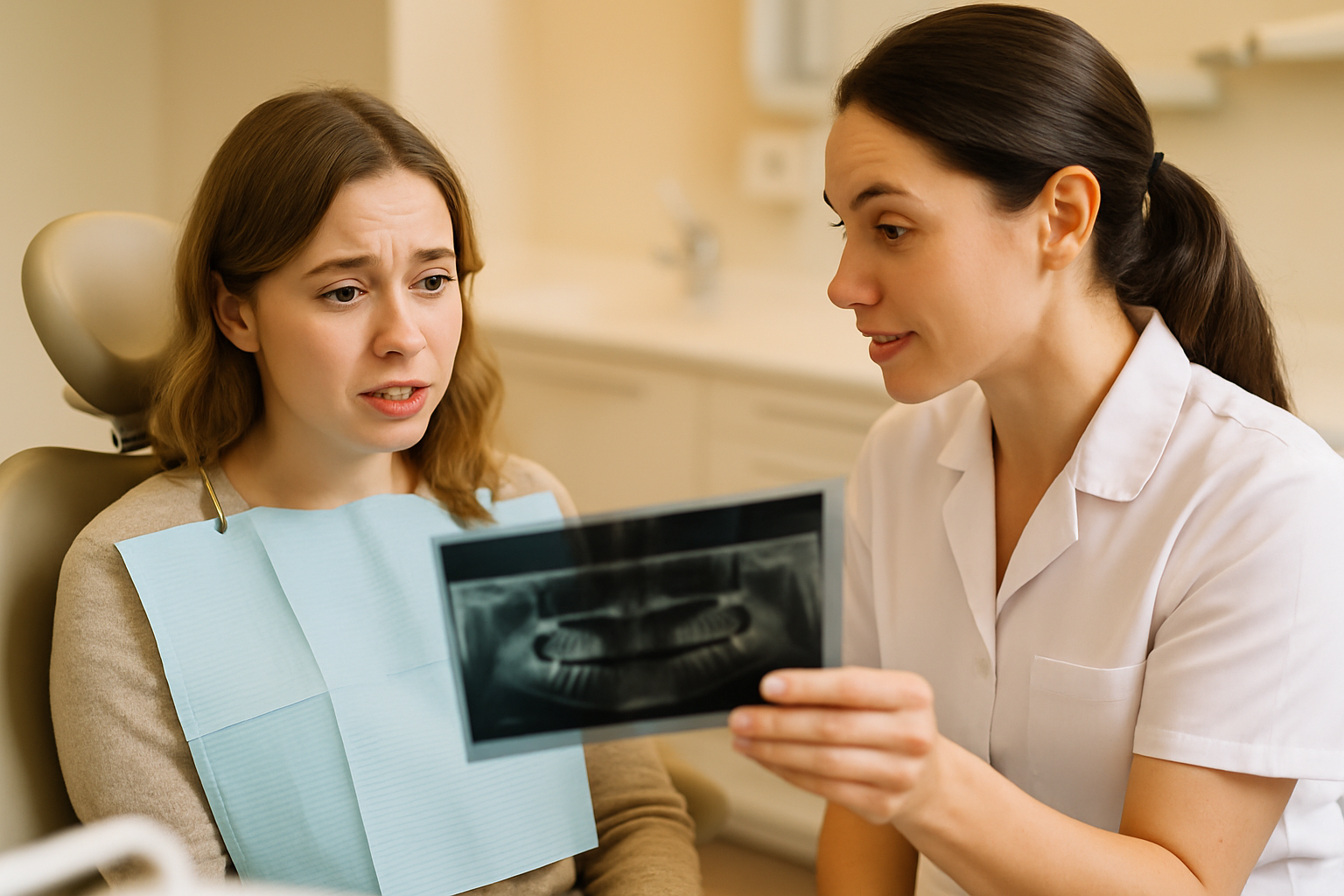
But here’s the honest answer: no dentist can responsibly tell you that without an exam and X-rays. The reason isn’t evasion — it’s that tooth pain alone doesn’t reveal what’s happening inside the tooth.
To figure out whether the nerve is involved, we look at a combination of things:
- Digital X-rays to check for infection at the root tip, bone changes, or deep decay
- Percussion testing — gently tapping the tooth to see if it responds with pain
- Thermal testing — applying cold or sometimes heat to see how the tooth reacts and whether the response lingers
- Pulp vitality checks to assess whether the nerve tissue inside the tooth is still healthy
Each of those tests tells us something different. Cold sensitivity that disappears in two seconds is not the same signal as cold sensitivity that hangs around for 30 seconds after the stimulus is gone. The pattern matters as much as the pain itself.
This is exactly why a phone conversation — no matter how detailed — can’t replace sitting down, taking a proper look, and running through those diagnostics.
Reading Your Own Pain: What the Pattern Is Telling You
Not all tooth pain is created equal. Different patterns tend to point toward different problems, and understanding that can at least help you know how urgently you need to be seen.
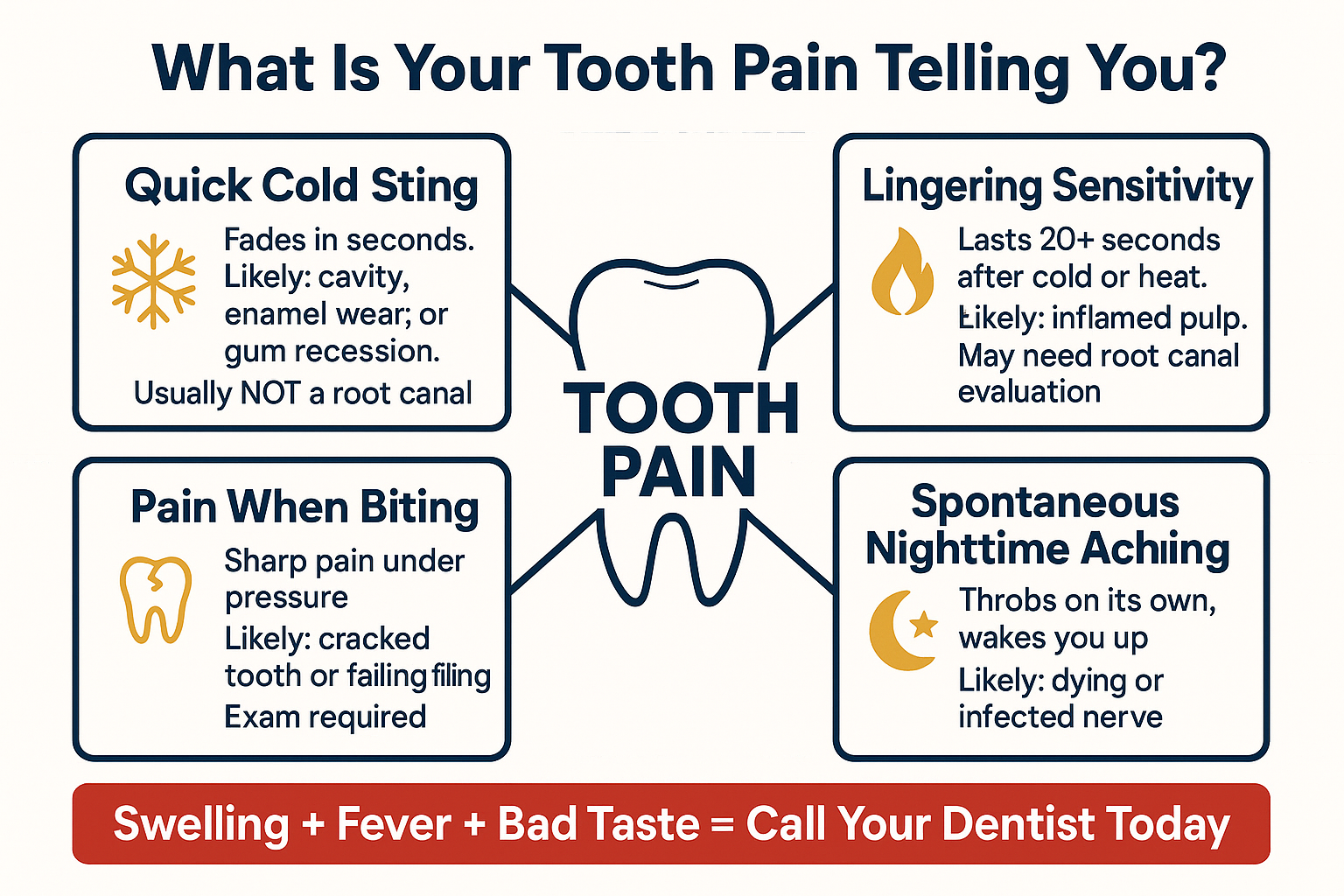
Brief cold sensitivity — a quick zing when you drink something cold that fades within a few seconds — is usually a sign of exposed dentin or early enamel wear. This often means a cavity, a small crack, or gum recession, not nerve damage. If you’ve been dealing with this, our article on tooth sensitive to cold but not hot walks through the most common causes.
Lingering cold or heat sensitivity — where the discomfort sticks around for 20 seconds or longer after you remove the stimulus — is a different story. That pattern suggests the pulp (the nerve-containing tissue inside the tooth) is inflamed, a condition called pulpitis. Whether it’s still reversible depends on how far that inflammation has progressed.
Pain when biting or chewing often points to a cracked tooth, a failing filling, or an abscess. A cracked tooth can be tricky because it may not show up clearly on an X-ray even when it’s causing real pain.
Spontaneous aching or throbbing that wakes you up at night is the symptom that most reliably suggests the nerve is in serious trouble. When pain starts on its own — without any temperature or pressure trigger — it typically means the pulp is dying or already infected.
None of this is a substitute for an actual diagnosis. But knowing which category your pain falls into can help you gauge whether you’re dealing with something that can wait a few days or something that needs attention now.
Pain Pattern Quick Reference
This isn’t a diagnosis — only an exam can give you that. But this table gives you a general sense of what different pain patterns tend to suggest.
| Pain Pattern | What It Often Suggests | Urgency Level |
|---|---|---|
| Brief cold sensitivity, fades fast | Exposed dentin, minor decay, gum recession | Schedule soon — not an emergency |
| Cold/heat sensitivity that lingers | Inflamed pulp (pulpitis) | Be seen within a few days |
| Pain when biting or chewing | Cracked tooth, failing filling, or abscess | Be seen soon |
| Spontaneous throbbing or nighttime aching | Dying or infected nerve tissue | Be seen promptly |
| Swelling, fever, or bad taste in the mouth | Active infection or abscess | Do not wait — call your dentist |
What Happens When You Wait Too Long
Tooth pain has a way of coming and going, which makes it easy to convince yourself it’s getting better. Sometimes it does quiet down — but with nerve damage, that silence can actually be a bad sign. When the nerve tissue dies completely, the pain often stops temporarily. The infection, though, keeps moving.
Untreated pulp infections don’t stay contained. They spread through the root into the surrounding bone and soft tissue. An abscess can form — a pocket of infection that shows up as swelling, a bad taste in your mouth, or a pimple-like bump on your gum. Left long enough, what started as a savable tooth becomes a tooth that needs to come out entirely.
Warning signs that should never be ignored:
- Visible swelling in your face, jaw, or gum tissue
- Fever alongside tooth pain
- A persistent bad taste or foul smell with no obvious cause
- Swelling that feels like it’s spreading toward your jaw or neck
If you’re experiencing any of those, don’t wait for a routine appointment slot. Dental infections that reach the jaw or surrounding spaces can become serious medical situations quickly.
For patients who do end up losing a tooth despite treatment, it’s worth knowing what tooth replacement looks like — our overview of multiple tooth implant options in Scottsdale covers what’s available when a tooth can’t be saved.
The Pain Pattern Decision Map
This infographic shows how different tooth pain patterns map to likely causes — and when each one typically warrants a root canal evaluation versus a different treatment.
What an Honest Evaluation Can Tell You — and What It Rules Out
One of the most reassuring things we can do for a patient in pain is tell them they don’t need a root canal. That happens more often than people expect, and it’s worth saying plainly: a thorough exam sometimes rules the procedure out entirely.
Adriana B., a patient who came in worried about exactly that, shared this after her visit: “After a thorough examination and honest evaluation, Dr. Fink assured me it wasn’t necessary. It’s rare to find a dental office where you feel truly cared for, but this is one of them.”
That kind of outcome is possible only because the diagnostic process is real. When we take X-rays, test the tooth’s response, and check the surrounding tissue carefully, we’re not guessing — we’re building a clear picture of what’s actually happening.
If a root canal isn’t indicated, the actual problem usually still needs addressing. A deep cavity might need a filling or a crown. A cracked tooth needs to be evaluated for what type of crown will protect it best going forward. A gum issue that’s causing sensitivity needs its own treatment — you can read more about what gum-related symptoms often mean in our post on why bleeding gums aren’t something to just wait out.
The point is that an honest evaluation gives you a real answer — not just the worst-case one.
What a Root Canal Actually Feels Like in 2025
Most of the fear around root canals comes from a reputation the procedure earned decades ago, before modern anesthesia and techniques caught up. Patients who’ve actually had one recently are often surprised by how different the experience is from what they expected.
A root canal today feels much more like a long filling appointment than anything dramatic. The tooth is numbed thoroughly before anything starts. Once that anesthetic is working, the procedure itself is more about pressure and duration than pain — most patients feel little to nothing during the actual treatment.
What a root canal does is remove the infected or dying nerve tissue from inside the tooth, clean and shape the canals, and seal them to prevent reinfection. After that, the tooth typically gets a dental crown to protect the remaining structure, since a tooth that’s had a root canal can become more brittle over time.
The discomfort people associate with root canals usually comes from the infection that was already there — not from the procedure itself. By the time a root canal is done, most patients feel significantly better within a day or two because the source of the pain has been removed.
For anyone in North Scottsdale who has been putting off a painful tooth because they’re afraid of what the treatment involves, that fear is understandable — but it’s worth reconsidering, because waiting tends to make both the problem and the recovery harder.
Frequently Asked Questions About Tooth Pain and Root Canals
Can a tooth hurt badly and still not need a root canal?
Yes, and it happens regularly. Severe sensitivity or sharp pain can come from a deep cavity, an exposed nerve from gum recession, a cracked filling, or a cracked tooth — none of which automatically require a root canal. The only way to know is a proper exam with X-rays.
What if my tooth stopped hurting on its own — does that mean it’s fine?
Not necessarily. When a nerve dies, the pain often stops temporarily because the nerve tissue is no longer sending signals. But the infection can still be present and spreading. A tooth that hurt and then mysteriously stopped hurting should still be evaluated — don’t assume silence means healed.
How long does a root canal procedure actually take?
Most single-canal root canals take about 60 to 90 minutes. Back molars with multiple canals can take longer, sometimes requiring a second appointment. After the root canal itself, you’ll typically need a follow-up visit to place a crown over the tooth.
Is it safe to take ibuprofen and wait a few days before being seen?
For mild, brief sensitivity — yes, waiting a few days while managing discomfort is usually fine. But if you have swelling, a fever, throbbing pain that keeps you up at night, or pain that’s getting worse rather than better, don’t wait. Those signs suggest an active infection that needs prompt attention.
If I need a root canal, will the tooth still look normal afterward?
Yes. After the root canal, the tooth is usually restored with a crown, which is designed to match the color and shape of your surrounding teeth. Most people can’t tell which tooth had the procedure done. You can read more about what to expect from a crown in our post on what your dentist means when they say you need a crown.
Ready to Find Out What’s Actually Going On With That Tooth?
If you’ve been sitting with tooth pain — or a tooth that went quiet after hurting for a while — the best thing you can do is get a real answer. Trinity Dental Care sees patients throughout North Scottsdale and the surrounding area, and Dr. Fink’s approach is to tell you exactly what she finds and what your options are, without pressure. Call 480-621-4040 or visit trinitydentalcares.com to schedule an exam.