
Direct Answer: Most crowns last 10 to 15 years, and plenty last longer. Replacement is driven by decay at the margin, cracks, or a loose fit, not by the crown’s age alone.
Patients ask me this one constantly, usually in one of two situations. Either they just had a crown placed and want to know what they paid for, or they have a crown from years ago that suddenly feels off and they want to know if something is wrong.
The number that gets repeated everywhere is 10 to 15 years. It is a reasonable average. But it is a range, not a promise, and I have seen crowns in North Scottsdale patients that were placed in the 1990s and still seal beautifully, right alongside crowns that gave out in under five.
So let me explain what actually decides dental crown lifespan and replacement, what counts as normal wear, and what is worth getting looked at. That way you are not guessing every time your tooth twinges.
What the 10 to 15 Year Number Really Means
That range comes from averages across a lot of patients with a lot of different habits. It is a planning number, not an expiration date printed on your tooth.
Here is the part that surprises people: age by itself is almost never the reason we replace a crown. A 20 year old crown that still seals tight, fits your bite, and has healthy gum around it is a crown doing its job.
What we actually look at is the condition of four things:
- The seal at the margin, where the crown edge meets your natural tooth
- The tooth underneath, which can still get decay even though the top is covered
- The gum tissue around the crown, including whether it has receded
- The bite, meaning how that crown meets the opposing tooth when you chew and clench
When one of those breaks down, the crown needs attention regardless of whether it is three years old or fifteen. And when all four look good, I am not going to recommend replacing something that works.
If your crown is newer and you are just uneasy about what to expect, our post on what it means when your dentist says you need a crown covers the front end of the process.
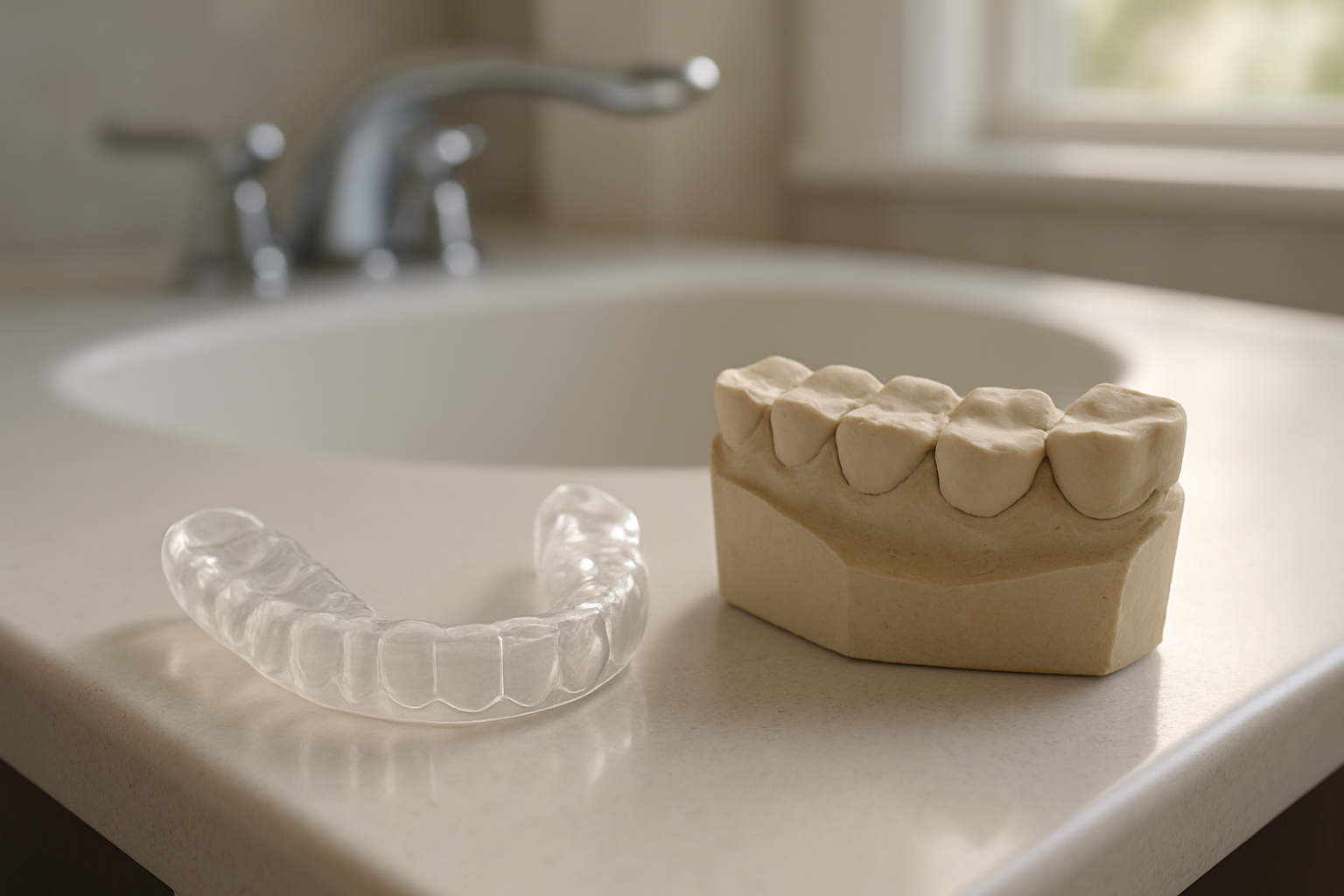
Your Bite Habits Shorten Crown Life More Than Anything Else
If I had to name the single biggest real-world variable, it is what you do with your teeth at night and under stress. Grinding and clenching put loads on a crown that normal chewing never comes close to.
Most people who grind have no idea they do it. Their partner mentions the sound, or they wake up with a tight jaw, or I see the telltale flat wear facets during an exam. According to the American Dental Association, grinding often happens during sleep and can be tied to stress, which fits a lot of the professionals I see from the Shea Corridor and McCormick Ranch juggling long work weeks.
The habits that consistently cut crown life short:
- Nighttime grinding or clenching that goes untreated for years
- Chewing ice, which is a big one here once summer hits and everyone is drinking iced everything
- Using teeth as tools to open packaging or tear tape
- Hard foods on a crowned molar, like popcorn kernels, hard candy, or nuts in the shell
- An uneven bite that puts more force on one crowned tooth than the rest
None of this is a lecture. It is just cause and effect. A custom night guard is one of the cheapest things you can do to protect expensive dental work, and I bring it up when I see the wear pattern, not to sell you something.
Most Crown Failures Start at the Margin, Not the Middle
This is the piece patients almost never know. The porcelain part of a modern crown is strong. What usually gives out first is the seam where the crown meets your natural tooth, right at or just under the gumline.
Over years, that margin can pick up plaque. Cement can wash out a little. And tooth decay does not care that there is a cap over the top. It works on the natural tooth structure underneath.
Gum recession makes it worse. When the gum pulls back, more root surface is exposed at the crown edge, and root surface is softer and decays faster than enamel. That is why an older crown on a patient with receding gums deserves a closer look.
A few things stack the deck in your favor:
- Flossing the crowned tooth, especially at the margin, and telling me if the floss shreds or catches
- Keeping your checkup schedule so a small margin cavity gets caught before it reaches the nerve
- Watching for dry mouth, which is common with blood pressure and allergy medications and increases decay risk fast
This is the honest reason crown longevity and routine cleanings are connected. The crown is not the thing that fails. The tooth under it is.
What Actually Drives Crown Lifespan
Here is how the main factors play out in practice, based on what I see during exams.
| Factor | Why It Matters | What Helps |
|---|---|---|
| Grinding and clenching | Repeated heavy force can chip porcelain or fracture the tooth under the crown | A custom night guard and a bite check at each visit |
| Margin decay | The most common reason a crown gets replaced, and it is often painless early on | Daily flossing at the crown edge plus regular X-rays |
| Gum recession | Exposes softer root surface at the crown edge where decay moves faster | Gum health monitoring and gentle brushing technique |
| Crown material | All-ceramic, zirconia, and porcelain-fused-to-metal each behave differently under stress | Material chosen for the tooth’s location and your bite |
| Home care and checkups | Small problems caught early can often be repaired instead of replaced | Exams roughly every six months unless we advise otherwise |
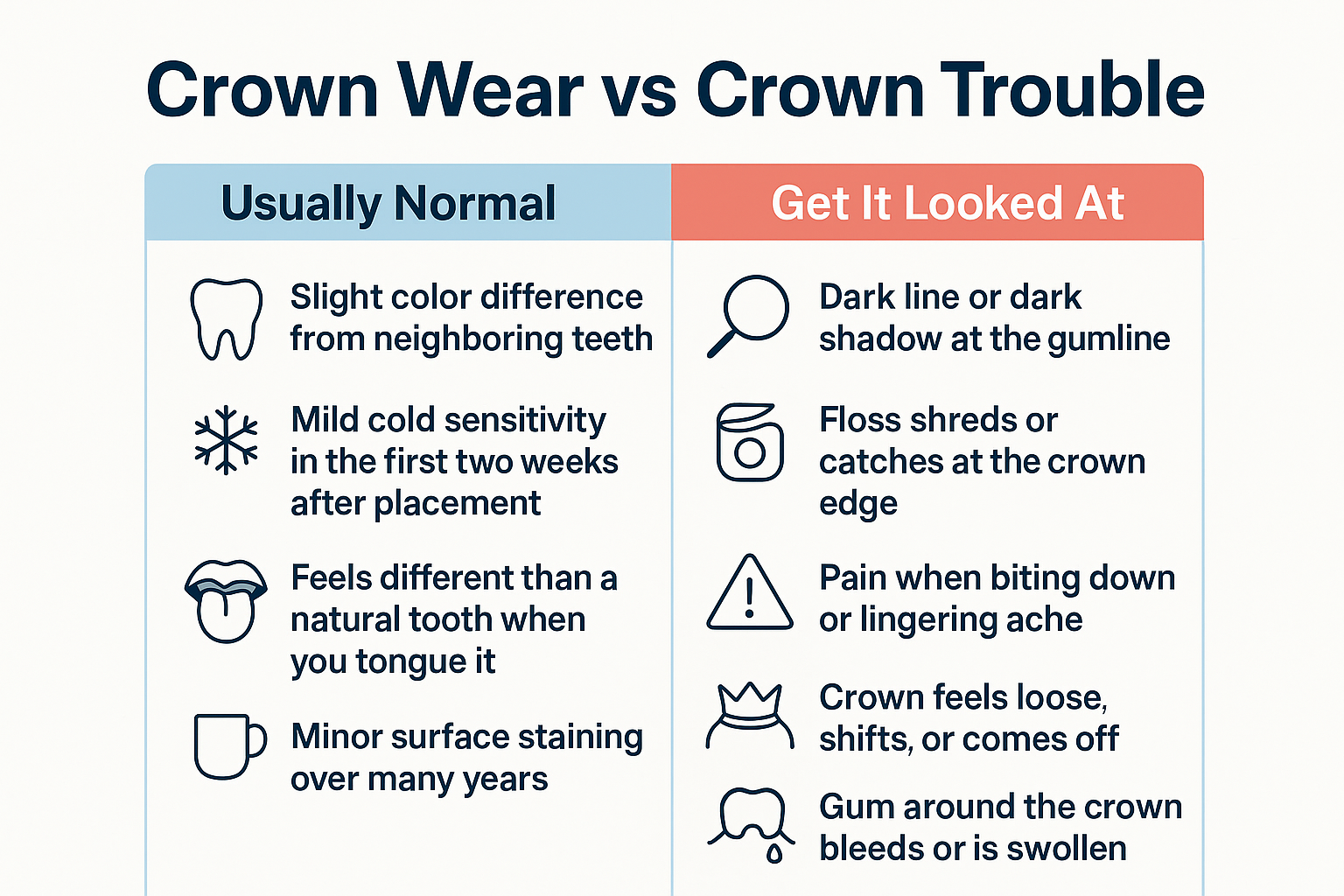
Normal Wear or Time to Get It Checked?
Use this as a quick gut check before you decide whether to call. When in doubt, an exam settles it in minutes.
Bringing an Older Crown From Another Office In for a Look
A good chunk of the new patients I meet come in with dental work done somewhere else, sometimes in another state, sometimes decades ago. Several call specifically because they want a second opinion on a crown someone told them to replace.
An older crown from another office is not automatically a problem. But when you establish care with a new dentist, it is worth having it assessed on purpose rather than assuming it is fine.
Here is what I am checking during that exam:
- X-rays to see decay or bone loss under and around the crown that you cannot see by eye
- The margin, probed with an explorer to feel for a ledge, gap, or catch
- Movement, since a crown that rocks slightly usually means the cement seal has broken
- The bite, to see if that crown is taking more force than it should
- Gum health, including pocket depths right around the crowned tooth
- The material and how it is aging, because a porcelain-fused-to-metal crown from years ago shows its age differently than newer all-ceramic or zirconia
Sometimes the answer is that nothing needs to be done for now, and we just document it and watch it. I would rather tell you that than replace something that has years left. If your crown has already come loose or come off, what to do in the first 24 hours is worth reading before you do anything else.
When Replacement Is Genuinely the Right Call
Replacement makes sense when the crown can no longer protect the tooth. That usually means decay has gotten under the margin, the porcelain has fractured, the fit has failed, or the tooth underneath has changed shape from wear.
On cost, I will not throw a number at you, because crown pricing swings a lot depending on the material, whether the underlying tooth needs work first, and what your plan covers. It is also worth knowing that many dental plans limit how often they will pay to replace the same crown, often somewhere in the five to eight year range, so the coverage question is worth asking before treatment is scheduled.
A few practical notes:
- Same-day crowns are available in many cases for patients who qualify, which spares you a temporary and a second visit. Candidacy gets decided at the exam, and our post on why not everyone is a same-day candidate explains the limits honestly.
- Material selection matters for how the replacement will hold up. How the material gets chosen depends on the tooth’s position and your bite force.
- Whitening will not change a crown’s color, so if you are planning both, sequence matters.
The short version: replace a crown because of its condition, not its birthday.
Frequently Asked Questions About Crown Lifespan and Replacement
My crown came off. Does that automatically mean I need a new one?
Not always. Sometimes the crown itself is intact and the cement simply failed, and it can be cleaned and re-cemented. But if there is decay on the tooth underneath or the crown is cracked, it will need to be remade. Keep the crown, do not try to glue it back yourself, and get seen soon so the exposed tooth does not shift or get sensitive.
How do I know my crown is failing if nothing hurts?
Often you do not, and that is exactly why margin decay gets caught on X-rays rather than by symptoms. A dark line at the gumline, floss that shreds in the same spot every time, or gums that bleed around one specific tooth are the early clues worth mentioning.
Will my insurance pay to replace an older crown?
Many plans will, but most set a replacement frequency limit, commonly around five to eight years from the original placement date. Coverage varies a lot by plan, so it is worth having the office verify your specific benefits before treatment is scheduled rather than after.
I grind my teeth. Should I expect my crowns to fail early?
Not necessarily, but you are working against a harder set of conditions than the average patient. Grinders who wear a custom night guard consistently tend to get much better mileage out of their crowns, and it is a lot cheaper to protect the work than to redo it.
Can a crown last longer than 15 years?
Yes, and plenty do. I regularly see crowns well past that mark in Scottsdale patients who kept up with cleanings and did not have heavy grinding. Good home care and catching small margin problems early are what push a crown into the long tail of that range.
Wondering Where Your Crown Actually Stands?
If you have a crown that is aging, acting up, or was placed at another office years ago, an exam and a current X-ray will tell you more than any article can. Our team sees patients from across North Scottsdale, from the Village at Frank Lloyd Wright to Paradise Heights, and we are happy to give you a straight read on whether a crown needs work or just needs watching. You can reach Trinity Dental Care at 480-621-4040 or at trinitydentalcares.com whenever you are ready to talk it through.