
Direct Answer: A deep cleaning treats bacterial buildup below the gumline that a routine cleaning cannot physically reach. If your gum pockets measure 4mm or deeper, it is a legitimate clinical recommendation, not an upsell.
You came in expecting a routine cleaning and left with a recommendation for something called scaling and root planing — and a bill that looked nothing like what you budgeted for. That moment of surprise is one of the most common reasons people in North Scottsdale start Googling whether their dentist is being straight with them.
I understand the skepticism. Dental care isn’t cheap, and when a procedure you’ve never heard of gets recommended out of nowhere, it’s fair to want a real explanation before you agree to anything. So let me walk through what a deep cleaning actually is, what the measurements behind the recommendation mean, and how you can tell the difference between a genuine clinical need and a treatment that doesn’t make sense for your situation.
This isn’t about defending or criticizing any particular recommendation — it’s about giving you enough information to have a real conversation with your provider and make a decision you feel good about.
What a Regular Cleaning Actually Does (and Where It Stops)
A standard prophylaxis — what most people call a routine cleaning — is designed for patients with healthy or mildly inflamed gums. The hygienist removes plaque and tartar from the surfaces of your teeth and just slightly below the gumline, typically to a depth of about 1 to 3 millimeters.
For most patients who come in regularly, that’s enough. The bacteria haven’t had time to colonize deeper, and the gum tissue stays healthy.
But when the gum tissue starts pulling away from the tooth — a process driven by bacterial infection and inflammation — it creates pockets that a standard cleaning instrument simply cannot reach. Trying to clean a 5mm or 6mm pocket with tools designed for a 2mm sulcus is like trying to wash the bottom of a tall, narrow glass with a sponge that doesn’t fit inside it. The bacteria stay, and they keep doing damage.
This is the core difference that rarely gets explained at the front desk, and it’s why patients feel blindsided. It’s not that the recommendation came out of nowhere — it’s that the context was missing. If you want a plain-language breakdown of how deep cleaning differs from a regular cleaning, that article goes into even more detail on the mechanics.
What Those Pocket Numbers Actually Mean
During your exam, the hygienist calls out numbers while probing around each tooth. Those numbers are millimeter measurements of the space between your gum tissue and the tooth root. They matter more than almost any other number recorded at your visit.
Here’s the general framework:
- 1–3mm: Healthy range. Routine cleaning is appropriate.
- 4mm: A borderline reading. May or may not require periodontal therapy depending on bleeding, bone loss, and overall gum health.
- 5–6mm: Active periodontal disease is likely. Scaling and root planing is a clinically supported recommendation at this depth.
- 7mm or deeper: Significant disease. Deep cleaning alone may not be sufficient — a referral to a periodontist is sometimes appropriate at this stage.
Bleeding during probing is also meaningful. Healthy gum tissue does not bleed when a probe is placed gently inside the sulcus. Consistent bleeding is a sign of active inflammation, not just sensitivity. If you’re seeing those numbers alongside bleeding at multiple sites, the recommendation for treatment is almost certainly grounded in what the data is showing — not in hitting a revenue target.
The CDC has reported that roughly 42% of adults over 30 have some form of periodontitis. So if you’re hearing this recommendation for the first time, you are not an outlier. It’s genuinely common, and needing this treatment is not a reflection of how well you take care of your teeth — it’s often a combination of genetics, inflammation history, and time between visits.

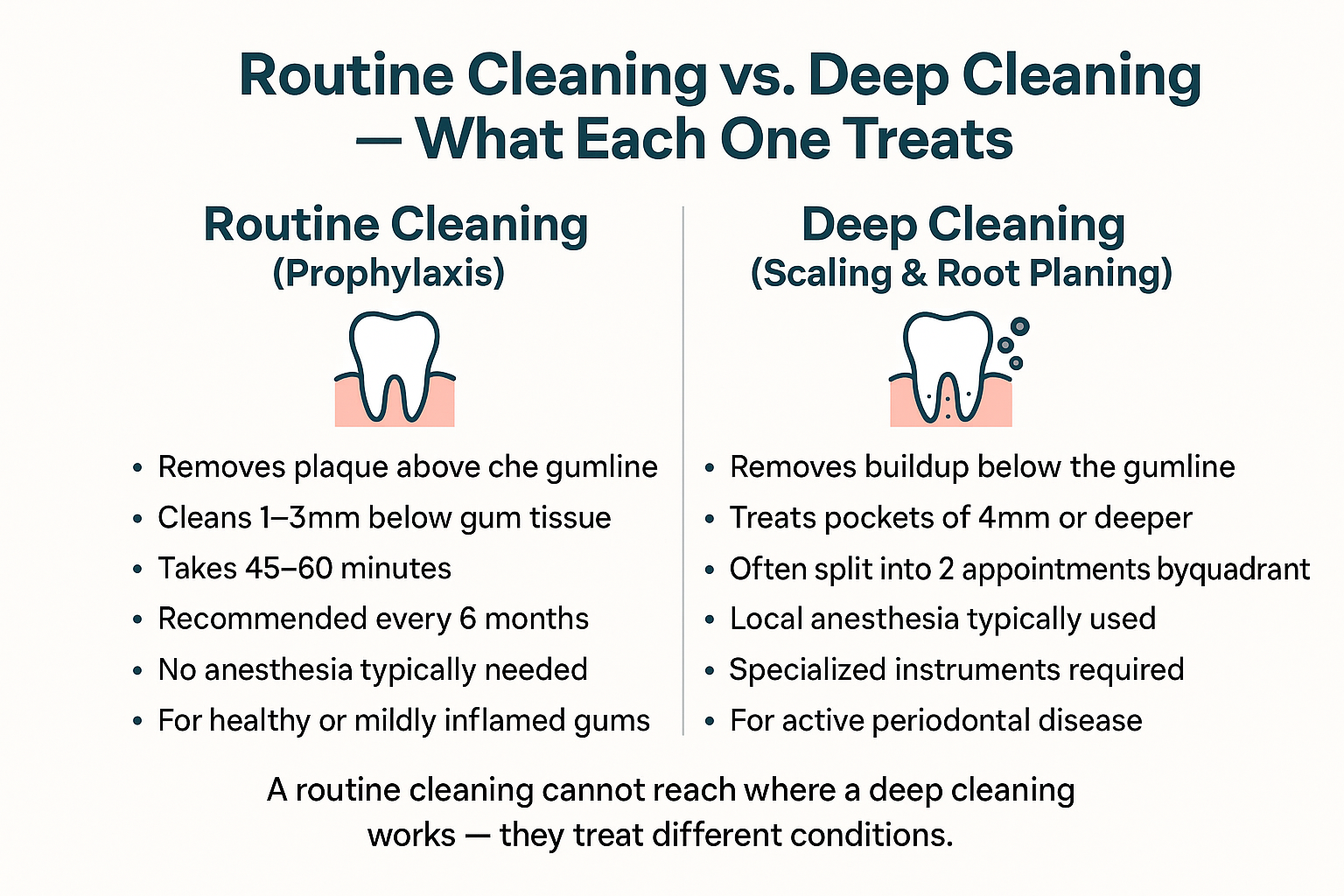
Routine Cleaning vs. Deep Cleaning: What Each One Actually Treats
This side-by-side comparison shows exactly where each procedure works — and why one cannot substitute for the other.
Why the Fee Is Higher — and What It Actually Covers
One of the reasons patients feel like they’re being upsold is that the price jump is significant and nobody explains why. A routine cleaning and a periodontal deep cleaning involve completely different resources, so the cost difference is real and has a clear explanation.
Here’s what the higher fee typically reflects:
- Local anesthesia — scaling and root planing goes below the gumline where tissue is inflamed and sensitive. Numbing is standard, and the anesthetic itself adds time and cost to the appointment.
- Specialized instruments — ultrasonic scalers and hand instruments designed to work in deep pockets are different from what’s used for a routine prophylaxis.
- Appointment time — a thorough deep cleaning is typically divided into two appointments, treating one side of the mouth per visit. Each session runs significantly longer than a routine cleaning.
- Post-treatment follow-up — most providers schedule a re-evaluation 4–6 weeks after treatment to measure whether the pockets have responded. That visit is part of the process.
As for what the procedure costs in the Scottsdale market, fees can vary depending on the number of teeth involved, the severity of the disease, and whether anesthesia is billed separately. It’s worth asking the front desk for a full breakdown with insurance estimated before you schedule, so you go in knowing your out-of-pocket range. Routine dental cleanings and periodontal therapy are billed under different dental codes, which affects how insurance processes the claim.
Routine Cleaning vs. Deep Cleaning at a Glance
This table covers the practical differences patients ask about most — from what’s treated to what the appointment actually looks like.
| Factor | Routine Cleaning | Deep Cleaning (Scaling & Root Planing) |
|---|---|---|
| Who it’s for | Healthy or mildly inflamed gums | Gum pockets of 4mm+ with active disease |
| Where it works | Above and just below the gumline (1–3mm) | Below the gumline into deep pockets (4mm+) |
| Anesthesia | Usually not needed | Local anesthesia is standard |
| Number of visits | One appointment | Typically two — one side per visit |
| Follow-up required | Next cleaning in 6 months | Re-evaluation at 4–6 weeks post-treatment |
| Insurance coverage | Usually covered at 100% preventive | Covered as a periodontal service — varies by plan |
What Happens If You Wait — and What Comfort Options Exist
This is the part that doesn’t always get communicated clearly: periodontal disease is not static. When pockets deepen and bacterial biofilm sits undisturbed below the gumline, the infection continues to work. Bone that supports the tooth starts to erode. A pocket that measures 5mm today can become 7mm or 8mm over a year or two without treatment.
At some point, a condition that was very manageable with a couple of deep cleaning appointments becomes a situation that involves bone loss, tooth mobility, and — in cases where patients wait long enough — tooth loss. That’s not a scare tactic. It’s just what the research on untreated periodontitis consistently shows.
For patients who are anxious about the procedure itself, comfort options have improved significantly. Local anesthesia makes the treatment itself tolerable for most people. One of our own patients left a review specifically noting it was “the first time I’ve ever had a deep cleaning that was enjoyable” — which tells you that the experience can be a lot better than what people expect going in.
If bleeding gums have been bothering you and you’ve been putting off getting them looked at, this article on why bleeding gums aren’t something to wait out explains what’s happening at the tissue level and why earlier treatment consistently leads to better outcomes. And if you want to understand what preventive care looks like beyond just cleanings, that’s a good place to start thinking about your full preventive picture.
How to Tell If the Recommendation Makes Sense for You
If you leave an appointment with a deep cleaning recommendation and you’re not sure whether to trust it, here are the questions worth asking before you decide:
- What are my pocket depth readings? Ask to see the numbers. Any depth of 4mm or greater at multiple sites, particularly with bleeding, supports the recommendation.
- Is there documented bone loss on my X-rays? Bone loss visible on a bitewing or periapical X-ray adds clinical weight to the diagnosis.
- How many teeth or quadrants are involved? A recommendation for one or two isolated deep pockets is a different situation than generalized disease throughout the mouth.
- What happens if I do a regular cleaning first and monitor? In early or borderline cases, some providers are willing to treat and re-evaluate. It’s a fair question to ask.
A provider who is being straight with you will answer all of these questions clearly and show you the data behind the recommendation. If the explanation you get is vague — or if you’re being told you need a deep cleaning but nobody is showing you measurements — it’s completely reasonable to ask for more detail or to get a second opinion.
At our practice, we walk patients through their pocket chart and X-rays before recommending any treatment. The goal is always for you to understand what’s happening in your mouth and why a particular path makes sense — or doesn’t.
Frequently Asked Questions About Deep Cleanings
Can I just ask for a regular cleaning instead of a deep cleaning?
You can, but if your pocket depths are 4mm or greater with active inflammation, a routine cleaning won’t reach the source of the problem. The hygienist may not be able to safely complete a standard prophylaxis when active disease is present — many practices will note this in your chart and recommend you make an informed decision rather than proceed with an inadequate treatment.
Does a deep cleaning hurt?
With local anesthesia, most patients describe the procedure as pressure rather than pain. Some tenderness in the gum tissue for a day or two after is normal, but it’s generally manageable with over-the-counter pain relief. The anxiety around it is usually worse than the actual experience.
Will my insurance cover a deep cleaning?
Most dental insurance plans cover scaling and root planing as a periodontal benefit, but coverage levels vary. Many plans cover 50–80% after the deductible, though the exact amount depends on your plan. The front desk can run a pre-authorization estimate so you know your out-of-pocket cost before you commit.
How often do I need a deep cleaning once I’ve had one?
After completing periodontal therapy, most patients move to a periodontal maintenance schedule — typically every 3 to 4 months instead of the standard 6-month routine cleaning. This is because the pockets that responded to treatment need more frequent monitoring to prevent the bacteria from re-establishing. It’s not a permanent upcharge — it’s what the evidence supports for keeping the disease controlled.
Is it true that almost half of adults over 30 have gum disease?
Yes. CDC data puts the figure at roughly 42% of adults over 30 having some form of periodontitis. It’s one of the most common chronic conditions in adults, and it often has no noticeable symptoms in early stages. Needing treatment is common — not a sign that you’ve been neglecting your oral health.
What’s the difference between scaling and root planing and a regular cleaning code on my insurance?
A routine cleaning is billed under a preventive code (typically D1110 for adults). Scaling and root planing is billed under periodontal codes (D4341 or D4342) per quadrant. These are entirely different benefit categories, which is why they’re processed differently by insurance and why the patient cost looks so different.
Have Questions About Your Gum Health Before Your Next Appointment?
If you’ve been putting off a visit because you’re not sure what to expect — or because a previous recommendation left you with more questions than answers — our team at Trinity Dental Care is happy to walk you through your records and explain exactly what we’re seeing and why. We’re at 10697 N. Frank Lloyd Wright Blvd. in North Scottsdale, and new patients from McCormick Ranch, the Shea Corridor, and surrounding communities are always welcome. Call us at 480-621-4040 or visit trinitydentalcares.com to schedule an exam or ask a question before you book.