
Direct Answer: Whitening lifts stains sitting on the enamel. Discoloration inside the dentin, from injury, certain antibiotics, or thinning enamel, usually will not budge, and needs bonding, veneers, or a crown instead.
You finished the whole box of strips. Or you wore the trays every night for two weeks like the instructions said. Then you stood in the bathroom mirror, tilted your chin up, and the color looked about the same as when you started.
That is one of the more common frustrations I hear from patients across North Scottsdale, and it almost never comes down to the product being too weak. It usually comes down to where the color actually lives inside the tooth.
This article is about that specific situation: whitening barely moved the shade, and what that tells you. I will walk through the difference between surface stain and deep discoloration, what I am checking before I recommend whitening at all, and the honest list of options when whitening is not the right tool.
Surface stain vs. deep discoloration: the whole hinge of this problem
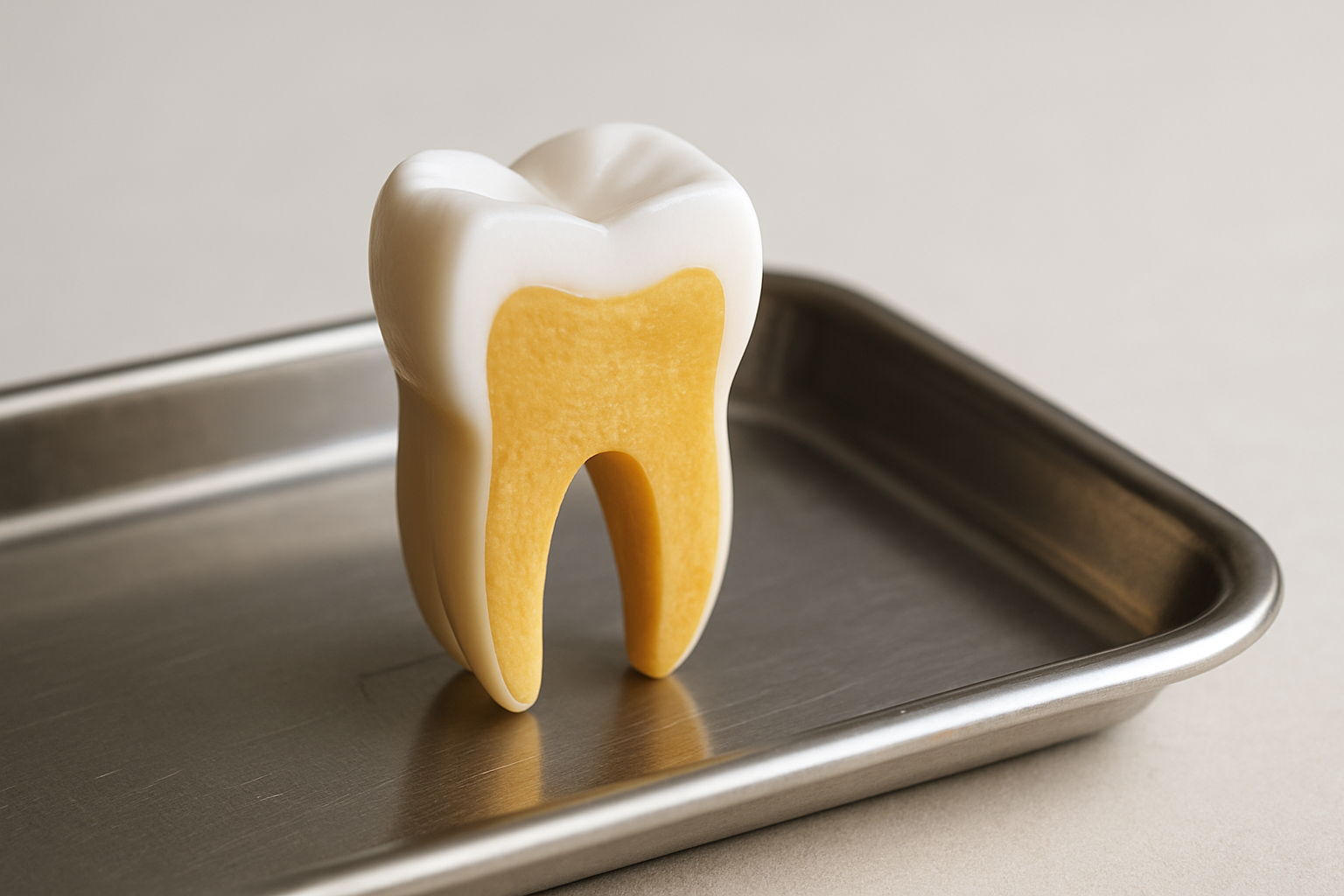
A tooth is not one solid block of white. There is an outer shell of enamel, and underneath it sits dentin, which is naturally more yellow and more gray than the layer covering it.
Surface stain sits on and just inside the enamel. It comes from the ordinary stuff a Scottsdale week is full of:
- Coffee and espresso
- Iced tea, especially the black tea most valley restaurants pour
- Red wine
- Dark sodas and berry-heavy smoothies
- Tobacco of any kind
That kind of staining responds well to professional whitening, because the whitening gel is working right where the color is.
Deep discoloration is a different animal. The color is coming from the dentin underneath, and the enamel over it is simply doing what glass does: showing you what is behind it. External whitening is largely limited to the enamel level. The American Dental Association’s overview of whitening describes removing discoloration that sits inside the dentin with an external product as close to impossible.
So when someone tells me they did three rounds of strips and got nothing, my first thought is not “try a stronger gel.” My first thought is that we are aiming at the wrong layer. If you have already run through the drugstore aisle, this piece on why store-bought strips keep letting people down covers the mechanical side of that in more detail.
Where deep discoloration usually comes from
Deep color changes tend to trace back to something that happened to the tooth, not to something you drank last month. The usual sources:
- Certain childhood antibiotics, most famously tetracycline, taken while adult teeth were still forming. This can leave banded gray or brown color that runs through the dentin.
- Too much fluoride during development, which can produce chalky white spots or mottled brown areas baked into the enamel itself.
- An old injury to one tooth. A hit to a front tooth years ago can damage the nerve, and the tooth slowly darkens from the inside out. Sometimes it takes five or ten years to show.
- Enamel thinning with age. Enamel wears down over decades. As it gets thinner, more of that yellower dentin reads through, which is why a lot of people notice their smile dulled without ever changing their habits.
- Old restorations. A large silver filling can cast a gray shadow through the surrounding tooth structure.
The pattern matters more than the shade. Blotchy, banded, or one-tooth-only discoloration points toward something structural. A whole smile that has drifted a couple of shades over 20 years is far more likely to be surface staining plus enamel wear, and that mix often responds nicely to professional whitening.
What I am actually looking at before I recommend whitening
Nobody explains this part, so I will. Before whitening comes up as an option, I want to know what I am looking at, because whitening a mouth that is not ready for it can turn a cosmetic visit into a painful one.
Here is what the exam is checking:
- Is one tooth darker than its neighbors? That is a different conversation entirely. A single dark front tooth usually points to nerve trauma rather than staining, and no amount of external whitening will fix it.
- Untreated decay. Whitening gel finding its way into a cavity is a bad afternoon.
- Cracks and worn edges, which can let the gel reach places it should not.
- Exposed root surfaces. Root surfaces do not whiten the way enamel does, and they are far more likely to get sensitive.
- Gum inflammation. Irritated tissue plus peroxide is an unpleasant combination, and healthy gums are the foundation everything cosmetic sits on anyway.
- Existing crowns, veneers, and tooth-colored fillings, since those hold their original shade no matter what you do. Our full explanation of whitening with crowns and fillings goes deeper on that.
One of our reviewers put the approach better than I can: “Dr. Fink is friendly, on time, and does a great job explaining potential issues/concerns and provides options.” That is the point of the exam. Not a single verdict, but a clear read on which category you are in.
Surface Stain or Deep Stain? A Quick Read
This breakdown shows the two categories side by side, and what each one typically means for your options.
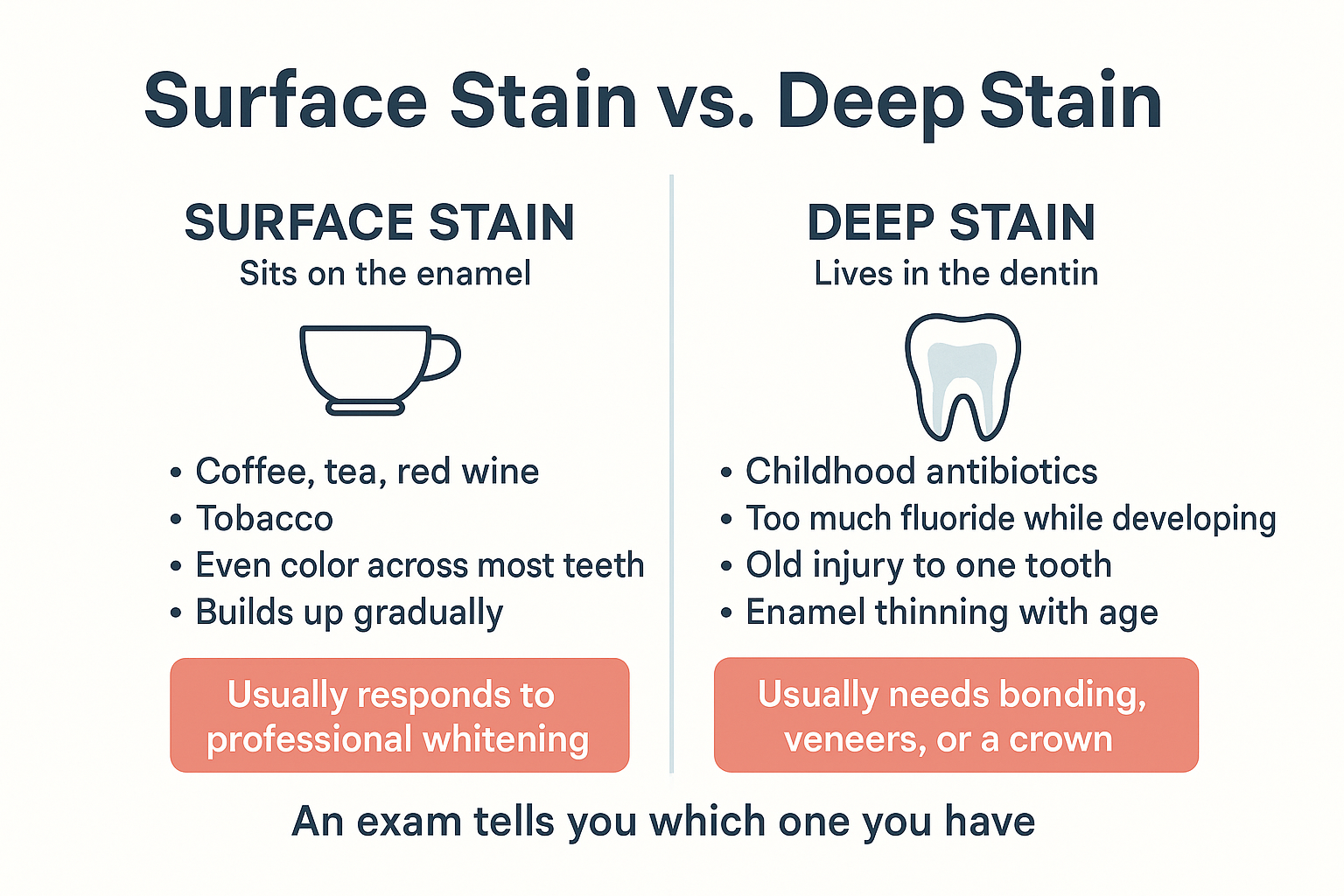
How Different Stains Typically Respond
This is a general guide, not a diagnosis. Your own pattern gets sorted out at the exam.
| What you see | Likely source | How it usually responds to whitening |
|---|---|---|
| Even yellowing across all teeth | Coffee, tea, wine, tobacco, age | Responds well in most cases |
| One front tooth noticeably darker | Old nerve trauma from an injury | Little to no change |
| Gray or brown horizontal banding | Antibiotics during tooth development | Minimal change, often uneven |
| Chalky white or mottled brown spots | Excess fluoride while teeth formed | Can look more obvious afterward |
| Gray shadow around an old filling | Metal restoration showing through | No change to the shadowed area |
| Dull, slightly translucent edges | Enamel wearing thin over decades | Partial improvement at best |
What the options look like when whitening is not the answer
I like to keep this list in order from least invasive to most, because the conservative option is often enough.
Bonding. A small dark spot or a single chipped, discolored area on one front tooth can often be handled with tooth-colored composite shaped and polished right in the chair. It is the least invasive of the group and typically done in one visit.
Porcelain veneers. When discoloration runs across the whole front of your smile and will not lift, this is where veneers come into the conversation. Thin custom porcelain shells bond to the front of the teeth and cover the color entirely. This is a multi-visit process with lab time in between.
A crown. If a tooth is discolored and structurally compromised, heavily filled, cracked, or worn down, we are no longer in a cosmetic conversation. A crown rebuilds the tooth and restores the color at the same time. If you want the material side of that decision, here is how crown material actually gets chosen.
The distinction most Scottsdale dental sites blur is worth naming plainly. Cosmetic work changes how a tooth looks. Restorative work rebuilds what the tooth is made of. A veneer sitting on a cracked, failing tooth is a short-term answer to a long-term problem, and I would rather tell you that up front than after the lab bill.
It is also completely fine to fix one thing and leave the rest alone. You do not have to fix everything to like your smile again.
Timing, photos, and what actually moves the cost
Scottsdale runs a heavy calendar. Weddings, reunions, family visiting for the season, travel photos. Most of the whitening questions I get come in a few weeks before someone knows they will be in front of a camera.
Here is where knowing your category early protects you. Surface staining can improve on a short timeline, and in-office whitening is a single appointment. A plan built around veneers or bonding is a sequence of visits with lab time sitting in the middle of it, which cannot be compressed by wanting it more.
So the useful move is not booking the whitening. It is booking the look. Patients around the Shea Corridor, McCormick Ranch, and the neighborhoods off Frank Lloyd Wright Blvd who come in two to three months ahead have every option open to them. Patients who come in ten days ahead have one.
On cost, I am not going to throw a number at you, because the honest answer is that it depends on three things:
- The shade evaluation. How far the color has to move, and whether it can move at all.
- How many teeth are involved. One tooth and eight teeth are very different plans.
- Whether lab-made restorations are part of it. Anything fabricated outside the office carries a real material and lab cost that in-chair treatment does not.
An exam with an itemized estimate is where a real number comes from. Insurance also treats cosmetic and restorative work very differently, which is another reason the category question matters before the price question.
Frequently Asked Questions About Stains Whitening Won’t Fix
I did three rounds of trays and saw almost nothing. Should I try a stronger gel?
Probably not. If professional-strength gel over multiple rounds did not move the shade, the issue is usually where the color is, not how strong the product is. More rounds mostly buys you sensitivity. That is the point to get an exam and find out whether you are dealing with dentin-level discoloration.
Why is just one of my front teeth darker than the others?
That pattern usually points to nerve trauma rather than staining, often from an injury years earlier that seemed minor at the time. The tooth darkens from the inside out, sometimes slowly enough that you only notice it in photos. External whitening will not reach it, so the plan is a different conversation entirely.
Will whitening make my white spots look worse?
Sometimes, at least temporarily. Chalky white spots from fluoride during development can become more noticeable right after whitening, because the surrounding enamel lightens at a different rate. Some of that evens out over the following weeks, some of it does not. It is worth discussing before you start rather than after.
Is there any way to whiten a tooth from the inside?
For a single tooth that has already had root canal treatment, internal bleaching is a recognized approach in dentistry. Whether it fits your situation depends on the condition of that specific tooth, so it is an exam question, not a website question.
How do I know if I need bonding or veneers?
Roughly speaking, bonding handles a small, localized problem on one or two teeth, and veneers handle color and shape across the front of your smile. Cost, number of visits, and how much tooth structure gets prepared all differ. An exam with photos sorts it out fast.
Still Not Sure Which Kind of Stain You Have?
Our office is on N. Frank Lloyd Wright Blvd in North Scottsdale, and Dr. Fink handles the shade evaluation and the plan herself rather than passing patients between rotating providers, which matters a great deal for color matching and for knowing when to hold off on cosmetic work. Reviewers here tend to mention being given options and explanations rather than a single recommendation, which is reflected in our 4.93 average across more than 100 Google reviews. If you are weighing whitening against bonding, veneers, or something restorative, the team can be reached at 480-621-4040 or at trinitydentalcares.com.