
Direct Answer: Most people only need one or two targeted changes — whitening, a crown, or veneers — to feel genuinely good about their smile again. A full overhaul is rarely necessary.
A lot of people in North Scottsdale spend years telling themselves their smile isn’t worth fixing — not because it’s hopeless, but because the idea of fixing it feels overwhelming. They picture months of appointments, a big treatment plan, and a bill that rivals a car payment. So they wait. And the longer they wait, the more they convince themselves they’ve let it go too far.
But most of the time, that’s not the reality. When patients finally sit down with Dr. Fink and talk honestly about what’s bothering them, it usually comes down to one or two specific things — a discolored tooth, a cracked crown, a gap that’s been there since high school. And those things? They’re often very fixable without touching anything else.
This article is for anyone who’s been putting off a dental visit because they think they need to fix everything before they can feel good about their smile. You probably don’t. Here’s how to think through what actually matters — and what you can realistically do about it.
Start With What’s Actually Bothering You
Before talking about treatments, it helps to get honest about the problem. Not in a clinical way — just in a human way. What is the one thing you’d change if you could?
For most people, it’s one of these:
- Staining or yellowing from years of coffee, wine, or just time
- A chipped or cracked tooth that catches your eye every time you smile in photos
- One tooth that looks off — slightly shorter, darker, or shaped differently than the rest
- A gap that’s been there for years but has started bothering you more lately
- An old filling or crown that’s turned gray or doesn’t match anymore
This list matters because each of these has a direct, targeted solution. You don’t need to rebuild your entire smile to fix one dark tooth or one worn edge.
When you come in for a consultation, we start exactly here — with what’s bothering you most, not with a treatment menu. Understanding the difference between a cosmetic touch-up and a real smile transformation can help you set realistic expectations before you even walk through the door.

What a Small Change Can Actually Do
People underestimate the visual impact of one well-placed change. A single tooth that’s significantly darker than the rest pulls attention every time you open your mouth. Fix that one tooth — through whitening, a new crown, or a veneer — and your whole smile looks more balanced.
Professional teeth whitening is often the first place to start because it’s the lowest-commitment option with real, visible results. Done in-office, most patients see a change of 4 to 8 shades in a single visit. And because it lifts color across all your teeth at once, it creates an immediate sense of uniformity. If you’ve been wondering how long professional teeth whitening actually lasts, the honest answer is 1 to 3 years depending on your habits — which is a much longer runway than most people expect.
For a chipped or cracked tooth, a porcelain crown or a veneer can restore the shape and color of a single tooth without touching anything around it. Crowns are typically the right call when the tooth has structural damage; veneers work well when the tooth is healthy but cosmetically off. If you’ve been going back and forth on whether a crown is even the right move, this guide on crowns vs. fillings breaks down when each one makes sense.
The takeaway: one targeted change, done well, can shift how you feel about your whole smile — without touching what’s already working.
Common Smile Concerns and the Most Direct Fix
Every concern on this list has a targeted solution. This is a starting point for your own thinking — not a prescription.
| What’s Bothering You | Most Direct Solution | Typical Timeframe |
|---|---|---|
| General yellowing or staining | In-office professional whitening | 1 appointment |
| One noticeably darker tooth | Crown or veneer on that tooth only | 2–3 appointments |
| Chipped or worn tooth edge | Bonding or porcelain veneer | 1–2 appointments |
| Old gray or visible filling | Tooth-colored composite filling or crown | 1–2 appointments |
| A gap between front teeth | Porcelain veneers or bonding | 2–3 appointments |
| Cracked crown that looks dark | Crown replacement with tooth-colored material | 2 appointments |
When You’ve Been Putting It Off Because of Cost
Cost is the most common reason patients in the McCormick Ranch and Shea Corridor areas delay dental care. And it’s a completely understandable reason. But the financial reality of partial cosmetic work is often much more manageable than people assume.
A single porcelain veneer in the Scottsdale area typically runs $900 to $1,400. A professional whitening session runs $300 to $600 depending on the method. These aren’t cheap, but they’re not the $15,000–$25,000 full-mouth rehabilitation that people sometimes imagine when they think “cosmetic dentistry.”
And many restorative services — like crowns and tooth-colored fillings — are partially covered by dental insurance, which drops the out-of-pocket number considerably. The key is knowing what you’re actually dealing with before making any assumptions about cost.
If fear around cost has kept you away from the dentist, the most useful thing you can do is schedule a consultation to get real numbers — not estimates based on worst-case scenarios you’ve read online. We’d rather give you an honest picture of what something costs than have you avoid care for years because of a number you guessed at.
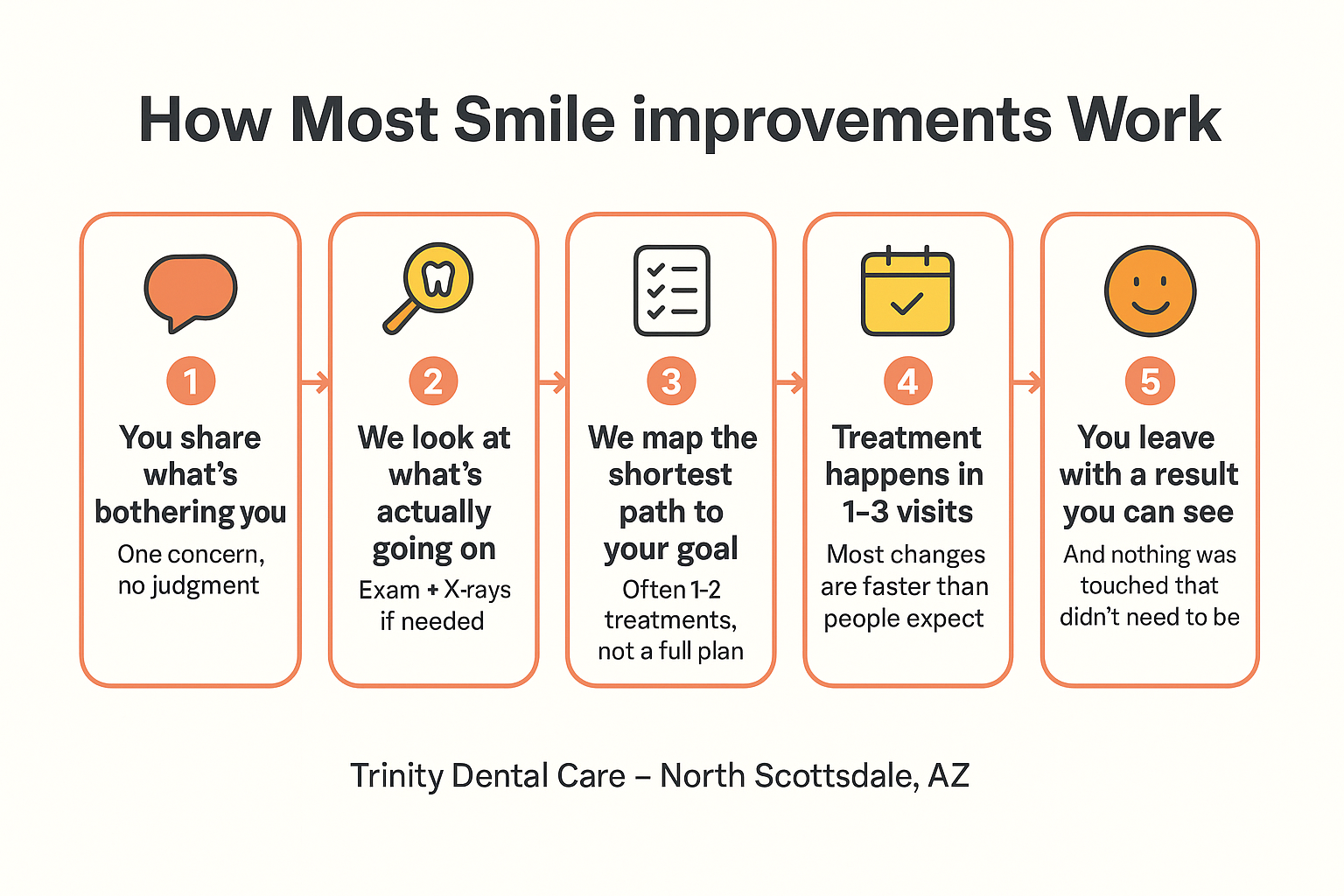
How Most Smile Improvements Actually Work
This infographic walks through the typical path from first concern to finished result — so you know what to expect at each step.
What If There’s an Underlying Problem You’ve Been Ignoring?
Sometimes what looks like a cosmetic issue is actually a sign of something that needs attention first. A tooth that keeps looking darker might have a dying nerve. A chip that keeps happening might mean your bite is off. And gum tissue that’s receding can change how your teeth look even when the teeth themselves are fine.
This is one place where getting an actual exam — rather than just researching online — makes a real difference. Cosmetic work done on top of an unaddressed problem doesn’t hold up the way it should, and it can end up costing more in the long run.
We’re not going to find a problem and then talk you into fixing ten things you weren’t worried about. But if there’s something that genuinely needs to be addressed before we do the cosmetic part you came in for, we’ll tell you clearly — and explain why the order matters. Gum health is one of those things that often gets overlooked until it becomes visible. If your gums have been bleeding or pulling back, that’s worth mentioning when you come in.
And if the problem turns out to be deeper — a missing tooth, not just a chipped one — we can talk through tooth replacement options that still don’t require rebuilding everything at once.
Frequently Asked Questions About Partial Smile Improvements
Can I whiten just a few teeth instead of all of them?
Professional whitening works across all your teeth at once — it’s not applied tooth by tooth. But if one tooth is noticeably darker than the rest, it often won’t respond the same way to whitening because the discoloration comes from inside the tooth, not the surface. In that case, a crown or veneer on that single tooth is usually the better path. We can tell you which situation you’re dealing with after a quick look.
What if I’ve been embarrassed about my smile for years — is it too late to fix it?
Almost never. Most people who’ve been carrying this kind of embarrassment for a long time are surprised by how straightforward the solution turns out to be. Smiles people have been embarrassed about for years are fixed in this office regularly — and the treatment is rarely as involved as the years of worry made it seem.
Do I have to get veneers to get a noticeable result?
No. Veneers are one option, not the only option. For a lot of patients, professional whitening alone produces a result they’re genuinely happy with. For others, fixing one damaged or discolored tooth with a crown does the job. Veneers make the most sense when you want to change the shape, size, or alignment of multiple teeth at once — which is a different goal.
How do I know if my old fillings or crowns need to be replaced?
Old metal fillings and older porcelain crowns can darken over time, and they can also fail structurally without obvious symptoms. If a filling or crown is more than 10–15 years old, it’s worth having it evaluated. Visible gray shadowing around a tooth, sensitivity, or a crown that looks obviously different from your natural teeth are all signs worth checking out. We cover this more in our guide on broken tooth fillings.
How long does it take to see results from cosmetic dental work?
For whitening, you’ll see results the same day. For a veneer or crown, the process typically takes 2 to 3 appointments spread over 2 to 4 weeks. Most cosmetic changes at this scale don’t require a long treatment timeline — the waiting is usually just the lab time between appointments.
Will cosmetic work look fake or obvious?
When it’s done well, no. Modern porcelain veneers and crowns are matched to the color, translucency, and texture of your surrounding teeth. The goal is always a natural-looking result — not a wall of perfectly uniform white that looks like a TV smile unless that’s specifically what you’re going for.
Ready to Find Out What One Change Could Do?
If you’ve been sitting with a smile concern for months — or years — and you’re not sure where to even start, a conversation is the right first step. Dr. Fink and our team at Trinity Dental Care work with patients across North Scottsdale, from Montana Ranch to the Shea Corridor, who came in not sure what they needed and left with a clear, manageable plan. Call us at 480-621-4040 or visit trinitydentalcares.com to schedule a consultation and find out what’s actually possible for your smile.