
Direct Answer: Store-bought whitening strips use low-concentration peroxide that can’t reach deep stains. Professional whitening uses stronger, dentist-controlled formulas that work in a single visit.
You bought the strips. You followed the directions — sometimes twice. And a few weeks later, your teeth look maybe slightly less yellow, or not much different at all. For a lot of North Scottsdale patients, this is a cycle they’ve repeated two or three times before finally asking what’s actually going on.
The problem isn’t that you did something wrong. Store-bought whitening strips are simply not designed to tackle the kind of staining that builds up over years of coffee, red wine, and everyday life in the Arizona heat. They’re a surface-level product sold as a real solution — and there’s a meaningful difference between the two.
This article breaks down exactly why strips underperform, what professional whitening actually does differently, and how to figure out which option is right for your specific situation.
The Real Reason Whitening Strips Don’t Work Like the Box Says
Every whitening product — strip, gel, or in-office treatment — depends on peroxide to break up stain molecules in your enamel. The gap between a drugstore strip and a professional treatment comes down to one thing: how much peroxide is in the formula and how long it stays in contact with your tooth surface.
Over-the-counter strips sold at places like Walgreens or Target are capped at around 6% hydrogen peroxide by FDA guidelines for consumer products. Professional whitening systems used in dental offices typically work at 25% to 40% hydrogen peroxide, applied in a controlled setting where your gums are protected.
That difference in concentration matters a lot. Lower-strength peroxide can lift surface discoloration — the light staining from a few weeks of coffee. But stains that have worked their way deeper into the enamel structure, or stains that are years old, need a stronger agent and more contact time than a strip can deliver.
There’s also a fit problem. Strips are made for a generic mouth, not yours. They don’t press evenly against every tooth surface, which means you often get uneven whitening — brighter in some spots, unchanged in others. A custom-fitted tray from a dental office eliminates this completely because the gel sits uniformly against every tooth.
Why Some Stains Will Never Respond to Strips — No Matter How Long You Use Them
Not all tooth discoloration comes from the outside. That’s the part most people don’t know until they’ve wasted a few months on strips that went nowhere.
Dentists classify tooth staining into two categories:
- Extrinsic staining — surface stains from food, drinks, and tobacco that sit on or just under the outer layer of enamel
- Intrinsic staining — discoloration that originates inside the tooth itself, from aging, old trauma, certain antibiotics like tetracycline, or excessive fluoride exposure during development
Whitening strips work on extrinsic stains only. If your discoloration is intrinsic — meaning the darkness is coming from within the tooth — no amount of peroxide applied to the outside surface will change what you see.
For intrinsic staining, the right answer is usually a cosmetic treatment like veneers or another restorative option. It’s worth getting a professional opinion before spending more money on products that aren’t built for what you’re dealing with.
Many patients who come to us after repeated strip failures are dealing with a mix of both — some extrinsic buildup combined with underlying discoloration that’s been there for years. Professional whitening can address the extrinsic layer effectively, and a dentist can then tell you honestly whether the remaining color is intrinsic and what your real options are.
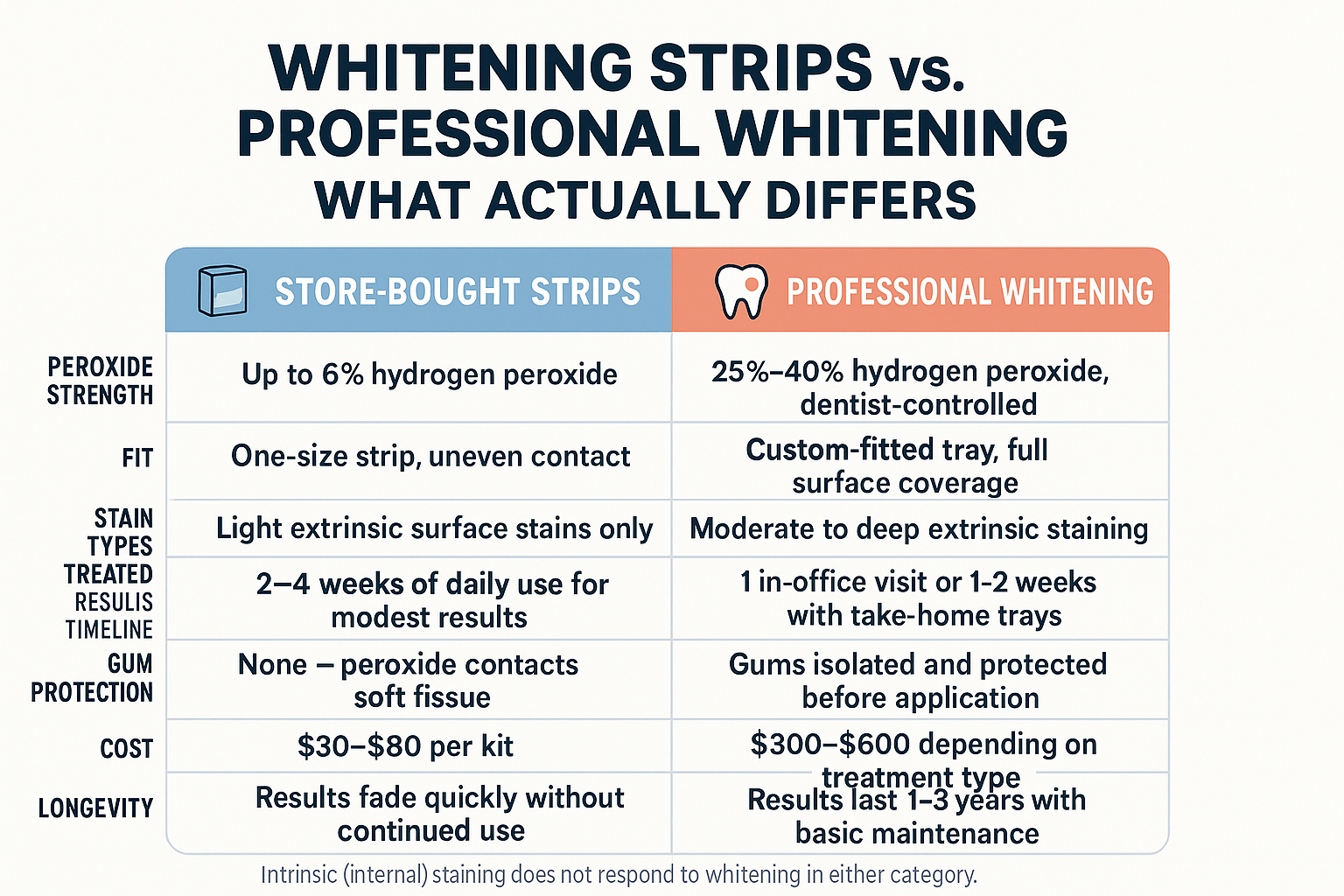
Store-Bought Strips vs. Professional Whitening: How They Compare
This breakdown shows the key differences between over-the-counter whitening strips and professional whitening — so you know exactly what you’re getting with each option.
Cost vs. Results: What You’re Actually Paying For
When you add up repeated strip purchases over a year versus a single professional whitening treatment, the math is closer than most people expect — and the results are not.
| Option | Average Cost | Results Timeline | Longevity |
|---|---|---|---|
| OTC Whitening Strips (per kit) | $30–$80 | 2–4 weeks of daily use | Fades in weeks to months |
| OTC Strips (annual spend, typical user) | $120–$300+ | Ongoing / inconsistent | Requires constant upkeep |
| Professional Take-Home Trays | $300–$450 | 1–2 weeks | 1–2 years with maintenance |
| In-Office Professional Whitening | $400–$600 | Single 60–90 minute visit | 1–3 years with maintenance |
| Whitening with Veneers (for intrinsic staining) | $900–$2,500+ per tooth | 2–3 appointments | 10–20 years |
The Sensitivity Problem That Strips Don’t Warn You About
One of the most common complaints we hear from patients who’ve used whitening strips is that their teeth became sensitive — sometimes uncomfortably so — and they weren’t sure whether to keep going or stop.
Strips leave peroxide in contact with your gum tissue and enamel without any barrier. Over time, repeated exposure can temporarily open up tiny channels in the enamel called dentinal tubules, which connect to the nerve of the tooth. When those are exposed, cold air and cold drinks hit the nerve much more directly.
If you’re already prone to sensitivity, you can read more about what causes that in our article on tooth sensitive to cold but not hot — because whitening is one of the triggers that can bring it on or make it worse.
Professional whitening isn’t without any sensitivity risk either. But there are real differences:
- A dentist can apply a desensitizing agent before and after treatment
- Your gums are physically protected with a barrier so peroxide doesn’t contact soft tissue
- The process is monitored — if your teeth are reacting, someone catches it
- Post-treatment recommendations are tailored to your mouth specifically
For most patients, any sensitivity from professional whitening is mild and resolves within 24 to 48 hours. With strips, sensitivity can linger for days because there’s no way to control the exposure.
When Whitening Isn’t the Right Starting Point
Before whitening can work well — professionally or otherwise — your teeth and gums need to be in a healthy baseline condition. This is something strip packaging will never tell you.
Active cavities, gum disease, or significant plaque buildup can all reduce whitening effectiveness and, in some cases, cause pain when peroxide reaches a compromised tooth surface. That’s one reason routine dental cleanings matter as a first step before any whitening treatment — they remove surface buildup that would otherwise block the whitening agent from reaching enamel.
If you have older dental work — crowns, fillings, veneers — those don’t whiten. Peroxide only affects natural tooth structure, so whitening your surrounding teeth can create a visible mismatch with existing restorations. A dentist can map this out for you before you start, so you’re not surprised by uneven results.
For patients who’ve been putting off care and are now looking at a bigger picture — staining plus chips plus old restorations — it’s worth reading about what a real smile transformation actually involves before narrowing in on whitening alone. Sometimes whitening is one piece of a larger plan, not the whole answer.
Frequently Asked Questions About Teeth Whitening
How many shades can professional whitening actually lift?
Most patients see a lift of 6 to 10 shades with professional in-office whitening. Take-home trays typically deliver 4 to 8 shades over one to two weeks. Results vary based on your starting shade and the nature of your staining — someone with deep, long-standing stains may see less dramatic results than someone with lighter, more recent discoloration. Your dentist can give you a realistic expectation at a consultation before you commit.
Is professional whitening safe for sensitive teeth?
Yes, with the right preparation. A dentist can apply a desensitizing treatment before whitening and recommend a lower-concentration formula if your sensitivity is significant. Many patients with mild to moderate sensitivity do fine with professional whitening — the key is that someone is actually monitoring the process and adjusting based on how your teeth respond.
Can I use whitening strips after professional whitening to maintain results?
You can, but prescription-strength take-home trays from your dentist are a much better maintenance tool. They use the same custom-fit tray from your original treatment, they cover all tooth surfaces evenly, and the formula is stronger than anything available over the counter. If you’re going to spend money maintaining your results, you’ll get more out of a professional touch-up kit than a repeat drugstore purchase.
Why did my teeth go yellow again so fast after whitening?
Your enamel is slightly more porous immediately after whitening, which makes it more vulnerable to staining from coffee, tea, red wine, and dark foods during the first 48 hours. Skipping those items right after treatment makes a real difference in how long your results last. Beyond that initial window, regular cleanings and moderate consumption of staining foods and drinks will extend your results significantly.
What if whitening doesn’t work on my teeth at all?
If your discoloration is intrinsic — coming from inside the tooth rather than the surface — whitening won’t change it, no matter how strong the formula. In those cases, options like veneers are worth exploring. A dentist can tell you during a simple exam whether your staining is extrinsic or intrinsic, which saves you from spending money on whitening that was never going to work for your specific situation.
Ready to Find Out What Would Actually Work for Your Teeth?
If you’ve been stuck in the strip cycle and not seeing the results you want, a quick conversation with our team can save you a lot of time and money. At Trinity Dental Care, we take a look at what’s actually causing your discoloration before recommending any whitening path — because the right treatment depends on your specific teeth, not a generic one-size approach. Call us at 480-621-4040 or visit trinitydentalcares.com to schedule a consultation with Dr. Fink and get a straight answer about what whitening can realistically do for your smile.