
Direct Answer: After a long gap, the first visit is usually an exam, not a cleaning: digital X-rays, a look at old fillings and crowns, an oral cancer screening, and gum measurements that decide what cleaning fits.
I have watched people sit in the parking lot off Frank Lloyd Wright Blvd for ten minutes before they come in. They are not afraid of the cleaning. They are bracing for a number and a lecture about the years they skipped.
If that is you, you are in large company. ADA News reported on a 2025 JADA study of just over 1,000 U.S. adults that found roughly 73% report fear of going to the dentist. Avoiding care for years is ordinary, not shameful.
So let me skip the pep talk and give you the useful part. Here is what a first dental visit after years without a dentist actually covers, how a long list of findings gets sorted, and the questions that tell you whether a treatment plan is honest.
Why the First Visit Back Usually Is Not a Cleaning
This surprises people more than anything else. You booked a cleaning, and the first appointment turns out to be an exam with a cleaning as a maybe.
There is a practical reason. After a gap of five or ten years, nobody knows yet what is under the gumline, and your gums decide which kind of cleaning is appropriate in the first place.
A first visit back typically includes:
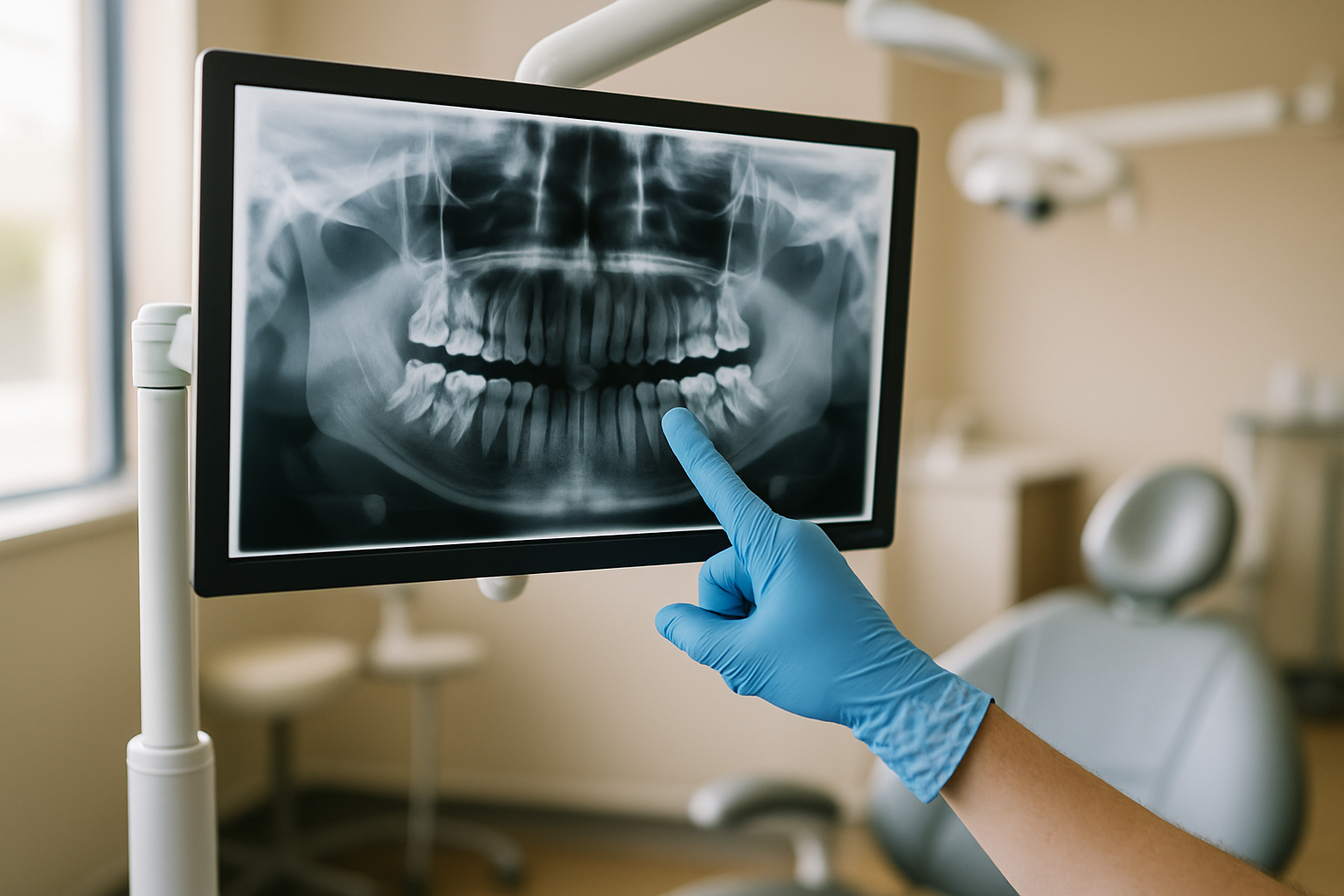
- Digital X-rays, because decay between teeth and problems at the root tip do not show up by looking
- A review of existing fillings, crowns, and old dental work, which is where failures usually start after a long stretch
- An oral cancer screening, a quick check of the tongue, cheeks, floor of the mouth, and neck
- Gum measurements around every tooth, recorded in millimeters at six points per tooth
- A conversation about what you have noticed yourself, like sensitivity, bleeding, or a tooth that feels different
Those gum numbers do the real work. Readings in the healthy range often mean you get cleaned the same day and walk out with the thing you came for.
Deeper pockets with bleeding point toward a different kind of cleaning that gets scheduled separately, sometimes in two visits. If you want the full breakdown of why that happens, we covered the difference between a deep cleaning and a regular cleaning in plain terms.
A Long List of Findings Gets Sorted, Not Stacked
Here is where most of the parking lot anxiety actually lives. You are afraid of hearing that eleven things are wrong and feeling like all eleven need to happen next Tuesday.
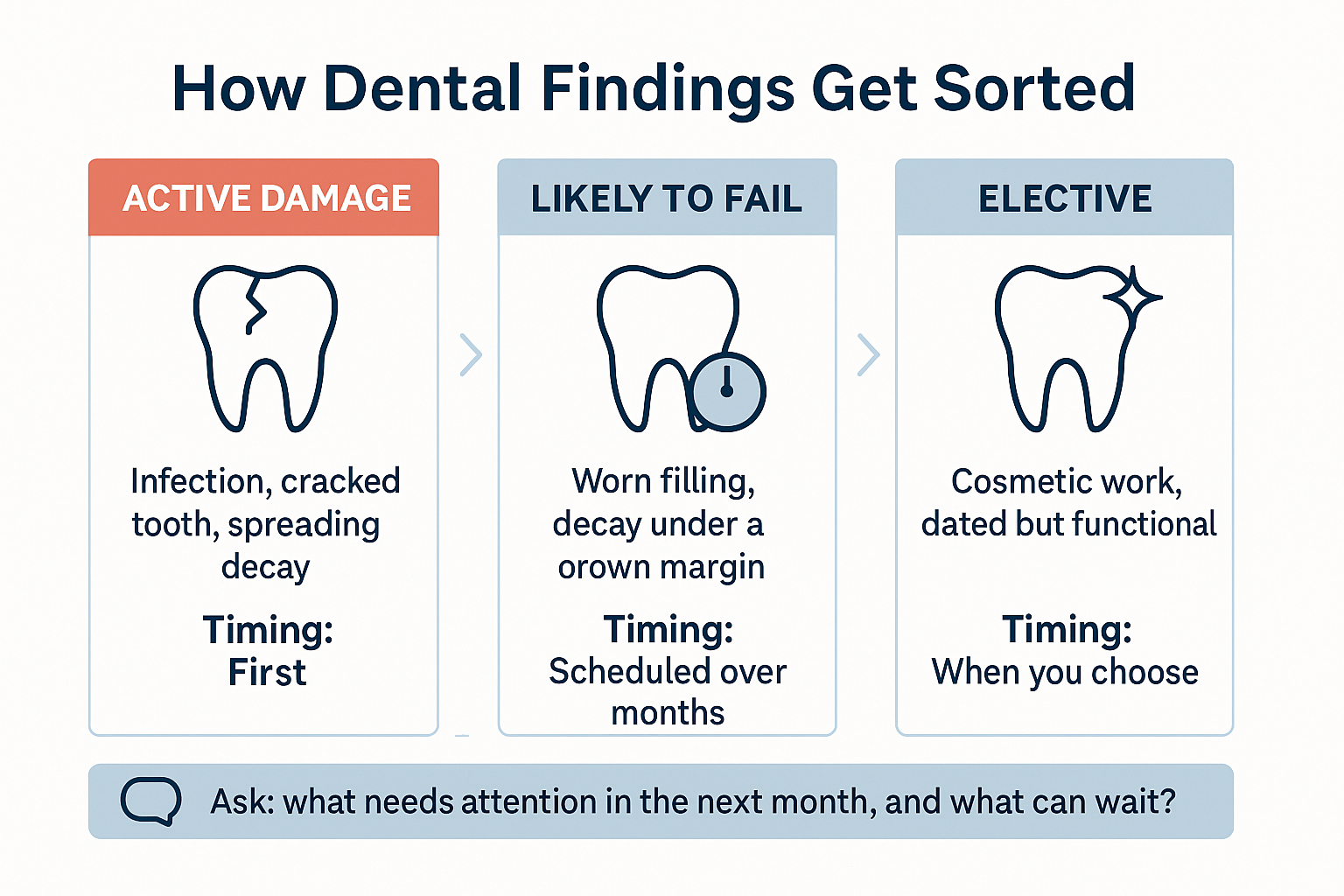
That is not how any reasonable treatment plan works. When I look at a long list, I am putting every item into one of three buckets:
- Active damage. Infection, a cracked tooth, decay that is spreading. This moves first.
- Likely to fail within a year. A worn filling with a hairline crack, a crown with decay creeping under the margin. This gets scheduled, not rushed.
- Elective. Cosmetic work, replacing something that looks dated but functions fine. This waits as long as you want it to.
Most people leave that first appointment having done nothing more than an exam and possibly a cleaning. The rest gets phased out over months, often around how your benefits renew.
You can ask for that sequence out loud, and I would rather you did. Try this exact wording: “What needs attention in the next month, and what can we watch until my next checkup?”
A good answer sounds like a plan with dates on it. A vague answer is worth a follow-up question.
How Findings Get Triaged After a Long Gap
This is the mental sort happening while we review your X-rays and gum chart together.
Is This a Real Finding or a Sales Pitch?
Nobody asks this out loud, and almost everybody is thinking it. You have been away for years, you get handed a plan with a long total at the bottom, and some part of your brain says this feels convenient.
I would rather you test it than quietly decide not to come back. There are concrete ways to do that.
- Ask to see it. Request the X-ray or the intraoral photo of the specific tooth, on the screen, right then. A real finding is visible and a dentist can point at it.
- Ask what happens if you wait. “If I do nothing for six months, what changes?” An honest answer is sometimes “probably nothing” and sometimes “this gets more expensive.”
- Ask which items are structural and which are cosmetic. Those are different categories and should never be blended into one number.
- Ask for the plan in writing with each item priced separately rather than as one lump sum.
A dentist who welcomes those questions is the whole point. I have had patients come in specifically for a second opinion on a crown or treatment plan from somewhere else, and that is a perfectly healthy thing to do.
For what it is worth, one of our Scottsdale patients put it this way in a review: “The dentist can give me anxiety, but everyone here made sure I was comfortable, and went above and beyond!” That is the bar.
The Phone Call That Decides Whether the Appointment Happens
Plenty of people never book because of friction that has nothing to do with teeth. Our front desk hears the same three things constantly, and all three are solvable before you ever commit to a date.
Get your benefits verified on the first call, not at check-in. Callers regularly name a specific plan, Delta Dental, Cigna, MetLife, BCBS Federal and similar, and ask whether it is accepted. Any office can run that check while you are on the phone, and you should ask them to.
Ask about transferring recent X-rays. If you were seen somewhere in the last year or two, the front desk can request those images directly from the prior office. That sometimes trims what you need taken on day one.
Pay attention to the calendar. Most dental plans cap what they pay out each year, commonly somewhere in the range of $1,000 to $2,000 depending on the plan, and unused benefits do not roll over. A plan started in October is funded very differently than the same plan started in January, which is why December gets crowded every year.
And if you have no insurance at all, ask what membership or in-house plan options exist before you assume the door is closed. Many Scottsdale offices have one, and paying out of pocket looks different than most people expect.
What to Ask, and When to Ask It
A quick reference for the three moments where asking one question saves you a lot of guessing.
| When | What to Ask | Why It Matters |
|---|---|---|
| On the booking call | Can you verify my plan and tell me what the first visit costs? | Removes the money unknown before you commit to a date |
| On the booking call | Can you request my X-rays from my old office? | May reduce imaging needed on day one |
| During the exam | Can I see the X-ray or photo of that tooth? | Turns a finding you have to trust into one you can see |
| During the exam | What happens if I wait six months on this? | Separates urgent from watchable |
| Before you leave | What needs attention this month versus at my next checkup? | Gives you a phased plan instead of one overwhelming total |
| Before you leave | Which items are structural and which are cosmetic? | Keeps optional work from getting bundled with necessary work |
What Changes When You Are Not Starting Over Every Visit
One more thing worth knowing if the reason you stopped going was never finding someone you trusted.
We are a single dentist practice in North Scottsdale led by Dr. Christine Fink. That means you see the same dentist and the same hygienist visit after visit instead of whoever happens to be on the schedule that week.
After a long gap, that continuity matters more than usual. The person who watched that small spot last spring is the person deciding whether it has changed this spring.
If dread is the main thing standing between you and a date on the calendar, there are practical things you can do before the appointment that help more than willpower does.
Frequently Asked Questions About Going Back After Years Away
Will I get judged for how long it has been?
No. Long gaps are common, and honestly the reasons behind them are usually fear, cost, or never clicking with a dentist. None of that is a character flaw, and shaming someone has never once made their teeth better.
How long should I block out for the first appointment?
Plan on about 60 to 90 minutes. X-rays, the exam, gum measurements, and a real conversation about findings take time, and if your gums are healthy enough for a same-day cleaning, that gets added on top.
Can I get the cleaning done on the same day?
Often yes, if your gum measurements come back in the healthy range. If the readings show deeper pockets with bleeding, a different kind of cleaning is the right call and that gets scheduled on its own. We wrote more about whether a deep cleaning is genuinely needed if that recommendation comes up.
Do I have to do everything on the treatment plan?
No. You decide what gets done and when. The realistic version for most people is handling anything actively causing damage first, then spreading the rest over several months, often across two benefit years.
What if I only have a budget for part of it?
Say so out loud at the appointment. That one sentence changes the plan from a wish list into a priority order, and it is a much better conversation than quietly canceling.
Thinking About Coming Back After a Few Years?
Our office sits at 10697 N Frank Lloyd Wright Blvd in North Scottsdale, and we currently hold a 4.94 average across more than 110 Google reviews, with patients regularly mentioning gentleness, private treatment rooms, and time spent explaining things. Trinity Dental Care is taking new patients. If you would rather ask a few questions before putting anything on the calendar, call 480-621-4040 or visit trinitydentalcares.com.