
Direct Answer: Traditional porcelain veneers usually require removing about half a millimeter of enamel from the front and biting edge of a tooth. Enamel does not grow back, so the tooth stays covered permanently.
Almost every week, someone in the chair for a routine cleaning brings up their front teeth. They have been thinking about veneers for a year, sometimes five, and the same question stops them cold: how much of my real tooth gets shaved down?
It is a fair question, and it deserves a straight answer instead of a brochure. In North Scottsdale, from the Shea Corridor to McCormick Ranch, patients are not usually shopping on price. They are worried about natural-looking results and about not being able to undo it later.
So here is what we actually reshape, what we leave alone, and what that means ten years down the road.
How Much Enamel Comes Off During Veneer Preparation
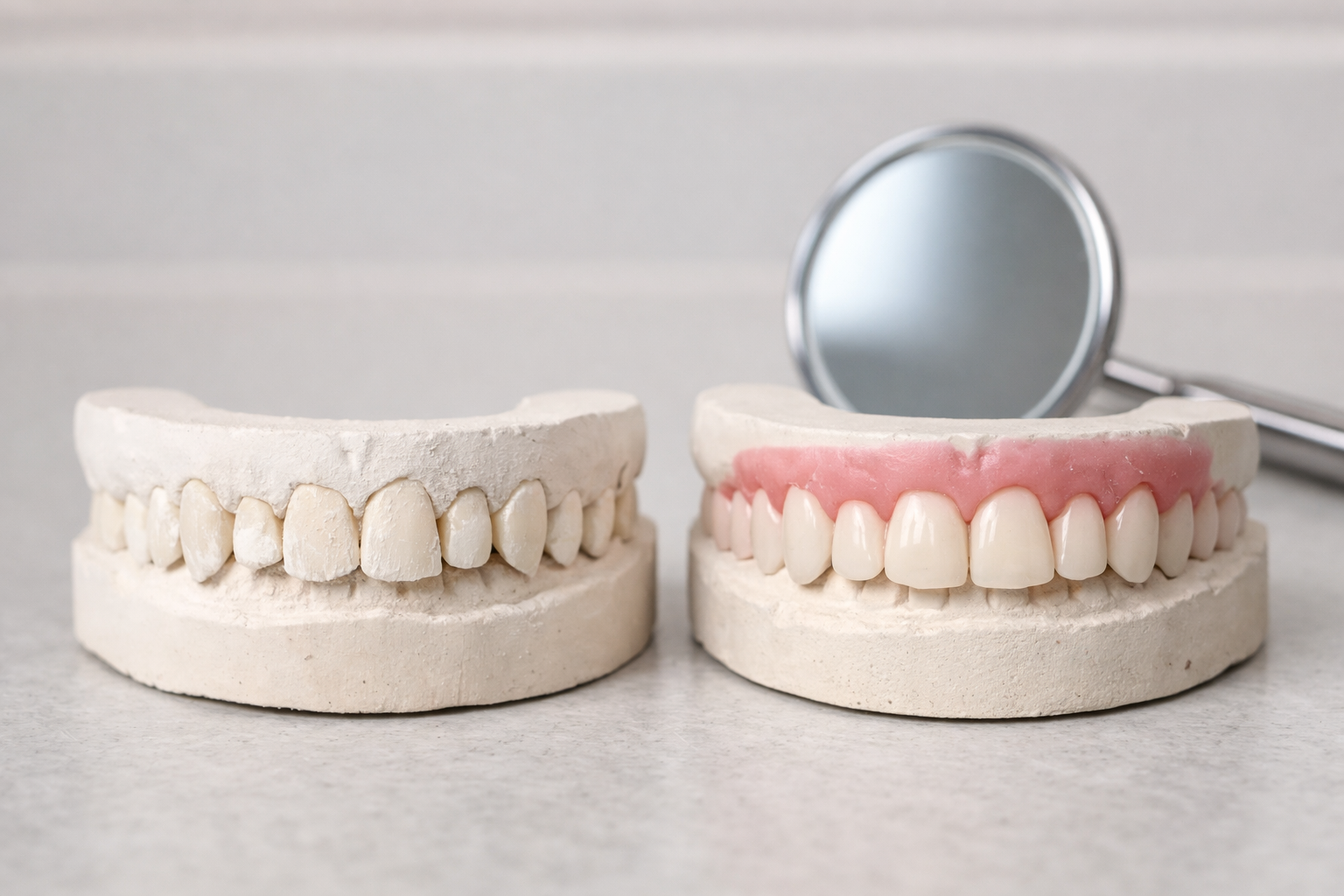
For traditional porcelain veneers, we reduce a thin layer from the front surface of the tooth and usually a small amount from the biting edge. Dentists commonly describe that reduction as being in the range of half a millimeter, which is about the thickness of a fingernail clipping.
The reason is simple. Porcelain needs room. If we bonded a shell on top of a full-size tooth with no reduction, the tooth would look thick and shelf-like near the gumline, and that is exactly the bulky look people are trying to avoid.
What typically gets touched and what does not:
- Reshaped: the outer enamel on the front face of the tooth
- Reshaped: a sliver of the biting edge, so the porcelain has a clean stopping point
- Lightly shaped: the edges where the tooth meets its neighbors, to hide the seam
- Left alone: the back of the tooth, the root, and the nerve inside
- Left alone: teeth that are not part of the cosmetic plan
Some cases qualify for minimal reduction, usually teeth that are already small, worn short, or tipped slightly inward. That is decided at the exam with photos and models, not from a photo on a website.
The part I will not soften: enamel does not grow back. Once a tooth is prepared, it stays covered for life. The American Dental Association’s patient guide to veneers says the same thing in plain terms, and I would rather you hear it from me before a deposit than after.
Before Veneers, Ask If There Is a Smaller Version of This
Veneers are not the first step for everyone, and asking for a more conservative option is a normal question, not a difficult one. I get asked it constantly, and I like the question.
Here is the filter I use with patients who come in unsure:
- Color only, on healthy natural teeth? Whitening usually handles it. There are stains that whitening will not fix, and those are worth identifying before you commit to anything permanent.
- One chipped corner or a small gap? Bonding can often rebuild it in a single visit with far less tooth reduction. Our guide on when bonding is enough for a chipped front tooth walks through where that line sits.
- A big old filling, or a crack running through the tooth? That is usually a crown case, not a veneer case. A veneer covers the front, and a cracked tooth needs the whole structure wrapped. We cover that split in detail in crown or veneer for a damaged front tooth.
- Several teeth, multiple issues, shape and color together? That is where veneers genuinely earn their place.
Plenty of people call us for a second opinion on a treatment plan from somewhere else, and I have never once minded. If a smaller version of the treatment will get you where you want to go, you should hear about it first.
How Much Tooth Each Option Actually Removes
This is the rough hierarchy I sketch out for patients who want to see the trade-off side by side.
| Treatment | Typical tooth reduction | Best suited for |
|---|---|---|
| Professional whitening | None | Color change on healthy natural teeth |
| Dental bonding | Little to none | Small chips, minor gaps, one tooth |
| Minimal prep veneers | Very light surface shaping | Small, short, or inward-tipped teeth |
| Traditional porcelain veneers | Around half a millimeter, front and edge | Shape, length, and color across several teeth |
| Dental crown | Reduction on all sides of the tooth | Cracked, heavily filled, or root canal treated teeth |
The Visit Sequence, and Where You Can Still Change Your Mind
Most of the anxiety I hear about is not the prep itself. It is the fear of losing control partway through something you cannot stop.
Veneers are a multi-visit process, and that is a feature, not a delay. The steps look like this:
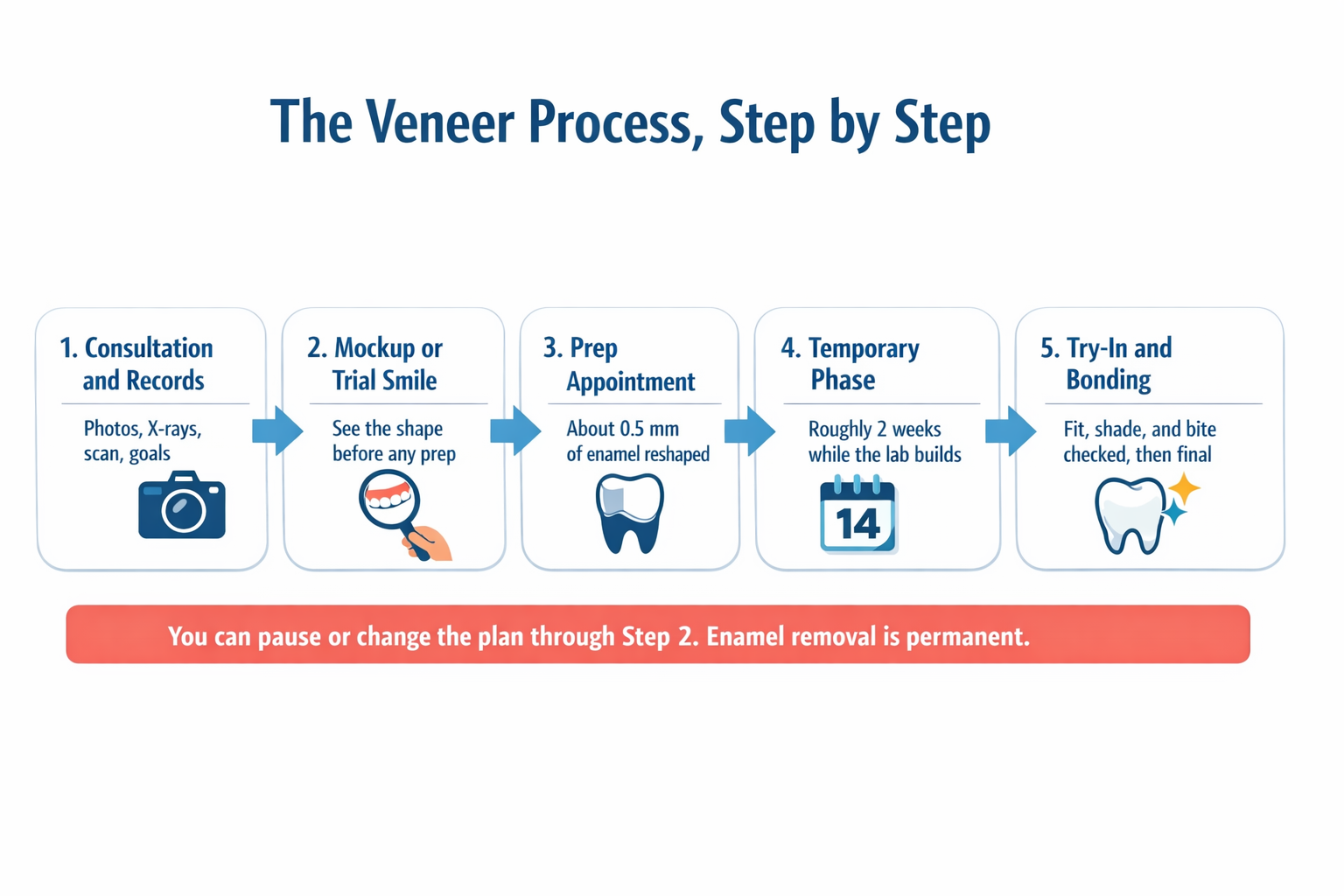
1. Consultation and records. Photos, X-rays, impressions or a digital scan, and a conversation about shape, length, and shade.
2. The mockup or trial smile. We show you the proposed result before any enamel is touched. You look in a mirror and say yes, go shorter, or not that shape.
3. Prep appointment. The enamel reduction happens here, and temporaries go on the same day.
4. The temporary phase. Usually a couple of weeks while the lab builds your porcelain. You eat, talk, and live in the shape we agreed on.
5. Try-in and bonding. We check fit, shade, and bite before anything is bonded for good.
The mockup is the part people skip past when they read about veneers, and it is the single most useful step for a nervous patient. Preview beats promise, every single time you can get one.
The Veneer Process at a Glance
A quick visual of where each visit falls and, more importantly, where you still have a say.
What Permanent Means Day to Day, Not Just on Prep Day
Most people picture the prep appointment and stop there. The real commitment is to a replacement cycle, not a single procedure.
Once a tooth is reduced, it stays covered for life. Veneers get maintained, occasionally repaired, and eventually remade, the same way crowns do. For a fair comparison point, we tell crown patients that porcelain typically lasts 10 to 15 years or longer with good hygiene and regular checkups, and front-tooth veneers live in that same neighborhood.
The variable is not usually the porcelain. It is what happens around it:
- Cleanings on schedule keep the margins, meaning the seam where porcelain meets tooth, healthy and sealed
- Gum health determines whether that margin stays hidden or starts to show
- Night grinding is the fastest way to chip a front veneer
- Decay at the gumline is what shortens the lifespan of otherwise fine veneers
If you keep your cleanings, this is a long-lasting solution you maintain. If you disappear for five years, the margins are where the trouble starts. We broke the full picture down in what makes one set of veneers last 15 years and another only 5, and none of it is complicated. It is just consistent.
What Has to Be Handled Before Any Veneer Work Starts
This is the part that gets skipped in cosmetic marketing, and it is where candidacy is genuinely decided.
Gums first. Active inflammation changes where the margins sit. If the tissue is puffy today and settles in three months, the porcelain edge that looked perfect at bonding can end up visible. If your teeth already look longer than they used to, that gets addressed before anything cosmetic.
Decay second. Untreated cavities have to be fixed before a tooth gets prepared. Scottsdale’s median age sits near 49, with roughly a quarter of residents 65 or older, and a lot of common medications cause dry mouth. Add our dry desert winter and you get exactly the conditions that drive decay right at the gumline where a veneer meets tooth. We wrote about what the desert winter does to teeth because so many patients here deal with it without realizing.
Bite third. If you clench or grind at night, a night guard is part of the plan rather than an upsell afterward. Porcelain on a front tooth takes the brunt of that force.
Gums and bite first, cosmetics second. The exam is where this gets sorted out, not the internet.
Why the Person Doing the Prep Matters More Than the Porcelain Brand
Labs are good. Materials are good. The reduction is the part that cannot be redone, and that comes down to judgment and hands.
What I think matters most is continuity. At our North Scottsdale office, the same dentist plans the case, preps the teeth, and then watches the result at every cleaning for years afterward. That is a different arrangement than the larger corporate groups spread across the Phoenix metro, where the person who preps your front teeth may not be the person who sees them again.
Patients tend to notice the explaining more than anything else. As one review put it, “Dr. Fink is friendly, on time, and does a great job explaining potential issues/concerns and provides options.” That matches what we hear across our Google reviews, which average 4.93 across roughly 103 reviews.
Frequently Asked Questions About Veneer Tooth Preparation
Can veneers be removed later and my teeth go back to normal?
Not with traditional veneers. Once that half millimeter of enamel is reshaped, the tooth needs to stay covered by something, whether that is a new veneer or a crown. Minimal prep cases are closer to reversible, but candidacy for those is narrow and gets decided at the exam.
Does the prep appointment hurt?
We numb the area, so the prep itself is not painful. Some people have mild sensitivity to cold during the temporary phase, which usually settles once the final porcelain is bonded. Tell us if it lingers, because that is worth checking rather than waiting out.
Can I get just one veneer on a single tooth?
Sometimes, yes, but matching one veneer to the natural teeth beside it is the hardest shade work in cosmetic dentistry. We look at the whole smile line first and will tell you honestly if one tooth is going to stand out.
What does veneer treatment cost in Scottsdale?
Cost depends on how many teeth are involved, the material, whether any gum or bite work comes first, and the lab. Fees vary quite a bit across the Phoenix metro, so a general range from the internet is not very useful. We give a written estimate after the exam so you see the whole plan, not a per-tooth number out of context.
What if I grind my teeth at night?
Grinding is not an automatic no. It does mean a night guard becomes part of the plan, and we may adjust the length and edge design of the porcelain to reduce the force on it. Skipping that step is one of the most common reasons a front veneer chips early.
Still Thinking About Your Front Teeth?
If you have been circling this decision for a while, a cosmetic consultation is mostly a conversation with photos and a mirror, and nothing gets touched that day. Trinity Dental Care sees patients for these conversations at our office on Frank Lloyd Wright Blvd in North Scottsdale. Questions are welcome at 480-621-4040 or trinitydentalcares.com whenever you are ready to ask them.