
Direct Answer: A traditional crown usually takes two visits about two to three weeks apart. A crown milled in the office can often be finished in one longer appointment for patients who qualify.
You cracked a molar back in August, or a filling popped out and you figured you would deal with it later. Since then you have been chewing on one side of your mouth and hoping it holds.
Now it is fall in North Scottsdale. The winter residents are rolling back into the Shea Corridor and McCormick Ranch, family is coming for Thanksgiving, and you have a flight on the calendar. The question you actually want answered is not “what is a crown.” It is how many appointments this takes and how much of your fall it eats.
I get this call every year, usually starting the week the weather finally breaks. So let me lay out the real timeline, both versions of it, and the year-end insurance wrinkle that trips people up in December.
How Long Does Getting a Dental Crown Take the Traditional Way?
The classic path is two visits, and the gap between them is the part that matters for your calendar.
Here is how it breaks down:
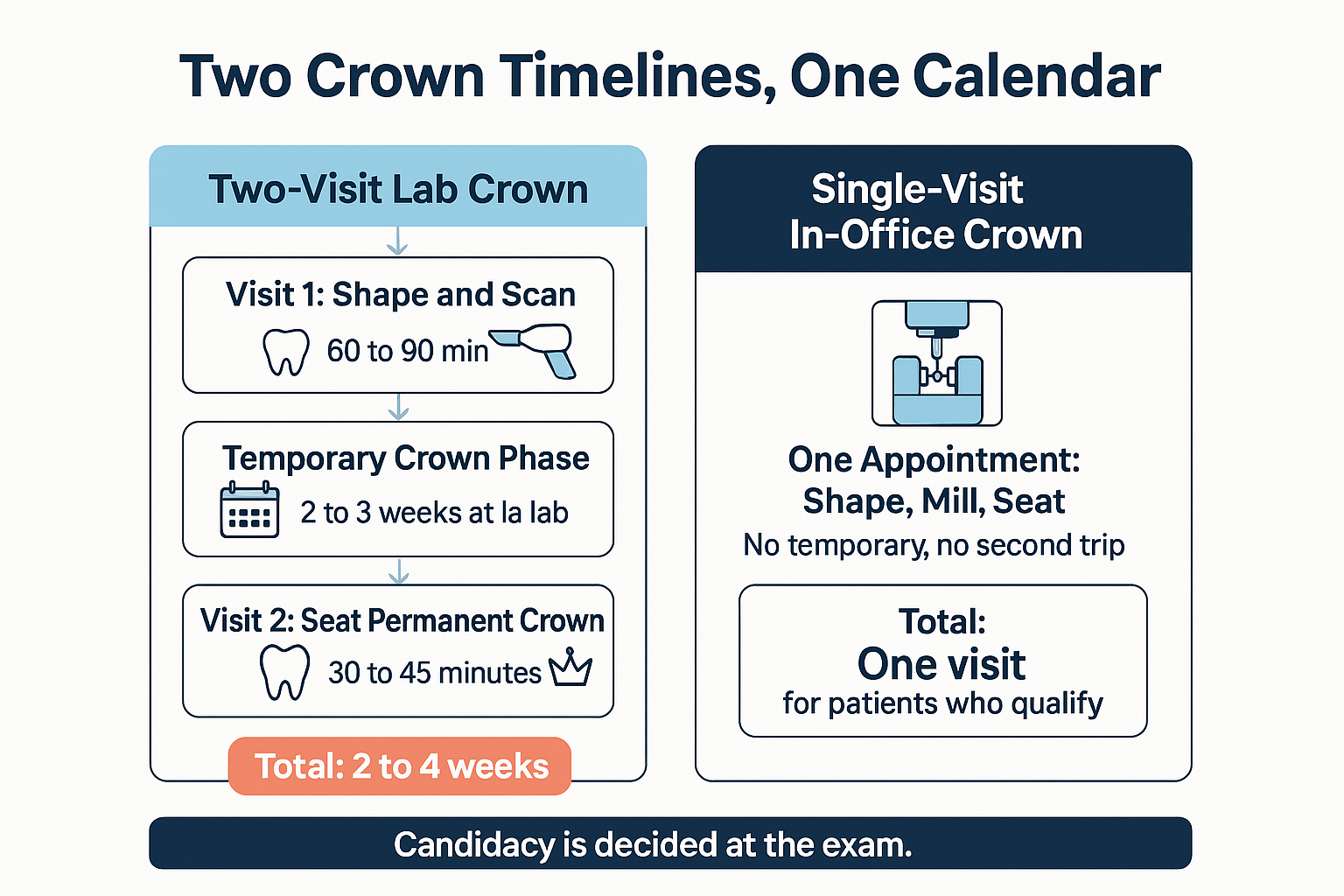
- Visit one: we numb the tooth, shape it down so the crown has something to sit on, and take a digital scan or an impression. This usually runs about an hour to an hour and a half.
- The lab stretch: the scan goes out to a dental lab that builds your permanent crown. Commonly two to three weeks, sometimes longer around the holidays when labs close for a few days.
- Visit two: we take the temporary off, check the fit and the bite, and cement the permanent crown. Often 30 to 45 minutes.
So start to finish, a lab-made crown frequently spans two to four weeks and requires you to be in town twice. If you leave for ten days in the middle of that, the gap just gets longer.
The American Dental Association explains the basics of what a crown does if you want the clinical side. What I want to give you is the scheduling side, because that is what people are really asking about when they call our office on Frank Lloyd Wright Blvd in October.
Living in a Temporary Crown Is the Part Nobody Warns You About
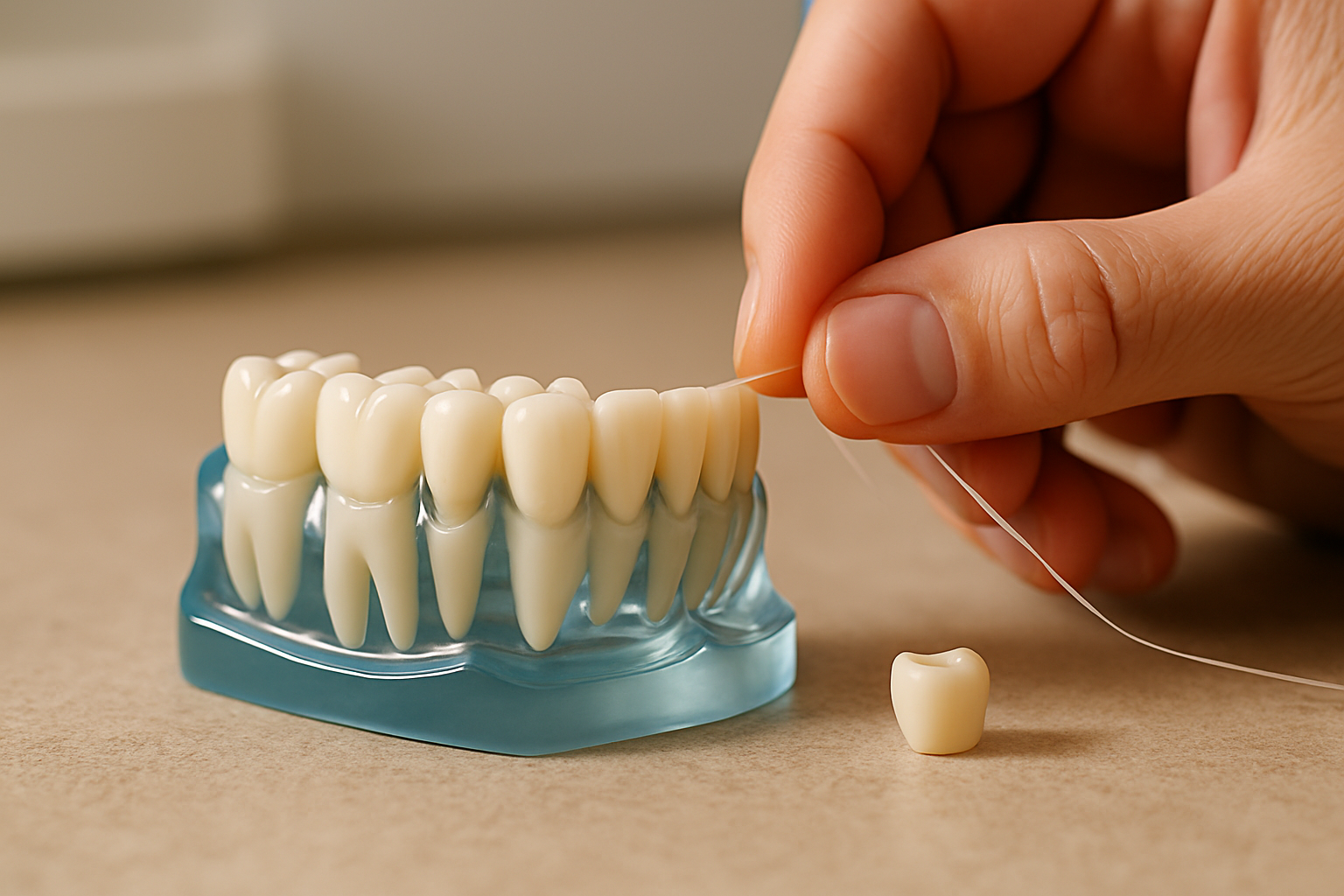
A temporary crown is not a weaker version of the real thing. It is a placeholder, and it is cemented lightly on purpose so we can pop it off cleanly at the second visit.
That light cement is exactly why it collides with travel. For the two or three weeks you wear one:
- Sticky foods are a problem. Caramel, taffy, soft bread, and gum can lift a temporary right off.
- Hard foods are a problem. Ice, nuts, pistachio shells, hard candy. Chew on the other side when you can.
- Flossing changes. You slide the floss out sideways instead of snapping it up through the contact, or you will pull the temporary with it.
None of that is a crisis at home. It is a different story when you are three time zones away at your sister’s house on Thanksgiving. That is the real argument for finishing before you fly, not after.
The Single-Visit Path Is Pure Calendar Math
Some crowns can be designed and milled right here in the office and seated the same day. No temporary. No second trip.
For travel planning, that is the whole point. You trade two appointments separated by weeks for one longer appointment block, often a couple of hours with some waiting time while the crown is milled.
I want to be straight with you about the catch, though. Same-day crowns are available in many cases, for patients who qualify, and that call gets made at the exam based on the tooth, your bite, and how much healthy structure is left. It is not something I can promise over the phone or from a photo.
If you want the full breakdown of who is a good fit, we already covered that in detail: same-day crowns sound great, so why can’t everyone get one. And if you are curious why your dentist might steer you toward one material over another, not all dental crowns are the same walks through it.
For this article, just hold onto the scheduling difference. One block versus two visits weeks apart changes what you can realistically fit in before a trip.
Mapping Both Paths to Your Fall Calendar
Here is how the two timelines compare when you are looking at a travel date. Times are typical and can shift based on your tooth and our schedule.
| Milestone | Two-Visit Lab Crown | Single-Visit In-Office Crown |
|---|---|---|
| Shaping and scanning | First appointment, roughly 60 to 90 minutes | Part of one longer appointment |
| Temporary crown | Yes, worn about 2 to 3 weeks | None needed |
| Wait between visits | Commonly 2 to 3 weeks at the lab | None |
| Second appointment | Yes, about 30 to 45 minutes | None |
| Total calendar span | Often 2 to 4 weeks | Typically one visit |
| Travel friction | You need to be in town twice | Done before you leave |
The Two Crown Timelines at a Glance
A side by side look at how each path lands on your calendar between now and your trip.
If a Crown Comes Loose at the Worst Possible Moment
Lost crowns are one of the most common urgent calls any general practice takes. One caller said it almost word for word: my crown came off, can I be seen today?
It happens with temporaries and it happens with older crowns that have been in place for a decade. If it happens to you:
- Keep the crown. Put it in a small container or a pill bottle, not a napkin in your pocket.
- Do not glue it back yourself. Nothing from the drugstore aisle, and definitely nothing from the hardware store. Household adhesives are not safe in your mouth and they can ruin a crown that was otherwise fine to re-cement.
- Stop chewing on that side. The exposed tooth is often sensitive to cold and to air.
- Call the office instead of waiting it out. Within days, neighboring teeth can drift just enough that the crown no longer seats the way it did.
We wrote a longer piece on exactly this: crown fell off, here’s what to do before you see a dentist. Read it now so you are not searching for it from a hotel room in December.
Why Mid-December Timing Changes How Your Benefits Apply
The second half of the real question is money, and the calendar matters there too.
Most dental plans run on a calendar year with an annual maximum. In the general market those maximums commonly land somewhere in the one to two thousand dollar range, and unused benefits do not roll over on January 1. Industry data from the National Association of Dental Plans has shown only about 2.8 percent of PPO members ever reach their annual maximum, which tells you how much coverage goes unused every year.
Crowns are usually classified as a major service, meaning the plan covers a smaller percentage than it does for a cleaning. Here is the timing piece that catches people: a lab-made crown started in mid-December can have its two visits land in different plan years. That can split how benefits apply and reset your deductible in between.
I will not quote you a crown price in an article, because the number moves based on the tooth, the material, whether a buildup is needed, and your specific plan. What I will tell you is to ask your dental office for a written estimate before treatment, not a ballpark over the phone. We go deeper on the cost drivers in what makes one crown cost more than another in Scottsdale, and on the year-end angle in dental benefits you don’t use by December 31.
An Honest Reason Not to Ride It Out Until January
I am not going to lecture anyone for waiting. Most Scottsdale patients who put things off are not careless, they are busy, nervous, or unsure what it will cost.
But here is the information you deserve. A cracked or heavily filled tooth that gets babied for months can shift from a straightforward crown into something that needs other treatment first. That adds visits and adds weeks, which is the opposite of what you want in November.
Nobody can predict that from a phone call or a photo. That is the entire reason the exam and X-rays exist. If anxiety is the thing holding you back, that is normal and worth saying out loud at the front desk, and we put together some practical steps in dental anxiety is real, here is what you can do before your appointment.
What a Smaller Practice Can Do With a Schedule
One practical note. In a large group setting, the schedule often belongs to a system rather than a person, and “the soonest we have is three weeks out” is just the answer you get.
In a smaller, owner-led office, the doctor can look at the day and make a judgment call about working someone in. That pattern shows up in our reviews pretty regularly, including one patient who wrote: “Was able to get in same day for crown repair. Friendly and courteous!”
It is not a guarantee, and a full day is a full day. But when your flight is Thursday, it is worth asking rather than assuming.
Frequently Asked Questions About Crown Timing
Can I fly with a temporary crown?
Yes, flying itself is fine. The issue is what you eat and how far you are from your dentist. If a temporary comes off in another state, you are looking for a dentist you do not know, on a holiday week, which is exactly the situation most people are trying to avoid.
How long does getting a dental crown take from the first phone call?
Add an exam to the front of whichever timeline applies. If you are a new patient, plan on an exam and X-rays first, then the crown appointment. For a lab-made crown that often means three to five weeks total from your first call to the permanent crown being seated.
If I start a crown in December, will insurance cover both visits?
It depends on when each visit happens and how your plan handles major services. Some plans apply benefits at the preparation visit, others at the seat date. Ask your office to verify that specific detail in writing before you start, because a split across two plan years can mean a second deductible.
Is a same-day crown as strong as one from a lab?
Modern milled ceramic crowns are strong and look natural. The better question is which material fits your particular tooth and bite, since a back molar that takes heavy grinding force has different needs than a front tooth. That decision happens at the exam, not at the keyboard.
My crown has been loose for weeks but it does not hurt. Can it wait until after the holidays?
A loose crown usually means something is going on underneath, often decay at the margin, and pain is a late signal rather than an early one. Waiting a few weeks sometimes means the tooth underneath needs more work than it would have. Getting it looked at is cheap information.
Want Your Own Timeline Mapped Out Before Your Trip?
If you have a tooth you have been working around and a fall calendar that is filling up, an exam will tell you which path your tooth is actually on and how many appointments that means. Our office is on Frank Lloyd Wright Blvd in North Scottsdale, a few minutes from the Shea Corridor and McCormick Ranch, and we are happy to look at your dates alongside your plan year. You can reach Trinity Dental Care at 480-621-4040 or at trinitydentalcares.com whenever you are ready to get it looked at.