Direct Answer: No. For plan years starting January 1, 2027, CMS bars Marketplace issuers from counting routine adult dental as an essential health benefit. Pediatric dental still counts. Adults need separate coverage.
If you buy your own health insurance and you have been putting off a cleaning, a filling, or a crown, there is a rule change worth knowing about before you shop this fall.
For plan years that begin January 1, 2027, routine adult dental will not be treated as an essential health benefit on Marketplace plans. That decision was finalized by CMS on May 20, 2026, and it affects anyone in Scottsdale, Paradise Valley, or anywhere in Maricopa County who buys individual or small group coverage through the exchange.
I field this question on the phone constantly, usually phrased as “do you take my insurance?” So here is the plain version of what changed, who it hits, and what adults actually use to pay for dental care instead.
What CMS actually changed, and when it starts
In the HHS Notice of Benefit and Payment Parameters for 2027 Final Rule, CMS reinstated the prohibition at 45 CFR 156.115(d). That provision bars issuers from including routine non-pediatric (adult) dental services as an essential health benefit.
This reverses a policy finalized in the 2025 Payment Notice, which would have allowed states to add adult dental to their essential health benefit benchmark plans beginning in plan year 2027. CMS said the reversal better matches the statute, which directs that the scope of essential health benefits be equal to the scope of benefits under a typical employer plan.
A few specifics worth holding onto:
- Who it applies to: individual and small group Marketplace coverage
- When it starts: plan years beginning January 1, 2027
- When you shop it: fall 2026 open enrollment, on the federal exchange that Arizona uses
- What stays put: pediatric dental remains one of the ten essential health benefit categories
You can read the agency’s own summary in the CMS fact sheet on the 2027 Payment Notice, published May 20, 2026. The Federal Register notice went out the same day, and ADA News covered the dental angle on May 21, 2026.
Who this actually hits around North Scottsdale
This change does not touch you if you get dental through an employer group plan, a retiree plan, or a plan you already buy separately from your medical coverage.
It matters most to the people I see coming in from the Shea Corridor, McCormick Ranch, and the neighborhoods around the Village at Frank Lloyd Wright who fall into one of these groups:
- Self-employed adults and small business owners buying their own coverage on the exchange
- Early retirees who left a job before 65 and are bridging the gap until Medicare
- Contract and commission workers without group benefits
- Families where the kids have dental through the plan but the parents do not
That last one surprises people. Pediatric oral care is still an essential health benefit, so a family plan may handle your 12-year-old’s cleanings while leaving both parents on their own.
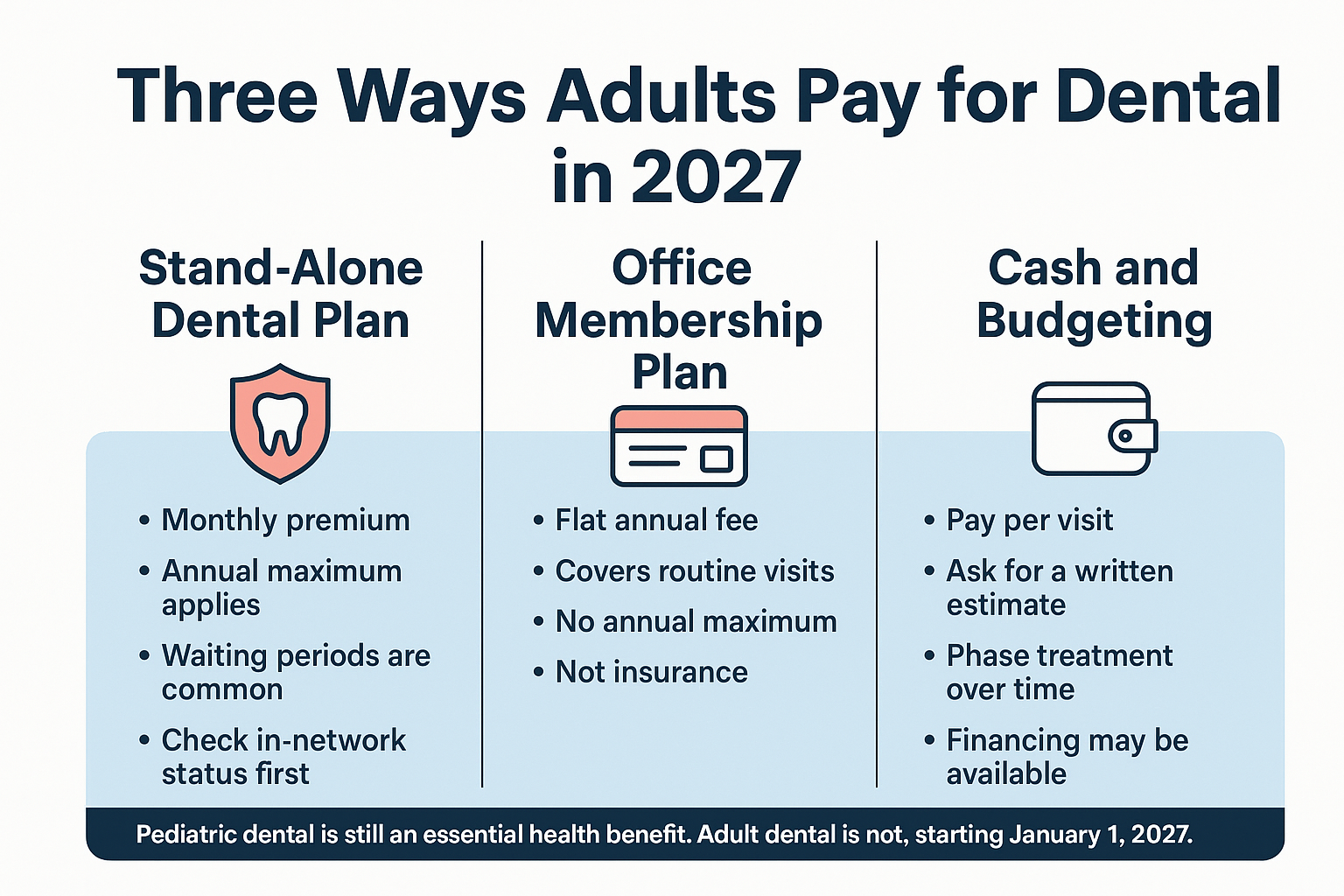
The practical takeaway: cleanings, fillings, crowns, and periodontal care for adults will not be baked into your 2027 health plan as a required benefit. A separate stand-alone dental plan, an in-office membership plan, or straight cash budgeting is still how most adults pay for this.
What 2027 Marketplace Coverage Does and Does Not Include
Here is the short version of where dental sits once these plans take effect. Always read your own plan documents, because issuers can choose to offer things beyond the required benefits.
| Type of care | Essential health benefit in 2027? | How adults typically pay |
|---|---|---|
| Adult cleanings and exams | No | Stand-alone dental plan, office membership plan, or cash |
| Adult fillings, crowns, root canals | No | Stand-alone dental plan or out of pocket |
| Adult gum and periodontal treatment | No | Stand-alone dental plan or out of pocket |
| Pediatric dental through age 18 | Yes, still one of the ten categories | Included in the plan or bought as a pediatric dental plan |
| Cosmetic work like whitening or veneers | No | Cash or third-party financing |
| Dental issues tied to an accident or medical condition | Depends entirely on the individual plan’s medical terms | Check the plan documents before assuming anything |
The Three Ways Scottsdale Adults Pay for Dental Without a Marketplace Benefit
Most adults without dental through work land in one of three buckets. None of them is automatically the cheapest; it depends on how much care you expect to need in a year.
How to read a stand-alone dental plan before you buy one
Stand-alone dental plans are sold alongside Marketplace medical coverage and directly from insurers. They are not all built the same, and the premium is the least useful number on the page.
Before you sign up, I would look at four things:
- The annual maximum. Many adult plans cap out somewhere in the $1,000 to $1,500 range per year. That number has barely moved in decades while treatment costs have.
- Waiting periods. Major work like crowns often sits behind a 6 to 12 month wait. If you need a crown now, a new plan may not help you now.
- The coverage tiers. Preventive care is often covered at or near 100%, basic work around 70 to 80%, and major work closer to 50%. Those are general market patterns, not a promise about any one plan.
- Network status. Ask the office directly whether they are in network for the specific plan, not just the carrier name. Out of network is where most of the surprise comes from.
If you expect two cleanings and nothing else, run the math. Two years of premiums can exceed what the cleanings would have cost you outright. If you already know a crown or implant is coming, the math usually flips the other way. We walk through this with people every week, and the honest answer changes patient by patient. There is more detail in our breakdown of what paying out of pocket looks like in Scottsdale.
If you have coverage right now, 2026 is the year to use it
Here is the piece people miss. This rule applies to plans beginning in 2027. Whatever dental benefit you have in 2026 is still sitting there, and most of it expires on December 31.
Annual maximums do not roll over. If your plan allows $1,500 a year and you have used $400 of it on cleanings, that remaining amount disappears at midnight on New Year’s Eve. We see the December scramble every year, and by then the schedule is tight.
A few things worth doing before fall:
- Call your carrier and ask what you have left on your annual maximum
- Ask whether your deductible has already been met this year
- Get a written treatment estimate so you can sequence work across two benefit years if needed
That last one matters more than people expect. Splitting a larger treatment plan across December and January can effectively double the benefit you get to use. Two related reads: where unused dental benefits go after December 31 and what comes next when your annual maximum runs out.
Frequently Asked Questions About Marketplace Plans and Adult Dental in 2027
Does Marketplace health insurance cover adult dental in 2027?
Not as a required benefit. CMS finalized a prohibition on issuers including routine non-pediatric (adult) dental services as an essential health benefit for plan years beginning January 1, 2027. You would need a separate dental plan, a membership plan, or to pay directly.
Are my kids losing their dental coverage too?
No. Pediatric oral care remains one of the ten essential health benefit categories. The prohibition is specific to non-pediatric, meaning adult, routine dental services.
What is an in-office membership plan, and is it insurance?
It is not insurance. It is a flat annual fee paid directly to a dental office that typically covers routine visits and gives a reduced rate on other treatment. We offer one here for patients without dental benefits, and for people who only need preventive care it often works out better than a premium. Call and ask us to compare it against what your plan would cost you.
I have been putting off a crown. Should I get it done in 2026?
If you have dental benefits in 2026 with room left on the annual maximum, that is usually the better year to use them. Candidacy and timing depend on what the exam shows, so get a written estimate first rather than guessing.
What if I am out of network with my plan?
Out of network does not always mean more expensive. Many plans still pay something toward out of network care, and a membership plan or cash rate can land close to what you would owe in network. Ask for both numbers side by side before you decide.
Does any of this affect dental implants?
Marketplace medical plans were never a reliable path to implant coverage for adults, so this rule does not change much there. Implant coverage, when it exists, comes from stand-alone dental plans and varies widely.
Want help mapping out your dental costs before open enrollment?
If you are weighing a 2027 Marketplace plan and trying to figure out where dental fits, we are happy to talk through what your treatment plan would actually cost and how a stand-alone plan or membership option compares. Our office sits on N. Frank Lloyd Wright Blvd. in North Scottsdale, and we see patients from Paradise Valley, McCormick Ranch, and the Shea Corridor. You can reach Trinity Dental Care at 480-621-4040 or at trinitydentalcares.com when you are ready to schedule.