
Direct Answer: A crown that keeps coming off usually points to a problem under it: decay at the margin, a short or worn-down tooth stub, or grinding. The crown itself is often still fine.
There is a very specific kind of quiet that happens when a crown comes off. You bite into something soft, feel the shift, and suddenly a small white cap is sitting in your hand. Then you run your tongue over the bare tooth and the worry starts.
One of the most common things we hear on the phone is some version of “My crown came off, can I be seen today?” It is one of the top reasons Scottsdale patients call us, and the question underneath the panic is almost never about the crown itself. People want to know whether the tooth is ruined, whether the dentistry was bad, and whether this is going to keep happening.
So let’s answer the cause question. A crown coming loose is usually information about the tooth underneath, not a verdict on the work that was done. And in a lot of cases, the crown you are holding is still perfectly usable.
Why a Crown Keeps Coming Off Is Usually About the Tooth, Not the Cement
Most people assume cement is what holds a crown on. It helps, but the real grip comes from the shape of the prepared tooth underneath.
Think of it like a post in the ground. A tall, straight post with a fence panel slid over it holds tight because there is a lot of surface gripping on all sides. A flat coin with something resting on top has almost nothing to hold onto.
That is the difference between a tooth with good height and a molar that has been worn down, root canaled, or rebuilt several times. When a crown comes off once, it is often just bad luck. When it keeps coming off every few months, the shape is usually telling us something.
Here is what I actually look at before deciding what to do next:
- Height of the remaining tooth. Short stubs do not hold crowns well, no matter how good the cement is.
- Taper. If the sides angle in sharply, the crown has less to grab.
- The core or buildup. Many crowned teeth have a filling material core underneath. If that core is cracking or separating, the crown comes off with the core still stuck inside it.
- The margin. That is the seam where crown meets tooth, and it is where trouble usually starts.
Those four things decide whether a tooth gets re-cemented, rebuilt, or needs a fresh crown. It is also a big part of how long a crown realistically lasts before replacement.
The Cause Almost Nobody Expects: Decay Under the Crown
This one surprises people more than anything else I explain in the chair. A crown can look flawless while the tooth under it quietly softens and gives up its grip.
Crowns do not decay. Teeth do. The seam around the bottom edge of the crown is still real tooth, and that seam sits right where plaque loves to collect.
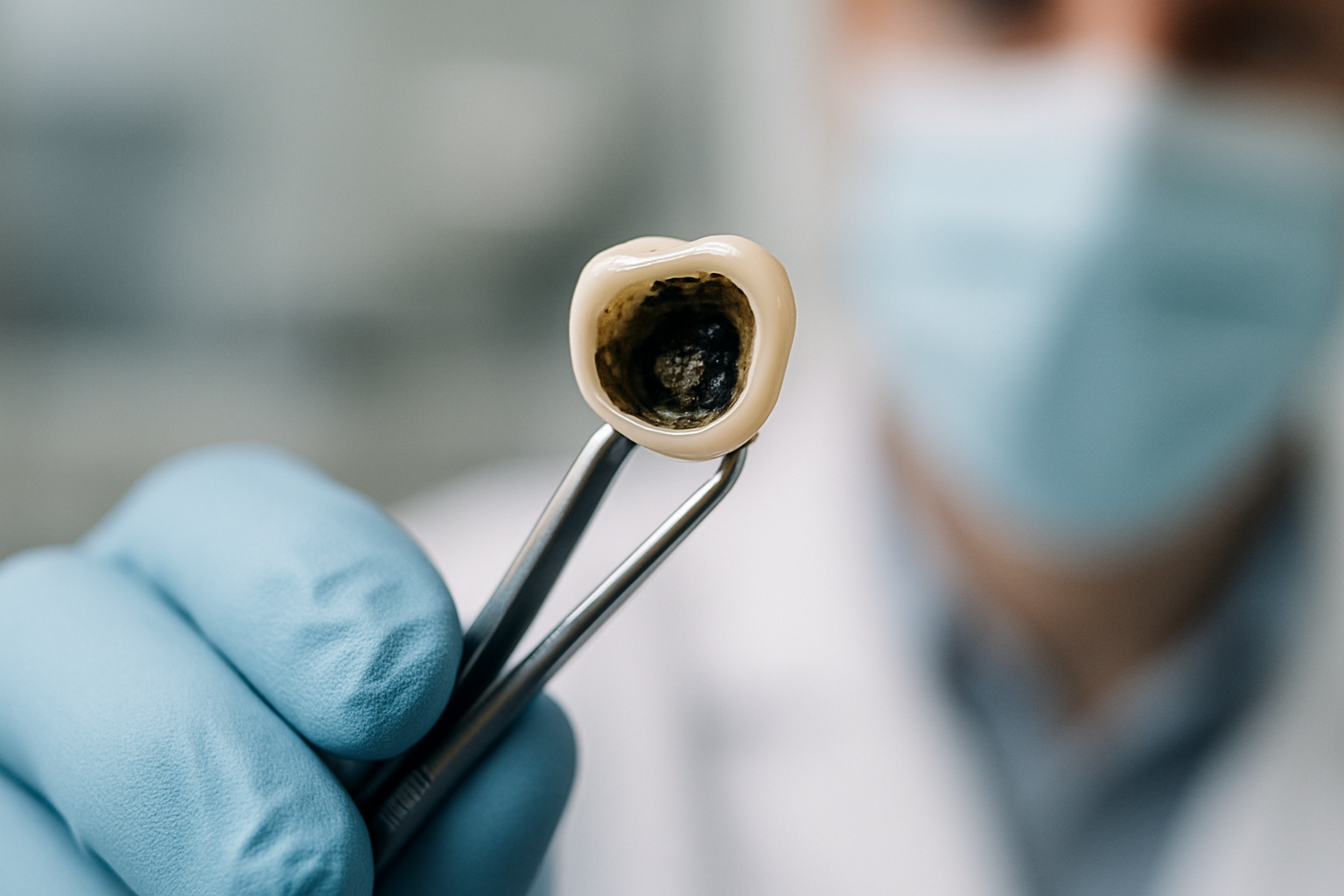
When a crown comes off, the first thing I look at is the inside of it:
- Clean inside, only old cement. The crown released from an intact tooth. Often this one can be cleaned and re-seated.
- Soft, dark tooth material inside. There is decay at the margin. The crown did not fail, the tooth under it did.
- A chunk of hard buildup material inside. The core separated, and the tooth usually needs to be rebuilt before anything gets cemented back on.
There is a local wrinkle worth knowing. The City of Scottsdale does not add fluoride to its drinking water, and naturally occurring levels run roughly 0.3 to 1.0 ppm. That is lower protection than many people grew up with elsewhere.
Add our dry air and the fact that a lot of common prescriptions cause dry mouth, including blood pressure and allergy medications, and you get a real pattern. Plenty of North Scottsdale patients who sailed through their forties with no cavities start seeing decay at crown margins in their sixties. Less saliva means less natural rinsing right at the gumline.
What the Inside of a Loose Crown Tells Us
When a patient brings the crown in with them, the inside of it does most of the diagnostic work. Here is the general pattern I see.
| What’s inside the crown | What it usually means | What typically comes next |
|---|---|---|
| Only old, dry cement | The tooth is likely intact and the seal simply gave out | Clean, check the fit, and often re-cement the same crown |
| Soft or dark tooth material | Decay at the margin undermined the grip | Remove the decay, then decide between a rebuild or a new crown |
| A solid piece of buildup material | The core under the crown separated from the tooth | Rebuild the core, then re-evaluate whether the old crown still fits |
| Crown is cracked or distorted | The restoration itself has fatigued | A new crown, with a look at why it fatigued in the first place |
| Crown is clean but tooth is broken at the gumline | Not enough structure left to hold a crown | A conversation about replacement options rather than another crown |
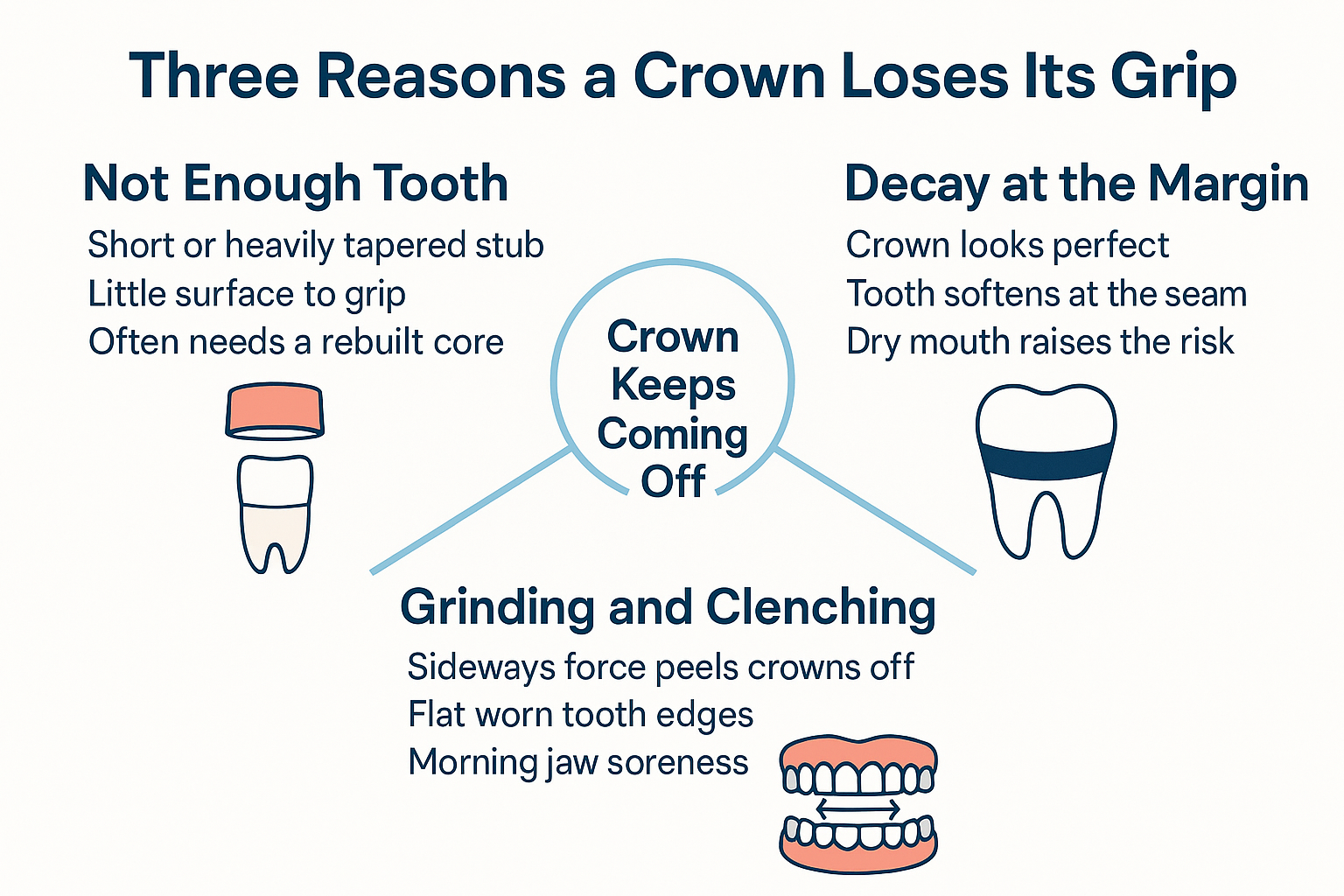
Three Reasons a Crown Loses Its Grip
Most repeat crown problems trace back to one of three causes. This breaks down what each one looks like.
When Grinding Is the Reason It Keeps Happening
If you have paid to have the same crown re-cemented twice, grinding is high on my list.
A straight up and down bite pushes a crown onto the tooth. A sideways grind does something different. It works the crown side to side and peels it off, the same way you would rock a stuck lid instead of pulling straight up.
Most people who do this have no idea. It usually happens at night. The signs I look for during an exam:
- Flat, polished wear facets on the biting edges, especially the canines
- Scalloped edges on the tongue where it presses against teeth
- Morning jaw soreness or a dull headache near the temples
- Hairline cracks in the enamel of nearby teeth
- Crowns that come off cleanly, again and again, with no decay underneath
A night guard is the usual starting point. It does not stop you from clenching, but it changes where the force lands and takes a lot of the sideways load off the crown.
I want to be straight about the limits. A night guard is not a cure, and it only helps if you actually wear it. In cases where grinding is heavy, the crown material and the bite adjustment matter too, which is part of how a crown material gets chosen for a specific tooth.
Does a Crown Falling Off Mean It Was Done Badly?
This is the question people are too polite to ask out loud, so I will answer it directly.
A crown coming off once, years after it was placed, is normal wear. Cement seals break down over time. That is not a sign anyone did anything wrong.
A crown coming off within days or weeks of being placed is different, and it deserves a careful second look at the whole tooth. Same goes for a crown that has been re-cemented twice in a year without anyone explaining why.
I am not interested in blaming whoever placed it. I have seen crowns fail on teeth where the dentist made a reasonable call with very little tooth to work with. But you are allowed to ask questions, and these are fair ones:
- How much natural tooth is actually left under this crown?
- Is there decay at the margin, and can you show me on the X-ray?
- Is the crown itself still intact and usable, or does it need replacing?
- If this is grinding, what changes besides a night guard?
- At what point would this tooth no longer be able to hold a crown at all?
That last one matters. There is a real line where a tooth fractures too far below the gum to support anything, and no amount of cement changes that. An honest answer about that limit is more useful than another temporary fix. If you want a neutral read before committing, what a second opinion visit on a crown actually involves is worth understanding.
Frequently Asked Questions About a Crown That Keeps Coming Off
Should I save the crown that fell off?
Yes. Put it in a small container and bring it with you. The inside of that crown is the single most useful piece of evidence we have, and in many cases the same crown can go right back on.
Can the same crown just be re-cemented?
Often, yes, as long as the crown is intact and the tooth underneath is healthy. The decision depends on what we find at the margin and how much tooth is left to grip. If there is decay or the core has broken apart, re-cementing it would just start the same cycle over again.
Is a bare tooth with no crown dangerous?
It is usually not an emergency in the dramatic sense, but it is vulnerable. The exposed tooth can be sensitive to cold and sweets, and neighboring teeth can start drifting if it sits uncovered for weeks. Getting it looked at sooner generally protects more of your options.
Why does my crown keep coming off but my other crowns are fine?
That usually points to something specific about that one tooth, not your mouth in general. The most common reasons are less remaining tooth height on that tooth, decay at that particular margin, or that tooth taking the brunt of a grinding pattern.
If I need a new crown, can it be done in one visit?
Same-day crowns are available in many cases, though candidacy is decided at the exam and not everyone qualifies. Teeth that need a rebuilt core or gum healing first usually need a different timeline. Here is more on why same-day crowns are not an option for every patient.
My loose crown is on an implant. Is this the same thing?
No, and that distinction matters. An implant crown that feels loose often involves the screw or the connection rather than decay, since there is no natural tooth underneath to break down. That situation is covered separately in what a loose implant crown usually means.
Getting a Loose Crown Looked At
A loose or lost crown is often handled in a single visit, and being seen sooner usually keeps more options open. We keep room in the schedule for crown problems for patients across North Scottsdale, the Shea Corridor, and the surrounding area. One patient put it simply: “Was able to get in same day for crown repair. Friendly and courteous!” If you want a tooth looked at, you can reach our team at 480-621-4040 or at trinitydentalcares.com.