
Direct Answer: Save the crown, avoid chewing on that side, and call your dentist the same day. Do not use household glue. A loose crown is rarely a same-hour emergency, but it should not wait more than a day or two.
It almost always happens at the worst possible moment. You’re eating lunch, or you’re two days out from a trip, and suddenly there’s something hard in your mouth that shouldn’t be there. A dental crown has come off — and now you’re not sure whether to panic, call the dentist immediately, or just wait and see.
This happens more often than most people realize. Based on real calls from patients across North Scottsdale, loose and fallen crowns are among the most common dental urgencies we hear about — and a meaningful number of those callers are scrambling because they’re about to travel. The good news is that most of these situations are manageable, as long as you take the right steps in the first 24 hours.
This article walks through what to do immediately, what the dentist actually evaluates when you come in, and why putting it off — even for budget reasons — tends to make the eventual treatment more involved, not less.
The First Things to Do When a Crown Falls Off
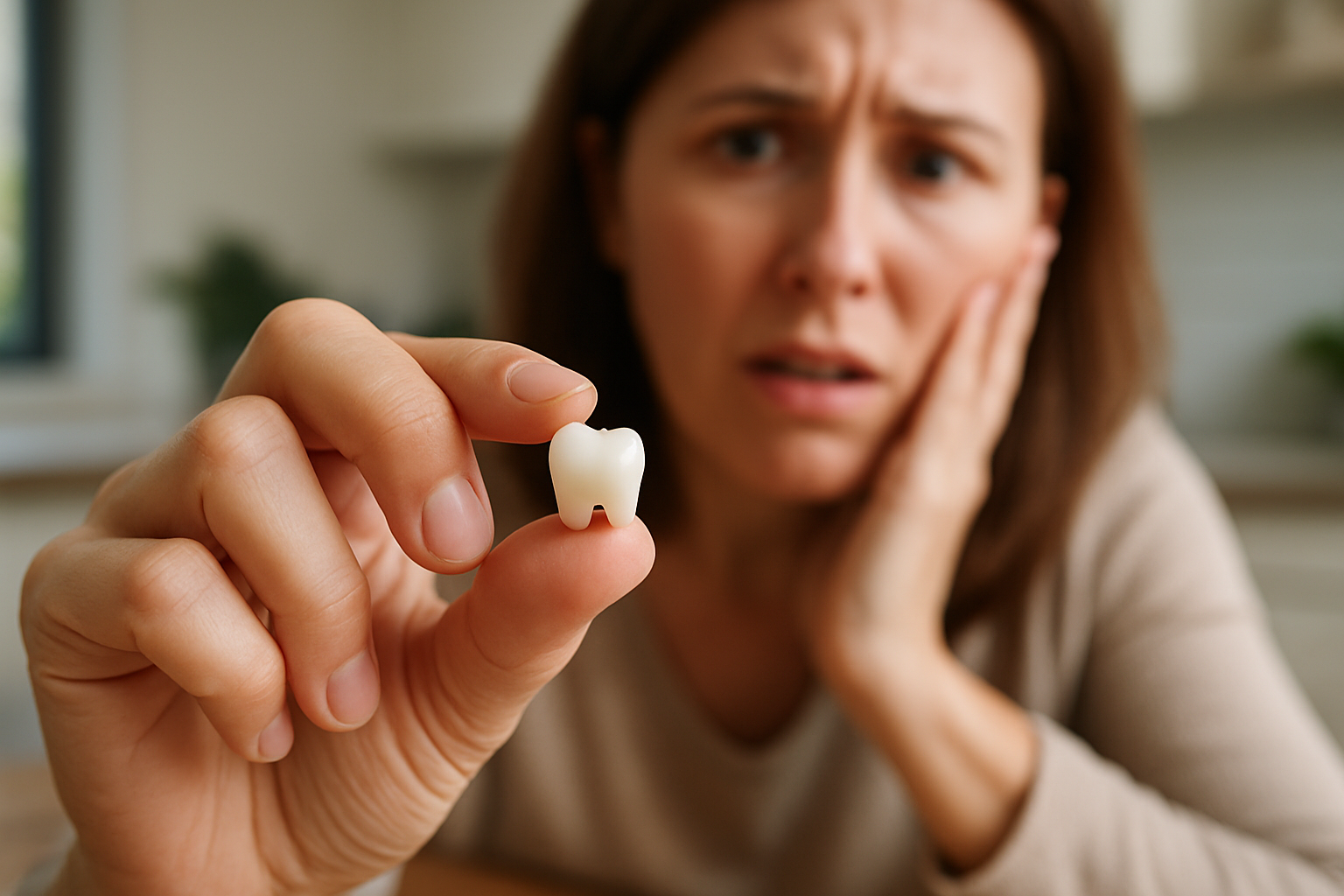
Before you do anything else, find the crown and keep it. It may look damaged or dirty, but your dentist needs to see it. In some cases it can be cleaned and recemented onto the same tooth. Wrap it in a small piece of tissue or a zip-lock bag and bring it to your appointment.
Once you have it secured, follow these steps:
- Rinse your mouth gently with warm water to clear any debris
- Avoid chewing on that side — the exposed tooth structure underneath is vulnerable and can be sensitive
- Do not use household glue, super glue, or any DIY adhesive — these are not safe for oral use, can damage the tooth, and make your dentist’s job significantly harder
- Call the dental office the same day, even if you’re not in pain — explain that a crown has come off and ask about same-day availability
If the tooth is acutely sensitive to air or temperature, or if you notice sharp pain, that moves the situation into more urgent territory. You can read more about when a tooth situation actually crosses into emergency territory if you’re unsure where your situation falls.
Over-the-counter dental cement (available at most pharmacies) is an option for temporary coverage if you absolutely cannot get in for a day or two — but this is a bridge, not a fix. Call first and use temporary cement only as a short-term measure while you wait for your appointment.
Urgent vs. Can-Wait-a-Day: How to Read Your Situation
A crown coming off does not automatically mean you need to drop everything and rush in right now. But it does mean today or tomorrow, not next week.
Here’s how to think about urgency level:
Get in the same day if:
– The exposed tooth is sharply painful or highly sensitive
– You can see visible damage to the tooth underneath
– You’re leaving town within 24–48 hours — this is a legitimate reason to ask for same-day help, and a good dental office will try to accommodate you
– There’s any sign of swelling or infection around the area
Within 1–2 days is generally okay if:
– The tooth feels mildly sensitive but not acutely painful
– The crown came off cleanly and the tooth looks intact
– You can protect the area with temporary dental cement
– You have no upcoming travel or events that would be disrupted
One patient review puts it simply: “Was able to get in same day for crown repair. Friendly and courteous!” — Max W. Same-day appointments for fallen crowns are something many dental offices can accommodate when you call early and explain the situation clearly.
If you’re unsure whether your symptoms suggest something more serious, your regular dentist can handle most dental emergencies — you typically do not need an emergency-only urgent care clinic for a fallen crown.
What Happens at Your Crown Repair Appointment
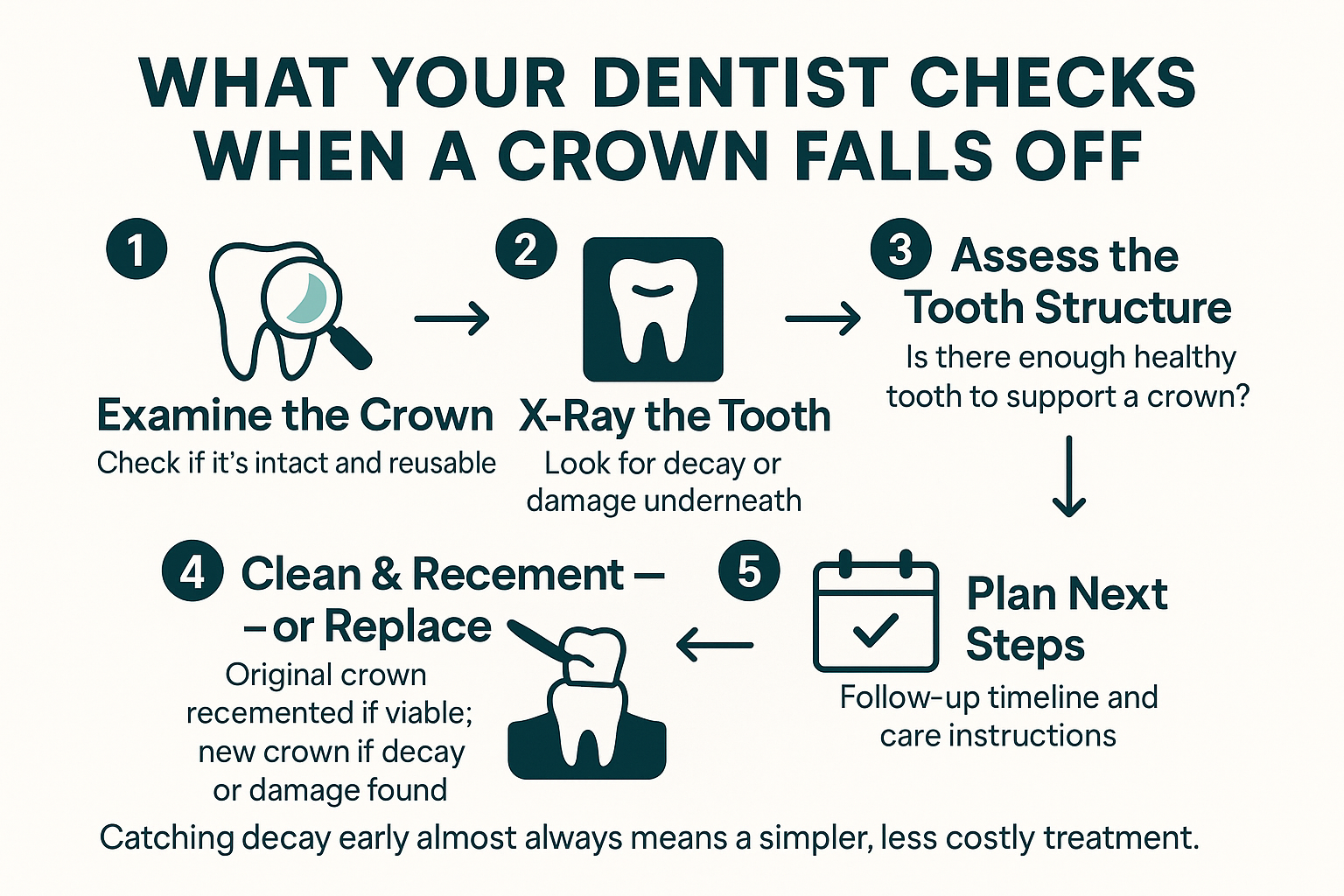
When you come in with a fallen crown, the dentist works through a specific sequence to figure out the best path forward. Here’s what that process looks like.
What the Dentist Is Actually Looking For at the Visit
A lot of patients assume the visit will be quick — the crown goes back on, done. Sometimes that’s exactly what happens. But there’s real diagnostic work involved, and the outcome depends on what the dentist finds underneath.
The first thing we check is whether the crown itself is still usable. If it came off cleanly and the fit is still accurate, recementation is often the right call. If the crown is cracked, significantly worn, or no longer fits well, a new one is the better long-term answer.
The more important question is what happened to the tooth underneath. A crown that loosens gradually — rather than coming off all at once — sometimes signals that decay has been forming at the margin between the crown and the tooth. That decay can quietly progress for months without causing obvious pain. An X-ray and visual exam will reveal whether that’s the case.
If decay is present, it needs to be removed before any crown goes back. Depending on how far it has progressed, this could be a straightforward cleaning-and-recementation situation, or it may mean a new crown is needed. In more advanced cases, the decay can affect the nerve of the tooth — which changes the treatment picture more significantly. You can get more context on what it actually means when your dentist says you need a crown if you want a fuller picture of how that decision gets made.
The key point: the sooner you come in, the more options remain on the table.
Recement vs. Replace: A Quick Reference
The right call depends on what the dentist finds at the appointment. This table summarizes the most common scenarios.
| Situation | Likely Outcome | Why |
|---|---|---|
| Crown came off cleanly, tooth looks intact | Recement existing crown | Crown still fits; no decay found underneath |
| Crown is cracked or no longer fits well | New crown | Damaged crown won’t seal properly long-term |
| Decay found at the margin | Remove decay first, then assess | Sealing decay under a crown accelerates tooth breakdown |
| Significant decay reached the nerve | May need additional treatment before crown | Decay at this depth changes the treatment sequence |
| Crown came off multiple times | New crown likely | Repeated loss suggests fit or structural issue with the original |
The Cost of Waiting — What Actually Happens to the Tooth
This is the part most people don’t want to hear, but it’s worth being direct about.
When a tooth loses its crown, the underlying tooth structure — which has been shaped and thinned to accommodate the crown — is exposed. It’s no longer protected from biting forces, temperature, bacteria, or wear. Over days and weeks, a few things can happen:
- The tooth can fracture under normal chewing pressure, especially if it was already compromised
- Decay accelerates at the exposed margins where bacteria can enter
- The nerve can become involved, which typically means more complex treatment
- In the worst cases, the tooth can break down to a point where it can no longer be saved — leading to extraction and replacement where a simple recementation would have done the job
Many people delay because of embarrassment about how long it’s been since they saw a dentist, or because they’re worried about the cost. Both of those concerns are understandable. But waiting almost always makes the eventual treatment larger and more expensive — not smaller. A recement appointment is a straightforward visit. A tooth that has fractured or developed significant decay underneath is a different conversation entirely.
If the underlying tooth does reach a point of no return, understanding your tooth replacement options becomes the next step — something that’s worth knowing about before you’re in that position.
And if cost is a genuine concern, the best move is still to call. Most dental offices can discuss what the visit will involve before you come in, so you’re not walking in blind.
Frequently Asked Questions About a Crown Falling Off
Can I just leave the crown off for a few weeks if I’m not in pain?
Pain isn’t a reliable signal for how much damage is happening. The exposed tooth can fracture or develop decay without causing significant discomfort — especially if the nerve was already treated during the original crown procedure. A few days while you arrange an appointment is reasonable. A few weeks is a real risk to the tooth.
What if I swallowed the crown by accident?
Dental crowns are small and smooth — swallowing one accidentally is not medically dangerous in most cases, as they typically pass without issue. Call your dentist and let them know. A new crown will be needed, and your dentist will take a new impression at the appointment.
Is a crown falling off covered by dental insurance?
Coverage depends on your specific plan and how long ago the original crown was placed. Many plans have a waiting period — often five to seven years — before they’ll cover crown replacement. Recementation of an existing crown is often covered at a lower cost. The dental office can help verify your benefits before the appointment so you know what to expect.
Why does my crown keep coming loose?
Recurring looseness usually points to one of three things: decay forming at the margin between the crown and tooth, a fit or bite issue with the crown itself, or changes in the underlying tooth structure over time. A crown that has come off more than once almost always warrants a new crown rather than repeated recementation. Your dentist can look at the full picture and explain what’s driving it. You can also read more about how long a dental crown should hold up before it needs replacing to understand what’s normal.
I’m leaving town in two days — is it worth trying to get in that quickly?
Yes, absolutely. Travel-deadline situations are exactly when calling early matters most. Call as soon as the office opens, explain your timeline clearly, and ask specifically about same-day availability. Many dental offices can work with urgent situations when they know the circumstances upfront. Going on a trip with an unprotected tooth — especially one that will be exposed to temperature changes, different foods, and no easy access to dental care — is a real risk.
Ready to Get That Crown Looked At?
If a crown has come off — whether it happened this morning or a few days ago — the right move is a quick call before the situation has a chance to get more complicated. Trinity Dental Care serves patients throughout North Scottsdale and the surrounding area, and our team makes every effort to accommodate same-day and urgent-care requests. Call us at 480-621-4040 or visit trinitydentalcares.com to request an appointment.