
Direct Answer: Most dental emergencies — fallen crowns, cracked teeth, sudden pain — can be handled by your regular dentist, often the same day, with far better results than a walk-in urgent care clinic.
Something goes wrong with a tooth — it cracks at dinner, a crown pops off, or you wake up at 3 a.m. with a throbbing jaw — and the first thing most people do is grab their phone and search ’emergency dentist near me.’ That instinct makes sense. But in most cases, it points you in the wrong direction.
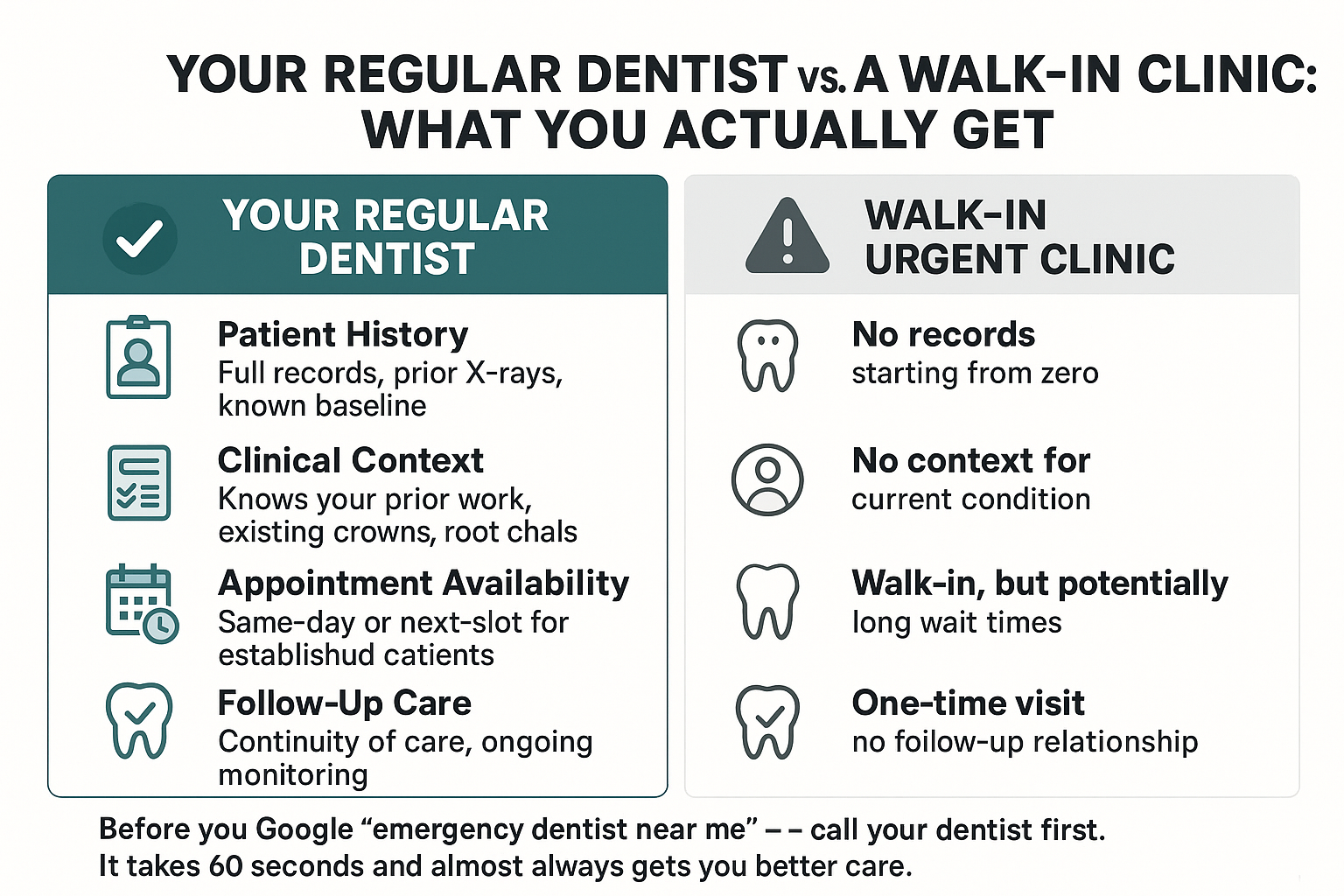
Walk-in dental urgent care clinics have multiplied across the Phoenix metro and the North Scottsdale corridor over the past few years. They’re marketed as fast and convenient. But the provider you see has never looked at your X-rays, doesn’t know which tooth had a root canal two years ago, and has no baseline to compare against. You’re not getting emergency care — you’re getting triage from a stranger.
Your regular general dentist can handle the vast majority of urgent dental situations, often with a same-day or next-available appointment. And when they already know your dental history, their clinical judgment is sharper from the first minute you’re in the chair.
What ‘Emergency Dental’ Actually Covers
People use the phrase ‘dental emergency’ to describe a wide range of situations, and not all of them carry the same urgency. Understanding the difference keeps you from either panicking over something manageable or waiting too long on something that genuinely needs same-day attention.
Situations that warrant same-day care — call a dentist as soon as the office opens, or go directly to an ER if it’s after hours:
- Swelling in your jaw, face, or neck
- Tooth pain accompanied by fever
- A dental abscess (visible pus, significant swelling, severe throbbing)
- A tooth knocked completely out of its socket
- Uncontrolled bleeding that won’t stop after gentle pressure
Situations that are urgent but can usually wait 24–48 hours with basic precautions:
- A crown that fell off with no pain underneath
- A lost or broken filling with mild sensitivity
- A chipped tooth with no exposed nerve
- A tooth that’s sore but not swollen
If you’re not sure which category you’re in, this breakdown of whether your situation is actually a dental emergency walks through the key signals to watch for. The short version: facial swelling, fever, or spreading pain moves you into the ‘call now’ column. Everything else — call your dentist first thing and describe exactly what’s happening.

Why a Walk-In Clinic Is the Wrong First Call
Walk-in emergency dental clinics are designed to get you in quickly. That’s their pitch. But speed and quality aren’t the same thing, and the gap shows up in ways patients don’t always anticipate.
When a dentist who has never seen you before examines an urgent situation, they’re working blind. They don’t know:
- Which teeth have had prior root canals
- What your baseline bite and occlusion looked like before the problem started
- Whether a crown that just fell off was placed six months ago or six years ago
- What restorative work is already in place that affects treatment options
That missing context changes clinical decisions in ways that matter. A dentist who already knows your records can tell at a glance whether the pain you’re describing is consistent with a tooth they’ve been watching, or whether something new is developing. A provider seeing you for the first time has to guess at too much.
One patient who reached out to our team described an experience with dental work done out of state that led to an infection serious enough to require hospitalization. That’s an extreme case, but it illustrates a real principle: when a dental problem gets treated without the full clinical picture, the fix can make things worse instead of better. Getting to a dentist who already knows your mouth — even if it takes a few hours longer — is almost always worth it.
For patients in North Scottsdale neighborhoods like McCormick Ranch or along the Shea Corridor, the practical reality is that your general dentist’s office may be able to see you just as fast as a walk-in clinic, without the information gap.
The 60-Second Call Most People Skip
When something goes wrong with a tooth, most patients assume their regular dentist can’t help them quickly. So they don’t even call. That assumption costs them more time, more money, and sometimes more tooth structure than they needed to lose.
Our team at Trinity Dental Care makes it a consistent practice to work urgent cases into the same day or the next available slot. Dr. Fink has treated patients across North Scottsdale who came in after a crown fell off at lunch and left with the tooth protected that afternoon. One patient left a review specifically about this: ‘Today I had an emergency and Trinity Dental worked me into their schedule immediately and took care of the problem.’
That’s not unusual. Most general dental practices hold open time in the schedule for exactly these situations — but patients never find out because they went to Google instead of picking up the phone.
The window between ‘something is wrong’ and ‘this is now a much bigger problem’ can be as short as 24–48 hours with certain infections or cracked teeth. A cracked tooth that’s left unprotected can split further. A crown that came off exposes the underlying tooth structure to bacteria, temperature, and pressure. The longer you wait, the more complicated the fix.
If you have a crown that’s come off or is failing, calling your regular dentist and describing the situation takes about 60 seconds. That call is almost always worth making before you drive to a clinic where nobody knows your name.
Emergency vs. Urgent: How to Read the Difference
Not every urgent dental situation is a true emergency, and treating them the same way leads to either unnecessary panic or dangerous delays. Use this as a quick reference.
| Situation | Urgency Level | What to Do |
|---|---|---|
| Swollen jaw or facial swelling | Emergency — same day | Call dentist immediately; ER if after hours |
| Tooth pain with fever | Emergency — same day | Call dentist immediately; may indicate abscess |
| Crown fell off, no pain | Urgent — 24–48 hrs OK | Protect the tooth, call dentist first thing |
| Lost filling, mild sensitivity | Urgent — 24–48 hrs OK | Avoid hard foods, call to schedule |
| Chipped tooth, no sharp pain | Non-emergency | Schedule within the week |
| Tooth knocked out completely | Emergency — within 30 min | Keep tooth moist, go directly to dentist or ER |
| Throbbing pain, no visible swelling | Urgent — call same day | Describe symptoms; dentist will advise |
What Happens When Your Regular Dentist Handles the Emergency
This shows the difference in care quality when your general dentist handles an urgent situation compared to a walk-in clinic visit.
Protecting a Tooth While You Wait for Your Appointment
If you’ve confirmed your situation can wait a day or two, there are a few things you can do to keep the tooth stable until you’re seen.
For a fallen crown: don’t throw it away. Rinse it gently and set it aside. In some cases, a dentist can re-cement the same crown rather than making a new one — but only if it’s intact. Keep it in a clean container. If the exposed tooth is sensitive, drugstore dental cement (sold as temporary filling material) can cover the area temporarily. Avoid chewing on that side.
For a lost filling: the same temporary cement works here too. The tooth is now exposed and vulnerable. Avoid anything sweet, hot, cold, or hard on that side until you’re seen. If you’re noticing significant sensitivity to temperature, that sensitivity has its own set of causes worth understanding — it doesn’t always mean the worst.
For a cracked or chipped tooth: rinse with warm water. If there’s any swelling, a cold compress on the outside of the cheek in 10-minute intervals helps. Don’t bite down on that tooth. A temporary fix for a broken tooth can buy you time, but it’s not a substitute for actual treatment.
None of these are permanent solutions. They’re bridges between the moment something goes wrong and the appointment where it gets fixed properly. If pain increases, swelling develops, or you develop a fever at any point, that moves you into same-day territory regardless of what the situation looked like when it started.
Frequently Asked Questions About Emergency Dental Care
Can my regular dentist really see me the same day for a dental emergency?
Often yes — but you have to call and ask. Most general dental practices, including ours, hold time in the daily schedule for urgent situations. Patients who assume their dentist is unavailable and go to a walk-in clinic instead are often surprised to learn a same-day slot was open. One call is all it takes to find out.
What if my crown fell off and I’m not in any pain — do I still need to go in quickly?
You don’t need to panic, but you do need to go in within 24–48 hours. The tooth under a crown isn’t built to handle direct exposure to temperature, pressure, and bacteria. Pain can develop quickly once the protection is gone. Save the crown — your dentist may be able to re-cement it if it’s still intact, which saves time and cost compared to making a new one. Read more about how long a dental crown should hold up and what affects its lifespan.
How do I know if my tooth pain is a real emergency or if it can wait?
The key signals that make something a true emergency are swelling, fever, and spreading pain. If any of those are present alongside tooth pain, call a dentist the same day — don’t wait. If the pain is significant but there’s no swelling or fever, call your dentist, describe the symptoms honestly, and let them advise you on timing. Tooth pain doesn’t always mean a root canal — but it does always mean you should get it evaluated.
Is a walk-in dental clinic ever the right choice?
If it’s a weekend, after hours, and you have genuine emergency symptoms — swelling, fever, a tooth knocked out — then yes, getting to whoever can see you fastest matters more than continuity of care. But on a weekday during business hours? Call your regular dentist first. The clinical difference is real, and you may find you can be seen just as fast.
What if I don’t have a regular dentist and something goes wrong?
That’s actually the most vulnerable position to be in dentally — and it’s worth fixing before a crisis happens. When you don’t have an established relationship with a dentist, you lose the clinical history advantage entirely. If you’re currently without a regular dentist in North Scottsdale, knowing what to look for when choosing a new one is a good place to start. Finding someone before you need urgent care puts you in a much better position.
Have an Urgent Dental Situation? Start With a Phone Call
If something is wrong with a tooth right now, the most useful thing you can do in the next two minutes is call your dentist and describe what’s happening. For patients across North Scottsdale — from McCormick Ranch to Scottsdale Mountain — Trinity Dental Care makes it a consistent practice to work urgent cases into the same day or next available slot. Dr. Fink and her team already know your records, and that matters when something goes wrong. Call 480-621-4040 or visit trinitydentalcares.com to reach the team and get an honest answer about what your situation actually needs.