
Direct Answer: Tooth pain usually signals decay, a crack, an infection, gum disease, or a failing restoration. The location, timing, and type of pain help narrow down which one — and some causes are more urgent than others.
Tooth pain is one of the most common reasons people search for a dentist — and one of the most misunderstood. I’ve seen patients in our North Scottsdale office who’ve been dealing with a dull ache for months, convincing themselves it would go away. It usually doesn’t.
The frustrating part is that tooth pain has a lot of possible causes, and they don’t all feel the same or require the same treatment. A sharp jab when you bite down is a different story than a constant throb that wakes you up at two in the morning.
This article breaks down the causes we see most often — what they feel like, why they happen, and when you should stop waiting and call someone. I’m not going to try to diagnose your specific situation, but I can help you understand what your pain pattern might be telling you.
Pain When You Bite Down: Cracks and Failing Restorations
If your tooth hurts specifically when you chew or bite, but feels fine the rest of the time, a cracked tooth or a failing restoration is often the culprit.
Cracked teeth are more common than most people realize — especially in adults over 40 who’ve been grinding, clenching, or who have older large fillings. The crack may be too small to see on an X-ray, but you’ll know it’s there because the pain is sharp and predictable. It happens when the two sides of the crack flex apart under pressure.
Failing restorations — old fillings, loose crowns, or a broken tooth filling — can cause similar biting pain. When the seal breaks down, bacteria get underneath, decay starts forming, and pressure becomes uncomfortable. If you’ve had a crown for more than ten years, it’s worth having it checked even if it still looks intact.
What to watch for:
– Sharp, shooting pain specifically when biting into something hard
– Pain that stops quickly after you release the bite
– Sensitivity to temperature in a tooth that didn’t used to be sensitive
– A crown that feels slightly loose or different when you close your jaw
This kind of pain tends to be intermittent, which lulls people into waiting. But a cracked tooth left untreated can progress to nerve involvement — and at that point, a simple restoration becomes a much more involved situation.
Constant Pain or Pain That Wakes You Up at Night: Take This Seriously
Pain that doesn’t go away — or that pulls you out of sleep — is in a different category than occasional sensitivity. This pattern almost always points to the nerve being involved, either through an abscess or advanced decay that has reached the pulp of the tooth.
An abscess is an infection at the root of the tooth or in the surrounding gum tissue. The pressure builds, and since there’s nowhere for it to go, the pain becomes relentless. Some patients describe it as a deep, pounding ache that makes it hard to focus on anything else. Others notice swelling near the gum line, a bad taste in their mouth, or a small pimple-like bump on the gum near the affected tooth.
I want to be direct about this: night pain and pain that won’t let up are reasons to call a dentist promptly — not something to manage with ibuprofen and wait out. The American Association of Endodontists notes that untreated dental abscesses can spread to surrounding tissue and, in rare cases, become a serious health issue. The infection doesn’t resolve on its own.
Over-the-counter pain relievers can take the edge off while you wait for your appointment, but they’re masking the symptom — not addressing the source. Several callers to our practice have described exactly this cycle: the pain eases up with medication, they wait a few days, it comes back worse. That “comes and goes” pattern is one of the more common reasons a problem that could have been caught early becomes a bigger fix.
If you’re unsure whether your situation is a true emergency, this article on whether your tooth situation is actually a dental emergency can help you think through it.
What Your Pain Pattern Might Be Telling You
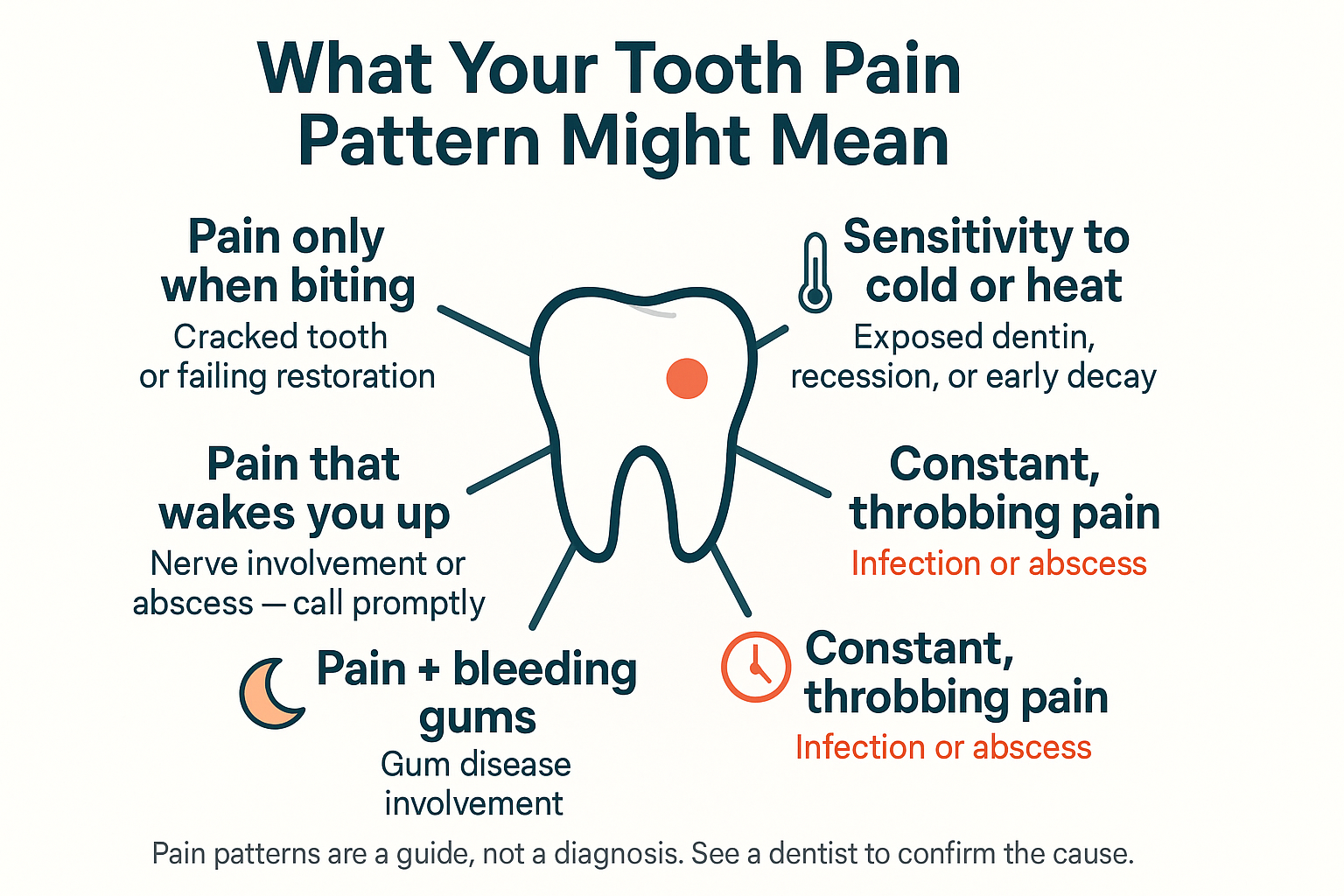
Different types of tooth pain tend to point in different directions. This quick reference shows the most common patterns and what each one often signals.
Temperature Sensitivity: When Hot or Cold Makes You Wince
Temperature-triggered pain is one of the most common complaints I hear — and it covers a wide range of underlying causes.
Brief, sharp sensitivity to cold that goes away within a few seconds is often a sign of exposed dentin. This happens when gum recession pulls the gum tissue away from the root surface, leaving an area of the tooth uncovered and unprotected. It can also happen when enamel wears down over time. It’s uncomfortable, but it’s usually not an emergency.
Sensitivity that lingers after the temperature source is gone — where cold water triggers pain that sticks around for 20 or 30 seconds — is a different signal. That lingering response often means the nerve is irritated or inflamed, which can be an early indicator that the pulp is involved. It doesn’t automatically mean you need a root canal, but it does mean the tooth deserves a closer look sooner rather than later. Our article on tooth sensitive to cold but not hot covers this in more detail.
Gum recession is worth its own mention here. It’s more common in adults in their 40s and 50s, and it can develop quietly over years without obvious symptoms — until one day, cold water or even air hits a root surface and produces a sharp response. If you’re also noticing bleeding when you floss, recession and gum disease may be connected.
The Combination That Catches People Off Guard: Pain Plus Bleeding Gums
One of the most overlooked causes of tooth pain is gum disease — and patients are often surprised to hear it because they think gum problems and tooth pain are separate categories.
They’re not. Active gum disease creates inflammation around the roots of your teeth, and that inflammation can absolutely produce pain — particularly when you’re chewing, flossing, or pressing on the area. One caller described upper molar pain alongside bleeding every time she flossed. She assumed the pain was in the tooth itself. In many situations like hers, the gum tissue around the tooth is the primary issue.
Gum disease also changes the environment around your roots. As pockets deepen between the gum and tooth, bacteria accumulate in areas that are impossible to reach with a toothbrush. That bacterial activity produces inflammation, and inflammation produces pain. If you’ve been noticing soreness near the gum line — not a sharp nerve pain, but a dull ache or tenderness — that’s a pattern worth mentioning when you call.
The tricky thing about gum-related pain is that it can feel similar to tooth pain and it often gets misattributed. Understanding whether you actually need a deep cleaning is a fair question to ask — and one we’re always willing to walk through with you.
Common Causes of Tooth Pain at a Glance
This table summarizes the most common causes, the typical pain pattern associated with each, and how urgent each one tends to be.
| Cause | Typical Pain Pattern | Urgency Level |
|---|---|---|
| Tooth decay | Dull ache or sensitivity; can worsen over time | Moderate — don’t wait indefinitely |
| Cracked tooth | Sharp pain on biting; may come and go | Moderate to high — cracks can deepen |
| Dental abscess | Constant, throbbing; may wake you at night | High — contact a dentist promptly |
| Failing restoration (crown or filling) | Sensitivity or biting pain in a previously treated tooth | Moderate — schedule soon |
| Gum recession | Brief cold sensitivity near the gum line | Lower — but worth addressing |
| Gum disease | Dull ache, tenderness, or pain when chewing; bleeding gums | Moderate — ongoing damage if untreated |
| Bruxism (grinding) | Generalized jaw soreness, dull ache in multiple teeth, morning pain | Moderate — protective treatment available |
Grinding and Clenching: The Cause That Hides in Plain Sight
Bruxism — the clinical term for grinding or clenching your teeth — is one of those causes that flies under the radar because it often happens at night, when you’re completely unaware of it.
The pain pattern tends to be different from other causes. Instead of a sharp, localized ache in one tooth, grinding pain is often more diffuse — a soreness in the jaw, a dull ache across several teeth, or morning headaches that start around the temples or ears. Some people wake up feeling like they’ve been chewing all night. Because the discomfort doesn’t pinpoint to a single tooth, patients sometimes don’t connect it to a dental cause at all.
Over time, grinding wears down enamel, creates small cracks, and puts stress on existing restorations. It also stresses the jaw joint (TMJ), which can make the pain feel more widespread and harder to track. A custom night guard is the most common protective measure — it doesn’t stop the grinding behavior, but it keeps the teeth from taking the full force of it. Our article on how to clean a mouth guard the right way has practical guidance if you’re already using one.
If you’ve been told by a partner that you grind at night, or if you’re waking up with jaw soreness, it’s worth mentioning at your next exam — even if your teeth look fine on the surface.
Frequently Asked Questions About Tooth Pain
My tooth hurt for a few days and now it doesn’t. Does that mean it healed on its own?
Unfortunately, no — this is one of the most common misreads I see. When a tooth stops hurting after a period of significant pain, it sometimes means the nerve has died rather than the problem resolving. The infection or decay may still be present and actively worsening, even though the pain signal is gone. A tooth that stopped hurting on its own after being significantly painful deserves an X-ray, not a sigh of relief.
Does tooth pain always mean I need a root canal?
No, and this is a fear that keeps a lot of people from calling. Many causes of tooth pain — decay caught early, a cracked tooth treated before it reaches the nerve, gum disease, or sensitivity from recession — do not require a root canal. The treatment depends entirely on what’s causing the pain and how far it’s progressed. Our article on whether tooth pain always means a root canal covers this in detail.
I have pain near a tooth that already has a crown. Can a crowned tooth still get infected?
Yes. A crown protects the visible part of the tooth, but the root and surrounding tissue are still vulnerable. Decay can form at the margin where the crown meets the gum line, and an infection can develop at the root tip even years after a crown is placed. Pain near a crowned tooth is worth having evaluated — it’s not automatically a sign the crown failed, but it shouldn’t be ignored either.
How does Dr. Fink approach figuring out what’s actually causing the pain?
The approach we take at Trinity Dental Care is to identify the root cause before recommending any treatment. That means a thorough exam, targeted X-rays, and a real conversation about what we’re seeing — not a rushed diagnosis. Patients who’ve been told conflicting things by other providers often tell us they appreciate that we take the time to explain what we found and why, before anything else is discussed.
Can pain in my upper back teeth actually be related to my sinuses?
Yes — this is a real phenomenon. The roots of the upper back molars sit close to the sinus cavity, and sinus pressure or a sinus infection can create a dull, generalized ache that mimics tooth pain. It typically affects multiple teeth rather than one isolated spot, and it often comes alongside other sinus symptoms like congestion or facial pressure. A dentist can usually help distinguish between sinus-related discomfort and a true dental problem.
Ready to Find Out What’s Actually Going On?
Tooth pain is your body’s way of flagging something that deserves attention — and the sooner it gets evaluated, the more options you usually have. If you’re in the North Scottsdale area and have been sitting with pain you can’t explain, Trinity Dental Care is here to help you figure out what’s behind it. Call us at 480-621-4040 or visit trinitydentalcares.com to schedule an appointment with Dr. Fink.