
Direct Answer: A smile makeover is a planned sequence of procedures — gum health, then restorative work, then cosmetic finishing — and the order protects both the outcome and your investment.
People come in asking for a specific thing — whiter teeth, a veneer on a chipped tooth, or bonding to close a gap. And that makes sense. You see a problem, you want it fixed. But a smile makeover almost never works the way a single repair does.
The reason isn’t complexity for its own sake. It’s that your teeth, gums, and bite are all connected. Work done in the wrong order either doesn’t hold up, doesn’t match, or creates a new problem while solving the first one. We’ve seen it happen — and when it does, patients end up spending more time and money than they would have with a proper plan from the start.
This article explains how a real smile makeover is sequenced, why the order matters, and what two realistic treatment tracks look like from beginning to end. If you’ve been thinking about improving your smile — whether it’s a minor refresh or something more involved — understanding the sequence is the most useful thing you can know going in.
Why the Order of Steps Isn’t Negotiable
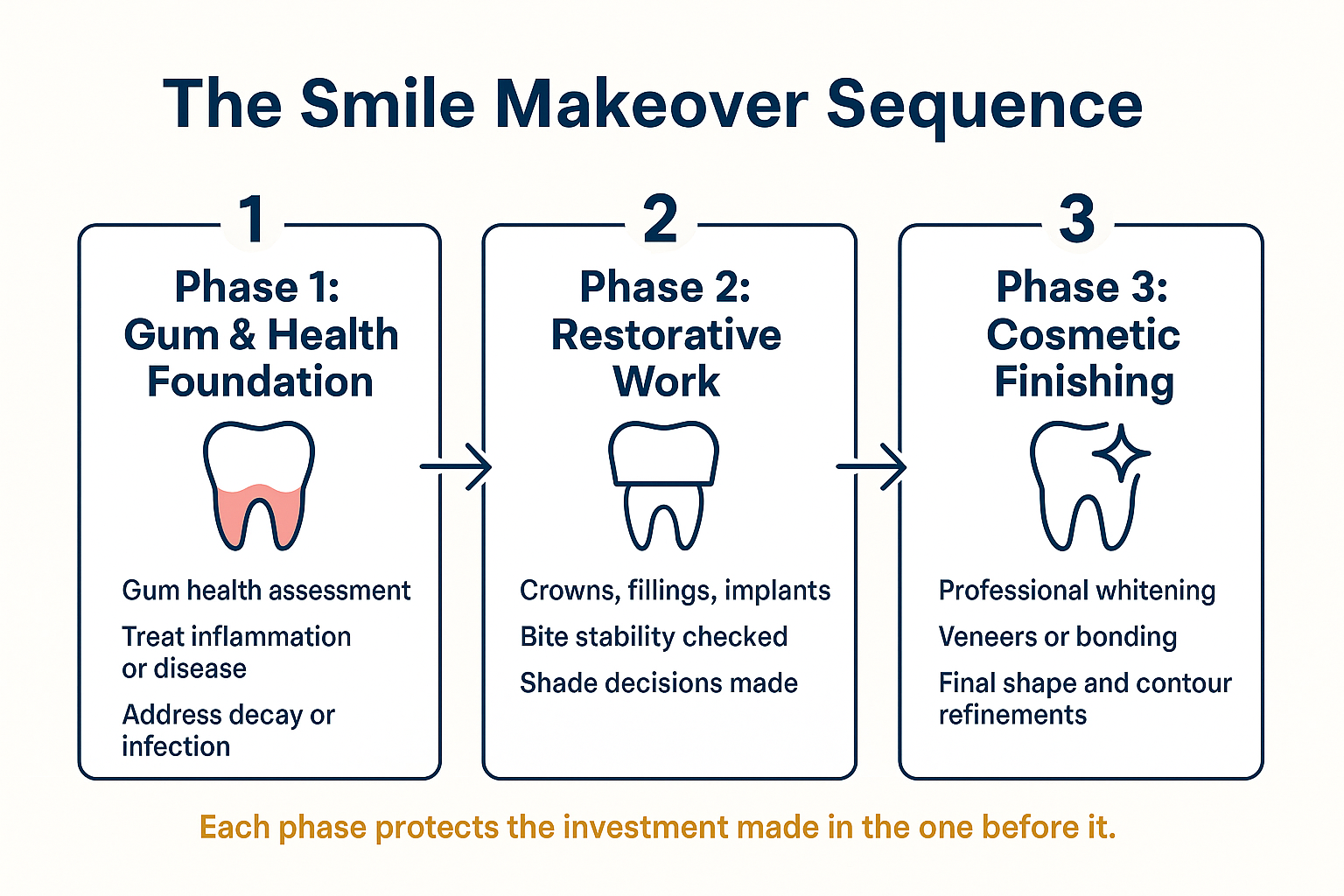
Every smile makeover, regardless of scope, follows the same basic logic: you fix what’s unhealthy first, then you restore what’s damaged, then you refine what’s cosmetic. Skipping ahead creates problems that are expensive to undo.
Gum health comes first — always. Inflamed or receding gums change the way a finished restoration looks. A veneer placed on a tooth with active gum disease sits on an unstable foundation. The gumline may recede further after placement, leaving an exposed margin that looks unnatural and is harder to correct later. If bleeding gums are part of the picture, that gets addressed before any cosmetic work begins.
Restorative needs — crowns, implants, fillings — come next. If a tooth needs a crown, that crown becomes part of the smile’s structure. Its shade, shape, and position all affect what cosmetic work can do afterward. Trying to add veneers before crowns are placed means the cosmetic work might not fit with what comes later.
Finally, cosmetic finishing — whitening, veneers, bonding refinements — happens last. By then, the foundation is stable, and every cosmetic decision can be made with the complete picture in view.
The Whitening-First Rule and Why It Matters
One of the most common sequencing mistakes we see is placing restorations before whitening. It seems minor, but it changes the entire outcome.
Crowns, veneers, and bonding are color-matched to your teeth at the time of placement. Once they’re placed, that color is permanent — those materials don’t respond to whitening the way natural enamel does. So if you whiten afterward, your natural teeth get brighter and your restorations stay the same shade they were when they were made. The mismatch is visible, especially on front teeth.
The right sequence: whiten first, let the shade stabilize for a couple of weeks, then match restorations to the brightened result. That way, everything finishes at the same tone. If you want to understand how long professional whitening results actually hold, that’s worth reading before you make decisions about timing.
Even small cosmetic refinements — redoing bonding on front teeth, for example — work best inside a bigger plan. Shade, shape, and how the teeth meet when you bite all need to stay consistent. One tooth that’s slightly brighter or a slightly different contour than the rest shows more than people expect.

The Smile Makeover Sequence at a Glance
Here’s how the three phases of a smile makeover build on each other — and why each one has to happen before the next.
Two Realistic Treatment Tracks — and Honest Timelines
Not every smile makeover is the same scope. Most patients fall into one of two tracks, and the difference between them is pretty clear once you’ve had a full evaluation.
Track 1 — Cosmetic Refresh
This is for patients whose teeth are structurally healthy but whose smile has dulled, chipped, or drifted over time. It typically involves:
- Professional whitening (in-office or take-home, or both)
- Bonding on one or two front teeth
- Minor reshaping or contouring
Timeline: Most of this can be completed in two to four appointments over four to six weeks, once gum health is confirmed. The whitening shade needs two weeks to stabilize before bonding shade is matched.
Track 2 — Comprehensive Rehabilitation
This track is for patients who need restorative work alongside cosmetic improvements — things like multiple crowns, an implant replacing a missing tooth, or significant bite correction alongside cosmetic finishing. This is also the track for patients who are correcting prior dental work that wasn’t done well.
Timeline: Depending on complexity, this can take anywhere from three to six months or longer, especially if implant placement is involved. The process around dental crowns adds time, but each step is there for a reason.
The key difference between tracks isn’t just cost or time — it’s how many interdependent decisions have to be made. In a comprehensive case, every choice affects the next one. That’s exactly why sequencing matters more, not less, when the scope is bigger.
When You’re Fixing Someone Else’s Mistakes
We occasionally get calls or form submissions from patients who’ve had dental work done elsewhere — sometimes in another state, sometimes at a practice they didn’t fully trust — and things went wrong. One patient described reaching out after receiving dental work that resulted in infections serious enough to require hospitalization. They weren’t looking for a quick fix. They needed someone to start over with a real plan.
Corrective cases are a category of their own, and they almost always require comprehensive evaluation before anyone recommends a single procedure. The original work may have altered the bite, changed how adjacent teeth sit, or left structural problems beneath a surface that looks repaired. Treating only the visible problem without evaluating everything underneath it is how patients end up in the same situation twice.
If you’ve had dental work that didn’t go the way it should have, the most important first step is a thorough exam — X-rays, bite assessment, gum evaluation, and an honest conversation about what’s actually there. Understanding what’s causing tooth pain is often the first real answer a corrective patient needs. From there, a sequenced plan gives you a path forward that doesn’t create new problems while solving old ones.
The American Dental Association notes that a thorough treatment plan should address all conditions affecting a patient’s oral health before elective cosmetic work is undertaken — a standard that holds especially true in corrective cases.
Cosmetic Refresh vs. Comprehensive Rehabilitation — What to Expect
These two tracks cover most smile makeover cases. Where you land depends on what your evaluation finds.
| Factor | Cosmetic Refresh | Comprehensive Rehabilitation |
|---|---|---|
| Who it’s for | Healthy teeth, mostly cosmetic concerns | Decay, missing teeth, prior bad work, or bite issues |
| Common procedures | Whitening, bonding, minor reshaping | Crowns, implants, veneers, possible gum treatment |
| Typical timeline | 4–6 weeks across 2–4 appointments | 3–6+ months depending on complexity |
| Whitening timing | Before bonding — always | Before restorations — always |
| Starting point | Gum health confirmation | Full evaluation including X-rays and bite assessment |
| Cost range | Generally lower; fewer procedures | Higher; scope-dependent — ask for a personalized estimate |
What Happens If You Skip the Sequence
It’s worth being direct about this, because it’s what causes patients to end up in corrective situations in the first place.
When cosmetic work is done without addressing underlying health issues, the results don’t last. A veneer placed over a tooth with undetected decay will eventually fail — and the failure is often more complicated than the original problem would have been. When restorations are placed before whitening, the color mismatch is permanent until the restoration is replaced.
And when small cosmetic work is done without considering the bigger picture — bite, adjacent teeth, gum architecture — it sometimes has to be undone entirely before a proper plan can move forward. The difference between a cosmetic touch-up and a real smile transformation comes down to whether the work fits into a coherent plan or just addresses the most visible problem in the moment.
We’re not saying this to make the process sound more complicated than it needs to be. Most patients who come in for a smile consultation find out their situation is simpler than they feared. But understanding why the sequence exists makes it easier to trust the plan when it’s presented to you — and to ask the right questions if something doesn’t add up.
Frequently Asked Questions About Smile Makeovers
Can I just get one veneer without doing a full smile makeover?
Yes, but the shade and shape still need to be planned carefully. A single veneer has to match the surrounding teeth — their color, contour, and how they sit when you bite. Even a single-tooth cosmetic procedure works best when the dentist has looked at the full picture. If whitening is something you’re considering, it should happen before the veneer is placed so the match is accurate.
How long does a smile makeover take from start to finish?
It depends on what your evaluation finds. A cosmetic refresh — whitening plus bonding or minor reshaping — can be done in four to six weeks across a handful of appointments. A comprehensive case involving crowns, implants, or corrective work can take three to six months or more. Your dentist can give you a realistic timeline once they know what’s actually needed.
Does whitening always have to come before veneers or bonding?
Yes, if whitening is part of your plan at all. Restorations are color-matched at placement and don’t respond to whitening later. If you whiten after your veneers or bonding are placed, your natural teeth will brighten but the restorations won’t. The shade gap is visible and the only fix is replacing the restoration.
I had bad dental work done by a previous dentist. Where do I even start?
With a full evaluation — no shortcuts. Before anyone recommends a single procedure, you need X-rays, a bite assessment, and a gum evaluation to understand what’s actually going on beneath the surface. Corrective cases need a sequenced plan because the prior work may have changed how your teeth, bite, and gums interact. Starting with a thorough exam is the only honest starting point.
Can I spread out a smile makeover over time for cost reasons?
In many cases, yes — as long as the sequencing is preserved. Some patients complete the health and restorative phases first and return for cosmetic finishing later. What matters is that the plan is mapped out from the beginning so later steps don’t conflict with earlier ones. A good treatment plan accounts for phasing if that’s what makes sense for your situation.
Does my gum health really affect cosmetic results that much?
More than most people expect. The gumline frames every tooth in your smile. If gums are inflamed, receding, or uneven, even excellent cosmetic work won’t look the way it should. Gum health also affects how long restorations last — healthy tissue holds them in place and maintains a stable margin. Skipping this step is one of the most common reasons cosmetic work has to be redone.
Ready to Understand What Your Smile Actually Needs?
If you’ve been thinking about improving your smile — whether it’s one chipped tooth or something more involved — the best first step is an honest evaluation that shows you the full picture. Our team at Trinity Dental Care works through cases like this every week, and we’ll tell you exactly what sequence makes sense for your situation before anything else. Call us at 480-621-4040 or visit trinitydentalcares.com to schedule a consultation.