
Direct Answer: After gum treatment, bacteria below the gumline start rebuilding within about 90 days. A three-month interval catches that regrowth before it damages bone. It is a clinical judgment, not a fixed rule.
You have been coming in twice a year since you were a kid. Then you finish gum treatment, and at checkout someone tells you the next visit is in three months, not six.
I have watched that moment land on a lot of faces. Most people are too polite to say it out loud, so they think it instead: is this office just padding the schedule?
That is a fair question, and we already wrote a whole piece on whether a deep cleaning is a real recommendation or an upsell. This article is a different one. This is about what happens to your calendar after that treatment is behind you, and why the number three keeps showing up.
Why Three Months and Not Six
The interval sounds arbitrary until someone explains the biology, so here it is in plain English.
Gum treatment clears bacteria out of the pockets between your teeth and gums. But that space does not stay empty. The bacterial population starts rebuilding toward pre-treatment levels within roughly 90 days.
Six months works fine for healthy gums, because there is nothing below the gumline that needs disrupting. Once you have a history of periodontal disease, that same six-month gap gives the bacteria about twice the runway they need.
So the three-month visit is not a new sales category. It is a timing decision built around how fast that population comes back.
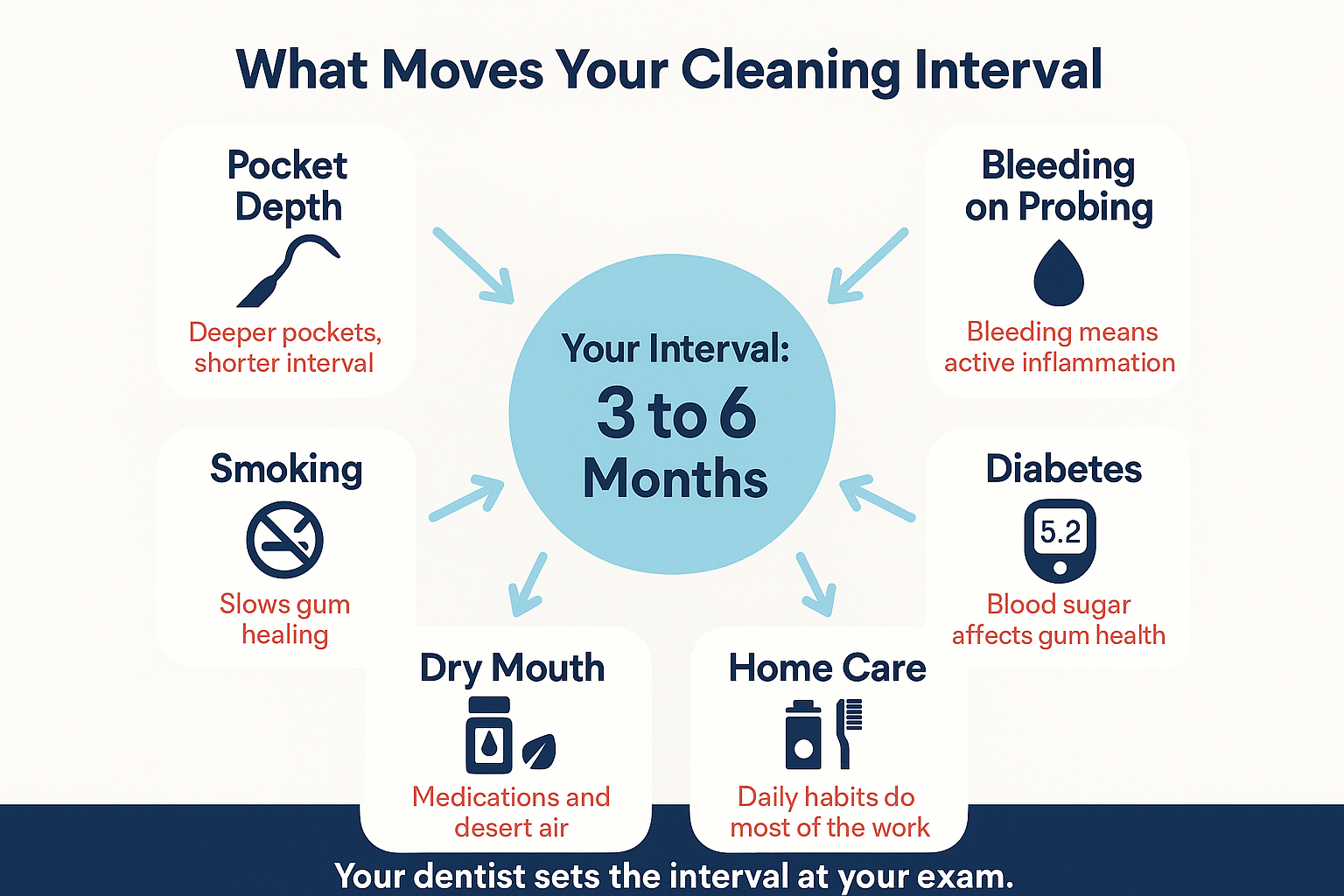
And it is a judgment call, not a fixed rule. Several things move the number up or down:
- Pocket depth readings around each tooth
- Whether your gums bleed when probed
- Smoking or vaping
- Diabetes and blood sugar control
- How fast you personally build tartar
- Certain medications that dry out your mouth
The National Institute of Dental and Craniofacial Research notes that gum disease is driven by bacteria in plaque along and under the gumline, which is exactly the material a maintenance visit is aimed at.
Plenty of patients tighten to three months for a season, stay stable, and stretch back out later. Others stay at three months long term. Your readings decide it, not a policy.
What a Maintenance Visit Actually Involves
Most people picture a polish. That is not what this appointment is.
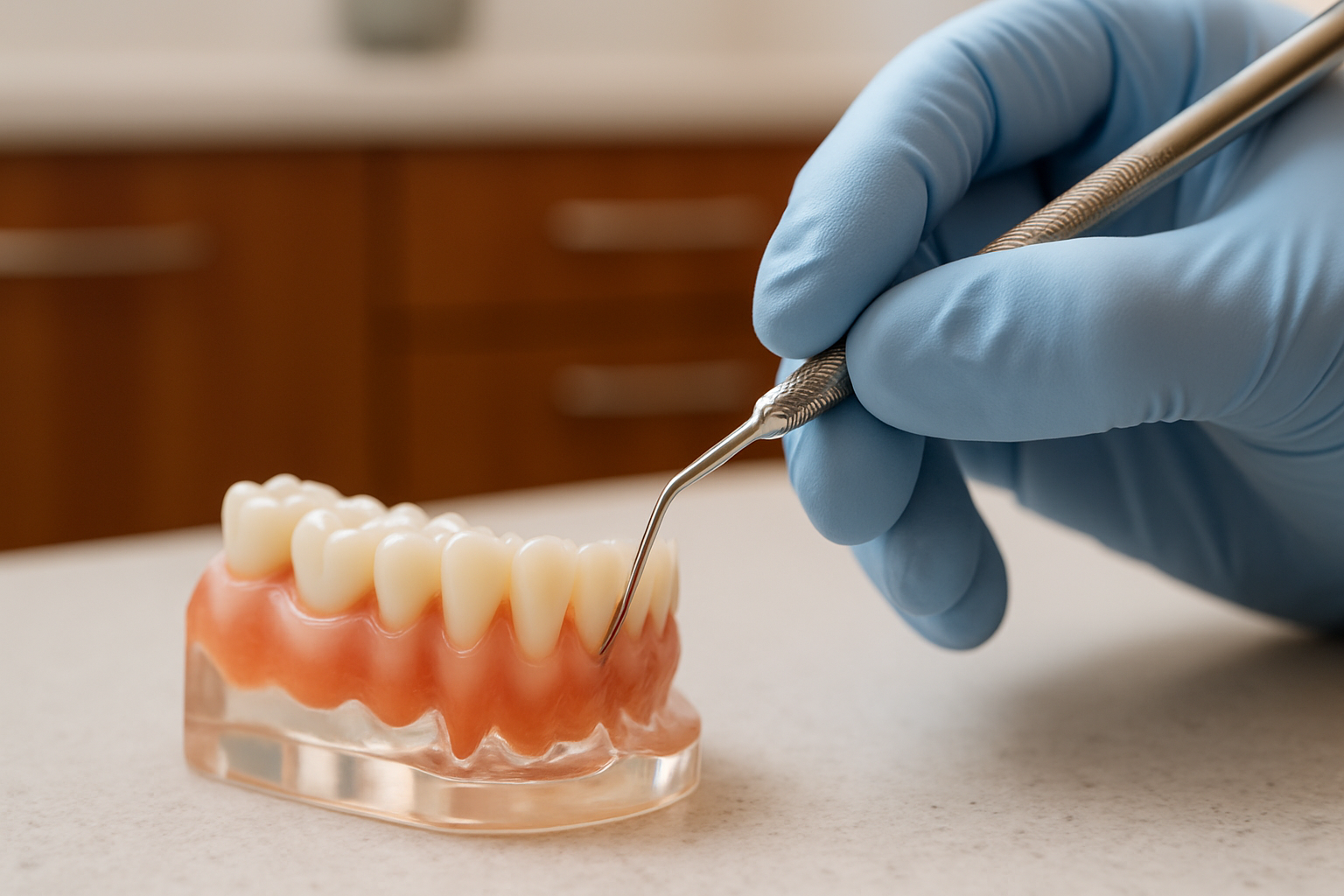
A periodontal maintenance visit starts with measurement. Your hygienist walks around each tooth with a probe and calls out pocket depth numbers, usually six readings per tooth, while someone charts them.
They also note where the gums bleed on probing. Bleeding points are the early warning system, and they often show up before you feel a single thing.
Then comes the cleaning itself, which goes above and below the gumline. Regular cleanings handle the surfaces you can see and feel. Maintenance goes into the pockets, where the bacteria actually live.
That is why the appointment can run longer and feel more detailed than what you remember from your twenties. Comparing the two is not a fair comparison.
Here is the part I wish more patients knew: the recurring measurements are the useful part. When a reading that sat at 4 for a year shows up at 5, that is information you get before anything is lost, not after.
If you want a walkthrough of the standard version for comparison, we covered what actually happens at a dental exam and cleaning separately.
Routine Cleaning vs. Periodontal Maintenance
These two appointments get lumped together in conversation, but they are built for different situations. Here is how they differ in practice.
| What’s compared | Routine cleaning | Periodontal maintenance |
|---|---|---|
| Typical interval | Every 6 months | Every 3 to 4 months, sometimes tighter |
| Who it’s for | Healthy gums, no history of bone loss | Patients who have completed gum treatment |
| What gets cleaned | Mostly at and above the gumline | Above and below the gumline, inside pockets |
| Measuring | Spot checks | Full pocket readings and bleeding points, every visit |
| Billed as | A preventive cleaning code | A separate periodontal code |
| How it feels | Quick and familiar | Longer, more methodical, more talking through numbers |
What Moves Your Cleaning Interval
Two people can finish the same gum treatment and end up on different schedules. These are the factors that push the number in one direction or the other.
The Insurance Question Nobody Wants to Ask Out Loud
This is the friction point that quietly breaks the schedule, and it comes up on our phones constantly. Roughly one in eight calls we take is somebody asking about coverage, naming plans like Delta Dental, Cigna, MetLife, Humana, and BCBS Federal.
Here is the wrinkle. A periodontal maintenance visit is billed under a different code than a routine cleaning. And many plans are written around two cleanings per calendar year.
So when your dentist recommends four visits, the third and fourth raise real questions about what gets paid and what does not. That is a legitimate concern, not a cheap excuse.
What I tell people to do, before they decide they cannot afford it:
- Ask the front desk to run a benefits check on your specific plan
- Request a written estimate before treatment, not after
- Ask whether your plan has a separate allowance for periodontal frequency
- Ask what happens to your annual maximum if you space visits differently
One patient called us specifically to ask whether her benefits covered extra cleanings during a pregnancy. She found out she qualified for more visits than she had assumed.
I will not put dollar figures here, because plans vary that much. But the answer is knowable, and it takes one phone call. If you are looking at the calendar year, our piece on unused dental benefits before December 31 is worth a read.
The North Scottsdale Reality Check: Travel and Dry Air
Two local things wreck this schedule more than anything clinical.
The first is age and dryness. Scottsdale skews older than the national average, with about a quarter of residents 65 or older, and gum problems climb with age. Add common medications that cause dry mouth, then add the desert air on top of that, and you have less saliva doing the work saliva is supposed to do.
The second is travel. A lot of our patients leave the Valley during the hottest stretch, and plenty of others are only here part of the year.
That is how a three-month interval quietly becomes an eight-month one. Nobody decided to skip anything. A trip moved, then the reschedule landed in a month they were gone, and suddenly it is fall.
Rescheduling is already the single most common reason patients call our office, so I am not scolding anyone. I am just saying the fix is boring and it works:
- Book the next visit before you leave the building, while the schedule is in front of you
- Work it around your travel window instead of hoping it fits
- If you are seasonal, ask for a plan that stacks visits around the months you are actually here
- Move a booked appointment rather than canceling it outright
The Three-Month Visit Is the Checkpoint. Your Daily Habits Are the Treatment.
I want to be honest about the math here. You are in our chair for about an hour, four times a year. That is four hours out of 8,760.
Everything else happens at your bathroom sink. The maintenance visit is the checkpoint, the measurement, the reset. Your daily routine is what actually holds the ground between visits.
This is where patients want specifics, not “brush and floss.” And it is one of the things our hygienists get singled out for in reviews, because they walk people through technique instead of handing over a pamphlet.
One patient put it this way: “Polly did a great job and appreciated her recommendations and explanation of strategies to use during flossing and use of water pik.” That is Dianne R., and it is a good description of what a maintenance appointment should include.
I am not going to give you technique instructions in a blog post, because the right approach depends on where your pockets are and how your teeth sit together. That comes from an exam, not an article.
But do ask at your next visit. Ask which specific areas are bleeding, and what tool works best for those spots. If you are still sorting out how these appointments differ at all, we broke down deep cleaning versus a regular cleaning in more detail.
Frequently Asked Questions About Periodontal Maintenance Every Three Months
Am I stuck at three months forever?
Not necessarily. Some patients tighten to three months for a season, hold stable readings across several visits, and stretch the interval back out. Others do better staying at three months long term. Your pocket readings and bleeding points decide it, and they get re-checked every single visit.
Will my insurance pay for four cleanings a year?
It depends entirely on your plan. Many plans allow two preventive cleanings per year, but periodontal maintenance is billed under a different code, and some plans handle frequency differently for it. Ask the front desk to run a benefits check and give you a written estimate before you commit.
I fell off the schedule for a year. Do I have to start over with a deep cleaning?
Sometimes yes, sometimes no. It comes down to what your gums look like now, not how long it has been. Some people come back after a gap with readings that held. Others have pockets that deepened and need treatment again. An exam answers it, guessing does not.
Does a water flosser replace regular floss?
For most people it works better alongside floss than instead of it. Which one matters more for you depends on where your problem areas are, so it is a good question to ask your hygienist while they are looking at your chart.
Why does this appointment take longer than my old cleanings?
Because more is happening. Full pocket measurements around every tooth take real time, and cleaning below the gumline is slower and more careful than polishing the surfaces you can see. It is a different appointment, not a longer version of the same one.
Not Sure Where Your Interval Stands?
Most articles about gum treatment stop at the procedure and go quiet about the two years that follow, which is the part that actually determines how things turn out. Seeing the same dentist and a small hygiene team visit after visit is how somebody notices that a reading crept from 4 to 5, back when it is still an easy conversation. If you are unsure what your current interval should be, or you have fallen off the schedule and want to know where you stand, you are welcome to call our North Scottsdale office at 480-621-4040 or visit trinitydentalcares.com to ask about a periodontal evaluation.