
Direct Answer: Seeing the same dental hygienist keeps your gum measurements comparable visit to visit, so small changes read as real signals instead of differences in technique. You also stop repeating your history.
Every month, a handful of people call our office and ask some version of the same question before they confirm anything: “Will I have the same hygienist?” A few would rather move their cleaning out a month than sit down with someone new.
I want to say this plainly, because most articles on this subject treat it as a sentimental preference. Wanting the same dental hygienist is a clinical preference, not a fussy one. It is the same instinct that keeps you with the same primary care doctor for twenty years.
Below I will walk through why continuity actually changes what gets caught, what a good handoff looks like when your hygienist is out, and the one scheduling habit that matters most for North Scottsdale patients who are only here part of the year.
Why asking for the same dental hygienist is not being difficult
When somebody calls and asks who they will be seeing, they are almost never asking about personality. They are asking whether they will have to explain themselves again.
They want to skip the part where they say they clench at night, that the lower left always runs sensitive, that they had a root canal in 2019 and the tooth still feels odd on cold water. A hygienist who already knows all of that starts the appointment twenty minutes ahead.
You can see this in how patients talk about their care. In our Google reviews, people name their hygienist by first name years into the relationship, which is unusual. One patient wrote that hers is “personable, gentle, and incredibly thorough,” and that cleanings feel “easy and stress-free.”
That matters most for the folks who put off dentistry in the first place. If you are someone who has to talk yourself into the chair, a familiar face is not a luxury. It is the thing that gets you through the door, which is why I usually bring it up alongside the other practical ways to take the edge off a dental appointment.
The clinical reason: a baseline is only useful if it was measured the same way
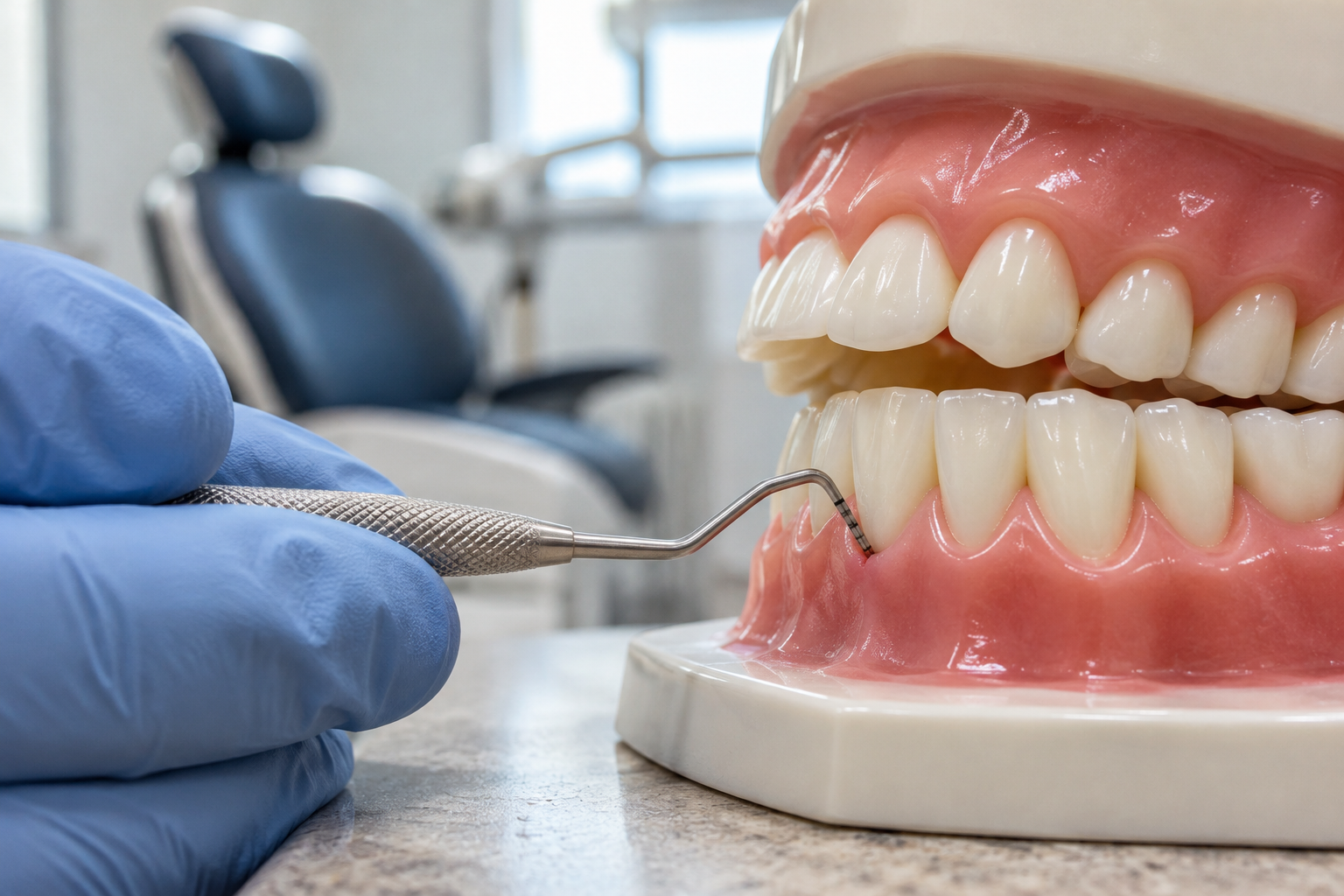
Here is the part that rarely gets explained to patients. Gum charting is a hand measurement taken at six points around every single tooth. That is roughly 168 readings in a full mouth, all taken with a thin probe, by feel.
The absolute numbers matter less than the direction they move. A 2 millimeter pocket that reads 4 millimeters a year later is a real signal. Gum disease is also quiet in its early stages, which is exactly why tracked measurements beat how your mouth feels, something the National Institute of Dental and Craniofacial Research spells out clearly.
But that 2 to 4 jump only means something if both readings were taken the same way. Probing pressure, angle, and where exactly the probe lands all vary a little between people. When the same hands take the readings year after year, that variable mostly drops out.
The same logic applies to things that never make it onto a chart as a number:
- New wear facets on the biting surfaces that were not there last spring
- A crown margin that looks slightly different than it did at the last visit
- Tissue color and texture in one quadrant that has shifted
- A filling edge that has started to catch floss
- Stain patterns that suggest a new habit or a changed medication
None of those are dramatic on their own. They are noticed by comparison, and comparison is easier when one person has been looking at your mouth for five years. If your hygienist has ever moved you from two cleanings a year to a three month schedule, that call was almost certainly built on exactly this kind of tracked change.
What continuity actually changes, visit to visit
This is the difference I see between a patient who sees one hygienist and a patient who gets whoever is open that day.
| What is being tracked | Same hygienist each visit | Different person each visit |
|---|---|---|
| Gum pocket depths | Small shifts stand out as real change | Small shifts may be technique variation |
| Tooth wear and clenching | Noticed by comparison to last visit | Usually only caught once it is obvious |
| Your sensitive areas | Already known, approach adjusted | Explained again every appointment |
| Home care coaching | Builds on what you tried last time | Restarts from the general advice |
| Older restorations | Watched over years before they fail | Judged on one snapshot in time |
Continuity will break eventually. What a good handoff looks like.
I am not going to pretend otherwise. People take vacations, get sick, have babies, and move. In a small practice, one planned week off turns directly into a stack of moved appointments, and our schedule is Monday through Thursday, which narrows the room to shuffle.
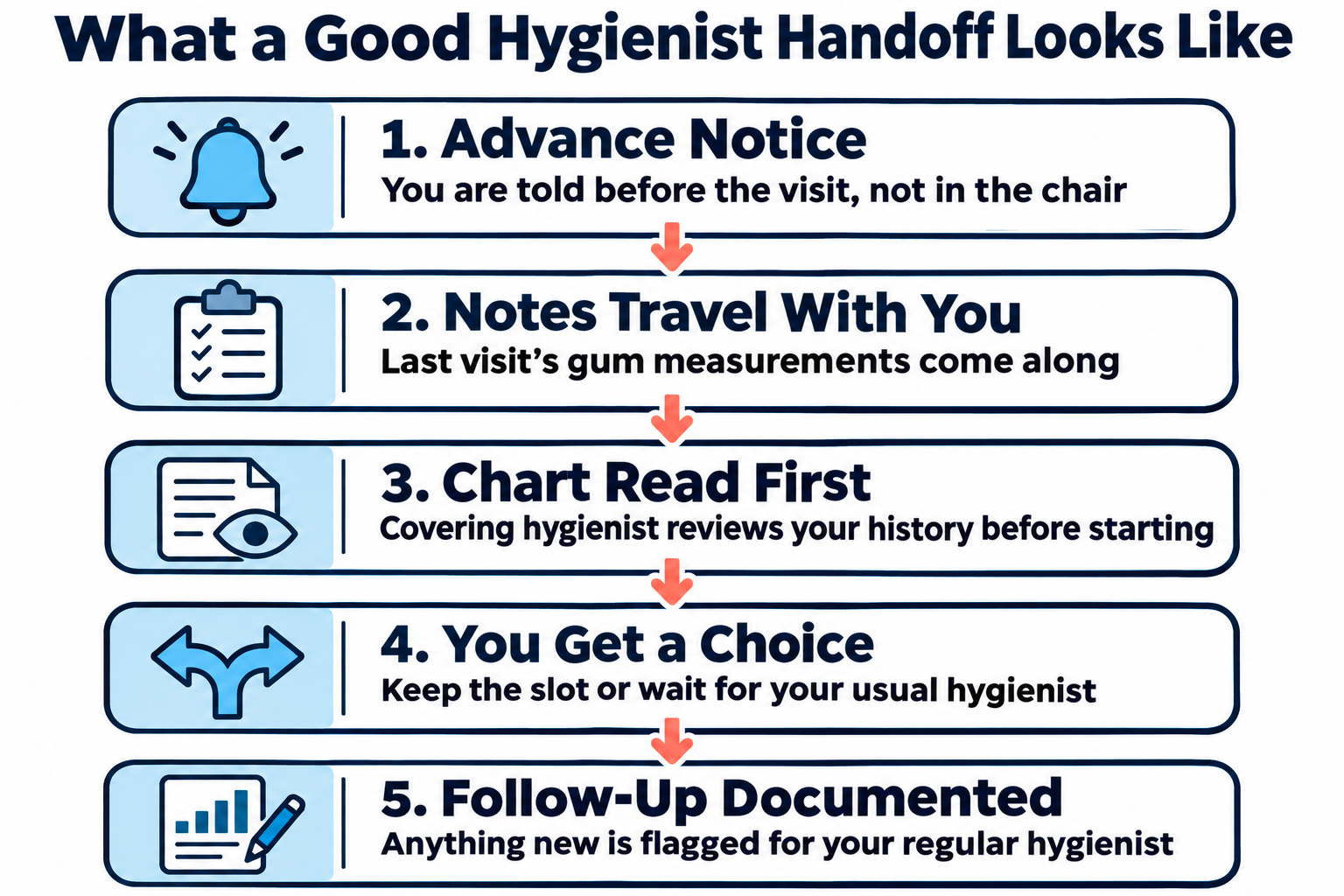
So the honest question is not whether you will ever see someone else. It is how that visit gets handled. A handoff done well looks like this:
- You hear about it before you arrive, not when you sit down in the chair
- Your chart notes travel with you, including last visit’s pocket depths and anything flagged to watch
- The covering hygienist reads those notes first and references them out loud so you know your history came along
- You are offered a choice, meaning you can take the appointment now or take the next opening with your usual person
- Anything new gets documented for your regular hygienist to follow up on next time
What patients are really afraid of is being handled as a chart number instead of a person. A heads up text and one sentence of continuity at the start of the visit fixes most of that.
We also get calls from patients untangling a confirmation text that did not match what they expected. If that happens, call the office rather than guessing. It takes about two minutes to sort out who you are scheduled with and why.
What a well run hygienist handoff includes
If your regular hygienist is out, these five things should happen without you having to ask.
The real tradeoff between a small office and a large group practice
I looked at how other offices in this market present themselves recently. One corporate affiliated practice lists eleven rotating providers on its site, with the team roster taking up more space than the clinical information.
That is not a knock on their dentistry. That model is built for coverage, and coverage has genuine value. More providers means more open slots, longer hours, and a better chance of getting seen this week instead of next month.
But you pay for it in repetition. With eleven people in rotation, the odds of the same hygienist charting your gums three years running get thin, and you end up re-explaining your history most visits.
So the tradeoff is straightforward:
- More availability and faster openings, against
- More repetition of your own history and less year over year comparison
For a patient with healthy gums and no complicated restorative work, availability might genuinely win. For someone tracking pocket depths, watching an older crown, or managing gum tissue around an implant, I think continuity wins most of the time. You get to decide which column matters more for your mouth.
Book your next cleaning before you walk out, especially October through March
Here is the one habit that makes all of this work. Schedule your next recall at the front desk before you leave the current appointment.
Scottsdale’s population climbs from late October into March as seasonal residents arrive. Recall slots with a specific hygienist get genuinely scarce in that stretch, and a morning slot with your preferred person in January is often spoken for by the previous August.
That is doubly true for patients across the Shea Corridor and McCormick Ranch who split the year between here and somewhere else. If you are only in town four months, mapping out your dental work before you arrive saves you from taking whatever is left.
A few things worth knowing when you book:
- Ask for your hygienist by name when you schedule, not when you arrive
- Early slots go first. A lot of our callers specifically ask for anything before 10 AM
- Leave a callback number so the office can reach you if a cancellation opens up with your person
- Book six months out if you are on a twice yearly schedule, or three months out if you are on periodontal maintenance
And if it has been years rather than months since your last cleaning, do not let that stop you from calling. The first visit back is mostly about building the baseline that every future visit gets compared against.
Frequently Asked Questions About Seeing the Same Dental Hygienist
Is it rude to ask for a specific hygienist?
Not at all. Front desk teams hear this request constantly and it makes scheduling easier, not harder, because it tells them which column to look at. Ask when you book, not when you arrive.
What happens if my hygienist leaves the practice?
Your chart stays, which is the part that protects your care. The new hygienist inherits your full gum charting history, your notes, and your x-rays.
Expect a slightly longer first visit while they build their own feel for your mouth, and expect your measurements to need one cycle before the comparisons are clean again. Say up front what your previous hygienist used to watch for. It helps.
Does seeing a different hygienist one time hurt my care?
A single visit with a covering hygienist is fine as long as your notes come with you and anything new gets documented for your regular person. The issue is not one substitution. It is never having the same person twice.
Does the dentist see the same notes my hygienist takes?
Yes. Your hygienist’s charting, photos, and observations all sit in the same record the dentist reviews during your exam, which is why those measurements carry weight when a treatment recommendation comes up later.
How far ahead should I book to get the same hygienist in winter?
For a January or February appointment in Scottsdale, I would book it at your summer or early fall visit. Those months fill first, and morning slots with a specific hygienist are usually the first thing to go.
Want the same hygienist at your next cleaning?
If you are in North Scottsdale and you would rather not start over with a stranger every six months, it is a reasonable thing to ask for when you schedule. Our team can tell you which recall slots are open with a specific hygienist, including the early morning times that tend to fill first. You can reach Trinity Dental Care at 480-621-4040 or at trinitydentalcares.com whenever you are ready to look at dates.