
Direct Answer: Healthy gums don’t bleed from routine flossing. If yours do regularly, it’s usually a sign of bacterial buildup along the gumline, not a reason to floss less.
I hear some version of this pretty often: ‘My gums bleed a little when I floss, but I think I’m just being too rough.’ It’s one of the most common things people tell us when they finally come in after a long gap between visits, and almost every time, the bleeding isn’t about flossing technique.
Bleeding gums during normal home care are one of the clearest signals your mouth sends that something needs attention. The tricky part is that it doesn’t hurt much, if at all, so it’s easy to file it away as ‘not a big deal.’ But for adults across Scottsdale and North Scottsdale, that quiet signal is often the first sign of gum disease, and the earlier you catch it, the easier it is to turn around.
This article explains what’s actually happening when your gums bleed, how to tell early-stage inflammation from something that needs more than a cleaning, and why a thorough first visit protects you far more than a simple polish ever could.
What Bleeding Gums Are Actually Telling You
The most common misconception I run into is that bleeding gums are caused by flossing too hard, and that the fix is to back off. Some patients stop flossing altogether to avoid it. That actually makes things worse.
Healthy gum tissue does not bleed from routine flossing. When gums bleed regularly, it’s because bacteria have built up along and just below the gumline, triggering inflammation. The gum tissue becomes irritated and fragile, and then the slightest contact causes bleeding. The floss isn’t the problem. The bacterial buildup is.
This inflammation is your body’s immune response trying to fight off that bacteria. It’s not dangerous on its own, but it is a sign that the gumline needs professional attention, because home care alone can’t remove the hardened deposits that form once plaque has been sitting there long enough to calcify into tartar.
A few things that commonly drive bacterial buildup along the gumline include:
- Infrequent or inconsistent flossing (letting plaque accumulate between visits)
- Long gaps between professional cleanings
- Dry mouth, which reduces the natural cleansing effect of saliva
- Certain medications that affect gum tissue
- Smoking or tobacco use, which masks symptoms and slows healing
If bleeding is occasional and stops within a day or two of getting back on a consistent flossing routine, it may be minor. But if it happens every single time you floss, that’s worth getting checked, not next year, but soon.

The Spectrum From Inflammation to Gum Disease, and Why It Matters
Not all bleeding gums mean you have advanced gum disease. There’s a real spectrum here, and where you fall on it determines what treatment actually looks like.
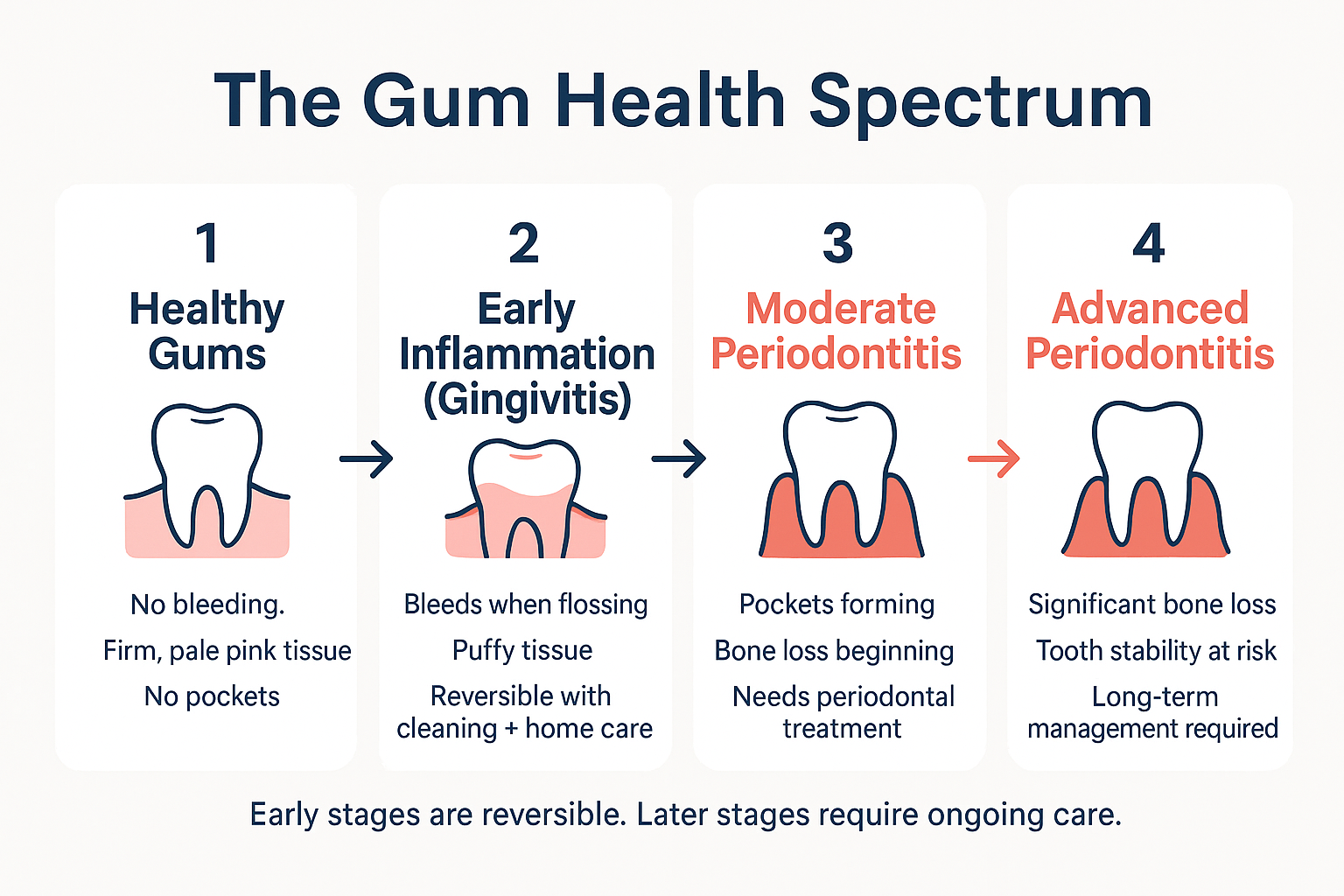
Early-stage gum inflammation (gingivitis) is the mildest and most reversible form. Gums look red or puffy, they bleed when touched, but there’s no bone loss yet. At this stage, a professional cleaning combined with better home care is usually enough to get things back on track. The tissue can fully heal.
Periodontitis is what happens when gingivitis goes untreated. Bacteria work their way deeper, pockets form between the teeth and gums, and the bone that supports your teeth begins to break down. This stage is not reversible in the same way, the damage that’s already done doesn’t undo itself, but it can absolutely be managed and stopped from progressing further. Treatment at this point typically goes beyond a standard cleaning and involves more involved periodontal care. You can read more about why bleeding gums aren’t something to just wait out and what that progression actually looks like.
The practical takeaway: catching this early is exactly the point of routine care. A patient who comes in with mild gingivitis leaves with a cleaning, improved home care instructions, and a clear path forward. A patient who waits until they notice loose teeth or significant recession has a much longer road ahead. The difference between a deep cleaning and a regular cleaning is directly tied to where on that spectrum someone falls when they finally come in.
The Gum Health Spectrum at a Glance
This infographic shows how gum health progresses from healthy tissue to advanced disease, and what each stage typically looks like in practice.
Early Gingivitis vs. Periodontitis: What’s Different
Patients often ask how to tell if their gum issue is minor or serious. This comparison covers the most practical differences.
| Factor | Gingivitis | Periodontitis |
|---|---|---|
| Bone loss present? | No | Yes, varies by severity |
| Reversible with cleaning? | Usually, yes | No, but it can be stopped |
| Pocket depth | Shallow (1-3 mm) | Deeper (4 mm or more) |
| Pain level | Often none | Often still minimal until advanced |
| Treatment needed | Standard cleaning + home care | Periodontal care, more frequent visits |
| Urgency | Should be addressed, not ignored | Should not wait, bone loss is cumulative |
Why a Thorough First Visit Is Not an Upsell
Something I want to address directly, because I hear it in calls and from new patients fairly regularly: the frustration of coming in expecting a simple cleaning and being told you need X-rays and a full exam first.
I understand that reaction. But here’s the honest reason it works that way: a dentist cannot safely treat what they cannot see. Gum disease lives below the gumline. Bone loss doesn’t show up on a visual exam. And a patient who comes in with bleeding gums may already have pockets or bone changes that need to be accounted for before anyone puts a scaler near their gumline.
Skipping the diagnostic step doesn’t protect you from treatment costs, it just delays them, usually until the problem is more advanced and more expensive to address. The American Academy of Periodontology notes that gum disease is often painless in its early stages, which is exactly why clinical measurements and imaging matter so much.
A thorough first visit, exam, X-rays, gum pocket measurements, gives us a real baseline. It’s what makes the treatment plan accurate. And it’s what protects you from surprises six months down the road.
On the Gap Between Visits, It Doesn’t Mean What You Think
One of the most common things people say when they finally call after a long break is some version of: ‘I know I haven’t been in a while.’ Sometimes it’s been two years. Sometimes it’s been a decade. And almost always, they’re embarrassed about it.
I want to be clear: the gap is common, and it doesn’t make you a bad patient. Delta Dental’s 2025 national oral health data shows that more than 1 in 5 adults have avoided dental care because of anxiety. That’s not a small number. And plenty of other people simply got busy, changed insurance, moved, or kept meaning to call and didn’t.
Whatever the reason, coming in now matters more than the length of the gap. We’re not here to judge how long it’s been. We’re here to figure out where things stand and what the path forward looks like, without making you feel worse about the detour it took to get here.
If you’ve noticed bleeding gums and you’ve been putting off calling because you’re not sure what you’ll hear, that hesitation is completely understandable. But gum disease is one of those things where earlier is genuinely better. The treatments are simpler, the results are more predictable, and the long-term outcome is much easier to maintain.
Frequently Asked Questions About Bleeding Gums
Is it normal for gums to bleed a little when I first start flossing again after a break?
There can be some initial sensitivity when you restart a flossing routine after a gap, and mild bleeding in the first few days is not automatically alarming. But if bleeding continues beyond one to two weeks of consistent flossing, that’s a sign the gumline needs professional attention, not a reason to stop flossing.
Can I just get a cleaning without the X-rays and full exam?
When there are symptoms like bleeding gums, a cleaning without a proper exam and X-rays can actually miss what’s driving the problem. We need to measure pocket depths and look at bone levels to know what kind of cleaning is appropriate. Skipping that step means treating the surface while the underlying issue continues. It genuinely is about your care, not about adding to the bill.
My gums bleed but they don’t hurt. Does that mean it’s not serious?
Gum disease is often painless for a long time, that’s one of the reasons it progresses as far as it does in many people. Lack of pain doesn’t mean lack of disease. Bleeding without pain is still a signal worth following up on.
Can gum disease affect anything beyond my mouth?
Research has consistently linked gum disease to systemic health conditions including heart disease and diabetes. The bacteria involved in periodontal infections don’t necessarily stay local. This is part of why gum health matters as a component of overall wellness, not just dental aesthetics.
What does periodontal treatment actually involve if a cleaning isn’t enough?
When pockets have deepened beyond what a standard cleaning addresses, the next step is typically a procedure called scaling and root planing, a deeper cleaning done below the gumline, often with local anesthetic. It’s more involved than a routine cleaning but is usually done in one or two appointments. After that, more frequent monitoring visits help keep things stable. You might also find it useful to read about whether you really need a deep cleaning to understand how that recommendation gets made.
Ready to Find Out Where Your Gum Health Actually Stands?
If you’ve noticed bleeding gums and haven’t been in for a while, the most useful thing you can do is get a real look at what’s going on. Trinity Dental Care serves patients across North Scottsdale, the Shea Corridor, McCormick Ranch, and surrounding communities, and we’re used to seeing patients who’ve had a gap and aren’t sure what to expect. You can reach us at 480-621-4040 or request an appointment at trinitydentalcares.com. We’ll tell you what we see, explain what it means, and give you a clear picture of your options, no pressure, no judgment.