
Direct Answer: There is no age cutoff for dental implants. Candidacy depends on jawbone density, gum health, and whether medical conditions are well controlled, all of which an imaging-based exam can show.
Almost every week, someone sits down in my chair and tells me before I’ve looked at anything that they’re probably too old for implants. Sometimes they’re 68. Sometimes they’re 82. Almost always, they’re repeating something a dentist said to them years ago, or a conclusion they came to on their own after a tooth came out and never got replaced.
This comes up a lot here. Roughly 26% of Scottsdale residents are 65 or older, and North Scottsdale neighborhoods like McCormick Ranch, the Shea Corridor, and Scottsdale Mountain skew even older than the city average.
So I want to walk through what actually decides whether implants are possible, why bone loss is not the automatic disqualifier people think it is, and what really happens during that first exam. My goal is that you finish reading knowing what the appointment involves before you ever pick up the phone.
Age Is Not What Rules You Out
I’ve never once made an implant decision based on a birth year. What I’m looking at is a set of physical conditions, and those vary wildly between two people who are the same age.
Here is what actually drives the answer:
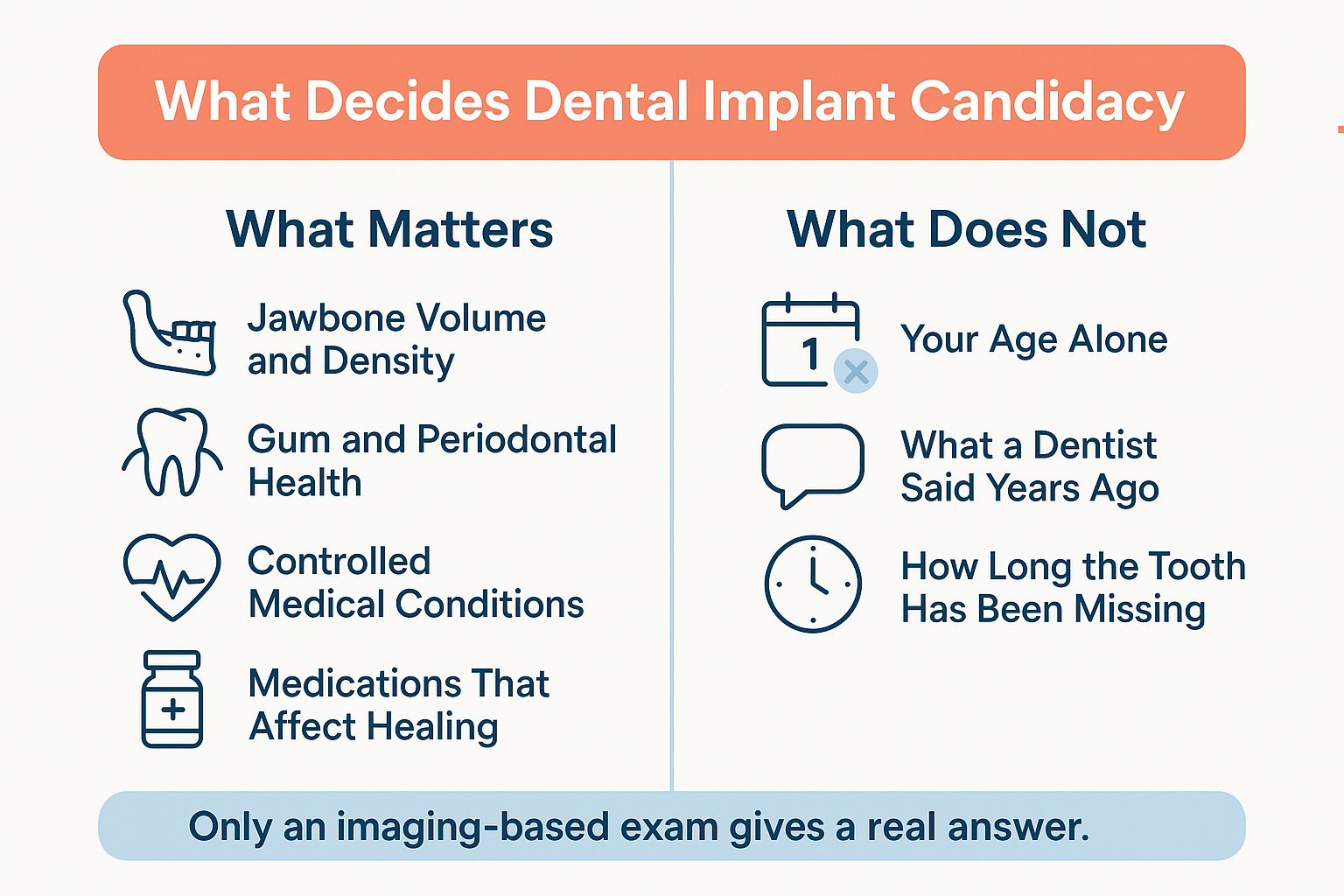
- Jawbone volume and density at the site where the tooth is missing
- Gum health, especially any active periodontal disease
- Overall medical status, and whether existing conditions are managed
- Medications that affect bone turnover or healing
- Habits like smoking, which slows healing at any age
That list has nothing to do with how many candles were on the last cake. A 2025 systematic review found no meaningful difference in implant success rates between patients aged 65 to 75 and those over 75. In other words, once you’re past middle age, adding more years does not statistically move the needle.
What does move the needle is time. Every year a gap sits empty, the jaw in that spot gets a little thinner. So the honest version of the age question isn’t “am I too old,” it’s “what does my jaw look like on imaging right now.”
That’s a question I can answer in one visit.
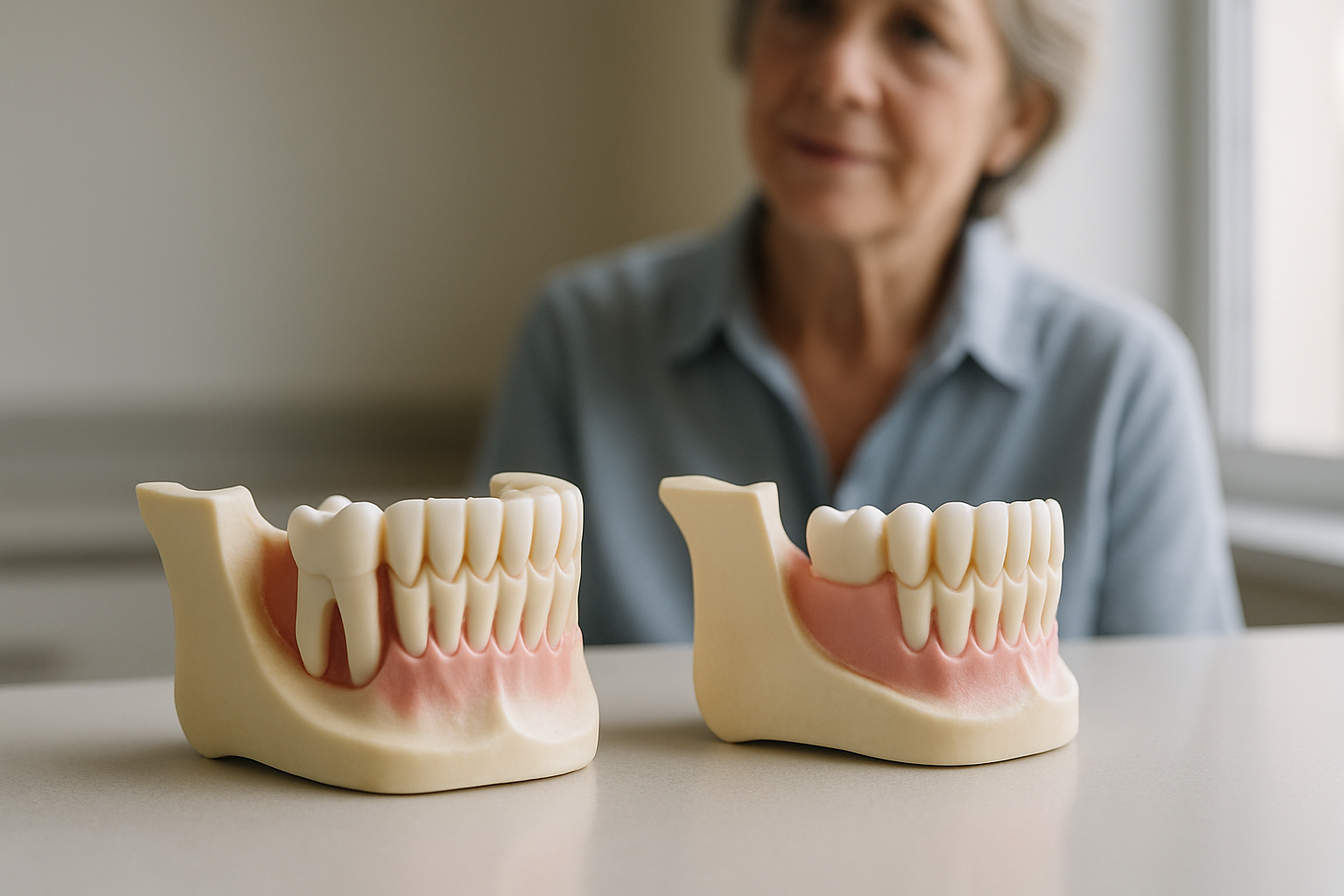
Bone Loss Is the Real Concern, and It Is Often Fixable
When older adults tell me they can’t have implants, bone loss is the reason nine times out of ten. Usually somebody mentioned it in passing years ago and it stuck.
Here’s the mechanism, in plain terms. Your jawbone stays dense because chewing puts pressure through the tooth root into the bone. Remove the root, and the bone in that area stops getting the signal to maintain itself, so it slowly shrinks.
That process is real. The National Institute of Dental and Craniofacial Research tracks tooth loss in older adults closely for exactly this reason, because losing teeth sets off changes that go well beyond the gap you can see.
But thin bone is not the same as no options. In a lot of cases, bone grafting can rebuild enough foundation to support an implant, using material placed at the site and given time to integrate before the implant goes in. That adds months to the timeline, not a permanent no.
A few things I see regularly:
- A tooth missing 5 to 15 years with more ridge available than the patient expected
- Adequate bone in one area and not another, so the plan differs tooth to tooth
- Upper back teeth where the sinus sits low, which changes the approach
- Cases where a graft is the right first step and the implant comes later
None of that can be determined by looking in your mouth or by guessing. It takes imaging. If you want more on the full evaluation, I wrote about what a dentist is actually looking for when you ask about implants in more detail.
Diabetes, Osteoporosis, and the “I Have a Condition” Worry
This is the other big one, and it’s a fair question. Plenty of patients in their sixties and seventies are managing something.
What I care about is control, not diagnosis. Well managed diabetes with stable blood sugar is a very different picture from uncontrolled diabetes, because healing at the implant site depends on your body’s ability to knit tissue and bone together predictably.
Same with bone density medication. Some drugs prescribed for osteoporosis affect how bone remodels, and the type, dose, and how long you’ve been on it all matter. That’s a conversation with your physician, not an automatic stop sign.
Things I ask about at that first visit:
- Current medications, including bone medications and blood thinners
- Recent lab work or A1C if diabetes is in the picture
- Any history of radiation to the head or neck
- Smoking, and whether you’d be willing to pause during healing
- Who else is on your care team, so we can coordinate
Nobody has ever been embarrassed out of this conversation in my office. I need the real answers to build a plan that holds up.
What Actually Determines Implant Candidacy
Here is the short version of what gets evaluated, and what does not.
What Gets Checked at an Implant Consultation
This is the general sequence of what I review before I say anything about whether implants make sense for you.
| What We Check | How We Check It | What It Tells Us |
|---|---|---|
| Bone height and width at the site | Digital X-rays and 3D imaging | Whether there is enough foundation, or whether grafting comes first |
| Gum condition | Visual exam and periodontal measurements | Whether gum disease needs treating before anything is placed |
| Bite and neighboring teeth | Clinical exam | How the implant will be loaded and whether nearby teeth need attention |
| Medical and medication history | Conversation and health forms | Healing risk, and whether we coordinate with your physician |
| Sinus position (upper back teeth) | 3D imaging | Whether the approach needs to account for sinus anatomy |
| Your goals and timeline | Conversation | Single implant, bridge, or full-arch options like All-on-4 |
What That First Appointment Actually Feels Like
A lot of the people who call us have been putting this off for years. Cost, fear, a bad experience somewhere else, or a quiet belief that it’s just too late now.
So let me take the mystery out of the visit. It’s mostly talking and imaging.
- We take digital X-rays and 3D imaging so I’m looking at actual bone, not guessing
- I do a full exam of your teeth, gums, and bite
- We go through your health history and current medications
- I show you the images on screen and explain what I see
- We talk through options, sequence, and roughly how long each path takes
- You get written information on cost and what your plan may or may not cover
No drilling happens at a consultation. Nothing gets decided in that chair that you can’t take home and think about.
On cost, I’ll be straight with you: it depends on how many teeth, whether grafting is needed, and what your plan covers. Fees for exams and imaging vary across the Phoenix metro, and coverage varies even more, which is why I put together a separate piece on what dental insurance actually covers for implants in Arizona. For an exact number on your case, you need your own exam and a written estimate.
If the dental chair itself is the sticking point, that’s worth saying out loud when you call. I’ve written about managing dental anxiety before an appointment, and it’s a normal thing for us to plan around.
Why the Size of the Practice Matters More Than People Expect
Implant care is not one appointment. It’s imaging, planning, placement, healing, and the restoration on top, spread across months. The timeline from start to finish usually runs longer than patients expect, and healing happens in stages that need someone actually watching them.
That’s where continuity matters. A patient of ours left a review that captures it better than I could: “She found my problem with my implant and referred me to a specialist. She also called me the next day to discuss what the specialist and she were going to do.”
That follow-up call is the whole point. When a case needs a specialist’s hands, you should still have one dentist tracking the whole picture and calling you back the next day.
Older patients in particular tell me they’ve felt rushed elsewhere, or handed off between providers with nobody holding the thread. If you’ve been sitting on this for years, that’s the part worth asking about when you’re comparing practices.
Frequently Asked Questions About Dental Implants for Older Adults
Is there an age limit for dental implants?
No. There is no upper age cutoff. What matters is bone, gums, and whether your health conditions are stable, all of which get evaluated at the exam.
My tooth has been missing for over ten years. Is it too late?
Not necessarily. The bone in that area has almost certainly thinned, but how much varies a lot between people. In many cases bone grafting can rebuild the site first. The only way to know is imaging.
I have osteoporosis and take medication for it. Does that rule me out?
Not on its own. Certain bone medications change how bone remodels, so the specific drug, dose, and how long you’ve taken it all factor in. I’d want to review that with you and coordinate with your physician before recommending anything.
What if I need all my teeth replaced, not just one?
Full-arch options exist for exactly that situation, including All-on-4, which supports a full arch on four implants. Whether it fits your case still comes down to what the imaging shows about your bone.
How long does the whole process take at my age?
Healing timelines are broadly similar across adult ages. Plan on several months from placement to final restoration, and longer if grafting is part of the plan. Age tends to affect the plan less than bone quality does.
Do I have to commit to anything at the consultation?
No. It’s imaging, an exam, and a conversation. You leave with information and an estimate, and you decide on your own time.
Ready to Find Out What Your Jaw Actually Shows?
If you’ve been carrying around an old assumption that you missed your window, an imaging-based exam will give you a real answer instead of a guess. Our office on N. Frank Lloyd Wright Blvd sees patients from across North Scottsdale, and consultations are available for anyone who wants to understand their options before deciding anything. You can reach Trinity Dental Care at 480-621-4040 or at trinitydentalcares.com when you’re ready to have that conversation.