
Direct Answer: Call the office ahead and say you are anxious, book a short first visit with no treatment, and ask for every step to be explained before it happens.
You know you are overdue. Maybe it has been two years, maybe closer to eight. And every time you think about picking up the phone, your stomach tightens and the whole thing gets pushed to next month.
I hear this from Scottsdale patients constantly. People drive down the Shea Corridor past three dental offices on their way to work and still cannot make themselves call one.
So this article is not a pep talk. It is a list of concrete things you can do before you ever sit in the chair, plus an honest look at what a genuinely gentle appointment feels like when a practice takes your anxiety seriously.
You Are Not Unusual, and the Avoidance Spiral Is Real
According to Delta Dental’s 2025 national oral health report, more than one in five adults avoid dental care because of anxiety. That is not a small pocket of people. That is a fifth of the adults in your neighborhood.
Here is the part that makes it worse. The longer you avoid care, the more likely it is that a small problem turns into a bigger one.
The cycle usually looks like this:
- You skip a cleaning because the thought of it feels overwhelming
- A cavity or some gum inflammation quietly progresses with no pain to warn you
- When you finally go, you need more work than you would have two years ago
- That harder visit confirms your fear, and you avoid even longer
I am not saying that to scare anyone. I am saying it because naming the cycle out loud is usually what breaks it.
The way out is almost always a smaller, lower-stakes first visit rather than a heroic one. Preventive visits exist specifically to catch things while they are still cheap, quick, and boring to fix. The CDC’s oral health guidance makes the same point: routine care is what keeps problems from becoming procedures.

Four Things to Do Before the Appointment That Actually Help
Most anxiety advice is vague. Breathe deeply, think calm thoughts, that sort of thing. These are the steps I have watched work for real patients.
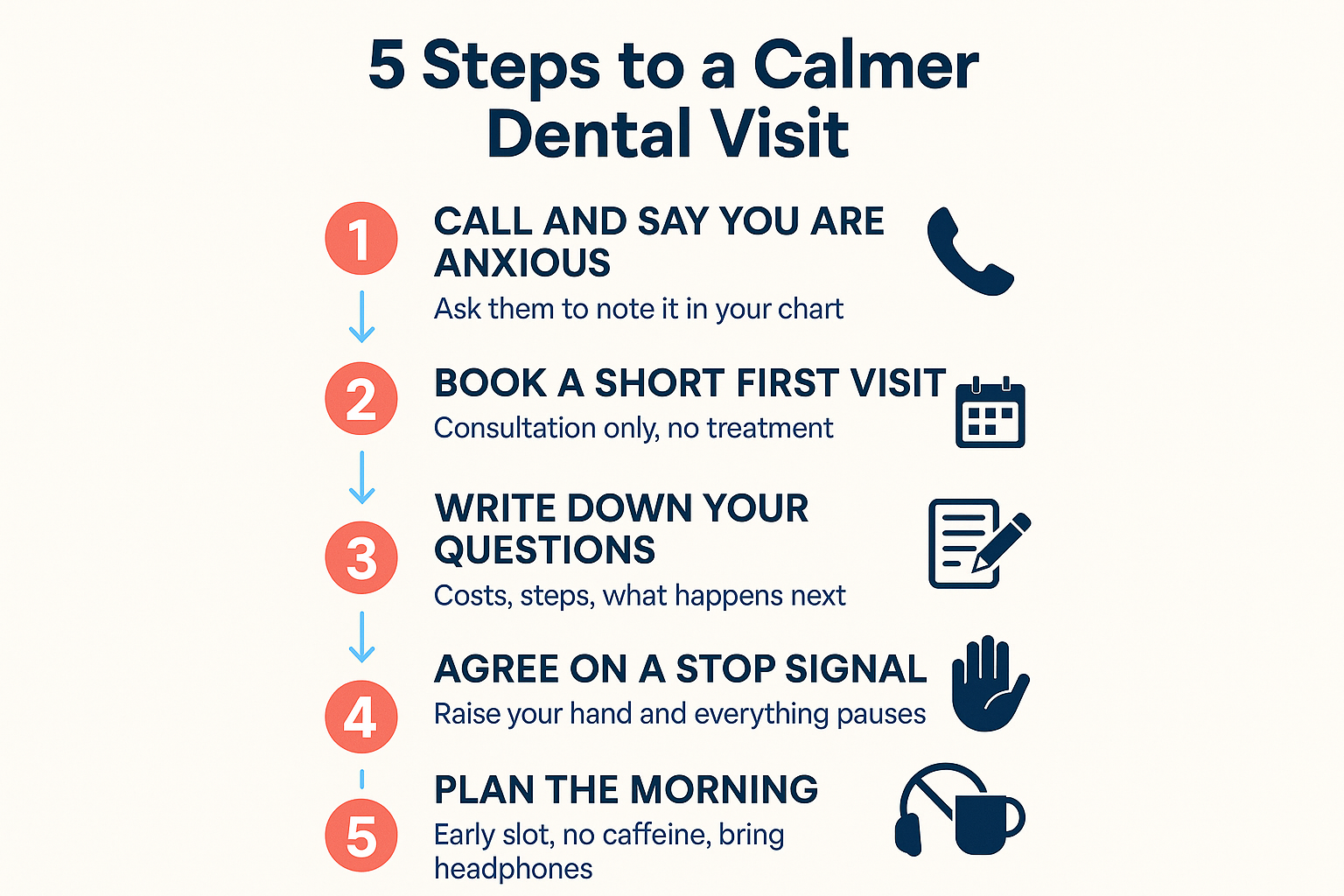
1. Say the word “anxious” when you call. Front desk teams cannot read minds. When someone tells us on the phone that dental visits are hard for them, we note it, we plan for more time, and the whole room approaches that appointment differently before you walk in.
2. Ask for a shorter first visit with no treatment. You are allowed to book a consultation, meet the dentist, look at the room, and leave. No instruments, no decisions. For a lot of people this single step removes about eighty percent of the fear.
3. Get your questions answered before you agree to anything. Surprise is the fuel for dental anxiety. Ask what the exam includes, what happens if something is found, and what the cost picture looks like before treatment is scheduled.
4. Set up a stop signal. Agree ahead of time that raising your left hand means everything pauses. Knowing you can stop the appointment is often enough that you never need to.
A few smaller things that help more than people expect:
- Book a morning slot so you are not dreading it all day
- Skip coffee that morning, since caffeine and adrenaline stack badly
- Bring headphones and your own music or a podcast
- Bring a friend or spouse to sit in the waiting room
What to Say on the Phone and What It Gets You
If you are not sure how to bring it up, here is the language that works and what the office can do with it.
| What you say | What the office can do | Why it helps |
|---|---|---|
| “I have a lot of anxiety about dental visits.” | Flag your chart, block extra time, brief the hygienist | Nobody rushes you, and you never have to explain twice |
| “Can I come in just to talk first?” | Schedule a short consult with no treatment planned | You meet the room and the people before anything happens |
| “It has been several years since my last visit.” | Set expectations honestly and plan the visit in stages | Removes the fear of being judged or lectured |
| “I need to know costs before we start.” | Provide an estimate and review insurance in advance | Money surprises are a top anxiety trigger, and they are avoidable |
| “I gag easily” or “numbing never works on me.” | Adjust imaging technique, positioning, and anesthetic approach | These are common and solvable, not personal failings |
Your Pre-Appointment Plan, Step by Step
This is the sequence I would give a friend in Paradise Heights or McCormick Ranch who has been putting off a visit for years.
What Comfort-Focused Care Looks Like Once You Are in the Chair
Every office says they are gentle. What matters is whether the behavior backs it up, so here is what to watch for.
A team that takes anxiety seriously will narrate before they act. You should hear what is coming next, roughly how long it will take, and what it will feel like, before anything touches your mouth.
They will also check in during the appointment rather than only at the end. Short pauses to ask how you are doing cost about four seconds and change the entire experience.
And they will slow down when you need it. A cleaning that takes an extra fifteen minutes because someone needed breaks is a better cleaning, not a failed one.
Our reviews describe this pattern more than any other thing. One patient put it simply: “The dentist can give me anxiety, but everyone here made sure I was comfortable, and went above and beyond!” Another wrote that it was the “first time I’ve ever had a deep cleaning that was enjoyable.”
I have also had patients tell me they finally went through with work they had been dreading for years, and the reason was not a new technique. It was that nobody rushed them.
If you want to know exactly what to expect step by step, we walk through it in detail in what actually happens at a dental exam and cleaning.
Start With the Smallest Possible Visit
If you have been away a long time, do not start by trying to fix everything. Start with an exam and a cleaning.
That visit does three things. It tells you where you actually stand, it gets the hardest appointment behind you, and it usually reveals that the situation is less dire than you imagined.
Cost worry is the other half of dental anxiety, and it is fair. Fees vary a lot by practice and by what your plan covers, so ask for an estimate up front and ask whether the office has a membership option if you are uninsured. Many practices in the North Scottsdale area do, and the numbers differ enough that you should get them directly rather than guessing.
A few things worth knowing before you go:
- Bleeding when you brush or floss is common after a long gap and usually reversible, which we cover in when bleeding gums are a warning sign
- A cleaning is not one-size-fits-all, and routine cleanings look different depending on how long it has been
- If something breaks or falls out, you do not need a specialist first, since your regular dentist can handle most dental emergencies
One appointment is the whole ask. Everything after that gets easier.
Frequently Asked Questions About Dental Anxiety Before an Appointment
Will the dentist judge me for how long it has been?
No. And if a practice makes you feel bad about it, that is information about the practice, not about you. We see patients who have been away for a decade, and the only useful reaction is figuring out where to start.
Can I really book an appointment just to talk?
Yes. Ask for a consultation with no treatment planned. You sit in a normal room, meet the dentist, ask your questions, and go home. For anxious patients this is often the single most useful first step.
What if I have had numbing that did not work before?
Tell the office ahead of time. There are several reasons anesthetic can fall short, including inflammation in the area and individual anatomy, and there are adjustments a dentist can make when they know in advance. Going in without mentioning it is how bad experiences repeat.
Does anxiety mean I need sedation?
Not usually. Most anxious patients do fine with more time, more explanation, and the ability to pause. Sedation options are a conversation to have with your dentist based on your health history and the specific treatment, not a default starting point.
How do I keep from spiraling the night before?
Have a concrete plan rather than a vague intention. Know your appointment time, know what is happening at the visit, have your questions written down, and have your headphones ready by the door. Anxiety feeds on the unknown, so remove as many unknowns as you can.
Ready to Take the First Small Step?
If you live or work around North Scottsdale and you have been putting off a visit, you are welcome to call and simply say you are nervous. Our team at Trinity Dental Care is used to that conversation, and it usually starts with a short, low-pressure appointment rather than a treatment plan. You can reach us at 480-621-4040 or read more at trinitydentalcares.com whenever you are ready.