
Direct Answer: Compare practices by reading review patterns instead of star ratings, asking direct insurance and cash pricing questions on the first call, and confirming who treats you at each visit.
Most people who call our office for the first time have already spent real time looking. They found us on Google, read through reviews, checked two or three other practices, and only then picked up the phone. One caller told us flat out that she found us on Google and wanted to become a patient.
That kind of research is smart. But I’ve noticed that a lot of it focuses on the things that are easiest to see, like star ratings and office photos, and skips the things that actually predict whether you’ll be happy in five years.
So here is how I’d compare dental practices in North Scottsdale if I were the patient instead of the dentist. Three areas matter most: how you read reviews, what happens on your first phone call, and who is actually going to treat you.
Read the pattern in the reviews, not the star rating
Almost every established practice along the Shea Corridor or near Frank Lloyd Wright Blvd has a rating between 4.6 and 5.0. That number stopped being useful as a comparison tool years ago.
What still tells you something is the repeated language across dozens of reviews. Ten reviews saying “great office” tells you nothing. Forty reviews independently mentioning the same specific behavior tells you a lot.
When you’re skimming, look for themes like these:
- Gentleness during actual procedures, not just cleanings. A patient who says a deep cleaning was comfortable is describing something hard to fake.
- Explanations before treatment. Reviewers who mention being shown options rather than handed a plan are describing a communication style you’ll experience too.
- Time spent. Words like thorough, unrushed, and “spends time with you” show up when a dentist isn’t running three chairs at once.
- Same-day help for urgent problems. Reviews mentioning a lost crown or broken tooth handled that day tell you the schedule has real flexibility built in.
- Follow-up after treatment. One patient wrote that her dentist “called me the next day to discuss” the plan. That behavior almost never appears in a review unless it genuinely happened.
Also read the negative reviews, including old ones. What you want to see is a specific, non-defensive reply from the practice. How an office handles a complaint publicly is a fair preview of how it will handle yours privately.

The first phone call is the best comparison tool you have
This is the part most people skip, and it’s the part that predicts the most. Before you book anywhere, call and ask three direct questions.
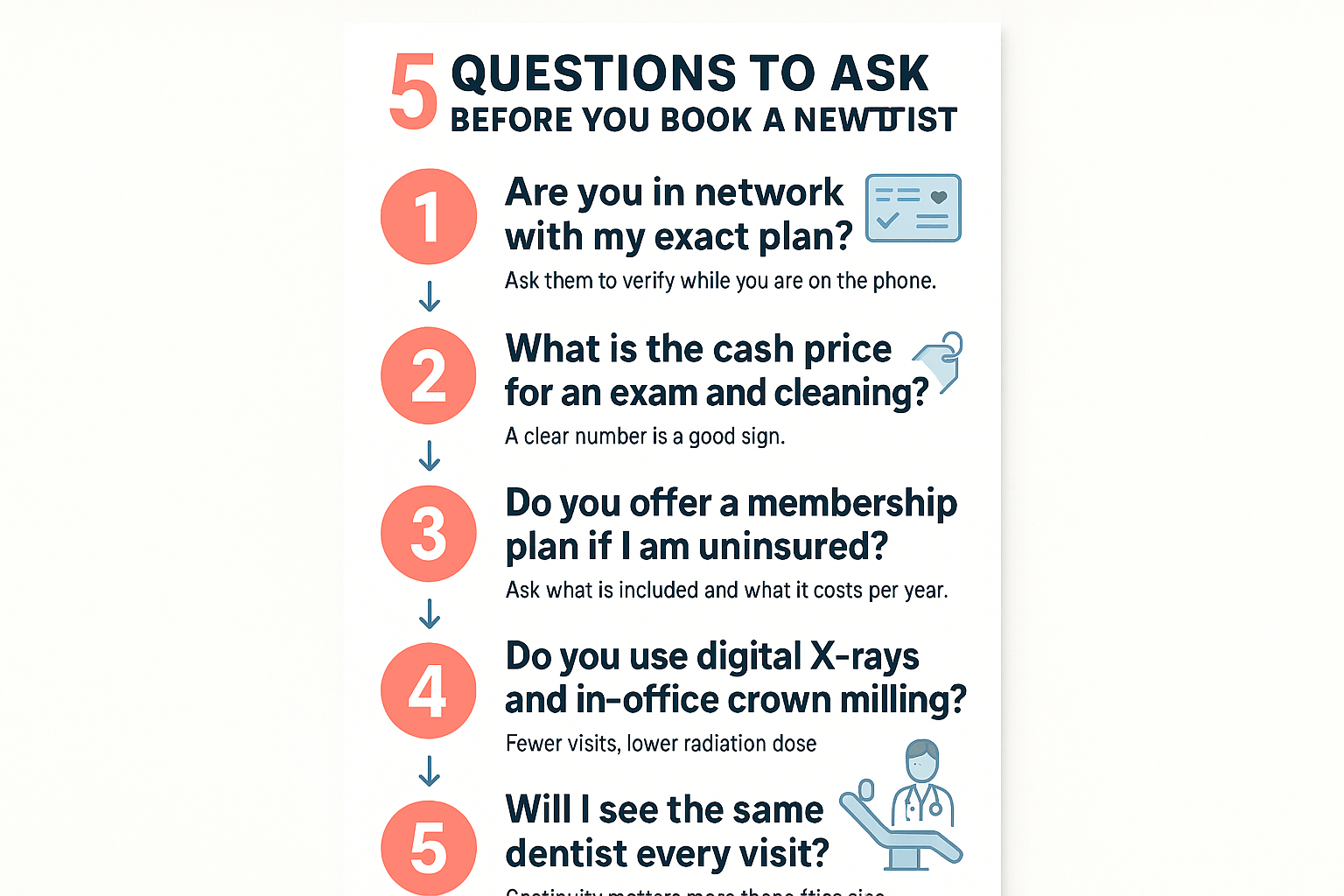
Question one: are you in network with my specific plan? Not “do you take Delta Dental,” but your exact plan. About one in eight calls we get is somebody naming a plan out loud, and the answer changes depending on whether it’s a PPO, a DPPO, or a Medicare Advantage dental plan. A good front desk will verify it while you’re still on the line.
Question two: what do you charge if I’m paying cash? A practice that can tell you their new patient exam fee and cleaning fee without checking with three people has thought about transparency. One that won’t give you a number until you come in has told you something too.
Question three: do you have a membership or savings plan for uninsured patients? This comes up constantly in our calls, often phrased almost exactly as “he’s uninsured, do you have a savings plan?” Many Scottsdale practices, including ours, offer an annual plan that bundles exams, cleanings, and X-rays, and pricing varies quite a bit between offices, so ask for the specific number and what’s included.
If a front desk answers all three clearly in one call, that is a meaningful positive signal. Cost confusion is the single most common reason people I talk to have gone years without care, and it’s usually worth understanding how insurance actually handles bigger treatment before you commit to anything.
What Patients Usually Check vs. What Actually Tells You Something
Here’s how I’d rank the common comparison points, based on which ones predict a good long-term fit.
| What patients check first | How useful it is | What to look at instead |
|---|---|---|
| Star rating (4.7 vs. 4.9) | Low. Nearly everyone clusters in the same range. | Repeated themes in the review text |
| Review count | Moderate. Shows longevity, not quality. | How recent the reviews are and whether themes hold up over time |
| Office photos | Low. Nice rooms are easy to buy. | Whether reviewers mention feeling unrushed |
| “Accepts most insurance” on the website | Low. Too vague to act on. | A live verification of your exact plan on the phone |
| Technology list on the website | Moderate. Depends which technology. | Digital X-rays, in-house crown milling, 3D imaging for implant planning |
| Number of dentists on staff | Moderate. | Whether the same dentist sees you at every visit |
Five Questions Worth Asking Before You Book
These are the five questions that separate a practice you’ll stay with from one you’ll leave after two visits.
Technology matters, but only three pieces of it really do
Website technology lists are mostly noise. There are three things I’d actually ask about, because each one changes your experience directly.
Digital X-rays instead of film. Digital sensors need a fraction of the radiation of older film and the image appears on screen instantly, so your dentist can turn the monitor toward you and point at the problem. The FDA’s guidance on medical X-ray imaging covers why dose reduction matters, and in practice it also means less repeat imaging.
In-office crown fabrication. For patients who qualify, a crown can be designed and milled in one appointment, which means no temporary crown and no second visit two weeks later. Not every tooth is a candidate, and that gets decided at the exam, but a practice with the equipment on site can at least offer it. If a crown is already in your future, it helps to understand what your dentist means when they recommend one.
Imaging good enough to plan restorative work. For implants or full-arch cases, planning depends on knowing exactly where bone and nerves are. Ask whether the office does that planning in house or sends it out.
Asking these questions on a first call doesn’t make you a difficult patient. It makes you a thorough one, and any office worth choosing will be glad you asked.
Who is actually going to treat you?
This is the criterion that’s hardest to measure and easiest to feel. Over the past several years, a lot of practices around the Phoenix metro have been rolled into larger groups, and staffing can rotate.
Ask two plain questions. Will I see the same dentist at every visit? And will the same hygienist follow my gum health over time?
Continuity is not just a comfort thing. It’s a clinical thing:
- Gum measurements only mean something when someone is comparing them to last year’s numbers.
- A dentist who watched a small crack for two years knows when it actually changed.
- Treatment plans stay consistent instead of getting rewritten by whoever is on shift.
We also see the flip side of this. If a practice runs on one primary dentist, ask what happens when they’re out and you have an urgent problem. There should be a clear answer, not a vague promise to call you back.
One of our patients drives nearly an hour, passing plenty of other offices, because the relationship is worth the drive to him. You don’t need to go that far. But that’s the standard worth aiming for: a practice where the team knows your name and your history without opening the chart. If you want a broader checklist, we’ve written more on what to look for when choosing a new dentist.
Frequently Asked Questions About Comparing Dental Practices
How many practices should I actually compare?
Two or three is plenty if you call each one. Ten website visits will teach you less than three real phone conversations, because the phone call is where you learn how an office handles insurance, pricing, and urgency.
Is it a bad sign if a practice is out of network with my insurance?
Not automatically. Out of network usually means higher out of pocket cost, but the gap is sometimes smaller than people expect, and a membership plan can change the math. Ask the office to compare your estimated out of pocket cost both ways before you rule them out.
What if I’ve put off going to the dentist for years? Will they lecture me?
A practice worth choosing will not. Plenty of the patients I see have been away for five or ten years, usually because of cost, fear, or a bad experience somewhere else. The first visit should be an exam, X-rays, and a conversation about priorities, not a lecture.
Should I get a second opinion before agreeing to a big treatment plan?
Yes, and any confident dentist will tell you the same. Second opinions come up often on our own phone line, usually about crowns or larger restorative plans. Bring your X-rays with you so the second dentist is looking at the same information. If you’re unsure whether a recommendation is necessary, this piece on deep cleanings and upselling explains how to evaluate one common example.
How do I know what a first visit will even include?
Ask before you book. A standard new patient visit generally includes a full exam, digital X-rays, and a cleaning, though a cleaning is sometimes scheduled separately if gum health needs attention first.
Still comparing practices in North Scottsdale?
If you’re mid-research and you want straight answers about insurance, cash pricing, or what a first visit would look like, we’re happy to talk it through on the phone before you commit to anything. Trinity Dental Care is on Frank Lloyd Wright Blvd, and we see patients from McCormick Ranch, the Shea Corridor, Paradise Heights, and across North Scottsdale. You can reach us at 480-621-4040 or at trinitydentalcares.com whenever you’re ready.