
Direct Answer: Only a licensed dentist is legally qualified to place veneers. Anyone else offering veneer placement — regardless of title or price — is practicing dentistry without a license.
I get asked about veneers constantly. And over the past couple of years, something has shifted — patients aren’t just asking what veneers are or how much they cost. They’re asking whether the person they found on Instagram is actually allowed to do them.
That question matters more than most people realize. Veneers are irreversible. To bond a veneer, a dentist removes a thin layer of enamel from the front of your tooth — and that enamel never grows back. If the procedure goes wrong, you’re not dealing with a disappointing haircut. You could be looking at nerve damage, tooth loss, or years of corrective work.
So before anyone touches your teeth, let’s talk about who is actually qualified to do this — and how to tell the difference between a skilled cosmetic dentist and someone who shouldn’t be anywhere near your smile.
The Rise of Unlicensed ‘Veneer Techs’ — and Why It’s a Real Problem
Social media has made it easy to stumble across beautiful before-and-after veneer photos posted by people who call themselves ‘veneer technicians’ or ‘smile designers.’ Some of them have polished-looking accounts, real testimonials, and prices that seem too good to pass up.
But here’s what that title actually means legally: nothing. There is no licensed dental profession called a veneer technician. In Arizona, as in every other state, placing veneers is the practice of dentistry — and the practice of dentistry requires a state-issued dental license.
The Arizona State Board of Dental Examiners maintains a public license lookup tool that anyone can use. If the person offering you veneers isn’t in that database with an active license, they are operating outside the law — full stop. I have seen patients come in after procedures done in makeshift settings, and the damage is often extensive and costly to correct.
This isn’t a fringe problem. Pop-up veneer operations have appeared throughout the Phoenix metro and even into North Scottsdale’s outer corridors. The patients who end up in real dental offices afterward are often in pain, sometimes with teeth that cannot be saved.
How to Actually Verify a Dentist’s Credentials Before You Commit
Verifying a dentist’s credentials takes about four minutes and requires no special knowledge. Here’s what I’d tell a neighbor to do:
- Look up the license. Go to the Arizona State Board of Dental Examiners website and search by name. You want to see an active license with no disciplinary actions.
- Ask where they trained. A qualified cosmetic dentist should be able to tell you clearly where they completed dental school and any continuing education in cosmetic procedures. Hesitation or vague answers are a signal.
- Ask to see real before-and-after cases — not stock photos. Any experienced veneer provider should have a portfolio of actual patients they’ve treated. Ask whether those cases were done entirely in-house by the same dentist.
- Confirm that a full exam and X-rays happen before treatment. Veneers are not a standalone cosmetic add-on. A dentist needs to assess the health of your underlying teeth, your bite, and your gum tissue before anyone decides whether veneers are even appropriate for you.
If a provider skips any of these steps, or gets defensive when you ask, that’s your answer. A dentist who is confident in their training welcomes these questions — they don’t avoid them. As one of our patients put it after their first visit, they were struck by how thoroughly Dr. Fink explained everything before suggesting any treatment path. That thoroughness isn’t extra — it’s the baseline.
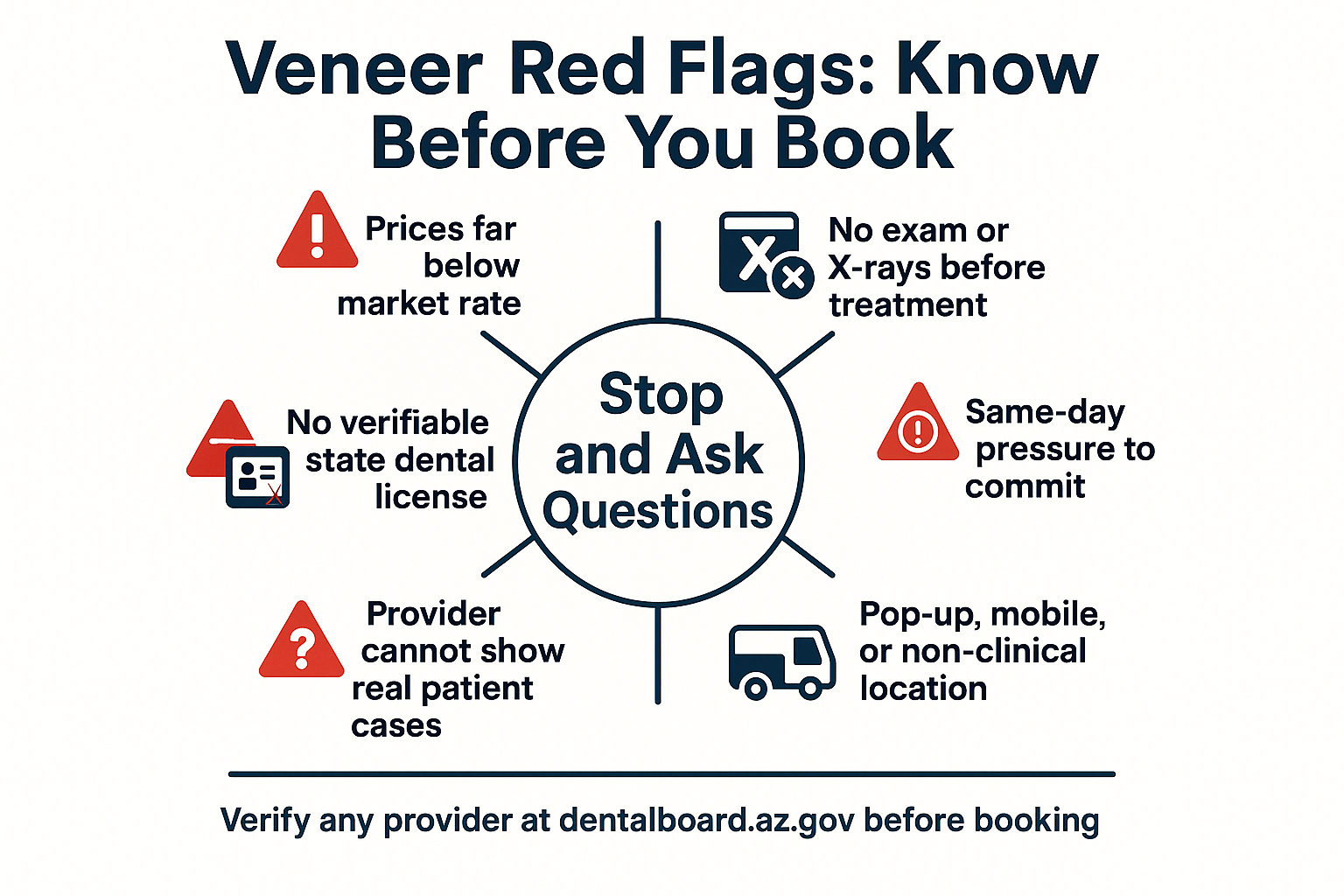
Red Flags That Should Stop You From Booking Veneers
If you’re researching veneer providers and see any of these warning signs, slow down. Each one is worth taking seriously on its own — and multiple flags together mean walk away.
The Questions You Should Be Asking at a Veneer Consultation
A good veneer consultation isn’t a sales presentation — it’s a conversation. If you walk in and feel like you’re being moved toward a decision before you’ve had a real chance to ask questions, that’s a problem.
Here are the specific questions worth asking, and why each one matters:
‘How much enamel will you remove?’ This tells you whether the dentist is thinking conservatively. Some cases — particularly with cosmetic changes that are part of a larger smile plan — require more preparation than others. But a dentist who can’t give you a clear, patient-specific answer to this question hasn’t thought it through.
‘What happens if a veneer chips or comes loose?’ Porcelain veneers are durable, but they’re not indestructible. A good dentist will explain the repair or replacement process, and whether your case is better suited for porcelain or composite resin based on your bite and habits.
‘How do you plan for natural-looking proportions?’ This one separates dentists who think carefully about aesthetics from those who apply a standard template to every patient. A smile that looks natural fits the shape of your face, the size of your other teeth, and the way you actually talk and laugh. The goal isn’t a ‘perfect’ smile — it’s your smile, improved.
If a consultation doesn’t include a conversation about these things, it’s worth scheduling a second opinion before you proceed. Veneers are not reversible. There’s no reason to rush.
Why Shade Matching Is One of the Most Important Things a Dentist Does
I want to spend a moment on shade matching, because patients almost never ask about it — and it’s one of the clearest signals of a dentist who takes cosmetic work seriously.
Once a veneer is bonded to your tooth, the shade is permanent. You cannot whiten it, adjust it, or nudge it slightly closer to your natural teeth. This means the shade selection that happens before the lab fabricates your veneers is one of the most consequential decisions in the entire process.
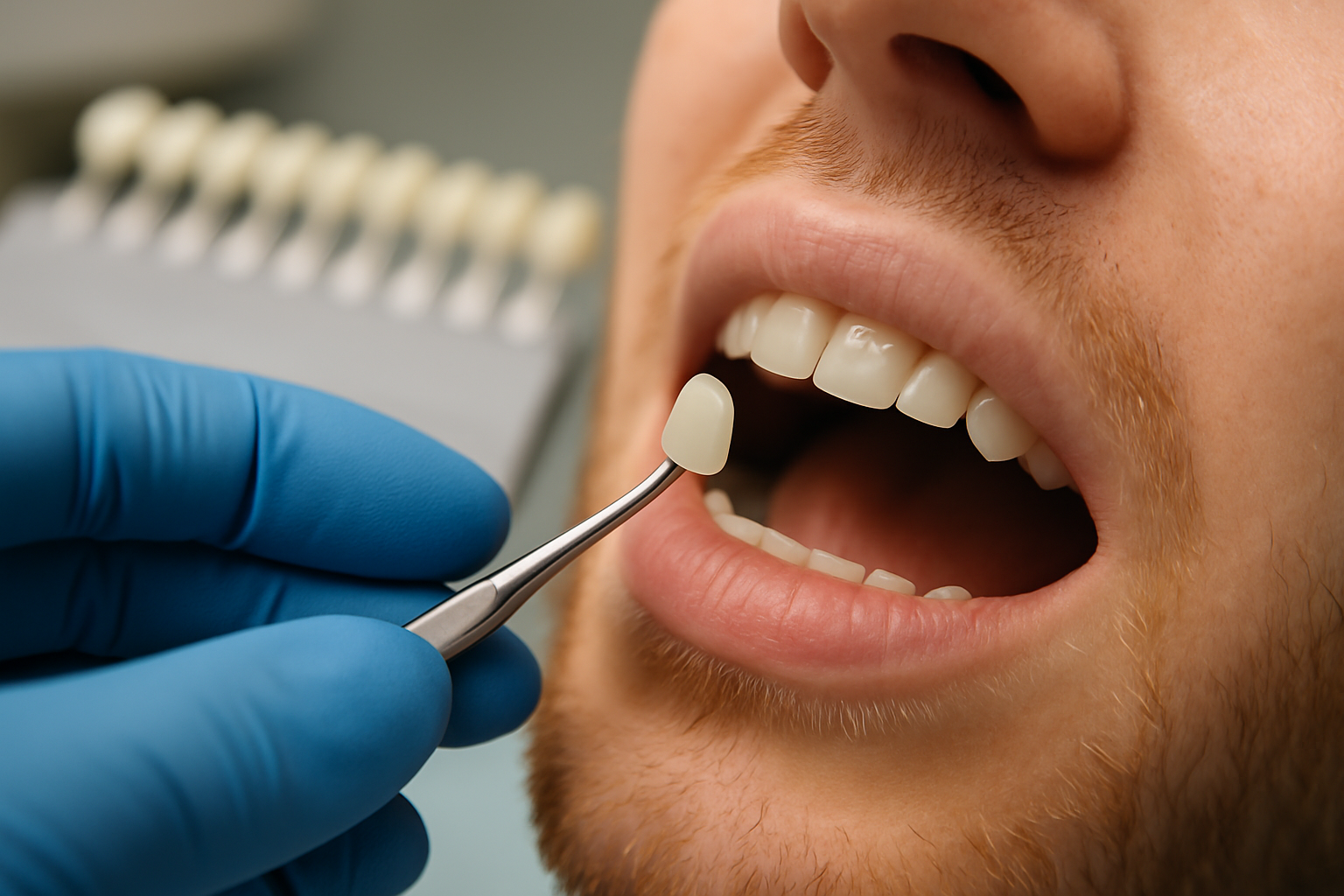
A careful dentist will take their time with this. They’ll look at your teeth under different lighting conditions. They’ll coordinate with the dental lab on the specific translucency and layering of the porcelain. And if the veneer comes back from the lab and the shade isn’t right, they will delay the seating rather than bond it anyway. That delay costs time and sometimes a second lab fee — but a dentist who prioritizes the result over the schedule is one you can trust.
This is also why it’s worth doing professional whitening before veneers if you’re considering brightening your surrounding teeth. Veneers are matched to your teeth at the time of fabrication — not to where you want your teeth to be afterward.
And for context on what a veneer treatment involves financially: costs vary considerably depending on the number of veneers, the material chosen, and the complexity of your case. In the greater Scottsdale and North Scottsdale market, fees for a single porcelain veneer can range broadly — and the total investment for a full smile treatment is something best discussed directly with a dentist after an exam. Any quote you get without a prior clinical evaluation should be treated with skepticism.
Licensed Dentist vs. Unlicensed Provider: Key Differences
This comparison covers what a legitimate, licensed veneer provider does — and what patients often encounter when they book through unverified channels.
| Factor | Licensed Dentist | Unlicensed Provider |
|---|---|---|
| Legal standing | Arizona state dental license, verifiable online | No dental license; illegal to perform the procedure |
| Pre-treatment exam | Full exam, X-rays, bite and gum assessment required | Typically skipped or absent |
| Shade matching | Careful coordination with dental lab; will delay if wrong | Often skipped or done without lab communication |
| Location | Licensed dental office with infection control protocols | Pop-up, mobile, or non-clinical setting |
| Recourse if something goes wrong | State dental board, malpractice coverage | Little to none — often untraceable |
| Pricing transparency | Personalized estimate after clinical evaluation | Flat ‘deals’ marketed on social media, often far below market |
Frequently Asked Questions About Veneer Qualifications
Can a dental hygienist place veneers?
No. Dental hygienists are licensed for preventive care — cleanings, scaling, and patient education. Placing veneers involves removing tooth structure and bonding a permanent restoration, which is the practice of dentistry and requires a dentist’s license.
Are ‘no-prep’ veneers any different from the legal standpoint?
No — even veneers marketed as ‘no-prep’ or ‘minimal-prep’ are still dental restorations that require a licensed dentist to evaluate your case and place them properly. The prep distinction refers to how much enamel is removed, not whether a clinical exam and dentist involvement are needed.
How do I know if a veneer provider in Scottsdale is actually licensed?
Go to the Arizona State Board of Dental Examiners at dentalboard.az.gov and use their public license lookup. Search by the dentist’s name. You’ll see their license status, any disciplinary history, and their license type. If the person you’re considering doesn’t appear there with an active license, do not proceed.
What should I do if I had veneers placed by an unlicensed provider and something went wrong?
See a licensed dentist as soon as possible. Describe exactly what was done and when. In some cases the damage is cosmetic and correctable — in others, the underlying tooth structure may be compromised. Don’t wait. Some of the issues that arise from improperly placed veneers can worsen quickly, and tooth pain after cosmetic procedures is never something to sit with.
Is it okay to get a second opinion before committing to veneers?
Absolutely — and any dentist worth seeing will tell you the same. Veneers are permanent, and you should feel completely confident in both the treatment plan and the person placing them. A second opinion is not an insult to the dentist; it’s a smart patient making a thoughtful decision.
Do veneers affect the teeth underneath them?
Yes, which is exactly why proper preparation matters. To place a traditional veneer, the dentist removes a thin layer of enamel from the front of the tooth — typically less than a millimeter, but sometimes more depending on your case. That enamel does not grow back, which is why the overall treatment sequence should be planned carefully, not improvised.
Ready to Get Real Answers About Veneers?
If you’ve been researching veneers and want to talk through your options with someone who will give you a straight answer — not a sales pitch — our team at Trinity Dental Care is here for that conversation. Dr. Fink takes the time to explain exactly what’s involved before any treatment is recommended, and no one leaves a consultation feeling pressured. Call us at 480-621-4040 or visit trinitydentalcares.com to request an appointment.