
Direct Answer: Some tooth problems need attention today — infection, severe pain, or a knocked-out tooth. Others can safely wait a few days. Knowing which is which helps you make the right call.
It happens in the middle of dinner, or first thing in the morning when you bite into something soft. A crown pops off, a tooth starts throbbing, or you notice swelling you didn’t have yesterday. And then comes the question every patient eventually asks: is this bad enough to call the dentist today?
Most people hesitate. They don’t want to overreact, they don’t want to be told they’re fine and feel embarrassed, and if they’re honest, part of them is hoping it just goes away. We hear this from patients around North Scottsdale constantly — people who waited days or even weeks before calling, sometimes long enough for a manageable problem to turn into a much bigger one.
This article breaks down how to read your own situation — from the kind of thing that genuinely cannot wait to the issues that are uncomfortable but stable. The goal is to help you make a clear-headed decision, not a panicked one.
What Actually Counts as a Dental Emergency
A true dental emergency is anything that involves active infection, severe uncontrolled pain, or a tooth that has been knocked completely out. These situations have a narrow window for the best outcome, and waiting even a day or two can change what’s possible.
Here’s what falls into the “call right now” category:
- A knocked-out permanent tooth — if you can get to a dentist within 30 to 60 minutes, there’s a real chance it can be re-implanted. Keep it moist (in milk, or between your cheek and gum) and don’t touch the root.
- Facial swelling, especially below the jaw or near the eye — this can signal an infection spreading beyond the tooth, which is a medical concern, not just a dental one.
- Fever combined with tooth pain — fever is your body’s signal that an infection is active and spreading.
- A pimple-like bump on the gum near a painful tooth — this is called a dental abscess, and it needs treatment. It won’t resolve on its own.
- Severe, constant throbbing pain that isn’t responding to over-the-counter pain relief.
If tooth pain has been going on for a while and is getting worse rather than better, that pattern matters. Escalating pain is your body telling you the problem isn’t stable.
Why Dental Infections Deserve Their Own Conversation
Patients sometimes describe an abscess as “a little sore spot on my gum” — and it’s easy to write that off as minor. But a dental infection is not the same as a canker sore or irritated tissue. It’s bacteria that has worked its way into the root of a tooth or the surrounding bone, and it does not get better without intervention.
The warning signs are specific:
- Swelling in the gum, jaw, or face — especially if it appeared quickly
- A small raised bump on the gum that may look white or yellow at the tip
- Throbbing pain that’s worst when lying down
- A bad taste in your mouth that comes and goes (this can mean the abscess is draining)
- Fever, chills, or feeling generally unwell alongside tooth pain
Left untreated, a dental infection can spread to surrounding teeth, the jawbone, and in serious cases, the soft tissues of the neck. That’s not meant to alarm you — it’s meant to explain why this particular situation has a different urgency than, say, a chipped tooth that isn’t painful.
If you’re noticing signs that go beyond just your gum tissue, it’s worth a call the same day.

Situations That Feel Urgent But Can Usually Wait a Few Days
Not everything that’s uncomfortable is a same-day emergency. There are plenty of situations that are annoying, a little worrying, and definitely worth scheduling — but aren’t going to become catastrophic if you call tomorrow morning instead of tonight.
These generally fall into the “urgent but not emergency” category:
- A crown or filling that came off while eating — common, and yes, it needs to be addressed, but if there’s no pain and no sharp edge cutting your tongue, a day or two is usually fine. Avoid chewing on that side. You can read more about what to do for a broken tooth filling while you wait.
- A chipped tooth with no pain — rough edges can be smoothed, and a temporary fix for a broken tooth can bridge the gap until your appointment.
- Mild to moderate sensitivity that started recently — if it’s not constant and not worsening, this can wait for a scheduled visit, though it does need attention.
- A loose crown — same logic as a lost one. Avoid sticky foods, don’t try to cement it yourself, and call first thing in the morning.
The key distinction is whether there are signs of infection or severe escalating pain. Without those, you have a little breathing room — but not weeks of it.
The Real Cost of Waiting — And Why Problems Almost Always Get Bigger
One of the most common patterns we see at Trinity Dental Care is a patient who ignored something for weeks — a filling that fell out a month ago, a crown that had been feeling loose for a while — and called once things got painful enough that they couldn’t wait anymore.
What started as a straightforward crown replacement becomes something more involved once decay gets into the exposed tooth structure underneath. What started as a chipped molar becomes a cracked tooth that now needs a full crown rather than a simple repair. The procedure gets bigger, and so does the cost.
This isn’t about judgment. Life gets busy, and dental concerns tend to fall below things that feel more urgent in the moment. But from a purely practical standpoint, early treatment is almost always less expensive and less involved than delayed treatment. A $200 filling replacement beats a $1,500 crown every time. And a crown beats a tooth loss situation that requires an implant.
If you’re curious about how long a dental crown should hold up before it needs replacing, that context helps too — because sometimes what feels like a sudden failure has actually been developing slowly for a while.
How to Read Your Tooth Situation: A Quick Reference
Use this guide to assess where your situation falls — and what to do next.
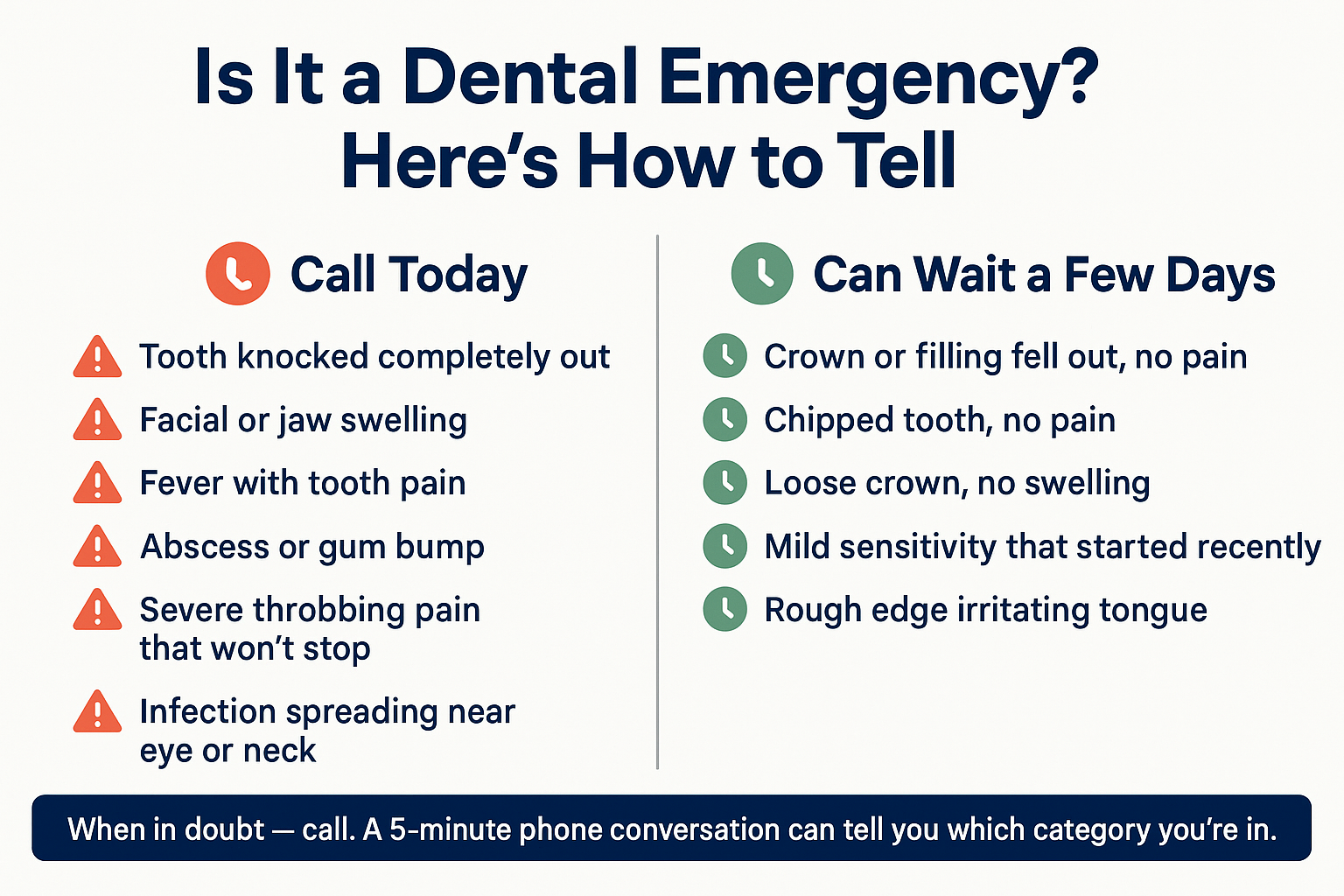
Dental Situations at a Glance: Wait or Call Now?
This table is a quick reference — not a diagnosis. If your symptoms are worsening or you’re unsure, call regardless of what category seems to fit.
| Situation | Pain Level | What to Do |
|---|---|---|
| Knocked-out tooth | Varies | Call immediately — time is critical |
| Facial swelling with fever | Moderate to severe | Call today — possible spreading infection |
| Abscess (gum bump) | Moderate to severe | Call today — needs treatment |
| Crown fell off, no pain | None or mild | Call next business day — avoid chewing on that side |
| Filling broke or fell out | None or mild | Call within 1-2 days — protect exposed area |
| Chipped tooth, no sensitivity | None | Schedule soon — no same-day urgency |
| New cold sensitivity | Mild | Schedule a visit — not an emergency yet |
| Constant, escalating tooth pain | Severe | Call today — could indicate infection |
When Timing Pressure Adds Stress to the Decision
We get a particular wave of calls before major life events — a family reunion, a destination wedding, a long trip planned out of Phoenix Sky Harbor. Someone realizes their tooth situation can’t be ignored for another two weeks, and now they need help fast.
The honest answer is that calling sooner always leaves more options open. If there’s a week before your event and you have a crown that’s been loose, there’s likely time to address it. If you call two days before, options narrow. Dental offices — including ours — do their best to accommodate urgent scheduling, but we can’t manufacture time.
The practical advice: if you have something on the calendar in the next three to four weeks and you’ve been quietly aware of a tooth issue, this is the moment to call. Not because you’re panicking, but because giving yourself a reasonable runway is always the smarter move.
Frequently Asked Questions About Dental Emergencies
My crown came off while I was eating. Do I need to go in today?
Usually not today, but you should call the next business day. If the tooth underneath is sensitive or painful, bump that up to same-day. In the meantime, don’t try to re-cement the crown with household adhesives — that can make proper re-seating harder. Keep the crown somewhere safe and avoid chewing on that side.
How do I know if I have a dental infection?
The clearest signs are swelling in the gum or jaw, a pimple-like bump on the gum near the painful tooth, throbbing pain that gets worse when lying down, and sometimes a fever or bad taste. If two or more of those are present, treat it as same-day. Infections don’t follow a predictable timeline, and waiting can let them spread.
I’ve had a toothache for a few weeks. Is that still an emergency?
If it’s been going on for weeks and hasn’t gotten dramatically worse, it’s not an emergency in the same way a knocked-out tooth is — but it absolutely needs attention. Chronic tooth pain usually means something is happening below the surface, and that process tends to progress the longer it’s left alone. Call and get it evaluated.
What if I’m not sure whether my pain is serious enough to call about?
Call anyway. A five-minute phone conversation can help determine whether you need to come in today, tomorrow, or just at your next available appointment. No one at a dental office is going to make you feel foolish for asking. That’s what the phone is for.
Can a chipped tooth wait, or does it need same-day treatment?
A chip with no pain and no sharp edge cutting your cheek or tongue can generally wait for a scheduled visit within a few days. If the chip is large, exposes the inner tooth, or hurts when you breathe in cold air, move that appointment up.
I’ve been putting off a dental problem for a while. Is it too late to fix?
Rarely. Most dental problems — even ones that have been ignored longer than they should have been — are still fixable. The repair might be more involved than it would have been earlier, but that’s a conversation, not a dead end. No judgment, no lecture — the focus is always on what can be done from here.
Not Sure Where Your Situation Falls? Start With a Phone Call.
Dr. Fink and our team at Trinity Dental Care work with patients across North Scottsdale — including many who have been quietly managing a tooth problem for longer than they’d like to admit. There’s no shame in that, and there’s no rush to judgment here. If you’re trying to decide whether what you’re dealing with can wait or needs attention soon, call us at 480-621-4040 or visit trinitydentalcares.com to request an appointment. A short conversation is usually all it takes to get you pointed in the right direction.