
Direct Answer: The choice usually comes down to three things: the health of the teeth beside the gap, whether you have enough jawbone for an implant post, and how fast you need the tooth replaced.
You lost a tooth, or you have one that can’t be saved. In the same appointment, someone hands you two words you barely know the difference between: implant and bridge.
I hear this constantly from patients across North Scottsdale, from the Shea Corridor to McCormick Ranch. They leave the exam with two options and no real sense of how a dentist actually picks one.
So let me walk you through the way the decision actually gets made in the chair. Three things drive it: the teeth next to the gap, the bone under it, and your timeline. Neither option is the “right” one in general. One of them is usually right for you.
How to know if you need a dental implant or a bridge: start with the neighbors
This is the part most patients don’t hear until after the fact, and I think that’s a shame.
A traditional bridge doesn’t float in the gap. It anchors to the teeth on either side, and to do that, we have to reduce the enamel on both of those teeth and cap them with crowns. That change is permanent.
So the first question I ask myself is simple: what shape are those two neighbors in?
- If they already have large fillings, cracks, or old crowns, a bridge can be a smart move. Those teeth were headed for crowns anyway, so you’re solving two problems with one restoration.
- If they’re pristine and untouched, reducing them to hold a bridge means permanently altering two healthy teeth that were never the problem. For a lot of patients, that alone points toward an implant.
- If one neighbor is missing or badly angled, a standard bridge may not have solid support at all, and we’d look at other designs, like a cantilever bridge, or move on to implants.
An implant replaces the tooth on its own. It doesn’t lean on anything. That independence is the single biggest structural argument in its favor, and it’s why I bring it up first.
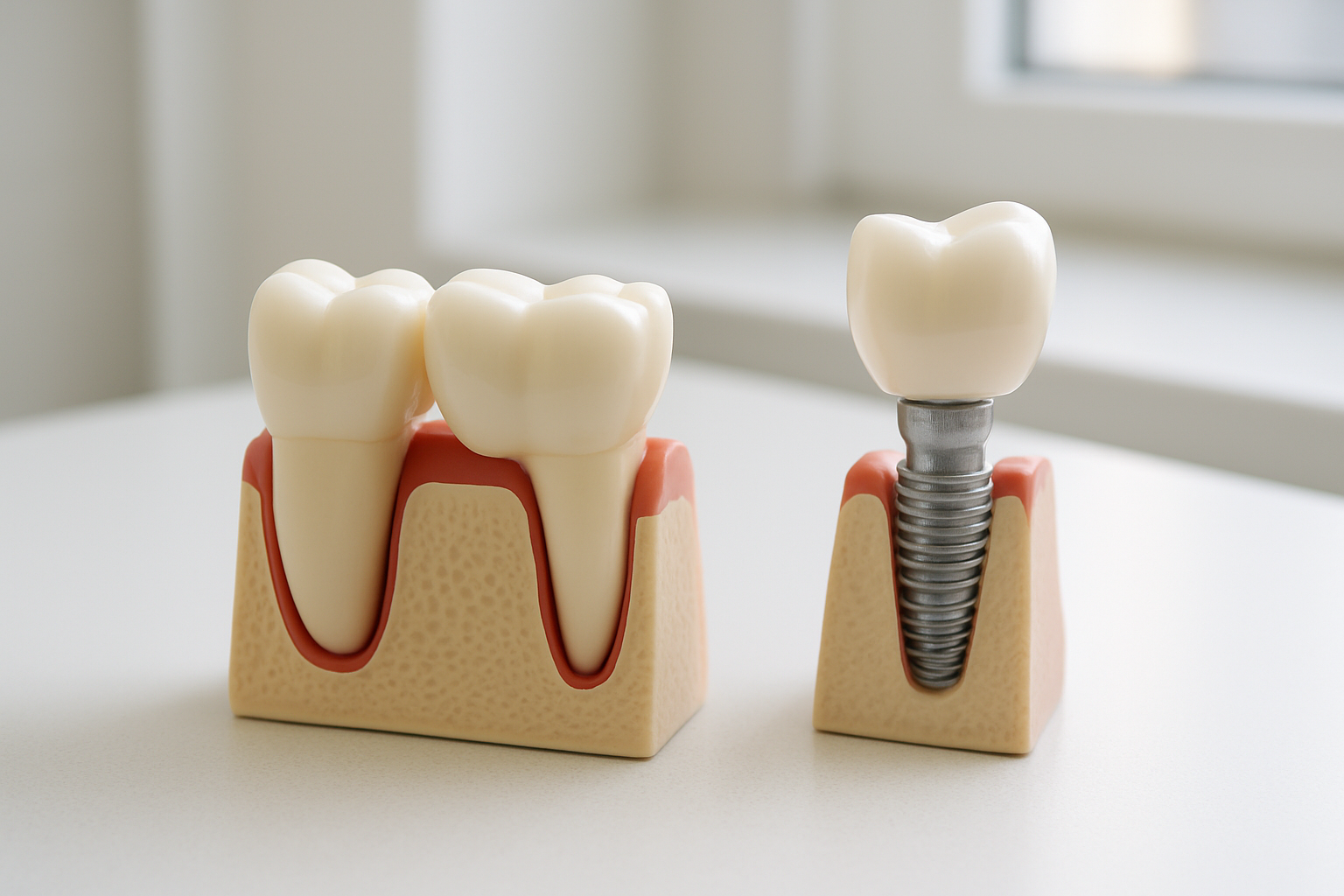
Bone is the gating factor for implants, and it’s not as scary as it sounds
An implant is a small titanium post placed into your jawbone. For that to work, there has to be enough bone there to hold it.
Here’s the wrinkle. When a tooth comes out, the bone that used to support it slowly shrinks because nothing is stimulating it anymore. The National Institute of Dental and Craniofacial Research covers this well: the ridge changes after tooth loss, and it keeps changing over time.
So a tooth that’s been missing for six months is a different situation than one missing for eight years.
But I want to be clear about something, because patients talk themselves out of implants before they ever get evaluated. I’ve had people call convinced they “don’t have enough bone,” based on something they read or something a dentist told them a decade ago. A large share of them turn out to be fine.
A proper assessment includes:
- Digital X-rays and imaging to see actual bone height and width at the site
- A look at the sinus or nerve position, which matters more in some spots than others
- Gum health screening, because active gum disease has to be handled before any implant goes in
- A review of medical history and medications that can affect healing
That’s what a consultation is for. It turns a guess into a plan.
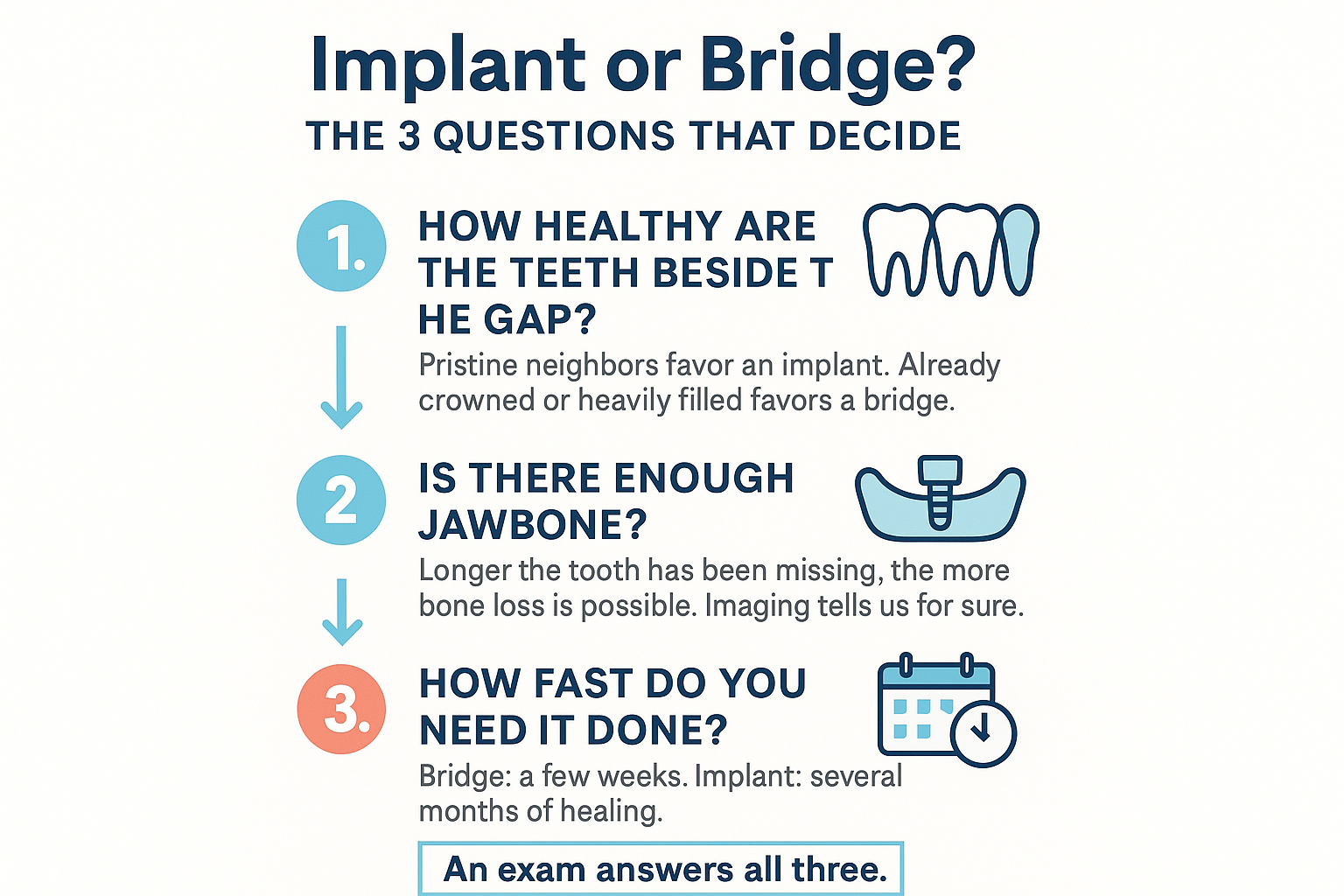
The three questions that decide it
When I’m sitting with a patient weighing these two options, the conversation almost always collapses into three questions. Here’s how they stack up.
Timeline is real, and nobody should feel silly for caring about it
Patients sometimes apologize for asking how fast this can be done, like it’s a shallow question. It isn’t. It’s a practical one.
A bridge is usually a matter of weeks from start to finish. Prep the anchor teeth, take impressions or a digital scan, place a temporary, then cement the final bridge.
An implant is a longer road. The post has to fuse with your bone before the final crown goes on, and that fusion typically takes several months, sometimes more if bone grafting is part of the plan. You’re not walking around with a hole the whole time, but the full process stretches out.
That difference matters when there’s a real deadline attached:
- A wedding, a reunion, or a family photo on the calendar
- A job where you present or sell face to face
- A long trip planned where you’d rather not be mid-treatment
I’ve had North Scottsdale patients pick a bridge purely because of a spring event, and it was the right call for them. I’ve had others decide the extra months were worth it to keep their healthy teeth untouched. Both are reasonable answers.
If you want a realistic picture of the implant side, our breakdown of what implant healing actually looks like week by week lays out the stages honestly.
Implant vs. bridge at a glance
This isn’t a scorecard where one side wins. It’s a way to see which trade-offs you’d rather live with.
| Factor | Dental Implant | Dental Bridge |
|---|---|---|
| Effect on neighboring teeth | None. Stands on its own | Requires reducing and crowning both adjacent teeth |
| Bone requirement | Needs adequate jawbone; grafting sometimes needed | No bone requirement at the gap |
| Typical timeline | Several months from post to final crown | Usually a few weeks |
| Effect on jawbone over time | Stimulates bone, helps limit shrinkage | Does not stimulate bone under the gap |
| Cleaning at home | Brush and floss like a natural tooth | Requires threading under the false tooth |
| Best fit | Healthy neighbors, good bone, no rush | Compromised neighbors, limited bone, or a firm deadline |
What about cost and insurance?
I won’t quote you a number in a blog post, because the honest answer is that it depends on the site, the materials, and whether anything extra like grafting is involved. Anyone who gives you a firm price before an exam is guessing.
What I can tell you is how the money usually shakes out in practice.
- Up front, a single bridge is often the lower number. That’s a big part of why patients pick it.
- Over the long run, the math can flip. A bridge involves three teeth instead of one, and if the whole unit needs replacing years later, you’re redoing all three.
- Insurance treats them differently. Many plans have historically covered bridges more readily than implants, though that has been shifting. We walk through this in more detail in our guide on what dental insurance actually covers for implants in Arizona.
A good share of the calls we get from Scottsdale residents are insurance questions, and plenty of them come from people who are out of network or uninsured entirely. If that’s you, ask about membership plan options when you call. Cost should be a path to figure out, not a wall you hit.
And if you’re replacing more than one tooth, the calculation changes again. Multiple tooth implant options can cover a span with fewer posts than you’d expect.
What I’d tell a friend
If your neighboring teeth are healthy, your bone is solid, and you’re not racing a calendar, an implant is usually the choice I’d lean toward. It protects teeth that don’t need protecting from anything else, and it keeps the bone working.
If those neighbors already need crowns, or bone is genuinely limited, or you have a real deadline, a bridge is not a consolation prize. It’s a durable, long-standing solution that has restored a lot of smiles.
What you shouldn’t do is decide from a search results page. Get imaging, get a look at the gum tissue, and get someone to explain the trade-offs in plain English before you commit to anything.
Frequently Asked Questions About Choosing Between an Implant and a Bridge
Can I switch to an implant later if I get a bridge now?
Sometimes, but it gets more complicated. The bone under a bridge doesn’t get stimulated, so it can continue to shrink over the years, which may mean grafting is needed later. If you think an implant is where you’ll eventually land, it’s worth discussing that at the start rather than after.
Does the implant procedure hurt?
Placing the post is usually more comfortable than patients expect, and the area is fully numbed. Most people describe the days afterward as soreness rather than sharp pain, similar to an extraction. We talk through comfort options ahead of time so nothing catches you off guard.
How long does a bridge last compared to an implant?
Bridges commonly last 10 to 15 years or more with good hygiene and regular checkups, and the anchor teeth underneath are what usually determine the lifespan. Implants can last much longer, often decades, because the post itself doesn’t decay. Gum health matters enormously for both.
I’ve been missing this tooth for years. Is it too late for an implant?
Probably not, and I’d hate for you to rule it out on your own. Bone loss is common after long gaps, but imaging often shows more workable bone than patients assume, and grafting can address a lot of the rest. Get evaluated before you decide.
Which one is easier to keep clean?
An implant, in most cases. You brush and floss it like a natural tooth. A bridge requires threading floss or using a special aid underneath the false tooth, and if you skip that step, the anchor teeth are the ones that pay for it.
Want a straight answer about your own situation?
The only way to know whether an implant or a bridge fits your mouth is to look at the bone, the gums, and the teeth beside the gap. Our team sees patients from across Scottsdale, Paradise Valley, and the surrounding North Scottsdale neighborhoods for exactly this kind of consultation. If you’d like to talk it through, you can reach us at 480-621-4040 or at trinitydentalcares.com.