
Direct Answer: Smile makeover cost is driven mostly by how many teeth are treated, the materials chosen, and whether restorative or gum problems need fixing first. Scope is the biggest variable, so quotes vary widely.
You typed “smile makeover cost” into Google, and every page you clicked gave you a range so wide it was useless. I understand the frustration. That range exists for a real reason, and once you understand it, you can actually plan.
Most of the patients I meet from North Scottsdale, Paradise Valley, and the Shea Corridor have already spent hours researching before they ever pick up the phone. They ask sharp questions. They deserve a straight explanation instead of a sales pitch.
So here is how I actually think about pricing a smile makeover: the number of teeth involved, the materials chosen, and the condition of what’s underneath. Those three things move the number more than anything else.
Why “Smile Makeover” Has No Single Price
A smile makeover is not one procedure with one code and one fee. It’s a plan built from several treatments that happen to share a goal.
For one patient, it means whitening plus two veneers on the front teeth. For another, it means crowns across the upper arch, gum therapy, an implant where a molar was lost years ago, and bonding to even out the lower teeth.
Those two plans are not close in price. They aren’t even close in appointment count. That’s why I can’t give you a number over the phone without seeing X-rays and looking in your mouth.
What I can tell you is what the plan gets built from:
- Whitening (in-office or take-home trays), usually done first so new restorations get matched to a brighter shade
- Composite bonding for chips, small gaps, and edges that have worn down
- Porcelain veneers on the teeth that show when you smile and talk
- Crowns where a tooth needs strength, not just a new surface
- Implants or bridges where teeth are missing
- Gum treatment when the tissue isn’t healthy enough to support cosmetic work yet
Every one of those has its own fee. Your total is just the sum of what you actually need, not a package price someone quoted you on a billboard along Frank Lloyd Wright Blvd.
Tooth Count Is the Biggest Cost Driver
If you take one thing from this article, take this: cost scales with the number of teeth being treated, and it scales almost linearly.
Each veneer or crown is its own restoration. It has its own preparation time, its own lab work, its own fitting and adjustment. Two teeth and ten teeth are different financial conversations entirely.
When I plan a case, I’m looking at a few specific things:
- Which teeth actually show. For most people that’s the upper front six to eight teeth. Some patients have a wide smile and show ten or twelve.
- Whether the lower teeth show when you talk or laugh. Many do, and ignoring them can make the upper work look obvious.
- What your goal really is. Fixing one chipped front tooth is a different project than changing the shape and color of your whole smile.
- Whether anything underneath needs repair first. Decay, a cracked molar, or gum inflammation changes both the plan and the price.
One of our patients shared publicly that she had 10 teeth recapped, and her words were honest about the tradeoff: “I had 10 teeth recapped which improved my smile and confidence. It was a costly item but so glad I decided to do it.” That’s a fair way to describe a ten-unit case. It’s a real investment, and it should be treated like one.
If your budget is fixed, tooth count is usually the lever we adjust. Sometimes the honest answer is that you don’t have to fix everything to love your smile again.
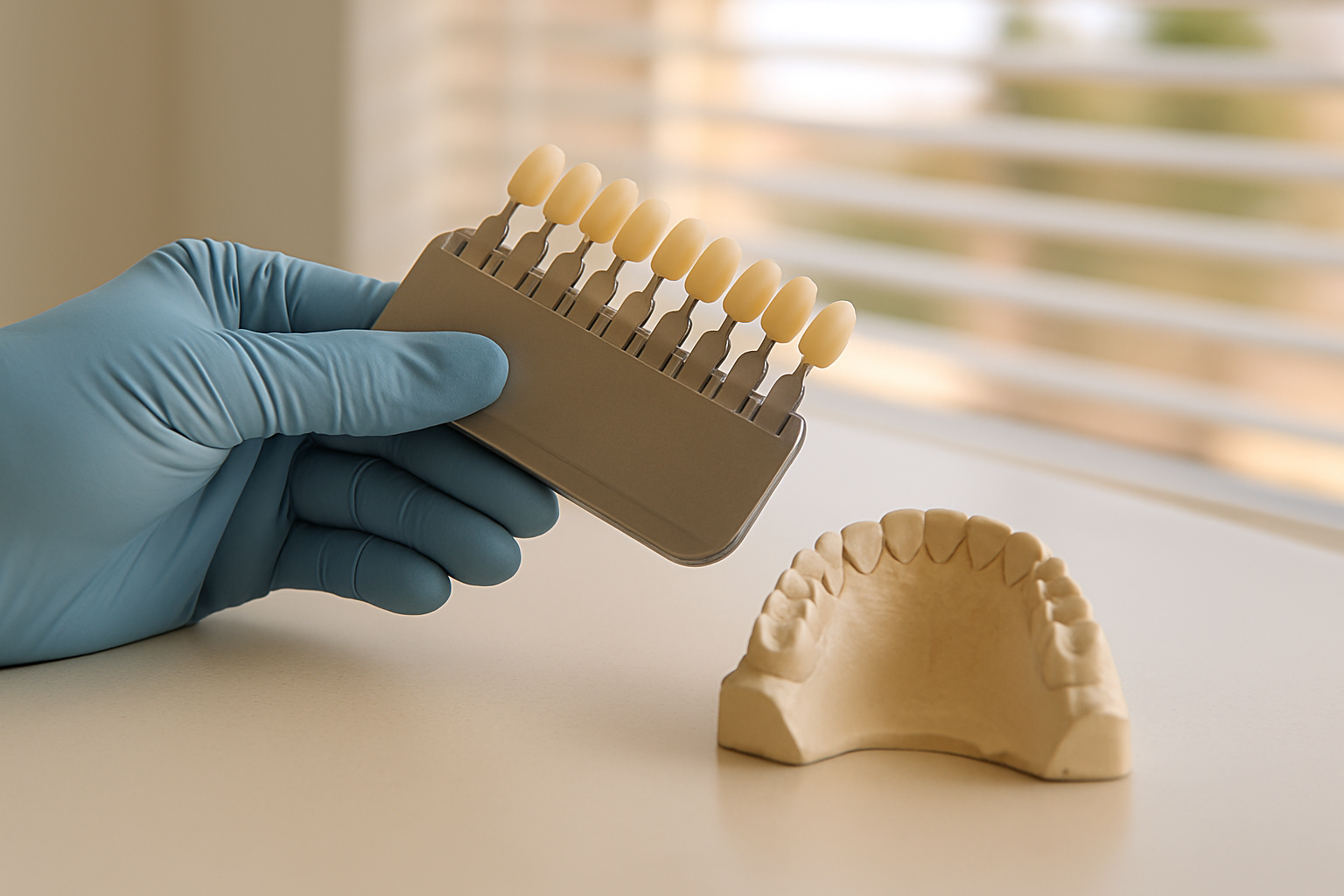
How Scope Changes the Conversation
Here’s a rough map of how different smile makeover scopes tend to differ. These are patterns I see, not price quotes.
| Scope | What it usually includes | How cost behaves |
|---|---|---|
| Single tooth touch-up | Bonding or one veneer, sometimes whitening first | Lowest total, often one or two visits |
| Front six to eight teeth | Veneers or crowns on the visible upper teeth, whitening beforehand | Multiplies per tooth, since each unit carries its own lab fee |
| Full upper arch | Eight to ten restorations, possible gum contouring, shade planning | Substantially higher, more chair time and more appointments |
| Makeover with restorative groundwork | Fillings, crowns on back teeth, gum therapy or implants before cosmetics | Health work is priced first, cosmetic phase follows separately |
Materials Change the Price and the Result
Material choice is where I see patients try to save money in a way that costs them later.
Composite bonding is the least expensive option. It’s done in one visit, it’s reversible, and it works beautifully for small chips and gaps. It also stains over time and doesn’t hold up under heavy bite force the way porcelain does.
Porcelain veneers cost more per tooth. They resist staining, they reflect light the way natural enamel does, and they hold their appearance for years. They’re a front-tooth solution, not a solution for a molar that grinds all night.
All-ceramic and zirconia crowns cost more than bonding and do a different job. A crown wraps the whole tooth and restores strength. Zirconia is the workhorse for back teeth that take real force. Well-cared-for crowns commonly last 10 to 15 years or longer.
The mistake is picking a material off a price list without asking where the tooth sits and what it has to do. A thin veneer placed on a tooth that carries a heavy bite is a repair waiting to happen. If you want to go deeper on this, we broke down the different types of crowns for teeth in plain language.
Material is a clinical decision first and a budget decision second. When we flip that order, results don’t last.
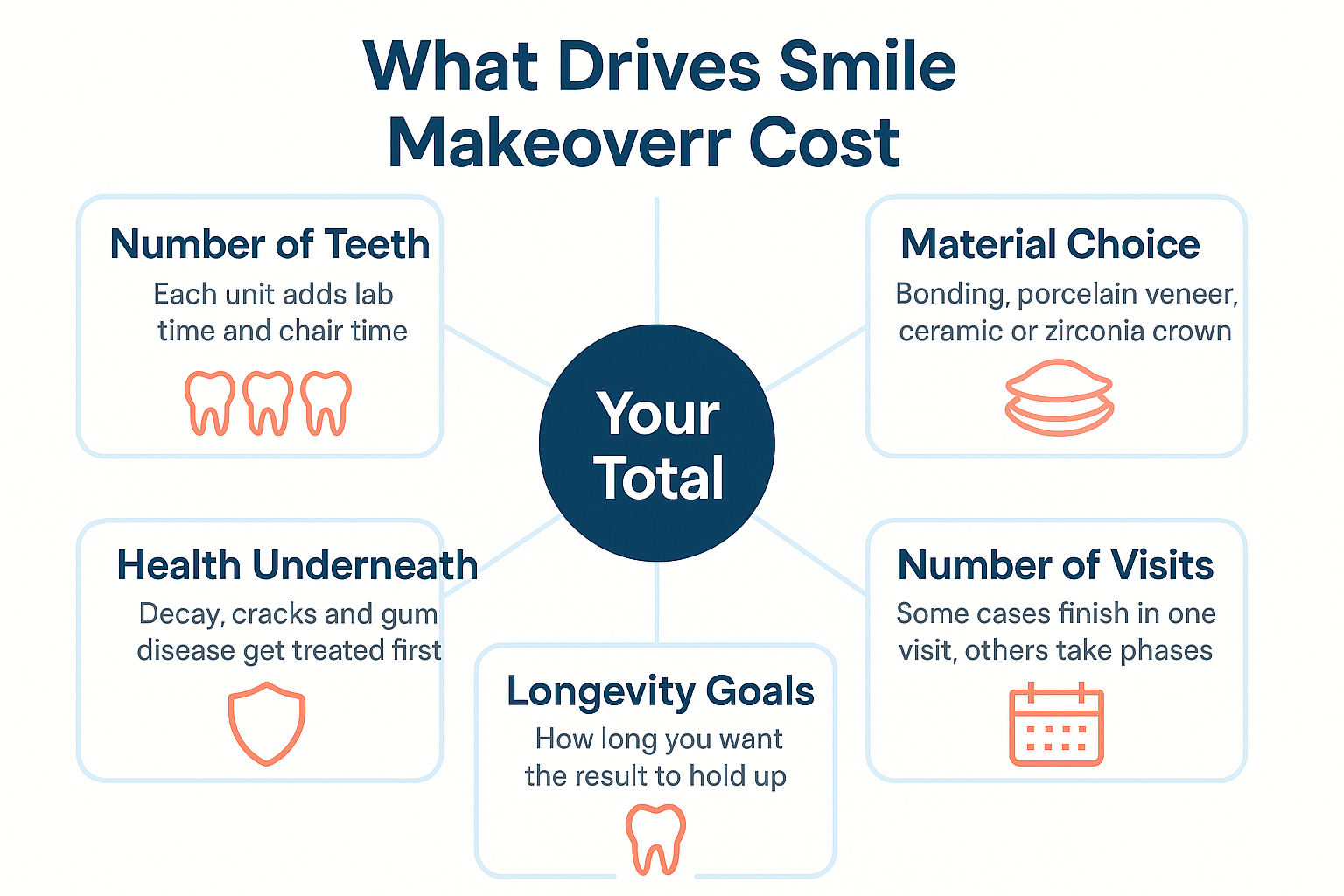
The Five Things That Move Your Number
This is the short version of everything a dentist weighs when pricing a smile makeover.
Sequence Affects Cost More Than People Expect
Here is the part most cost articles skip. The order of treatment changes what you spend and how long the result lasts.
Cosmetic work belongs on a stable foundation. If a back molar needs a crown, that gets handled before veneers go on the front teeth. If gums are inflamed, we treat that first, because tissue shrinks and shifts as it heals, and a veneer margin placed against unhealthy gum tissue will show a line later.
Gum health isn’t cosmetic fine print either. The National Institute of Dental and Craniofacial Research notes that untreated gum disease can damage the bone that supports your teeth, which is the same bone holding up any restoration we place.
So a typical order looks like this:
- Exam, X-rays, and a real diagnosis before any pricing conversation
- Gum therapy if the tissue needs it
- Restorative work, meaning fillings, crowns, root canal treatment or implants where teeth are missing
- Whitening, so we can match new porcelain to your final shade
- Cosmetic phase, meaning veneers, bonding, and final shaping
That sequence is also why the treatment plan you receive may look different from the one you pictured. We wrote a whole piece on why a smile makeover isn’t one procedure, it’s a sequence if you want the longer explanation.
And the phasing helps financially. Splitting a large case across two calendar years lets you use two years of insurance benefits instead of one.
What the Scottsdale Market Means for You
Scottsdale is a premium dental market and also a competitive one. Median household income here tops $110,000, and more than 60% of adults hold a college degree, so patients in Montana Ranch, McCormick Ranch, and Scottsdale Mountain tend to shop carefully and ask good questions.
That’s a healthy thing. But it also means you’ll see quotes that differ a lot between offices for what sounds like the same work.
When you compare, look past the total and ask:
- How many units is the quote actually covering?
- What material is specified for each tooth, and why that one?
- Is any restorative or gum work included, or priced separately later?
- Who fabricates the restorations, and what happens if a shade needs adjusting?
- Is a consultation fee credited toward treatment?
On insurance: purely cosmetic work is generally not covered, but the restorative pieces of a makeover, like a crown on a cracked tooth, often carry partial coverage. We verify plans before treatment and can talk through options for patients without insurance. Ask us directly rather than guessing from a benefits booklet.
And if you’re still deciding how far to go, the difference between a cosmetic touch-up and a real smile transformation is worth reading before you set a budget.
Frequently Asked Questions About Smile Makeover Costs
Can you give me a ballpark price over the phone?
Not an honest one. Without X-rays and an exam, I can’t tell how many teeth are involved, whether there’s decay under an old filling, or whether your gums need attention first. What I can do on the phone is explain the pieces and what a consultation includes.
Does dental insurance pay for a smile makeover?
Usually not for the purely cosmetic parts, like veneers placed for appearance alone. But restorative components often carry partial coverage, since a crown on a cracked tooth is a health treatment, not a cosmetic one. We verify your plan before you commit to anything.
Is it cheaper to do everything at once or in phases?
The total is similar either way. Phasing can be easier on your budget because you may be able to use two years of insurance benefits, and it spreads payments out. Some cases do need to be completed together for shade matching, and I’ll tell you when that’s true.
Do veneers always cost more than crowns?
Not always. They’re priced in a similar neighborhood in most practices, and the choice comes down to how much tooth structure remains and how much force that tooth takes. A veneer covers the front surface, a crown covers the whole tooth.
How long should a smile makeover last?
With good hygiene and regular checkups, crowns commonly last 10 to 15 years or more, and quality porcelain veneers are in the same range. Bonding has a shorter lifespan and may need refreshing sooner. Nightguards matter a lot if you grind.
Want a real number instead of a range?
The only way to price a smile makeover accurately is to look at your teeth, your gums, and your goals together, then build the plan in the right order. Our team in North Scottsdale is currently accepting new patients for consultations at our office on Frank Lloyd Wright Blvd. You can reach Trinity Dental Care at 480-621-4040 or at trinitydentalcares.com when you’re ready to talk it through.