
Direct Answer: Professional teeth whitening typically lasts anywhere from one to three years. How long yours holds depends mostly on what you eat, drink, and whether you do occasional touch-ups.
One of the most common questions we hear — often from patients who are scheduling a routine cleaning — is some version of: ‘How long is this actually going to last?’ It’s a fair question, and it deserves a straight answer instead of a vague ‘it depends.’
The honest answer is that professional whitening results typically last one to three years, but that range is wide for a reason. Your daily habits, the foods and drinks you love, and whether you do the occasional touch-up will determine where you land in that window.
We want patients to go into whitening with accurate expectations — not inflated ones. So let’s break down what actually drives longevity, what the in-office and take-home options look like side by side, and what you need to know about sensitivity before you start.
Why Whitening Results Fade (and What You Can Do About It)
Whitening works by using a peroxide-based agent to break up the stain molecules inside your enamel. The results are real — but your enamel is porous, and it picks up new stains over time just as it did before.
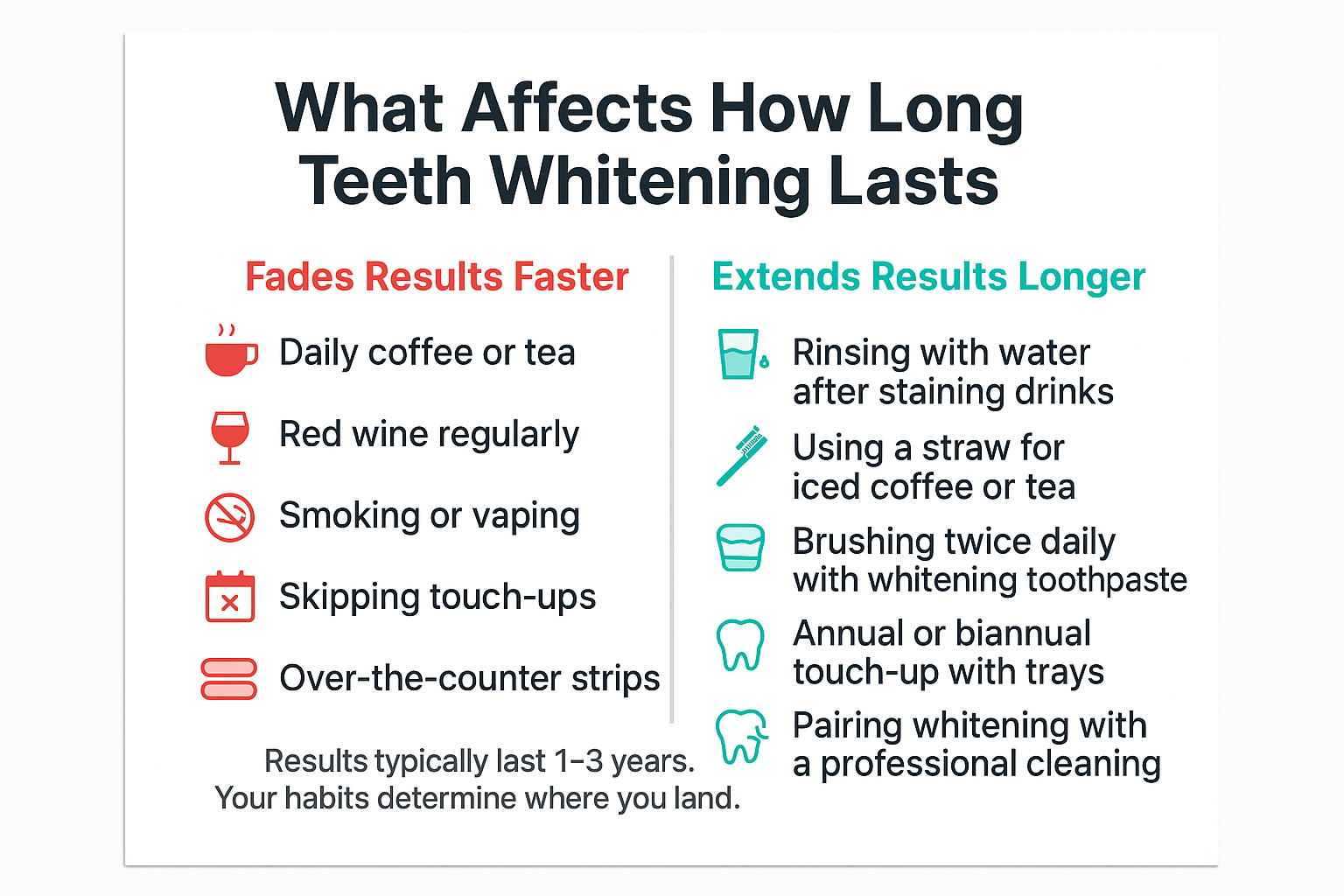
The biggest accelerators of fading are things most of us deal with every day in Scottsdale’s coffee-shop culture:
- Coffee — the single biggest culprit, especially when consumed daily without rinsing
- Red wine — deeply pigmented and acidic, which opens pores in enamel and lets color in faster
- Tea — black and green teas both stain, often more than people expect
- Smoking or vaping — tobacco and nicotine products re-stain teeth aggressively and quickly
- Dark sauces and berries — balsamic vinegar, soy sauce, and blueberries all contribute over time
On the flip side, habits that genuinely extend your results include rinsing with water after staining foods, brushing twice daily with a whitening toothpaste, and using a straw when drinking iced coffee or tea. None of these are dramatic changes — they just reduce the contact time staining agents have with your enamel.
And the biggest longevity tool of all? Periodic touch-ups. Patients who do a brief touch-up once or twice a year consistently maintain results that others lose within six months.

In-Office vs. Take-Home: It’s Not Just About Speed
Most people compare these two options based on how fast they work. But for long-term results, the more useful comparison is how well each one fits into your life.
In-office whitening delivers dramatic results in a single appointment — typically one to two hours in the chair. The professional-strength gel is applied by our team and often activated with a light or laser. You leave noticeably brighter that same day. For patients with an upcoming event — a wedding, a reunion, a work milestone — this is the obvious choice.
Take-home whitening trays from a dental office are custom-fitted to your teeth, which matters more than most people realize. Over-the-counter trays are one-size-fits-all, which means the whitening gel doesn’t stay in even contact with your enamel. Custom trays hold the gel exactly where it needs to be, which produces more even, consistent results over a two-week application period.
But here’s the real advantage of take-home trays for the long haul: you already have them. When your results start to fade six months or a year later, a quick touch-up cycle with the same trays — using a small amount of additional gel — can refresh your shade without another full treatment. That makes take-home trays the more practical option for patients who want to maintain results over years, not just months.
Many patients who want the immediate impact of in-office whitening also leave with a take-home kit for exactly this reason. The two approaches work well together. You can learn more about why store-bought whitening strips keep letting you down compared to professional options — the difference in tray fit alone explains a lot.
In-Office vs. Take-Home Whitening: A Side-by-Side Look
Both options use professional-strength peroxide — the differences are in timing, flexibility, and how they fit into your maintenance routine.
| Factor | In-Office Whitening | Take-Home Trays |
|---|---|---|
| Time to results | Same appointment (1–2 hours) | 1–2 weeks of nightly use |
| Results intensity | Dramatic, immediate lift | Gradual, very even coverage |
| Custom fit | Applied by the dental team | Custom-molded to your teeth |
| Touch-up convenience | Requires a return visit | Use your existing trays at home |
| Best for | Events, fast timelines | Ongoing maintenance, flexibility |
| Sensitivity control | Adjusted in real time by dentist | Controlled by application time and gel strength |
What Shortens — and Extends — Your Whitening Results
This visual breaks down the key daily habits that affect how long your results hold, and what simple steps actually make a difference.
The Timing That Most People Miss: Whiten After Your Cleaning, Not Before
We hear this question frequently when patients call to book their regular cleaning: ‘Can I also do whitening at the same time?’ The answer is yes — and the order actually matters.
A professional cleaning removes the surface-level plaque and tartar buildup that sits on your enamel. When you whiten on top of that freshly cleaned surface, the whitening gel makes direct contact with your enamel rather than working through a layer of buildup. The result is more consistent and typically a few shades brighter than whitening on un-cleaned teeth.
This is one reason we think pairing whitening with a routine dental cleaning is the smart approach — not just for aesthetics, but because the cleaning itself sets the stage for whitening to work the way it’s supposed to. If you’ve been thinking about whitening, your next scheduled cleaning is a natural time to ask about it.
What Whitening Can’t Fix — and Why That Matters Before You Start
This is the part most whitening articles skip, and it’s the part that matters most if you have any existing dental work.
Whitening only works on natural tooth enamel. It has no effect on the shade of crowns, porcelain veneers, or dental bonding. Those materials don’t respond to peroxide the same way natural teeth do.
What this means practically: if you have a visible crown on a front tooth, whitening your natural teeth will make the crown look darker by comparison — not lighter. The mismatch can be more noticeable after whitening than it was before.
If you’re planning cosmetic work in the near future — veneers, bonding, or a new crown — the right sequence is usually to whiten first, then match your new restorations to the whitened shade. That way everything is consistent from the start. If you whiten after getting new restorations, the natural teeth around them change and the restorations don’t.
This is one reason we always have this conversation before starting whitening, not after. If you’re curious about how whitening fits into a bigger smile goal, you don’t have to fix everything to love your smile again — sometimes whitening alone makes a meaningful difference, and sometimes it’s one piece of a larger plan.
Sensitivity During Whitening: What’s Normal and What Isn’t
Tooth sensitivity is the most common concern patients mention when asking about whitening — and it’s worth addressing honestly instead of glossing over it.
Temporary sensitivity during or after whitening is common. It usually feels like a mild zing or ache, particularly to cold temperatures, and it typically resolves within 24 to 48 hours after treatment. For most patients, it’s manageable and not a reason to avoid whitening entirely.
The bigger picture here is that dentist-supervised whitening gives you options that a drugstore kit doesn’t. We can:
- Adjust the concentration of the whitening gel based on your sensitivity level
- Shorten application times if sensitivity becomes uncomfortable
- Recommend a desensitizing gel or toothpaste to use before and after treatment
- Space out treatment sessions if needed
Patients with pre-existing sensitivity — or those who know from experience that their teeth react strongly — often do better with the take-home option simply because they can control the pace. If you’ve ever wondered whether your tooth sensitivity has a separate cause worth looking into, our article on tooth sensitive to cold but not hot covers the most common reasons that happens.
The short version: sensitivity is a normal part of the process for many people, it’s manageable, and a dentist can adjust your treatment in ways a box from the drugstore never could.
Frequently Asked Questions About Teeth Whitening Results
How long do professional teeth whitening results actually last?
Most patients see results that hold for one to three years. Daily coffee, tea, and red wine consumption will shorten that window. Periodic touch-ups — even brief ones every six to twelve months — can extend results significantly.
Is in-office whitening worth the cost compared to take-home trays?
They serve different needs. In-office whitening is ideal when you need fast, dramatic results for an event. Take-home trays are often the better long-term value because the custom trays make future touch-ups easy and affordable. Many patients do both — start with in-office for the immediate lift, then use the trays for maintenance. Exact costs vary based on your treatment plan, so it’s worth asking about pricing when you call.
Will whitening work on my dental crowns or veneers?
No. Whitening only affects natural tooth enamel. Crowns, veneers, and dental bonding won’t change shade with any whitening treatment. If you have visible restorations near your front teeth, this is an important conversation to have before starting whitening — the color contrast can become more noticeable if your natural teeth brighten and the restorations stay the same.
I have sensitive teeth. Can I still whiten?
Most patients with sensitivity can still whiten — it just requires some adjustments. Lowering the gel concentration, shortening application time, and using a desensitizing toothpaste before and after treatment are all tools we use. The advantage of professional whitening is that these adjustments are actually possible, unlike with over-the-counter strips where you’re stuck with whatever’s in the box.
When’s the best time to whiten — before or after my cleaning?
After your cleaning. A fresh professional cleaning removes buildup that would otherwise sit between the whitening gel and your enamel. Whitening on a freshly cleaned surface produces more even, more effective results.
Can I whiten if I’m planning to get veneers or new crowns soon?
Yes — and actually, whitening first is usually the recommended sequence. You whiten your natural teeth to the shade you want, then your new restorations are matched to that shade. If you do it in the other order, your natural teeth will be a different shade than your new work and the restorations can’t be adjusted afterward.
Ready to See What Whitening Can Actually Do for Your Smile?
If you’ve been sitting on the whitening question — waiting until after your next cleaning, or wondering whether your teeth are even a good candidate — the easiest next step is a conversation. Our team at Trinity Dental Care works with patients across North Scottsdale to figure out what makes sense for their specific teeth, their existing dental work, and their lifestyle. Call us at 480-621-4040 or visit trinitydentalcares.com to request a consultation or ask about adding whitening to your next appointment.