
Direct Answer: Keep the crown safe, avoid chewing on that side, and call your dentist as soon as possible — even without pain, the exposed tooth is vulnerable to fracture and decay.
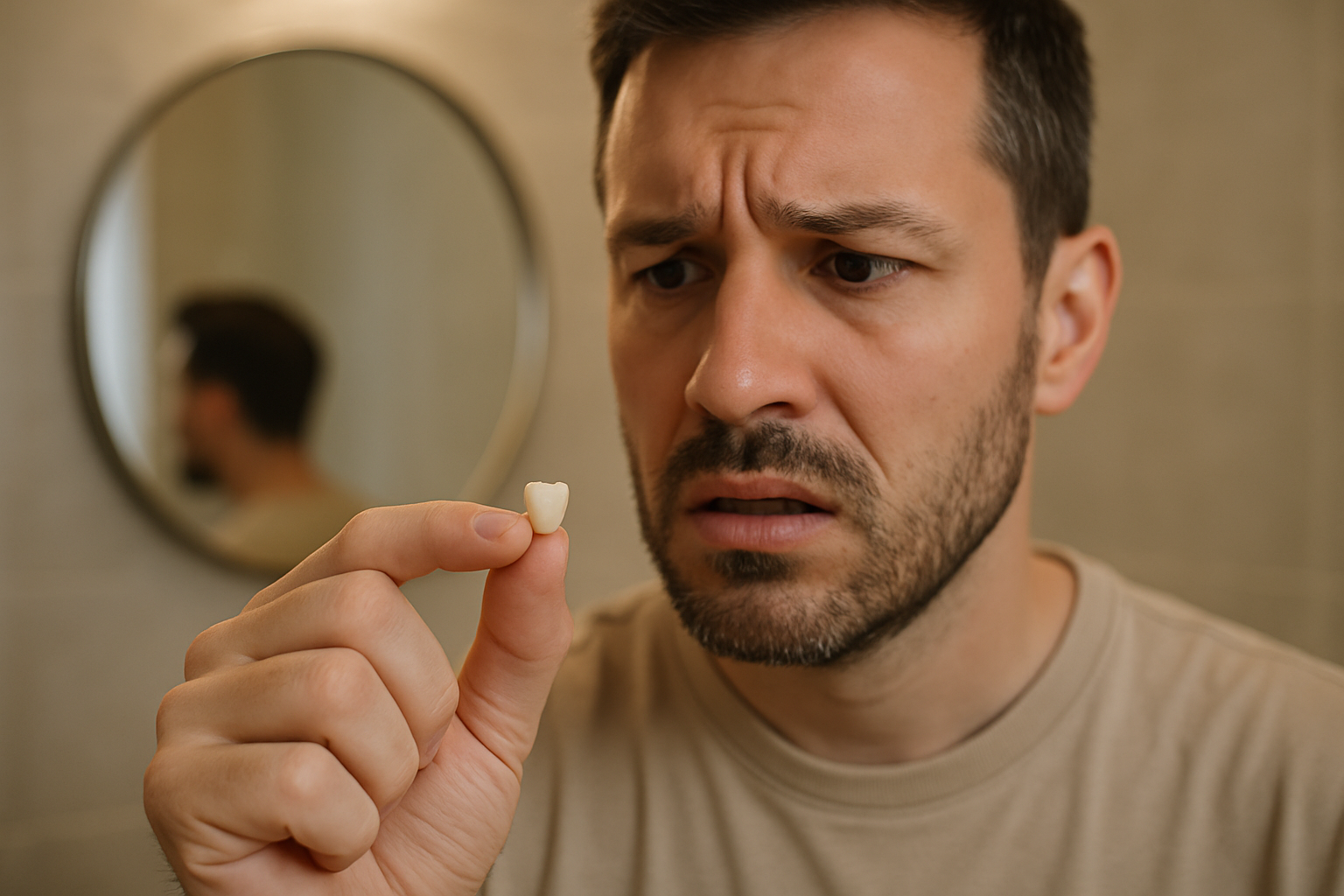
It’s a surprisingly common moment — you’re eating lunch, biting into something, and suddenly there’s a small hard object rolling around in your mouth. Your crown came off. The first feeling is usually panic, followed quickly by the question: what do I do right now?
I see this fairly often at our practice, and I want to be straightforward with you: a dislodged crown is not a reason to spiral, but it is a reason to act. The tooth underneath that crown is exposed and vulnerable in ways that can get worse the longer you wait.
This article walks through the two things that matter most before you get to the dentist — what to do in the immediate moment, and why it’s worth calling sooner than you might think even if there’s no pain yet.
Why Crowns Come Off in the First Place
People often assume a crown falling off means something went wrong. Usually, it’s just time and wear doing what they do. Understanding the reason helps set realistic expectations for your appointment.
The most common causes I see are:
- Cement aging out — dental cement can weaken after many years, especially on older restorations
- Decay forming underneath — if bacteria worked their way under the crown, the tooth structure supporting it erodes and the bond fails
- Bite forces — grinding, clenching, or biting into something hard can pop a crown loose even on a relatively healthy tooth
- Physical trauma — a hit to the mouth or an unexpected crunch on ice or a hard food can dislodge a crown
Why does this matter to you? Because the reason the crown came off largely determines what happens next. If the cement simply failed and the underlying tooth is intact, there’s a good chance the original crown can be re-cemented. If there’s decay or damage to the tooth underneath, the crown will likely need to be replaced and the tooth treated first. Understanding what a crown actually does for a tooth makes this clearer — it’s protecting a compromised structure, so when that protection disappears, the clock starts.
I always tell patients: don’t assume the news before you come in. We won’t know what we’re dealing with until we can see it.
The First 24 Hours: What to Do and What to Avoid
The steps you take immediately after a crown comes off matter more than most people realize. The exposed tooth — whatever is left of it under that crown — is now unprotected. It can be sensitive, it can fracture under chewing pressure, and decay can start faster than you’d expect.
Here’s what I’d tell a friend to do right now:
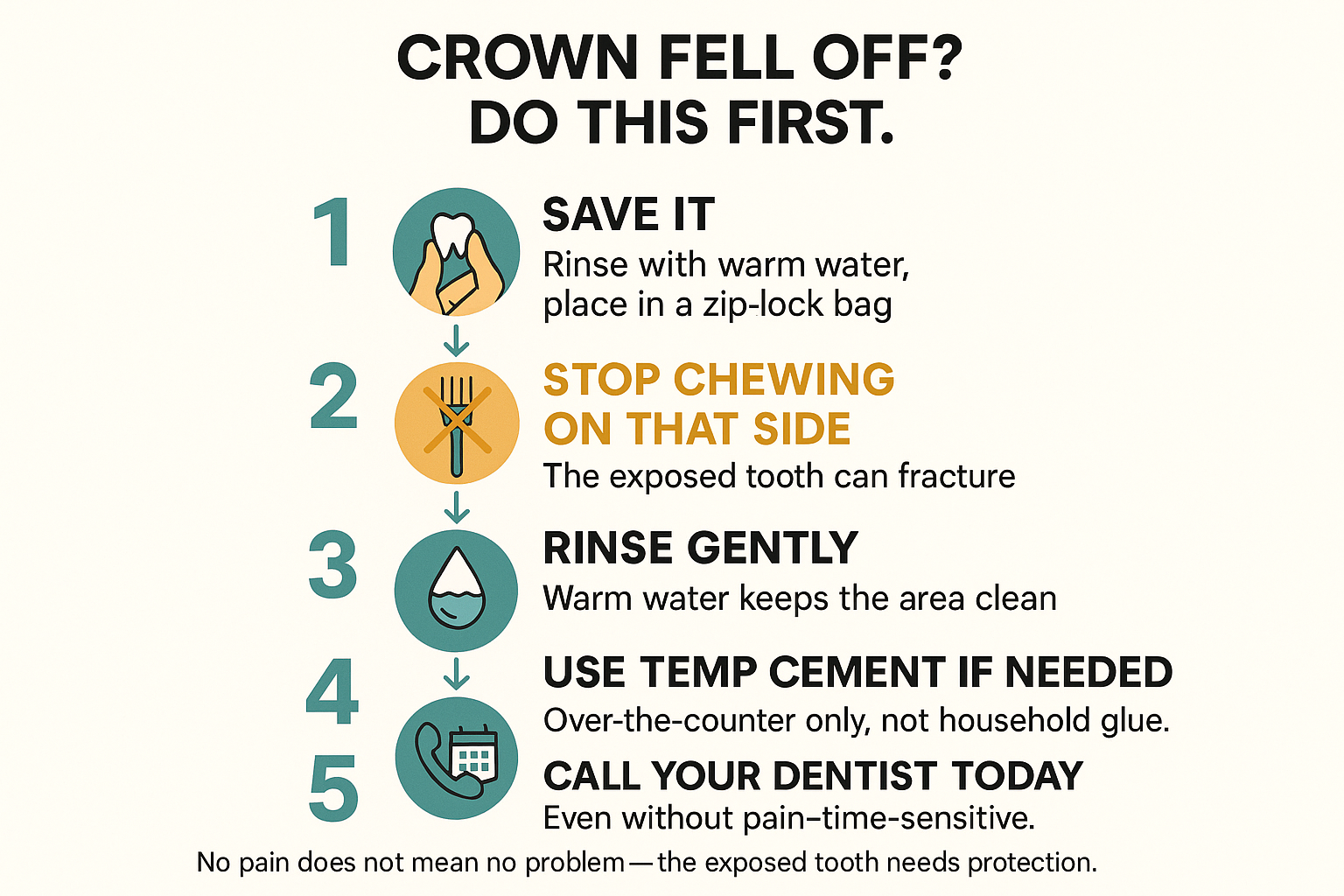
- Save the crown — rinse it gently with warm water and put it in a small zip-lock bag or container. Bring it with you. We may be able to reuse it.
- Avoid chewing on that side — the exposed tooth is not built to handle direct bite force without its crown. One wrong bite can crack what remains.
- Rinse your mouth gently with warm water to keep the area clean
- If there’s sensitivity, a small amount of clove oil on a cotton swab can take the edge off temporarily
- Over-the-counter dental cement (sold at most pharmacies) is a reasonable short-term option if you genuinely can’t be seen for a day or two — but it is a temporary measure only, not a fix
The one thing I want to be emphatic about: do not use household glue. Super glue, Gorilla Glue, and similar adhesives are not safe inside your mouth and can cause real problems — both for the tissue and for the tooth itself. I’ve seen patients come in with glued-on crowns that created a much harder situation to work with.
For a more detailed breakdown of the immediate response window, this guide on what to do in the first 24 hours walks through each step in more depth.
Crown Fell Off: A Quick-Reference Action Plan
Here’s a simple step-by-step to follow from the moment the crown comes out until you’re seen by a dentist.
No Pain Doesn’t Mean No Problem
This is the part I want to spend a moment on, because it’s where a lot of patients talk themselves out of calling quickly.
Plenty of dislodged crowns don’t hurt — at least not right away. The nerve may be protected, the fit may still be snug enough, or the tooth may simply not be reacting yet. So patients wait a few days, then a week, thinking they’re fine because nothing hurts.
But the exposed tooth is at risk regardless of how it feels. Three real problems can develop even without pain:
- Sensitivity that worsens — temperature changes, air, and pressure can start triggering sharp reactions as the dentin becomes exposed
- Fracture — the tooth structure underneath a crown is often weakened; without the crown distributing bite forces, it can crack under normal chewing
- Rapid decay — a bare tooth surface without its protective covering is significantly more susceptible to decay, and cavities can progress quickly
I’ve seen teeth that came in one week after a crown fell off looking manageable, and the same situation two or three weeks later needing substantially more work — occasionally to the point where the crown couldn’t simply be recemented and a replacement was needed. That’s not meant to alarm you. It’s just honest context about why this is genuinely time-sensitive.
If you’re unsure whether your situation is a true dental emergency, this guide on whether your tooth situation qualifies as a dental emergency is worth a quick read.
Can the Original Crown Be Reused?
One of the most common questions we get when a patient calls about a dislodged crown is whether we can simply put it back on. The honest answer is: it depends on what we find when we look at the tooth. Here’s a general breakdown.
| Situation | Likely Outcome | What It Means for You |
|---|---|---|
| Crown came off cleanly, cement failed | Original crown re-cemented | Faster, simpler appointment — may only need cleaning and recementation |
| Decay found under the crown | Tooth treated, new crown needed | Decay must be removed first; original crown won’t fit the same way afterward |
| Tooth fractured under the crown | New crown required, possibly more work | Severity of fracture determines whether the tooth can still support a crown |
| Crown itself is cracked or worn | New crown fabricated | A damaged crown can’t seal properly even if the tooth is healthy |
| Crown is intact, tooth is intact | Re-cementation likely possible | Best case scenario — bring the crown to the appointment |
What to Expect When You Call
I’ve noticed a real pattern in calls we receive — patients who have never dealt with a dislodged crown before often hesitate to call because they’re not sure if it’s “urgent enough.” It absolutely is.
Dental offices are used to prioritizing these calls. During a stretch of calls in May, multiple patients reached us with exactly this situation and were seen promptly — same-day or next-available. That’s not unusual. A fallen crown is exactly the kind of thing where getting in quickly is realistic, and most practices will make room.
When you call, it helps to have a few things ready:
- Whether you still have the crown (and approximately what condition it’s in)
- Which tooth it was on — front, back, upper, or lower
- Whether there’s any pain or sensitivity so the team can triage appropriately
- How long ago it came off
The goal of your appointment isn’t just to get the crown back on — it’s to fully evaluate what’s going on with the tooth underneath so you leave with a clear plan. Whether that’s recementation, a new crown, or something more, you’ll know exactly where things stand before you leave.
And if there’s any concern about what’s happening below the gumline or with surrounding gum tissue, that gets addressed too. Your regular dentist really can handle most dental emergencies — a fallen crown included.
Frequently Asked Questions About a Fallen Crown
Can I just put the crown back on myself until I get to the dentist?
You can use over-the-counter dental cement from a pharmacy as a short-term measure — think of it as a way to protect the tooth for a day or two, not a real fix. Make sure the area is clean before you try. Never use super glue or any household adhesive — it’s not safe inside your mouth and can create complications when we go to do the actual repair.
What if there’s no pain — do I still need to go in quickly?
Yes. No pain is a good sign, but it doesn’t mean the tooth is safe. The exposed surface is vulnerable to fracture under chewing pressure and to decay, both of which can progress fast — sometimes within a week or two. I’d call within a day or two regardless of how it feels.
Will my original crown be usable, or will I need a new one?
It depends on what’s found when we examine the tooth. If the crown came off because the cement failed and the tooth underneath is healthy and intact, there’s a good chance the original crown can be cleaned and recemented. If there’s decay, a fracture, or damage to the crown itself, a new one will be needed. We won’t know for certain until we look — so try not to assume either way before the appointment.
How long does a crown appointment usually take?
If the situation is straightforward — crown is intact, tooth is intact, just a cement failure — the visit can be relatively quick. If we find decay or other issues that need to be addressed first, the appointment will take longer and may involve additional steps. Either way, you’ll leave with a clear understanding of what was found and what the plan is.
I lost the crown — does that change anything?
It means we’ll definitely need to fabricate a new one, but it doesn’t change the urgency of being seen. The tooth still needs to be evaluated and protected. Come in as soon as you can — we’ll assess the tooth and discuss what the replacement process looks like from there.
How long should a crown typically last before something like this happens?
Most crowns hold up well for 10 to 15 years, and many last longer with good care. A lot depends on where the crown is (back teeth take more force), how well it was maintained, and whether any grinding or clenching has been putting extra stress on it over time. This breakdown on how long a dental crown should hold up covers what affects longevity in more detail.
Ready to Get the Tooth Evaluated and a Plan in Place?
At Trinity Dental Care, we handle crown situations regularly — and patients consistently describe the experience as efficient and low-stress. Dr. Fink evaluates the tooth fully before recommending repair or replacement, so you leave knowing exactly what’s happening and what comes next. If your crown has come off, call us at 480-621-4040 or visit trinitydentalcares.com to request an appointment — the sooner we see it, the simpler the solution tends to be.