
Direct Answer: A good dental implant candidate has enough healthy jawbone, stable gums, and controlled overall health. Age matters far less than most people assume. Candidacy is decided at an exam, not over the phone.
Almost every implant conversation I have starts the same way. Someone sits down, points at a gap they have been hiding for years, and asks, “Am I even a candidate?” They ask it like it is a yes or no question with a stamp on the end.
It is not. Implant candidacy is a handful of things looked at together, and most of them can be improved if they are not where I want them yet. That is the part patients almost never hear before they walk in.
So let me walk you through what I am actually evaluating. If you live in North Scottsdale and you have been researching implants for months before making a call, this is the information that will make your consultation far more useful.
What Makes a Good Dental Implant Candidate, Honestly
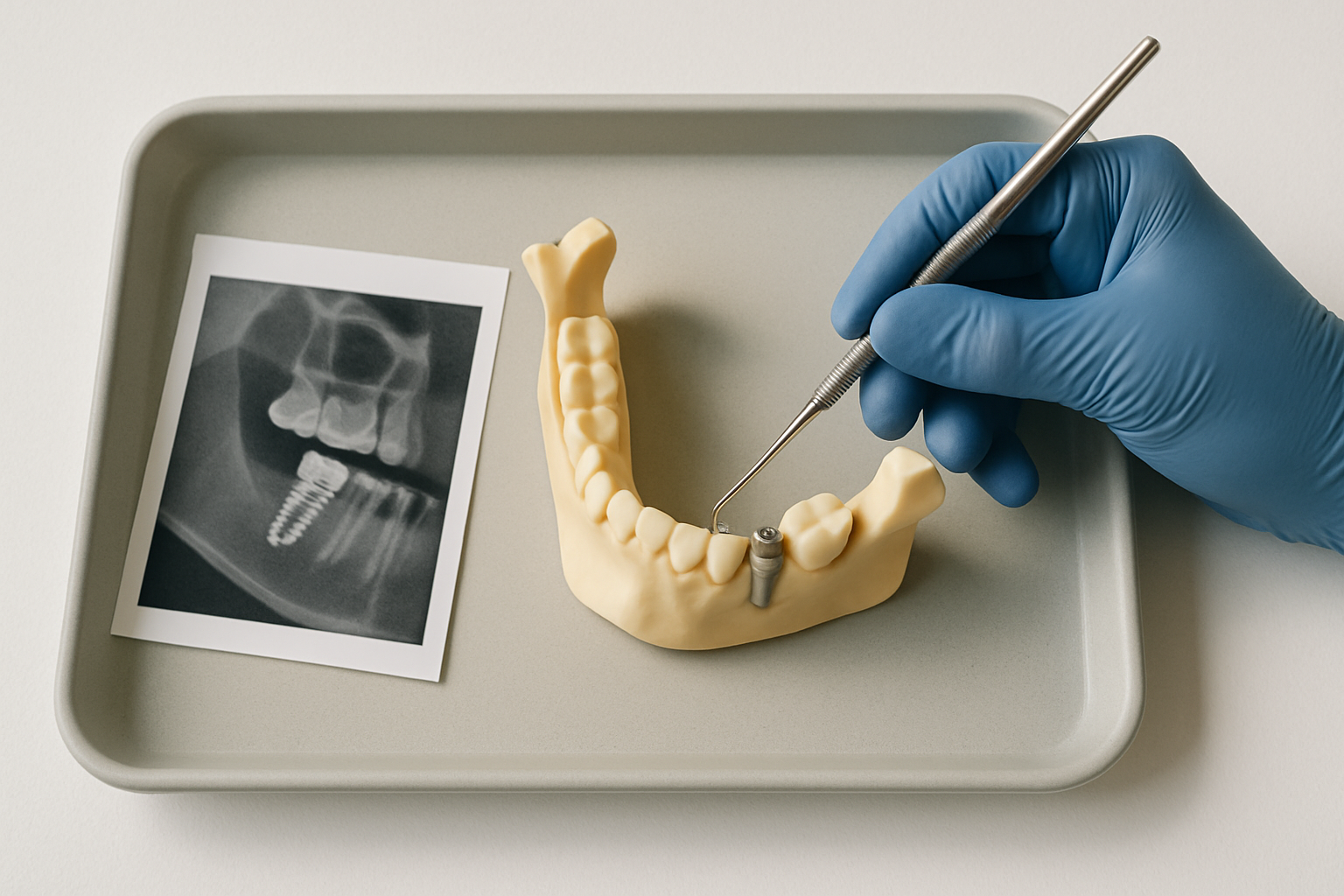
An implant is a small titanium post placed into the jawbone, which then fuses to that bone and holds a crown. Because it lives in bone and sits through gum tissue, the things I care about are the things that keep bone and gum tissue healthy.
Here is what goes into the evaluation:
- Bone volume and density in the exact spot where the implant would go
- Gum health, including whether there is any active periodontal disease
- Overall medical status, especially conditions that affect healing
- Medications you take and how long you have taken them
- Smoking history, current or past
- Bite and habits like nighttime grinding, which affect long-term load on the implant
Notice that none of those are pass or fail on their own. They stack. Someone with slightly thin bone and perfect gum health and no medical issues is often a straightforward case. Someone with plenty of bone but untreated gum disease needs a different sequence before we place anything.
That is why I never answer the candidacy question on the phone. A cone beam scan and a periodontal exam tell me more in twenty minutes than any description ever could.
Bone Is the First Thing Patients Worry About, and the Most Misunderstood
When you lose a tooth, the root stops stimulating the bone around it. The body reads that bone as unused and slowly reabsorbs it. This is why a gap that has been there for ten years looks different on a scan than one from last spring.
Patients hear that and assume the door has closed. It usually has not.
What matters is not just how much bone is left, but where it sits. I am measuring:
- Height of bone above the sinus in the upper jaw, or above the nerve in the lower jaw
- Width of the ridge from cheek side to tongue side
- Density, which affects how well the implant stabilizes on day one
Plenty of patients who show up convinced they have “no bone left” turn out to have enough. Others need a bone graft first, which sounds far more dramatic than it is. In many cases it is a small amount of grafting material placed at the site, then a healing period of several months before the implant goes in.
Grafting adds time to the plan, not a wall. If you want a realistic picture of the timeline once treatment starts, what dental implant healing actually looks like, week by week lays it out honestly.
And if bone loss is significant across a whole arch, that is often where All-on-4® implants enter the conversation, because the approach is designed to work with the bone that remains.
What I Look At and What It Means for Your Plan
This is roughly how I sort the findings during an implant consultation. Nothing here is a verdict on its own.
| Factor | What I am checking | If it is not ideal |
|---|---|---|
| Bone volume | Height, width, and density at the site | Bone graft or sinus augmentation may be added before placement |
| Gum health | Pocket depths, bleeding, bone support around remaining teeth | Periodontal treatment first, then reassess and proceed |
| Diabetes | Whether it is controlled and stable | Coordinate with your physician; controlled diabetes is generally workable |
| Smoking | Current use and how much | Higher failure risk discussed openly; reduction before and after helps |
| Grinding or clenching | Wear patterns, muscle tenderness, jaw symptoms | Night guard planned as part of the restoration |
| Medications | Bone medications, blood thinners, immune suppressants | Review with your prescribing doctor before scheduling surgery |
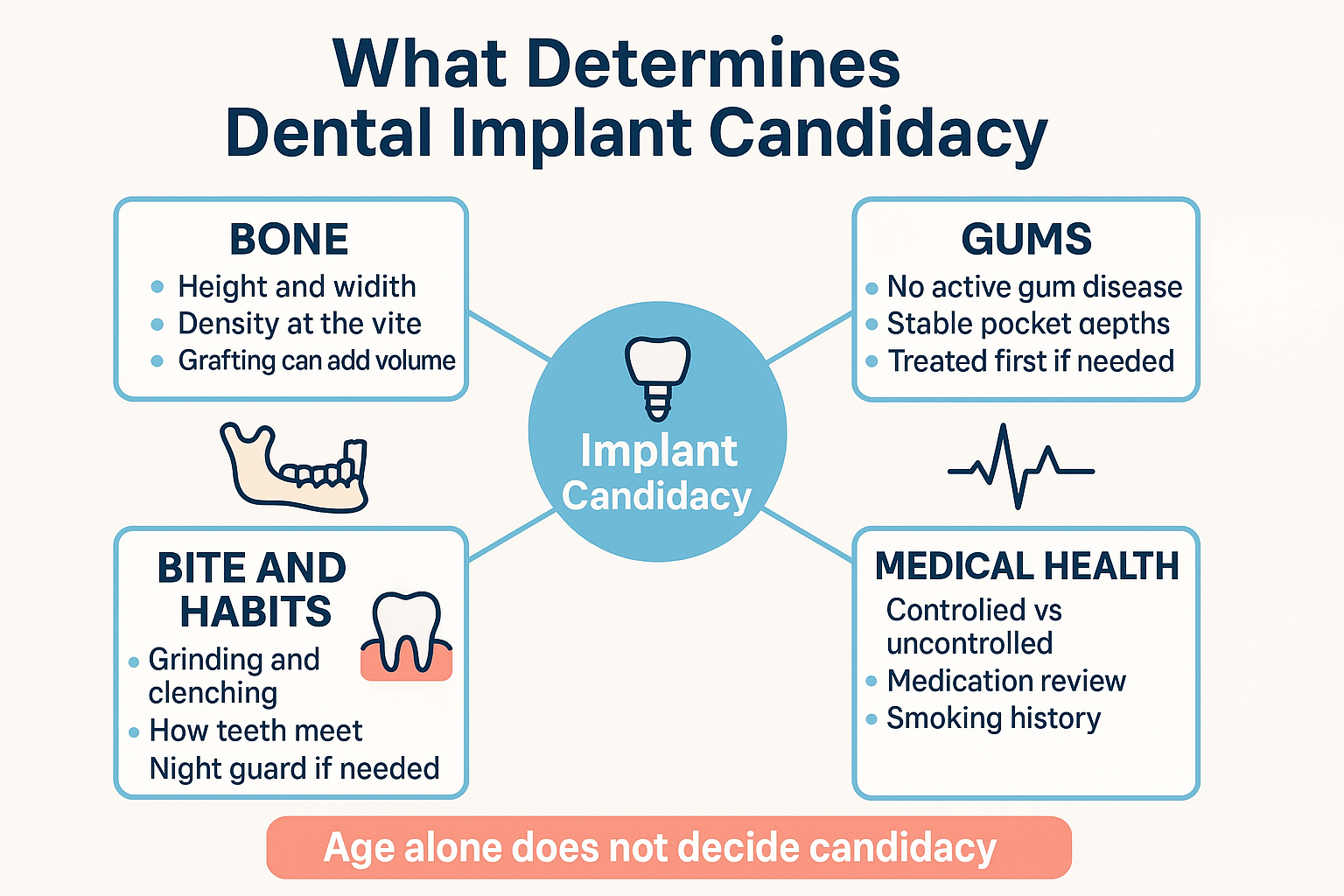
The Four Areas Behind an Implant Yes or No
Here is the same evaluation in a simpler visual, showing what sits under each of the four main areas I assess.
Gum Health Is the Factor That Surprises People Most
Patients expect me to talk about bone. They rarely expect me to spend the first part of the exam probing gum tissue around teeth that are not even involved.
Here is why I do it. Active periodontal disease means bacteria are already breaking down the support structures in your mouth. Placing an implant into that environment raises the odds of peri-implantitis, which is essentially gum disease around the implant, and it is the leading reason implants fail years down the road.
Gum disease is also far more common than most people realize. According to the National Institute of Dental and Craniofacial Research, a large share of adults have some form of it, and many have no idea.
So the sequence looks like this:
- Assess and treat the gum condition first
- Let tissue respond and stabilize, usually over a few weeks to a few months
- Reassess, then move forward with the implant plan
This is not a reason to put off asking about implants. It is the exact reason to ask sooner. Every month of untreated gum disease costs you bone you would rather keep.
Medical History and Medications: Controlled Is Different From Uncontrolled
This is where I see the most unnecessary self-disqualification. Someone hears that diabetes affects implants and assumes they are out.
Well-controlled diabetes and uncontrolled diabetes are two completely different clinical situations. Controlled diabetes generally heals predictably. Uncontrolled diabetes slows healing and raises infection risk, so I would want to coordinate with your physician before scheduling surgery, not cancel the idea.
Same logic applies elsewhere:
- Blood thinners usually require planning and communication with your prescriber, not avoidance
- Certain bone medications taken for osteoporosis need a careful history review, especially IV forms
- Smoking raises failure risk in a real, measurable way, and I will tell you that plainly rather than dance around it
Bring your actual medication list to the consultation. Not a rough memory of it. That one piece of paper often shortens the whole planning process.
Age Almost Never Rules Anyone Out
There is no upper age limit for dental implants. I want to say that as directly as possible, because I hear the opposite assumption constantly.
What matters is bone quality, gum health, and medical stability. A healthy 74 year old with dense bone is a better candidate than a 45 year old smoker with untreated gum disease, every time.
This matters a lot in our area. Per U.S. Census Bureau data, roughly 26.4% of Scottsdale residents are 65 or older, and a meaningful share of the implant patients I see across McCormick Ranch, the Shea Corridor, and Scottsdale Mountain are in their sixties and seventies.
Many of them spent years in removable dentures or a failing bridge before asking the question. If you are weighing that comparison, implant or bridge: how do you actually choose between them walks through the tradeoffs without pushing you toward either one.
What Actually Happens at the Consultation
A real implant consultation is mostly information gathering. Expect a 3D scan, a periodontal exam, a bite evaluation, a medical and medication review, and a conversation about what you want the result to look like.
You should leave knowing three things: whether you are a candidate today, what would need to happen first if you are not, and roughly what the sequence and timeline look like.
Cost comes up too, and it should. Implant cost varies widely based on whether grafting is needed, how many teeth are involved, and what your plan covers, so anyone quoting you a firm number before a scan is guessing. Insurance behavior in Arizona is its own puzzle, and what dental insurance actually covers on implants covers that ground.
One more thing. A lot of people avoid this appointment because of dental anxiety, not because of the implant itself. If that is you, there are practical things you can do before the visit, and telling us up front changes how the whole appointment goes.
Frequently Asked Questions About Dental Implant Candidacy
I lost the tooth over a decade ago. Is it too late for an implant?
Usually not. Bone does shrink after tooth loss, but long gaps are placed successfully all the time, sometimes with grafting first. The only way to know is a 3D scan of that specific site.
Can I get an implant if I have gum disease?
Not while it is active. The gum condition needs to be treated and stable first, because placing an implant into inflamed, infected tissue significantly raises the odds of failure later. Think of it as a sequence, not a rejection.
Does being a smoker automatically disqualify me?
No, but I will be straight with you about it. Smoking meaningfully increases the risk of implant failure and slows healing. Cutting back before surgery and during healing genuinely improves the odds, and plenty of smokers have successful implants.
I am 78. Am I too old?
No. Age by itself is not a factor I use to rule anyone out. Bone quality, gum health, and how stable your overall health is matter far more than the number.
Should I get a second opinion before committing to implants?
Absolutely, and I say that sincerely. Implants are a significant decision, and patients here research heavily before they commit. A good consultation should give you enough detail that a second opinion confirms rather than contradicts.
How long does the whole process take from start to finish?
It depends on whether grafting is needed. A straightforward case often runs a few months from placement to final crown, because the implant needs time to fuse with bone. Add a graft and you are typically looking at several additional months of healing first.
Want a Straight Answer About Your Own Implant Candidacy?
If you have been quietly wondering whether implants are even possible for you, an exam and a 3D scan will tell you more in one visit than another year of reading will. We see patients from across North Scottsdale, Paradise Valley, and the Shea Corridor who arrive with exactly these questions. You can reach our office at 480-621-4040 or visit trinitydentalcares.com when you are ready to have the conversation.