
Direct Answer: Gum disease is a chronic infection that adds inflammation to your whole body. Research links untreated gum disease to higher heart risk, harder blood sugar control, and pregnancy complications.
Most people who sit in my chair treat their gums as a separate department. They track their cholesterol, they know their A1C, they run the Gainey Ranch loop three mornings a week. But bleeding gums? That feels like a minor annoyance to deal with later.
I understand why. Gums do not hurt much in the early stages, and nothing about them feels connected to the rest of your health. That is exactly what makes gum disease easy to postpone for years.
So let me explain what the research actually shows about gum disease and whole-body health, what the difference is between the reversible stage and the one that is not, and why pregnancy deserves its own conversation. This is not a warning-sign checklist. It is the bigger picture behind the checklist.
Why gum disease and whole-body health are connected
Gum disease is a chronic bacterial infection with chronic inflammation attached to it. Your gums are living tissue packed with blood vessels, so anything happening in an infected pocket around a tooth does not stay politely in your mouth.
When the seal between gum and tooth breaks down, bacteria and the inflammatory chemicals your body produces to fight them get into the bloodstream. Your immune system stays partly switched on, all day, for years.
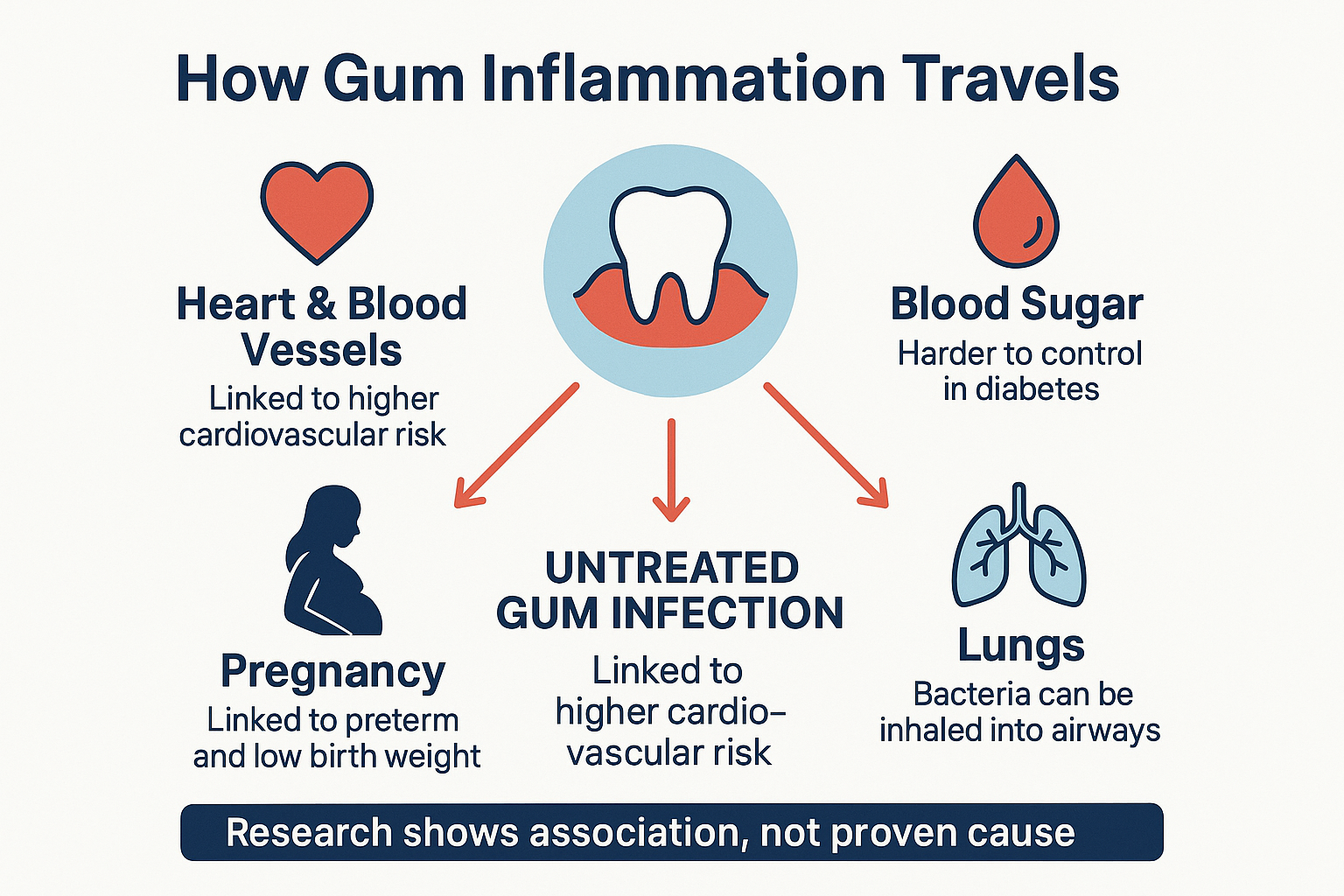
That low-grade inflammation is where the whole-body links come from. Decades of research, including work summarized by the National Institute of Dental and Craniofacial Research, consistently connects untreated periodontal disease with:
- Higher cardiovascular risk, including associations with heart disease and stroke
- Harder blood sugar control in people with diabetes or prediabetes
- Pregnancy complications, including low birth weight and preterm birth
- Worse outcomes in some respiratory conditions, especially in older adults
One honest caveat, because I would rather be trusted than dramatic. Most of this evidence shows association, not proven cause. Nobody can tell you that cleaning your gums will prevent a heart attack.
What we can say is that untreated gum disease adds inflammatory load to a body that already has other things to manage. Delta Dental’s 2025 report found 91% of adults say oral health is part of overall health. Most patients already sense this. The specifics just fill it in.

Gingivitis is reversible. Periodontitis is a different conversation.
This is the part I wish every patient understood before they cancel two cleanings in a row.
Gingivitis is the early stage. Your gums are inflamed, they bleed when you brush or floss, and they may look puffy or darker red. Nothing structural has been lost yet.
Gingivitis responds well to a professional cleaning plus better habits at home. In many cases we see real improvement within two to four weeks once the plaque and tartar are removed and the daily routine tightens up.
Periodontitis is what happens when that inflammation keeps going. The infection moves below the gum line, pockets deepen, and the bone that holds your teeth in place starts to erode. Bone does not grow back on its own.
At that point the goal shifts from reversal to control. Treatment gets more involved, appointments get longer, and maintenance visits often move to every three or four months instead of every six.
The practical difference for a Scottsdale patient looks like this:
- Gingivitis usually means a cleaning and a plan you follow at home
- Periodontitis usually means deeper cleaning below the gum line and ongoing maintenance
- Gingivitis costs less to treat, in both money and chair time
- Advanced periodontitis is the leading reason adults lose teeth they otherwise could have kept
If your gums bleed and you are not sure whether that counts as normal, we wrote a full breakdown of when bleeding gums are actually a warning sign.
Gingivitis vs. periodontitis at a glance
Here is the plainest version of the progression I can give you. The line between column two and column three is the one that matters most.
| Stage | What is happening | Can it be reversed? |
|---|---|---|
| Healthy gums | Firm, pale pink, no bleeding when you floss | Nothing to reverse, keep it there |
| Gingivitis | Gum inflammation and bleeding, no bone loss yet | Yes, with a professional cleaning and better home care |
| Early periodontitis | Pockets deepen, early bone loss begins | Damage is not reversible, but it can be stabilized |
| Advanced periodontitis | Significant bone loss, loose teeth, possible abscesses | Managed long term, teeth may not be savable |
The diabetes connection runs both directions
This one surprises people. Gum disease and blood sugar feed each other.
High blood sugar makes it harder for your body to fight infection, so gum disease shows up more often and progresses faster. Then the inflammation from that gum infection makes blood sugar harder to keep steady. Each side makes the other worse.
If you are managing diabetes or prediabetes, treating your gums is part of managing the condition, not a side project. I have had patients tell me their endocrinologist was the one who finally pushed them to book a cleaning.
Arizona adds its own wrinkle. Dry mouth is common here, partly from our climate and partly from the blood pressure, allergy, and antidepressant medications that a lot of adults over 50 take. Less saliva means less natural rinsing, and plaque builds faster.
If that sounds familiar, our piece on dry mouth and diabetes goes deeper on what to do about it.
How gum inflammation reaches the rest of your body
This is the short version of the connection, in one picture.
If you are pregnant or planning to be, read this part
Pregnancy hormones change how gum tissue responds to plaque. The same amount of bacteria that caused nothing before can now produce swollen, tender, bleeding gums. It is common enough that it has a name, pregnancy gingivitis, and it often shows up in the second trimester.
Many OBs now recommend at least two dental cleanings during pregnancy instead of the usual one. That is not overkill. Your OB and your dentist are working toward the same outcome.
One caller asked us something I hear often: does insurance cover an extra cleaning while pregnant? The honest answer is that it depends entirely on the plan. Some dental plans do allow an additional cleaning during pregnancy, some do not, and the only way to know is to have the specific benefit checked.
We verify plans on the first call, and our team can look at your coverage before you commit to anything. For patients without insurance, there is also a membership plan option, and the office can walk you through what it includes and what it costs. Whatever the answer on coverage, routine cleanings are safe during pregnancy and the second trimester is usually the most comfortable window for them.
What protecting the system actually looks like
None of this requires a dramatic overhaul. Gum health is mostly about consistency and catching things early.
What I ask patients to do:
- Keep two cleanings a year, or three to four if you have already been treated for periodontitis
- Floss or use a water flosser daily, and tell us if the same spot bleeds every time
- Bring your medication list to appointments, since dry mouth changes the math
- Mention any diabetes, heart condition, or pregnancy plans so we can adjust your schedule
- Do not skip the exam portion when you come in for a cleaning, because pocket depths are measured there
On cost, the general pattern holds everywhere including here in North Scottsdale. Preventive visits are the least expensive care in dentistry, and periodontal therapy, crowns, and implants sit far above them. Actual fees depend on your plan, the extent of treatment, and what we find at the exam, so the office is the right place to get real numbers.
If you are unsure what a visit even involves, here is what actually happens at a dental exam and cleaning. And if it has been a while and you feel behind, you are far from alone in that. Nobody in our office is going to lecture you about it.
Frequently Asked Questions About Gum Disease and Whole-Body Health
Can treating my gums lower my risk of heart disease?
I cannot promise that, and anyone who does is overstating the science. What research supports is an association between untreated gum disease and cardiovascular risk. Treating gum disease removes a source of chronic inflammation, which is worth doing on its own merits.
How do I know if I have gingivitis or something worse?
You mostly cannot tell from the mirror, which is the frustrating part. The difference comes down to bone loss, and that is measured with a periodontal probe and X-rays at an exam. Bleeding alone does not tell us the stage.
Are dental cleanings safe during pregnancy?
Yes, routine cleanings and exams are considered safe throughout pregnancy, and the second trimester is often the most comfortable time. Let us know you are pregnant when you book so we can plan positioning, timing, and imaging appropriately.
My gums stopped bleeding on their own. Am I fine now?
Not necessarily. Bleeding can quiet down while the infection continues below the gum line, and in longtime smokers gums often bleed less even when disease is active. That is worth an exam rather than a wait-and-see.
How often should I be seen if I already have periodontitis?
Usually every three to four months rather than every six. The maintenance interval is set by how deep your pockets are and how your tissue responds, so it is a judgment call made at your visits, not a fixed rule.
Thinking about getting your gums checked?
If you live around the Shea Corridor, McCormick Ranch, or anywhere in North Scottsdale and it has been longer than you would like since your last cleaning, an exam is a reasonable place to start. Our office on Frank Lloyd Wright Blvd has appointments available for new and returning patients, and we are happy to check your coverage first. You can reach Trinity Dental Care at 480-621-4040 or at trinitydentalcares.com whenever you are ready.