
Direct Answer: The teeth you leave with on All-on-4 surgery day are a temporary arch, not your permanent restoration. Your final teeth come after your implants fuse with the jawbone, a process that typically takes several months.
Most people who research All-on-4 dental implants in Scottsdale focus on the big promise: same-day teeth. And that part is real. But what the websites and before-and-after photos rarely spell out is that the teeth you walk out with on surgery day are not your permanent set. They are a temporary arch, and understanding what that means for the next several months is just as important as understanding the procedure itself.
I talk to patients who have been dealing with failing teeth, painful dentures, or gaps they have been covering up for years. They are ready to be done with all of it. And they should be excited, because All-on-4 delivers a genuinely life-changing result. But the temporary phase is where most of the questions and most of the anxiety live, and it is the part of the process that gets the least explanation upfront.
This post is about that phase specifically. What the temporary teeth are made of, why they exist, what eating looks like in the first weeks, and how to think about the cost of the full process. If you are researching All-on-4 dental implants in Scottsdale and want a straight answer about what the recovery period actually involves, this is what I wish more patients heard before their consultation.
Why You Leave Surgery Day With a Temporary Arch, Not Your Final Teeth
All-on-4 works by placing four implant posts into the jawbone, which then support a full arch of replacement teeth. The procedure itself is done in a single appointment. But the implants cannot carry the full load of a permanent restoration right away.
After placement, the implants go through a process called osseointegration, where the titanium posts gradually fuse with the surrounding bone. This is what gives the final restoration its permanence and strength. Rushing that process by immediately loading the implants with heavy chewing forces can disrupt the fusion and compromise the result.
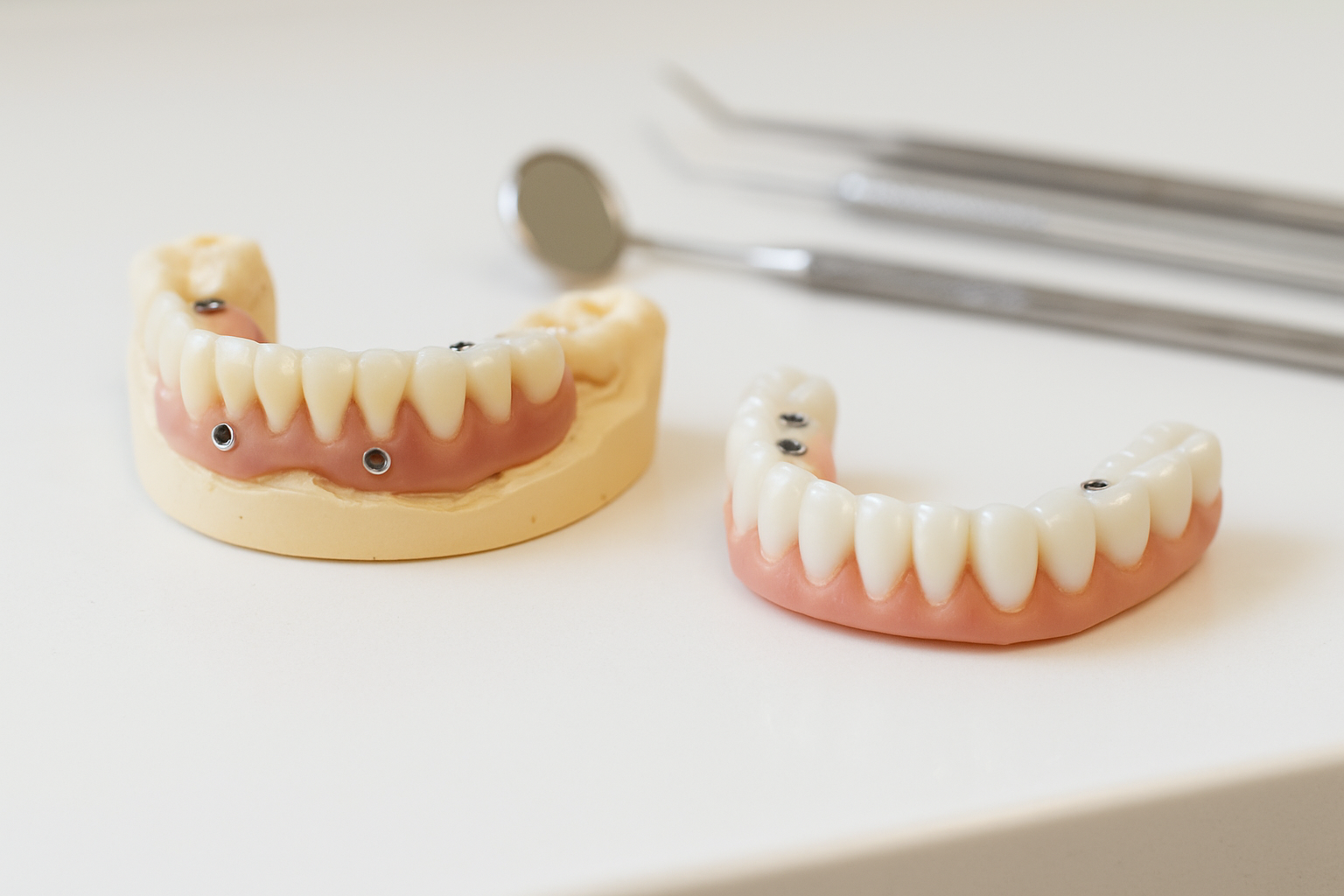
So instead, a temporary arch is placed the same day. It looks like teeth. It functions at a basic level. But it is designed to be lighter and gentler on the healing implants underneath it. Think of it as a bridge between surgery day and the finished result, not the finished result itself.
The temporary arch is typically made from an acrylic-based material, which is lighter and more flexible than the zirconia or porcelain materials used in most final restorations. It will not look identical to your permanent teeth, but it should look natural enough that most people around you will not know anything is different. The goal of the temporary phase is to protect the healing implants while your bone does its work, and that process generally takes three to six months, sometimes a bit longer depending on individual healing.
For patients who want to understand how healing timelines compare across different implant types, our post on what dental implant healing actually looks like, week by week covers single implant recovery in detail, which is a useful contrast to the full-arch timeline discussed here.
What Eating Actually Looks Like During the Temporary Phase
Diet is the question I hear most often after patients learn about the temporary phase, and it is almost always a question they ask after the procedure rather than before. So let me address it plainly here.
During the healing period, soft foods are required. This is not an arbitrary restriction. The temporary arch is supported by implants that are still in the process of fusing with bone. Biting into something hard or crunchy too early puts lateral and vertical stress on the implant posts at exactly the time when they are most vulnerable. That kind of force can disrupt osseointegration before it is complete, and that is a problem worth avoiding.
In the first couple of weeks, most patients are eating things like:
- Yogurt, smoothies, and protein shakes
- Soft scrambled eggs and oatmeal
- Mashed potatoes, soft cooked vegetables, and soups
- Soft fish, tender ground meat, and well-cooked pasta
- Pudding, applesauce, and similar soft textures
As healing progresses over the following weeks, the diet typically opens up gradually, with your provider guiding exactly what is appropriate based on how your healing is going. Each patient’s timeline is different, and your dentist determines what is safe at each stage.
The framing I always encourage patients to hold onto is this: the soft food window is time-limited. It feels significant in the moment, but measured against the years of unrestricted function that follow a successful full-arch restoration, a few weeks of yogurt and soup is a small trade. Patients who have been struggling with removable dentures or painful failing teeth for years tend to find the adjustment much easier than they expected, because even the temporary arch is more stable and comfortable than what they were dealing with before.
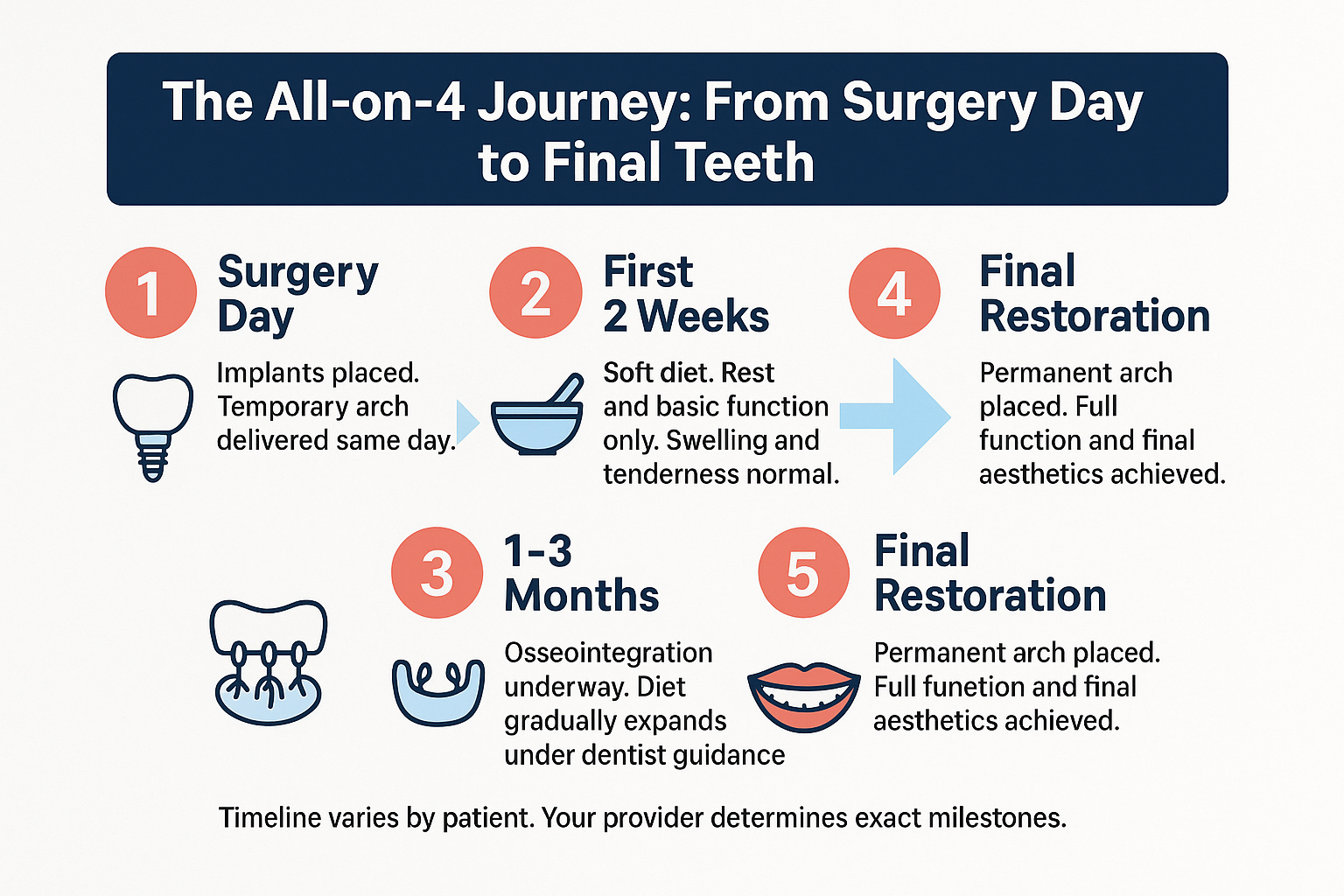
The All-on-4 Timeline at a Glance
Here is a simple overview of the key phases from surgery day through final restoration, so you know exactly what to expect and when.
Speech Changes During the Temporary Phase: What to Expect
Speech is another concern that comes up regularly, and it is one that patients often feel embarrassed to ask about. A full arch of teeth changes the shape of the space inside your mouth and the way air moves across your teeth when you form certain sounds.
For some patients, certain consonants, especially “s” and “th” sounds, may sound slightly different in the days and first couple of weeks after placement. This is a known and common adjustment, and for most patients it resolves within a few weeks as the tongue and mouth adapt to the new arch.
Practicing reading aloud, having conversations, and just giving yourself time to adjust accelerates that process. I have seen patients who were initially worried about this feel completely natural with their speech within two to three weeks. And by the time the permanent arch is placed, most patients have fully adapted.
If you are already feeling self-conscious about your teeth or smile, the idea of a speech adjustment might feel like one more thing to manage. But it is worth keeping in perspective. The temporary phase is a transition, not a permanent state. The patients who come out the other side consistently describe the result as worth every adjustment they made along the way.
Temporary Arch vs. Final Restoration: Key Differences
Understanding how the temporary and permanent arches differ helps patients set realistic expectations for each phase of the process.
| Feature | Temporary Arch | Final Restoration |
|---|---|---|
| Material | Typically acrylic-based | Usually zirconia or porcelain |
| Placed | Same day as surgery | After osseointegration is complete (typically 3-6 months) |
| Function | Basic chewing on soft foods | Full chewing function restored |
| Appearance | Natural-looking, functional | Final aesthetic detail and fit |
| Durability | Designed for temporary use | Built for long-term wear |
| Purpose | Protects healing implants | Permanent daily use |
How to Think About the Cost Before You Get a Quote
All-on-4 is a significant financial investment, and I want to address that plainly because patients deserve a straight answer, not vague reassurances.
Most private dental insurance plans classify implants as a major restorative procedure. Even when coverage exists, annual maximums often limit what the plan will pay, and many patients find that their out-of-pocket responsibility for an All-on-4 procedure is substantial. The American Dental Association Health Policy Institute has also reported that a growing share of dentists have been dropping out of insurance networks, which can affect what patients with certain PPO plans can expect to recoup.
Several factors drive the total cost of All-on-4, and understanding them helps make sense of the estimate you receive:
- Number of arches being treated (upper, lower, or both)
- Whether extractions are needed before implant placement
- The materials selected for the final restoration, since zirconia and porcelain differ in cost
- The temporary arch itself, which is a real component of the treatment and is reflected in the overall fee
- Individual anatomy and bone density, which can affect treatment complexity
Financing options are available at many practices, and some patients find that the monthly payment on a financing plan compares favorably to what they were spending managing failing teeth over time. For an exact breakdown of what your specific plan would include and cost, a consultation is the only way to get a number that actually applies to your situation.
For patients who want to understand the material differences between crown and restoration types that feed into these cost decisions, our post on not all dental crowns are the same is a useful starting point.
The Patient Who Is Done With Removable Teeth
I want to speak directly to one particular group of people who ask about All-on-4, because they represent a lot of the conversations I have had.
These are patients who have been living with removable dentures that no longer fit right, or with a mouth full of teeth that have been failing slowly for years. They are done with adhesives, done with the embarrassment of a plate that moves when they eat or talk, done with avoiding foods they used to love. They know they want a fixed solution. What they are afraid of is the surgery and the recovery.
If that describes you, here is what I want you to know. The temporary phase, the soft foods, the speech adjustment, the three-to-six months of waiting for the final teeth, is a small window relative to what comes after. Patients who have spent years managing a failing dental situation consistently describe that waiting period as genuinely manageable once they understand what is happening and why. The temporary arch already gives them something they have not had in a long time: stable, fixed teeth that do not move.
For a deeper look at why removable options lose their fit over time and what that means for the underlying bone, our post on why dentures fit differently over time explains the bone loss dynamic that makes fixed implant solutions worth considering for long-term cases.
And if you are weighing whether your situation has progressed to the point where a single procedure is no longer enough, this post on when a single procedure stops being sufficient walks through how to think about that decision.
Frequently Asked Questions About the All-on-4 Temporary Phase
Can the temporary arch fall off or break?
The temporary arch is designed to stay in place and function through normal daily activity, but it is made from a lighter material than the permanent restoration and is not meant to withstand the same forces. Avoiding hard foods and following your provider’s guidelines reduces the risk of damage. If something does feel loose or off, contact your dental office promptly rather than waiting.
What happens if osseointegration does not go as expected?
Osseointegration does not complete on schedule for every patient, and your dentist monitors healing at follow-up appointments. If integration is slower or there are concerns, the timeline for the final restoration simply adjusts. Your provider will not move forward with the permanent arch until healing is confirmed.
Will the temporary teeth look natural enough to go to work or social events?
Yes. The temporary arch is made to look like a full set of teeth and reads as a normal smile to other people. Most patients feel confident returning to work and social situations within a short recovery period after surgery, once initial swelling has settled.
How long does the speech adjustment actually last?
For most patients, any noticeable speech change resolves within two to four weeks. Some patients adapt faster than that. The adjustment period depends on the individual, but it is genuinely temporary in the vast majority of cases.
Is the temporary arch included in the All-on-4 treatment cost?
The temporary arch is part of the overall All-on-4 treatment and is typically reflected in the total fee rather than billed separately. When you receive a quote, ask specifically what it includes so you have a clear picture of the full treatment plan. A consultation is the only way to get a cost breakdown that applies to your specific situation.
Can I go back to a normal diet after the final arch is placed?
For most patients, yes. The final restoration is designed for full function, and most patients return to the foods they have been missing. Your provider will give you specific guidance based on your restoration material and individual healing, but the long-term goal is a diet that is as close to unrestricted as possible.
Ready to Get Honest Answers About All-on-4 in Scottsdale?
If you are researching All-on-4 dental implants in Scottsdale and want to understand exactly what the process looks like for your specific situation, a consultation with our team is the right starting point. We walk through the full timeline, what the temporary phase involves, and what your final restoration would look like, so you leave with a clear picture rather than more questions. Reach out to us at Trinity Dental Care by calling 480-621-4040 or visiting trinitydentalcares.com to request an appointment.