
Direct Answer: Most dental crowns last between 10 and 15 years. With good care and the right material, many hold up for 20 to 25 years before needing replacement.
If you have a crown — or you’re about to get one — the first question most people ask is some version of: how long is this actually going to last? It’s a fair question, and the honest answer is that it depends on a few specific things, most of which are within your control.
The general range dentists work with is 10 to 15 years for a typical crown. But plenty of crowns placed in North Scottsdale patients are still going strong at 20 years. And some fail at year six. The difference usually comes down to the material used, how the crown was placed, and what happens in the patient’s mouth after they leave the chair.
This article breaks down what actually determines crown lifespan — not just a number, but the real factors that make or break how long yours holds up.
What the Research Actually Says About Crown Lifespan
Clinical studies have tracked dental crowns for decades, and the numbers land in a consistent range. A well-placed crown on a back molar has roughly a 90% survival rate at 10 years. Push that to 20 years, and you’re looking at somewhere around 60–70% still intact — depending heavily on material and location in the mouth.
Front teeth are a little more forgiving because they handle lighter biting pressure. Molars take the brunt of chewing force day after day, which is why back crowns tend to wear faster.
Material plays a big role here:
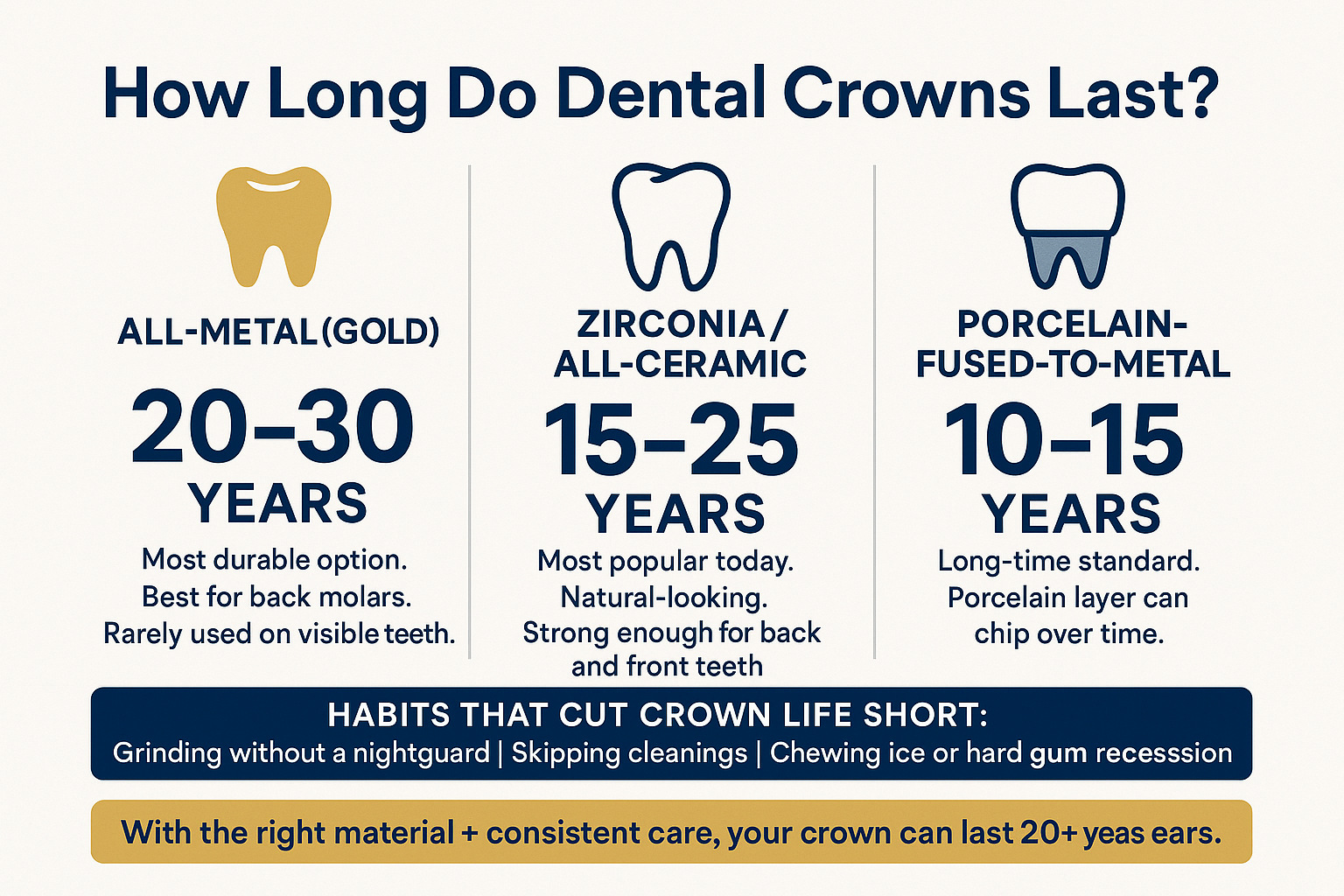
- Porcelain-fused-to-metal (PFM): Durable and the standard for years, but the porcelain layer can chip. Generally lasts 10–15 years.
- All-ceramic or zirconia: The most common choice today. Excellent aesthetics, very strong. Can last 15–25 years with proper care.
- All-metal (gold or alloy): Rarely used on visible teeth, but exceptionally durable — often 20–30 years on back molars.
If you want to understand more about the different types of crowns available for Scottsdale patients, the material breakdown matters a lot when you’re deciding what’s right for your specific tooth.
The Habits That Either Extend or Shorten a Crown’s Life
Your crown doesn’t live in a vacuum. Every day, it’s exposed to the same forces and conditions as your natural teeth — plus a few risks that natural teeth don’t face quite the same way.
The habits that tend to shorten crown life the most:
- Grinding or clenching (bruxism): This is the single biggest accelerator of crown failure. The repeated pressure — especially at night — wears down the crown surface and stresses the cement seal underneath. If you’re a grinder, a nightguard isn’t optional, it’s essential. Our article on how to clean a mouth guard is worth reading if you already use one.
- Chewing ice, hard candy, or using teeth as tools: Crowns are strong, but they’re not indestructible. Cracking a zirconia crown on a popcorn kernel is real, and it happens more than people expect.
- Skipping routine cleanings: The crown itself won’t decay, but the tooth underneath it can — especially at the margin where the crown meets the gumline. If bacteria get into that junction, the underlying tooth structure can break down and the crown fails, not because of the crown material, but because there’s nothing solid left to hold it. Routine dental cleanings are genuinely what protect that margin.
- Gum recession: As the gum pulls back over time, the margin of the crown can become exposed, creating a gap where decay starts.
On the positive side, patients who wear their nightguard consistently, see their dentist twice a year, and avoid high-risk habits regularly report crowns still performing well past 15 to 20 years.
Crown Lifespan at a Glance
Here’s a quick visual summary of how crown material, location, and patient habits interact to determine how long a crown typically lasts.
Signs Your Crown May Be Reaching the End of Its Life
Crowns don’t usually fail dramatically — they tend to give you signals first. Knowing what to look for can save you from a bigger problem down the road.
Things worth calling your dentist about:
- Sensitivity or pain when biting: Could mean the crown has shifted, the seal has broken, or there’s decay developing underneath. A tooth sensitive to cold is sometimes the first clue something’s changed under or around a crown.
- A visible crack or chip in the crown: Small chips in porcelain may be patchable, but a crack that runs deep usually means replacement.
- Feeling the crown move: Any rocking or looseness is a sign the cement has broken down. Left alone, this lets bacteria in.
- Dark line at the gumline: Common with older PFM crowns — the metal base showing through as the gum recedes. Not always a functional problem, but cosmetically it’s noticeable.
- Crown is more than 15 years old and showing wear: Even if it feels fine, your dentist can check the margins and underlying tooth on an X-ray to see what’s actually happening.
None of these automatically mean you need a replacement immediately. But they do mean a conversation with your dentist shouldn’t wait.
Crown Lifespan by Material and Location
This table summarizes what you can realistically expect based on crown type and where the tooth sits in your mouth.
| Crown Material | Typical Lifespan | Best For |
|---|---|---|
| All-metal (gold/alloy) | 20–30 years | Back molars, patients who grind |
| Zirconia (all-ceramic) | 15–25 years | Front and back teeth, high-visibility areas |
| Porcelain-fused-to-metal (PFM) | 10–15 years | Back teeth, older restorations |
| E-max (lithium disilicate) | 15–20 years | Front teeth, high aesthetics needed |
| Any crown + untreated grinding | 5–8 years | High-risk scenario without a nightguard |
What Happens If You Wait Too Long to Replace a Failing Crown
Delaying a crown replacement when there are clear warning signs is where small problems become expensive ones.
When a crown seal breaks down and bacteria get underneath, they attack the natural tooth structure that the crown is sitting on. In some cases, enough decay accumulates that there’s no longer enough healthy tooth left to support a new crown. At that point, you’re often looking at extraction and tooth replacement options — a much larger conversation than simply recrowning a tooth.
This is one of the reasons understanding what a crown is actually doing for a tooth from the beginning matters. A crown isn’t decorative — it’s structural. When it starts to fail, the tooth it’s protecting isn’t just exposed, it’s vulnerable in a way it wasn’t before the crown was placed.
The general advice: if your dentist flags a crown at your cleaning and recommends monitoring or replacement, take that seriously. Most dentists won’t suggest replacing a crown unless there’s a genuine clinical reason to.
Frequently Asked Questions About Dental Crown Lifespan
Does insurance cover crown replacement?
Most dental insurance plans cover crowns on a 5-year or 7-year replacement cycle — meaning they won’t pay for a new crown on the same tooth until that window has passed, even if the crown genuinely needs replacing sooner. If your crown fails early, your dentist can sometimes submit documentation to support a clinical exception, but coverage isn’t guaranteed. It’s worth calling your insurance provider before you assume it’s covered.
Can a crown last forever if I take care of it?
Practically speaking, no. Even well-maintained crowns experience wear at the margins over decades. A zirconia crown with excellent home care and regular professional cleanings could realistically last 25 years or more, but at some point the cement, the margin, or the underlying tooth structure will need attention. Think of a crown as a long-term solution, not a permanent one.
My crown came off — is that an emergency?
It’s not life-threatening, but you should call your dentist the same day. The exposed tooth underneath is sensitive and vulnerable to decay and fracture. In the meantime, avoid chewing on that side. Some pharmacies sell temporary dental cement that can hold the crown in place short-term — our guide on a temporary fix for a broken tooth covers what to do while you wait.
How do I know if I need a new crown or just a repair?
Small chips on the surface of a porcelain crown can sometimes be polished or repaired chairside. But if the crown is cracked, the seal is broken, there’s decay underneath, or the crown is significantly worn down, replacement is usually the right call. Your dentist can tell you definitively after an exam and X-ray — it’s not something you can assess from the outside.
Does the tooth still need a root canal if the crown fails?
Not automatically. A failing crown doesn’t always mean the tooth’s nerve is involved. But if decay has progressed deep into the tooth under a failing crown, a root canal may become necessary before placing a new crown. Catching it early — before decay reaches the nerve — usually avoids that step.
Have Questions About a Crown You Already Have — or One You Might Need?
If you’re a North Scottsdale patient with an older crown that’s been bothering you, or you’ve been told you need one and want to understand your options, Trinity Dental Care is a good place to start that conversation. Dr. Fink takes the time to look at what’s actually happening with your specific tooth — not just hand you a standard answer. Call 480-621-4040 or visit trinitydentalcares.com to schedule an exam or ask about a crown consultation.