
Direct Answer: A dental membership plan is a flat annual fee paid straight to the dental office. It covers set preventive visits and discounts other treatment, with no claims, deductible, waiting period, or annual cap.
You call a dental office, give them your plan name, and hear the words “we’re out of network.” Or you have no dental coverage at all, so you are trying to find out what a cleaning costs before you agree to anything.
I hear both versions of that call every week here in North Scottsdale. One caller asked straight out whether we had a savings plan for an uninsured family member. Questions about cost or plans come up on roughly one in twelve of the calls we sample.
So let me explain what an in-office dental membership plan actually is, how to compare it against an insurance plan you would buy yourself, and who it genuinely does not help. That last part matters most.
What an In-Office Dental Membership Plan Actually Is
Most people hear “plan” and picture insurance. A membership plan is not insurance, and the difference is the whole point.
It is an agreement directly between you and one dental office. You pay a flat annual fee, and in return you get a set number of preventive visits built in plus a discount on other treatment you need that year.
Here is what that structure removes:
- No claims. Nothing gets submitted to a third party and nothing gets denied.
- No deductible to satisfy before benefits start.
- No waiting period. The discount applies the day you enroll, not six or twelve months later.
- No annual maximum. Your discount does not stop in September because you used up a cap.
- No pre-authorization for treatment the office recommends.
What it is not: coverage. Nobody is paying a percentage of your crown on your behalf. You are buying a known preventive package and a reduced fee schedule from one practice.
That is the honest version, and I lead with it because the real worry behind this question is signing up for something that turns out to be worthless. A membership plan has a narrow job. When it fits, it fits well. When it does not, it is just a fee.

How to Run the Math Yourself on a Membership Plan vs Insurance
I am not going to publish numbers here, because fees change and every mouth is different. What I can give you is the comparison that actually answers the question.
On one side, add up:
- The annual membership fee
- The discounted cost of whatever treatment you actually need this year
On the other side, add up:
- Twelve months of premiums on an individual plan you would buy on your own
- The deductible before benefits kick in
- Whatever the plan will not pay during a waiting period
- Everything above the plan’s annual maximum
The answer flips depending on one thing: whether you need two cleanings this year or a crown.
If you are a healthy adult who wants exams, cleanings, and X-rays, a membership plan usually wins on simple arithmetic. The preventive visits are the bulk of what you will use, and they are already included.
If you are looking at a crown, the math gets closer, and you have to compare a percentage discount against a plan that pays a share but caps out fast. The American Dental Association has reported on how annual maximums and coinsurance limit the care patients can actually get, which is the gap between having insurance and having benefits you can use.
Call the office and ask for current fees in both directions. Ask what the plan includes and what the member fee would be for the specific treatment you are considering. Any office worth your time will tell you both before you book.
Membership Plan vs Individual Dental Insurance: Structural Differences
This is not a cost comparison. It is a comparison of how the two things are built, which is what drives cost for you.
| Feature | In-Office Membership Plan | Individual Dental Insurance |
|---|---|---|
| Who you pay | The dental office directly | An insurance carrier |
| Preventive visits | Set number included in the fee | Usually covered, often at 100% |
| Waiting period | None | Common on major work, often 6-12 months |
| Deductible | None | Typically applies before benefits start |
| Annual maximum | None | Yes, and it can run out mid-year |
| Major treatment | Discounted, not covered | Partially covered until the cap is reached |
| Claims paperwork | None | Yes, and claims can be denied |
| Works at other offices | No, single practice only | Yes, within the network |
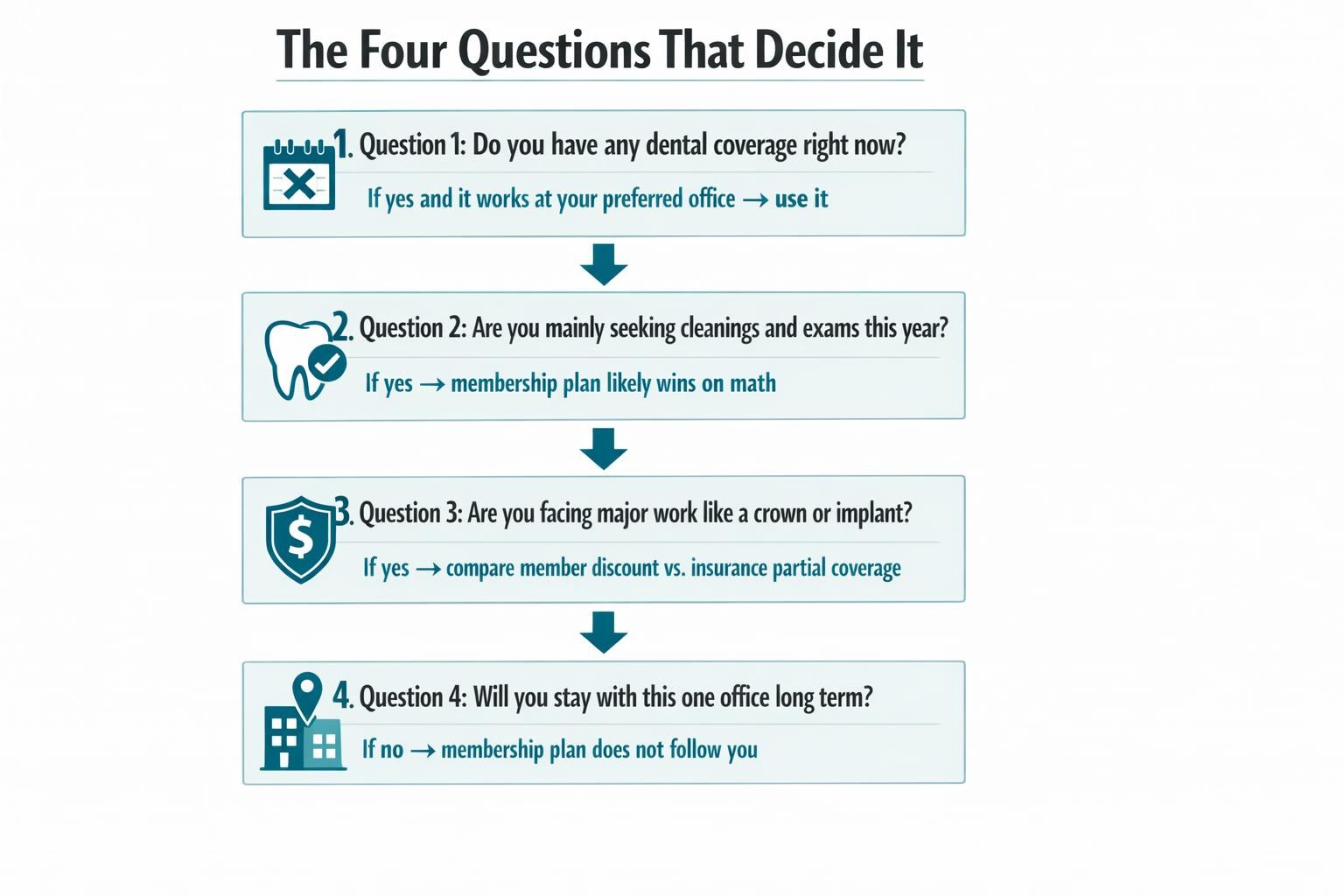
The Four Questions That Decide It
Before you compare any two plans, answer these in order. Most people know the answer after question two.
When a Membership Plan Is the Wrong Answer
This is the section most practices skip, and it is the one that should decide whether you trust the rest of the article.
If you are facing implants or a full-arch restoration, a membership plan is not your solution. A discount on a treatment plan that runs into five figures is still a very large number. You would be better off comparing financing options or looking at whether a plan with real major-service benefits is worth the premiums. I have seen treatment plans priced well beyond what any annual insurance cap would cover anyway, which is its own argument. If that is where you are, what dental insurance actually pays toward implants in Arizona is a more useful read than this one.
If you already have decent employer dental, do not pay twice. Use the benefits you are already paying for through payroll. A membership plan on top of working coverage is a second bill for a discount you may never use.
If you need a lot of work right now and almost none next year, think about timing. The membership fee resets annually and the discount only helps while the plan is active.
The patients this fits are the uninsured and the out-of-network, and that is who it keeps showing up for on our phone line. Not everyone. That narrowness is the feature.
If the Office You Want Is Out of Network
This one deserves its own paragraph because it ends more calls than anything else.
Someone finds a practice, likes the reviews, calls to establish care, gives their plan name, and hears “we’re out of network.” The call stops there. I have had callers describe real financial strain in that exact moment.
But out of network does not automatically mean more expensive. Sometimes a membership plan plus the office’s cash fees comes out better than what you would net after out-of-network reimbursement, especially on preventive visits where the plan already includes them.
Ask it both ways before you give up:
- “What would my out-of-network cost be after reimbursement?”
- “What would it be on your membership plan at member pricing?”
Then compare. It takes one phone call. This is a different question from what changes when a dentist leaves your network, which is its own situation, but the same instinct applies: get the number before you walk away from an office you liked.
Why This Question Comes Up So Often Around North Scottsdale
There is a local reason this topic lands harder here than it would in most towns.
Roughly a quarter of Scottsdale residents are 65 or older, and routine dental is generally not part of Original Medicare. Plenty of our neighbors in McCormick Ranch and along the Shea Corridor retired with good medical coverage and no dental.
Then there is the self-employed crowd, consultants, realtors, small business owners, who never had group dental to begin with.
And from late October through March, the Phoenix area takes in several hundred thousand seasonal residents. A couple splitting the year between Minnesota and the Village at Frank Lloyd Wright often holds coverage tied to a network that does not exist in Arizona. Their plan technically works. It just does not work here.
For all three groups, a flat annual arrangement with one local office is simpler than a plan that does not travel. If you are only here four months, what dental work actually fits in a winter stay is worth thinking through before you enroll in anything.
Frequently Asked Questions About Dental Membership Plans
Is a dental membership plan the same as dental insurance?
No. Insurance is a third party that pays a share of your bill. A membership plan is an agreement with one dental office for included preventive visits and reduced fees. There are no claims and no coverage percentages.
Can I use a membership plan at any dentist?
No, and this is the real tradeoff. The plan only works at the practice that offers it. If you move or switch offices, it does not follow you, so only enroll somewhere you actually intend to stay.
What if I need a crown while I am on a membership plan?
You would pay the member rate for the crown, which is a discount off the office’s regular fee rather than a covered benefit. Ask for that figure specifically before you enroll, since crown pricing varies by material and by tooth. If you are weighing a crown recommendation in general, getting a second set of eyes on it is reasonable.
Do membership plans have a waiting period before I can use them?
Typically no. That is one of the clearest differences from an individual insurance plan, where major treatment often sits behind a 6-12 month waiting period. Confirm the terms with the office, since plans are written by each practice.
I am uninsured and just want a cleaning. What should I ask on the phone?
Ask three things: the cash fee for a new patient exam and X-rays, the cash fee for a cleaning, and whether a membership plan would make those cheaper together than separately. You should get real numbers on that call, not a vague answer.
Want the Actual Numbers Before You Decide?
Our office keeps an in-house membership option and current cash fees available, and our team will walk you through both over the phone so you can compare them against whatever plan you are holding. Trinity Dental Care sees patients from across North Scottsdale, Paradise Valley, and the surrounding northeast Valley. You can reach us at 480-621-4040 or at trinitydentalcares.com whenever you are ready to ask.