
For anyone told they don't have enough bone for traditional dental implants, the dream of a full, confident smile can feel out of reach. Many patients who’ve been told they don’t qualify for implants assume they’re out of options.
But when patients ask, "can All-on-4 implants really work without bone grafting?" the answer, in most cases, is a resounding yes. This technique was engineered from the ground up as a solution for patients with bone loss, often making invasive grafting surgeries a thing of the past.
A Modern Answer to Full Arch Restoration
If you've heard "no" to dental implants because of bone loss, you are far from alone. Many patients here in Scottsdale, AZ assume their only choice is a removable denture, completely unaware that smarter, less invasive solutions are available.
A common misstep is that some patients delay treatment or avoid implants altogether after being told they need bone grafting. They don't realize there are newer solutions available. The great news is that modern dentistry has a powerful alternative.
Bypassing the Need for Bone Grafts
The All-on-4® treatment concept is a brilliant approach to restoring a full arch of teeth. Traditional methods might demand six to eight implants and require extensive bone grafting to create enough support.
All-on-4®, on the other hand, uses just four strategically placed implants to anchor an entire set of beautiful, fixed teeth. This advanced implant technique uses angled implants to maximize contact with existing bone. This minimizes the need for grafts and reduces recovery time—while offering a full, secure smile.
So, how does it pull this off? The secret is in the biomechanics.
- Strategic Placement: Two implants are placed vertically in the front of your jaw, where the bone is naturally denser and stronger.
- Angled Implants: The two back implants are tilted at a 45-degree angle. This clever technique increases the surface area of contact between the implant and your existing bone, building a stable foundation without surgically adding more bone.
This intelligent design provides all the support needed for a full arch of teeth. For a deeper dive into how implants work, you can learn more about dental implants in our comprehensive guide.
All-on-4 vs. Traditional Implants: A Quick Comparison
To see just how different these two approaches are, let's break them down side-by-side. The table below highlights why All-on-4® is often a more direct path to a new smile for patients with bone loss.
| Feature | All-on-4 Implants | Traditional Full Arch Implants |
|---|---|---|
| Bone Grafting | Rarely needed due to angled implants | Frequently required, especially in the back of the jaw |
| Number of Implants | 4 per arch | Typically 6 to 8 per arch |
| Treatment Timeline | Often immediate (teeth-in-a-day) | Can take 6-12+ months due to grafting and healing |
| Surgical Invasiveness | Less invasive; one surgical procedure | More invasive; multiple surgeries for grafting and placement |
| Overall Cost | Often more cost-effective | Can be higher due to extra procedures and implants |
As you can see, the All-on-4® technique was designed to be a more efficient and less invasive solution. It sidesteps the lengthy healing and additional costs associated with bone grafting, making a full-arch restoration accessible to more people.
At Trinity Dental Care in Scottsdale, Dr. Christine Ann Fink specializes in All-on-4® full-arch restorations. She offers patients a life-changing solution that skips the grafting process for faster, more comfortable results.
How Angled Implants Make Graftless Solutions Possible
The genius behind the All-on-4® treatment concept is that it works with your natural anatomy. Its incredible success boils down to a powerful principle of biomechanics, allowing a rock-solid foundation for a full set of teeth with just four implants.
The secret sauce is the deliberate angulation of the two back (posterior) implants. These are tilted at a precise 45-degree angle, a technique that lets us anchor them into the denser, higher-quality bone at the front of the jaw.
Think of it like the legs on a sturdy table. Four straight legs make it stable, but if you angle those legs outward, you dramatically increase the table's footprint and make it nearly impossible to tip over. Angled implants do the exact same thing, spreading chewing forces over a much wider area of bone for maximum support.
The Science of Stability
This groundbreaking technique, developed by Dr. Paulo Maló, was designed to maximize contact between the implant and your bone. By angling the implants, we can use longer posts that grip more of your existing jawbone.
It also lets us completely avoid sensitive areas like the sinuses in your upper jaw and the main nerve in your lower jaw. This smart placement is precisely why so many people who were previously told they needed a sinus lift or major bone grafts are perfect candidates for All-on-4.
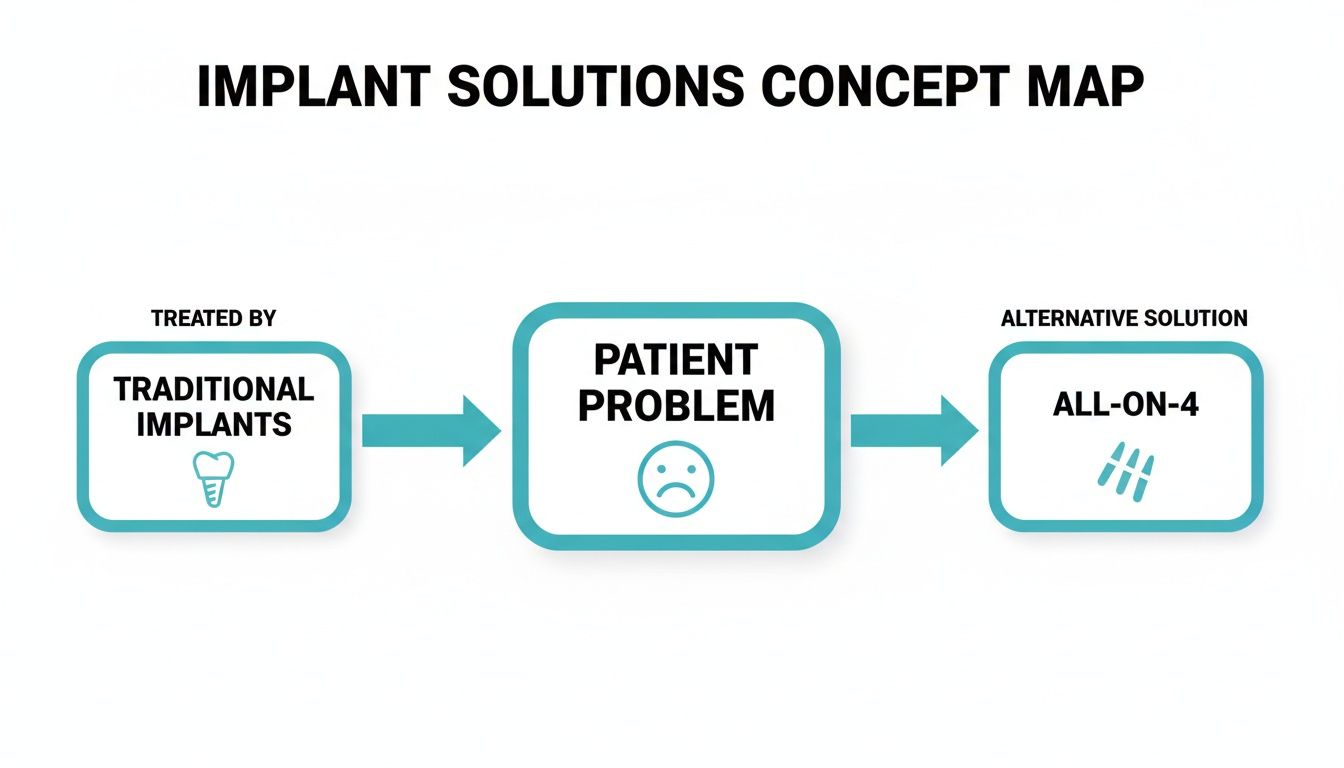
This visual shows the two paths patients often face when they need a full arch of teeth, making it clear how All-on-4 offers a much more direct route to a new smile.
The long-term success of this graftless method is incredibly well-documented. A landmark study tracking patients over 10 years found a cumulative implant survival rate of 94.8%, with the prosthetic teeth themselves hitting a 99.2% survival rate.
This stability also makes "immediate function" possible—a cornerstone of the patient experience. The dental specialists who design and create these life-like new teeth are called prosthodontists. You can learn more about dental specialties like prosthodontics in our guide.
Here at our Scottsdale practice, Dr. Christine Ann Fink uses advanced 3D imaging to meticulously map out every single implant placement, ensuring a perfect fit and lasting results.
The Data Behind All-on-4 Success Rates
When considering a significant investment in your health, it’s natural to ask, "Do All-on-4 implants really work without bone grafting?" The great news is, the answer isn’t based on theory. It’s built on decades of clinical research and real-world results.

The All-on-4 technique has been meticulously studied, and the numbers consistently point to remarkable long-term success. At Trinity Dental Care, we find that patients are often surprised to learn that All-on-4® doesn't require bone grafting in most cases.
Consistently High Survival Rates
Clinical studies consistently report implant survival rates for the All-on-4 procedure that are well above 95%. This high success rate holds true even for patients who have lost significant bone.
These impressive figures aren't just from one or two studies. Systematic reviews combining data from numerous clinical trials confirm All-on-4 implants hit survival rates of 98.8% in the lower jaw and 95-97% in the upper jaw, often with no bone grafting at all.
This mountain of evidence directly tackles the main concern about whether a graftless approach can really last. The numbers make it crystal clear: it's not just possible, it’s highly successful.
A Predictable Path to a New Smile
The success of All-on-4 is rooted in its predictability. By using advanced 3D imaging, dentists like Dr. Christine Ann Fink at Trinity Dental Care can map out the perfect implant positions before the procedure even starts.
The consistency of All-on-4 success rates across thousands of patients worldwide proves it is a well-established and dependable treatment. It offers a clear, data-driven "yes" to patients who thought a permanent smile was out of reach.
For many, this data is the final piece of the puzzle. It transforms the idea of a new smile from a hopeful wish into a tangible, achievable reality. If you've been weighing your options, our guide on when to consider dental implants can provide some extra clarity.
Are You a Candidate for Graftless All-on-4 Implants?
Figuring out if All-on-4® is the right fit for your smile begins with understanding who this procedure helps the most. The treatment is especially life-changing for those facing specific dental hurdles.
The perfect candidate is often someone fed up with uncomfortable or loose dentures. They might also be facing the loss of many teeth and are looking for a solid, long-term alternative.
Who Is an Ideal Candidate?
Many patients who do incredibly well with All-on-4® share a common story: they’ve been told they don’t have enough bone for traditional dental implants. This is the exact problem the graftless technique was created to solve.
You might be a great candidate if you:
- Currently wear full or partial dentures and are looking for a more secure, permanent solution.
- Have multiple failing or missing teeth and want to restore an entire arch at once.
- Have experienced significant jawbone loss and were told you’d need extensive bone grafting.
- Want to avoid the long timeline and multiple surgeries that come with bone grafting.
Beyond these points, a good candidate should be in good overall health and be ready to commit to excellent oral hygiene. This commitment ensures the long-term success of your new smile. For a deeper dive, you can read our guide on how to stop bone loss in your teeth.
The Deciding Factor: The Consultation
While you can see if your situation lines up with the typical patient profile, there’s only one way to know for sure. A definitive answer always requires a comprehensive evaluation with an experienced dental professional.
The first step is always a thorough consultation. This is a detailed diagnostic process designed to give you a clear and accurate picture of your oral health.
During this visit at Trinity Dental Care, Dr. Christine Ann Fink will use advanced 3D CBCT (Cone Beam Computed Tomography) scanning. This imaging provides a precise, three-dimensional map of your jawbone, revealing its exact density and shape. This is the crucial step that confirms whether you can move forward without bone grafting.
Your All-on-4 Journey With Trinity Dental Care
Thinking about restoring your smile can feel like a huge step, but at Trinity Dental Care, we make the process clear and comfortable. We'll walk with you through every single phase, making sure our Scottsdale patients feel confident and cared for.

It all kicks off with a personal consultation with Dr. Christine Ann Fink. This is our chance to listen to your goals and use incredible technology to map out a precise plan tailored just for you.
The Initial Consultation and Digital Plan
Your first visit is all about getting the full picture. Dr. Fink uses state-of-the-art 3D CBCT scanning to create a detailed, three-dimensional map of your jawbone.
This digital model lets her see everything—bone density, nerve locations, and the ideal spots to place the four implants. This meticulous digital planning is the secret to a predictable, successful outcome.
Your Surgery and Same-Day Smile
When you come in for your procedure, your comfort is our absolute priority. The surgery is performed with incredible care and precision.
That very same day, we attach a beautiful, custom-crafted temporary bridge to those implants. You will not leave our Scottsdale office with a gap in your smile. You'll walk out with a full set of fixed, functional teeth, ready to smile with renewed confidence right away.
At Trinity Dental Care, our goal is to deliver a transformative "same-day smile." The ability for our patients to leave with a full set of fixed teeth on the day of surgery is one of the most significant and life-changing benefits of this treatment.
Healing and Your Final Custom Restoration
Over the next few months, your jaw will heal as the implants fuse with the bone—a natural process called osseointegration. During this healing period, you'll be wearing your beautiful temporary bridge. We have an excellent resource covering what you need to know before treatment that offers more helpful insights.
Once healing is complete, you’ll come back to our office to get your final, permanent teeth. This final bridge is meticulously crafted from durable, natural-looking materials. Dr. Fink will work closely with you to ensure the final result gives you a smile that’s truly built to last.
Got Questions About All-on-4? We've Got Answers
Deciding on a full-arch restoration is a big step, and it's completely normal to have a lot of questions. We’ve put together answers to some of the most common things patients ask us here at Trinity Dental Care.
Is the All-on-4 Procedure Painful?
The surgery itself is comfortable and performed under anesthesia, so you won’t feel any pain. Afterwards, some post-operative discomfort is normal but is typically well-managed with prescribed medication.
How Long Do All-on-4 Implants Last?
With the right care, the four dental implants are designed to be a permanent part of your smile and can easily last a lifetime. The beautiful prosthetic bridge attached to them is incredibly durable but may need to be replaced after 10 to 15 years due to normal wear.
What if I Still Need a Bone Graft for All-on-4?
While the point of the All-on-4 technique is to avoid grafting, some people with extremely severe bone loss might still need it. Dr. Christine Ann Fink will perform a thorough 3D assessment to get a crystal-clear picture of your unique anatomy and discuss every possible solution.
How Do I Clean and Maintain My New Teeth?
Caring for your All-on-4 bridge is refreshingly straightforward. Your daily routine will feel a lot like brushing natural teeth, but you'll also use special tools, like a water flosser, to clean underneath the bridge. Our team gives every patient detailed instructions.
What Is the Cost of All-on-4 in Scottsdale?
The final cost can vary based on your specific needs and materials. That said, All-on-4 is often more cost-effective than replacing an entire arch with individual implants, which nearly always require expensive and time-consuming bone grafting. We provide a fully transparent cost breakdown during your consultation.
If you’re in Scottsdale, AZ and thought dental implants weren’t an option, schedule a consultation with Trinity Dental Care. You might be a great candidate for All-on-4®—even without a bone graft. Book your appointment online or call us to get started.