
When considering dental implants, the first question on most people's minds is about the cost. What is the investment for a permanent solution to a missing tooth?
Here in Scottsdale, the price for a single dental implant typically lands between $3,000 and $6,000. This range includes the surgery, the connecting abutment, and the final, custom-made crown. It’s an upfront cost that reflects a long-term fix for a healthy, confident smile.
Breaking Down the Real Cost of Dental Implants

To understand "how much do dental implants cost," it is important to look beyond a single number. The final price is not a flat fee. Instead, it is a combination of key services and high-quality components, each with its own cost.
At Trinity Dental Care, Dr. Christine Ann Fink believes in total transparency with patients. Providing a clear breakdown helps patients in Scottsdale understand exactly what they are investing in for their oral health. This approach ensures there are no surprises.
What Goes Into the Total Price
The journey to a new, permanent tooth involves a few distinct stages. Every step is essential to ensure your implant is safe, stable, and looks completely natural.
Here are the core parts of the process that make up the final cost:
- Initial Consultation and Imaging: This first step includes a thorough exam and advanced 3D scans to check jawbone health and map out the procedure.
- The Implant Surgery: This covers the careful placement of the titanium implant post, which acts as a new tooth root.
- The Abutment and Crown: These are the final pieces—the small connector and the beautiful, custom-made tooth that attaches to the implant post.
The table below outlines the typical costs for each component of a single implant procedure.
Estimated Cost Breakdown for a Single Dental Implant Procedure
| Procedure Component | Average Cost Range (U.S.) | Purpose of This Component |
|---|---|---|
| Consultation & 3D Imaging | $200 – $500 | To assess jawbone health and create a precise surgical plan. |
| Titanium Implant Post | $1,000 – $3,000 | The biocompatible screw that acts as the artificial tooth root. |
| Surgical Placement | $1,500 – $3,000 | The surgical procedure to place the implant post into the jawbone. |
| Abutment | $300 – $600 | A small connector piece that attaches the crown to the implant post. |
| Custom Crown | $1,000 – $2,500 | The final, visible porcelain tooth that is crafted to match your smile. |
This breakdown shows that the final number is a sum of its parts. Each plays a vital role in creating a successful, long-lasting restoration.
A dental implant is an investment in long-term health, confidence, and quality of life. Unlike other options, it preserves the jawbone and functions like a natural tooth.
The only way to know the personal investment is with a detailed consultation. While online estimates are a helpful start, a personalized plan from Dr. Fink will provide a precise and transparent quote for specific needs. You can learn more about whether dental implants in Arizona are worth it in our detailed guide.
What Your Dental Implant Investment Truly Covers
Understanding dental implant costs is easier when viewed as a sophisticated, three-part system. It is engineered to replicate a natural tooth from root to crown. Each piece has a specific job and is made from high-quality, biocompatible materials.
At Trinity Dental Care, Dr. Christine Ann Fink carefully selects every component to build a smile that is made to last. Let's break down the anatomy of a dental implant to see what your investment covers.
The Implant Post: The New Root
First is the most critical part: the implant post. This is a small, screw-like post, usually crafted from medical-grade titanium. It acts as a new, artificial tooth root surgically placed into the jawbone.
The magic happens through a process called osseointegration, where the jawbone fuses with the titanium. This creates an incredibly strong and stable foundation, mimicking a natural tooth root.
By stimulating the jawbone, the implant post prevents the bone loss that occurs after a tooth is lost. This is a significant health benefit that traditional bridges and dentures cannot offer.
The quality of the titanium and the precision of its placement are vital for long-term success. That is why Dr. Fink uses advanced imaging and careful planning to position the post perfectly.
The Abutment: The Sturdy Connector
Once the implant post has integrated with the jawbone, it is time for the abutment. This small connector attaches to the top of the post, just above the gum line. Its job is to securely link the hidden implant to the new tooth.
There are two main types of abutments:
- Stock Abutments: These are pre-made, one-size-fits-all components that are more cost-effective.
- Custom Abutments: These are specially designed to fit the unique contours of your gums and implant position.
While a custom abutment might add to the initial cost, it often creates a better fit and a more natural-looking result. Trinity Dental Care frequently recommends them to achieve the best aesthetics and promote long-term gum health for our Scottsdale patients.
The Crown: The Visible Tooth
The final piece is the crown, which is the visible, tooth-shaped cap. This is the part of the new tooth that everyone will see. It is custom-made to perfectly match the color, shape, and size of surrounding teeth.
The material used for the crown plays a big role in both cost and appearance. Materials like zirconia and porcelain are popular because they offer incredible strength and a lifelike appearance. The goal is for the new tooth to blend in seamlessly.
If you want to take a deeper dive into the procedure itself, check out our ultimate guide to dental implants.
Key Factors That Influence Your Final Implant Price
The cost of dental implants can feel like a moving target because every patient’s oral health is unique. While national averages provide a useful starting point, the final price is shaped by specific needs.
Dr. Christine Ann Fink at Trinity Dental Care develops a personalized treatment plan for every patient. This means the price is a direct reflection of the care you need—nothing more, nothing less.
Preparatory Procedures Your Smile Might Need
Before an implant can be placed, the jawbone must be strong enough to support it. If a tooth has been missing for a while, the bone in that area naturally starts to shrink.
In these cases, one or more of the following procedures might be necessary:
- Bone Grafting: This common prep work involves adding bone material to the jaw to create a solid base for the implant.
- Sinus Lift: This procedure is for implants in the upper back jaw. A sinus lift gently raises the sinus floor and places a bone graft underneath, creating needed height and stability.
- Tooth Extractions: If a damaged or failing tooth is still present, it needs to be carefully removed before an implant can be placed.
These steps are essential investments in the long-term success of your implant. Ensuring the site is perfectly prepared helps prevent complications. To better understand this process, you can learn more about how to stop bone loss in teeth in our related article.
Number and Type of Implants
This is the most straightforward factor influencing the total investment. A single dental implant will cost less than a full-arch restoration that requires multiple implants.
The American Dental Association notes that more than 3 million Americans have dental implants, a number that grows by 500,000 each year. While many are for single teeth, solutions for multiple missing teeth are increasingly popular. An implant-supported bridge, for example, can replace several teeth in a row using just two implants.
The Expertise and Technology Behind Your Care
Finally, the experience of the dentist and the technology they use are crucial components of the final cost. The skill of your doctor is the single most important factor in a successful outcome. Dr. Christine Ann Fink combines years of specialized training with a deep understanding of implant dentistry.
Trinity Dental Care uses advanced technology like 3D cone-beam computed tomography (CBCT) imaging. This provides a precise, three-dimensional map of your jaw. This detailed planning leads to safer, more predictable surgery.
Investing in a dentist with proven expertise and modern technology is your best insurance policy for a successful result. It minimizes risks and ensures your smile is built to last.
While these elements shape the final number, the best way to understand your personal investment is to schedule a consultation at our Scottsdale office.
Comparing Single Implants Versus Full Arch Solutions
When several teeth are missing, replacing them one by one can feel daunting. Modern dentistry offers ways to restore an entire arch of teeth using just a few strategically placed implants.
Think of it like fixing a broken fence. If only one or two posts are wobbly, it makes sense to replace just those posts. That is the logic behind a single dental implant for each missing tooth. But if the whole fence is failing, a new, integrated structure is a more stable and efficient fix. That is the principle behind a full-arch restoration.
Single Implants for Individual Gaps
A single dental implant is the gold standard for replacing one missing tooth. It involves placing a titanium post into the jawbone, followed by an abutment and a custom crown. This approach is perfect when you have healthy teeth on either side of a space.
The biggest benefit is that it is a targeted fix. It leaves healthy neighboring teeth untouched, unlike a traditional bridge. While it's an amazing solution, the cost can add up if you need to replace many teeth this way.
This flowchart breaks down the different factors that go into your final implant costs, from any prep work to the type of crown you choose.
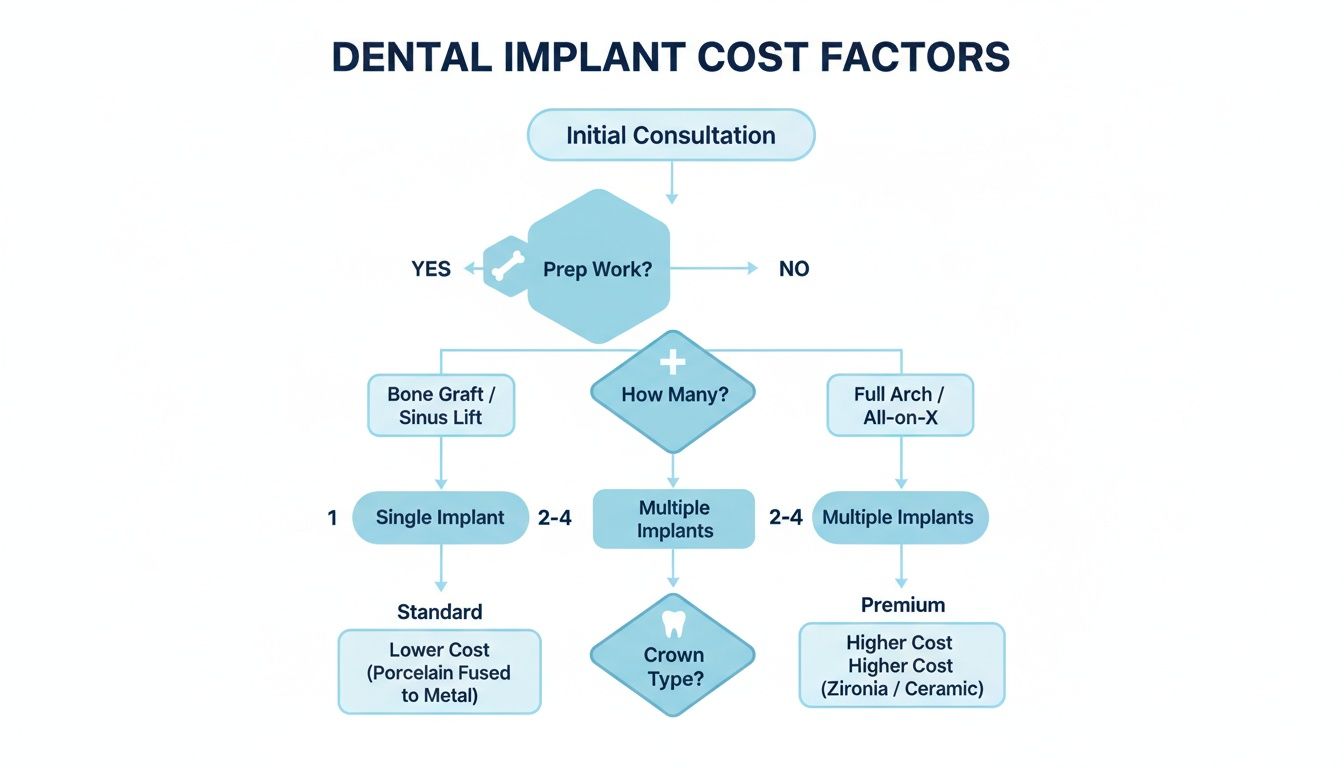
As you can see, figuring out the final price involves answering a few key questions, which shows how personalized every treatment plan is.
Full Arch Solutions for a Complete Smile Overhaul
When most or all teeth in an arch are failing, a full-arch restoration is usually the best path forward. This approach uses just four to six implants to anchor an entire row of permanent teeth. It is a powerful way to get a complete smile makeover without needing an implant for every lost tooth.
A full-arch solution, like the All-on-4® treatment concept, is a life-changing restoration that gives you a permanent, stable, and gorgeous new smile.
This method is also more cost-effective for extensive tooth loss. The total investment for a full arch is significantly less than what you would pay for a dozen individual implants. You can learn more by checking out our guide on the All-on-4® treatment concept explained.
Cost and Feature Comparison of Implant Solutions
To make things clearer, let's put these options side-by-side. The best choice always depends on the number of missing teeth and overall dental health.
| Implant Solution | Typical Cost Range | Best For | Key Benefit |
|---|---|---|---|
| Single Implants | $3,000 – $6,000 (per tooth) | Replacing one or a few non-adjacent missing teeth. | Preserves healthy neighboring teeth and feels just like a natural tooth. |
| Implant-Supported Bridge | $7,000 – $18,000 | Replacing two to four missing teeth in a row. | Uses fewer implants than single replacements, making it more cost-effective for a small section. |
| Full-Arch Restoration | $20,000 – $45,000+ | Replacing all or most teeth in the upper or lower jaw. | Provides a complete, permanent smile restoration with excellent stability and function. |
During your consultation, Dr. Christine Ann Fink will give you a personalized recommendation based on your unique situation. When you visit our Scottsdale office, she will review your 3D imaging and help you understand which option is the most suitable for you.
Making Your Implants Affordable in Scottsdale
A beautiful, functional smile should be within reach for everyone in Scottsdale. At Trinity Dental Care, we know getting a price for dental implants is just the first step. The next question is, "How can I fit this into my budget?"
Fortunately, there are several ways to make this life-changing investment work for you. From using existing benefits to exploring flexible payment plans, our team is here to help.
Using Dental Insurance for Your Restoration
One of the first questions we get is whether dental insurance will cover implants. While most plans do not cover the surgical placement, they often provide partial coverage for the final crown.
The team at Trinity Dental Care has years of experience working with insurance providers. We will help you understand what your plan covers and handle claim submissions to maximize your benefits.
Leveraging Pre-Tax Health Accounts
Another great way to manage the cost is by using pre-tax funds from a Health Savings Account (HSA) or a Flexible Spending Account (FSA). These accounts let you pay for dental expenses with money set aside before taxes.
Using an HSA or FSA can lead to significant savings. If you have one of these accounts, dental implants are an eligible expense. For more ideas, check out our guide on 5 tips to find affordable dental care.
Third-Party Financing Options
For many patients, the most practical approach is to break the total investment into manageable monthly payments. We partner with financing companies, like CareCredit, to offer flexible payment plans. These plans often have low-interest or even interest-free options.
Financing empowers you to get the treatment you need now and pay for it over time. It removes the financial barrier so you don't have to put off getting a healthy, confident smile.
This accessibility is a big reason the demand for tooth replacement is rising. More people are seeking long-term solutions, driving growth in the market. You can discover more insights about the dental implant market on grandviewresearch.com.
Your Personalized Implant Consultation at Trinity Dental Care
While guides like this help in understanding the ballpark cost, the only way to get a meaningful number is with a one-on-one consultation. An online calculator cannot see the specifics of your smile, but Dr. Christine Ann Fink can.
This appointment is more than just getting a price tag. It is a collaborative session where we map out your perfect treatment plan together.
What to Expect During Your Visit
Dr. Fink will use advanced 3D imaging to get a clear picture of your jawbone’s density and structure. This blueprint allows for precise planning, ensuring a safe and predictable outcome. After that, we will discuss your smile goals and answer every question.
Your consultation is an open conversation. It’s your chance to understand the clinical and financial sides of your care, ensuring the final plan fits your health needs and budget.
At Trinity Dental Care, our goal is to leave you feeling empowered with total clarity. A personalized approach is the only way to achieve a result that not only looks stunning but is built to last.
Answers to Your Top Questions About Dental Implant Costs
It is normal to have questions when exploring a significant investment like dental implants. We’ve put together answers to the most common questions our Scottsdale patients ask Dr. Christine Ann Fink.
Are dental implants worth the cost?
Yes. While the initial investment is higher than options like bridges, their long-term value is unmatched. Implants are designed to last a lifetime with proper care, all while preventing jaw bone loss. This durability often makes them the most cost-effective solution over time.
Why do some dental implants cost so much less?
A significant price difference often comes down to the quality of materials, the surgeon’s experience, and the technology used. At Trinity Dental Care, Dr. Fink uses only high-grade, biocompatible materials from trusted manufacturers to ensure high success rates. Lower-cost alternatives may cut corners on these critical factors.
Does dental insurance cover dental implants?
This varies by plan. Many insurance plans do not cover the surgical placement of the implant itself. However, they may offer partial coverage for the final crown. Our team can review your insurance benefits to help maximize your coverage.
What is the success rate for dental implants?
Dental implants have an incredibly high success rate, typically around 95-98%. This makes them one of the most reliable procedures in modern dentistry. This track record is thanks to the patient's oral hygiene, jawbone quality, and the skill of the dental professional.
Can I get a payment plan for my dental implants?
Absolutely. Trinity Dental Care believes financial concerns should not be a barrier to a healthy smile. We work with third-party financing companies like CareCredit to offer flexible and affordable payment plans. These plans allow you to break down the total cost into manageable monthly payments.
Ready to restore your smile with dental implants in Scottsdale? Contact Trinity Dental Care today to schedule a personalized consultation with Dr. Christine Ann Fink. Schedule your consultation with Dr. Christine Ann Fink in Scottsdale today.