
When you're hit with that unmistakable, throbbing tooth pain, the first thing on your mind is, "Where can I find a root canal dentist in Scottsdale right now?" It’s an urgent question, and thankfully, there are straightforward answers.
If you know you need a specialist, the American Association of Endodontists (AAE) has a fantastic "Find an Endodontist" tool on their website. It's the most direct way to find a board-certified expert near you. For general dentists who also perform root canals, a quick Google search for "root canal dentist Scottsdale" will give you plenty of immediate options to start with.
Starting Your Search for a Scottsdale Root Canal Dentist
Trying to find the right dentist when you're in pain can feel like a monumental task. But breaking it down into a few logical steps makes it much more manageable.
The first thing to understand is the difference between a general dentist and an endodontist. Many highly skilled general dentists, like our own Dr. Fink here at Trinity Dental Care, routinely perform root canals. An endodontist, however, is a specialist who has completed two or more years of advanced training focused exclusively on saving teeth through this specific procedure.
Your general dentist is always a great first call. They know your dental history and can quickly assess whether your situation is something they can handle or if it's a more complex case that calls for the specialized equipment and deep experience of an endodontist.
To give you a better idea of what the procedure involves, this image breaks down the core steps.
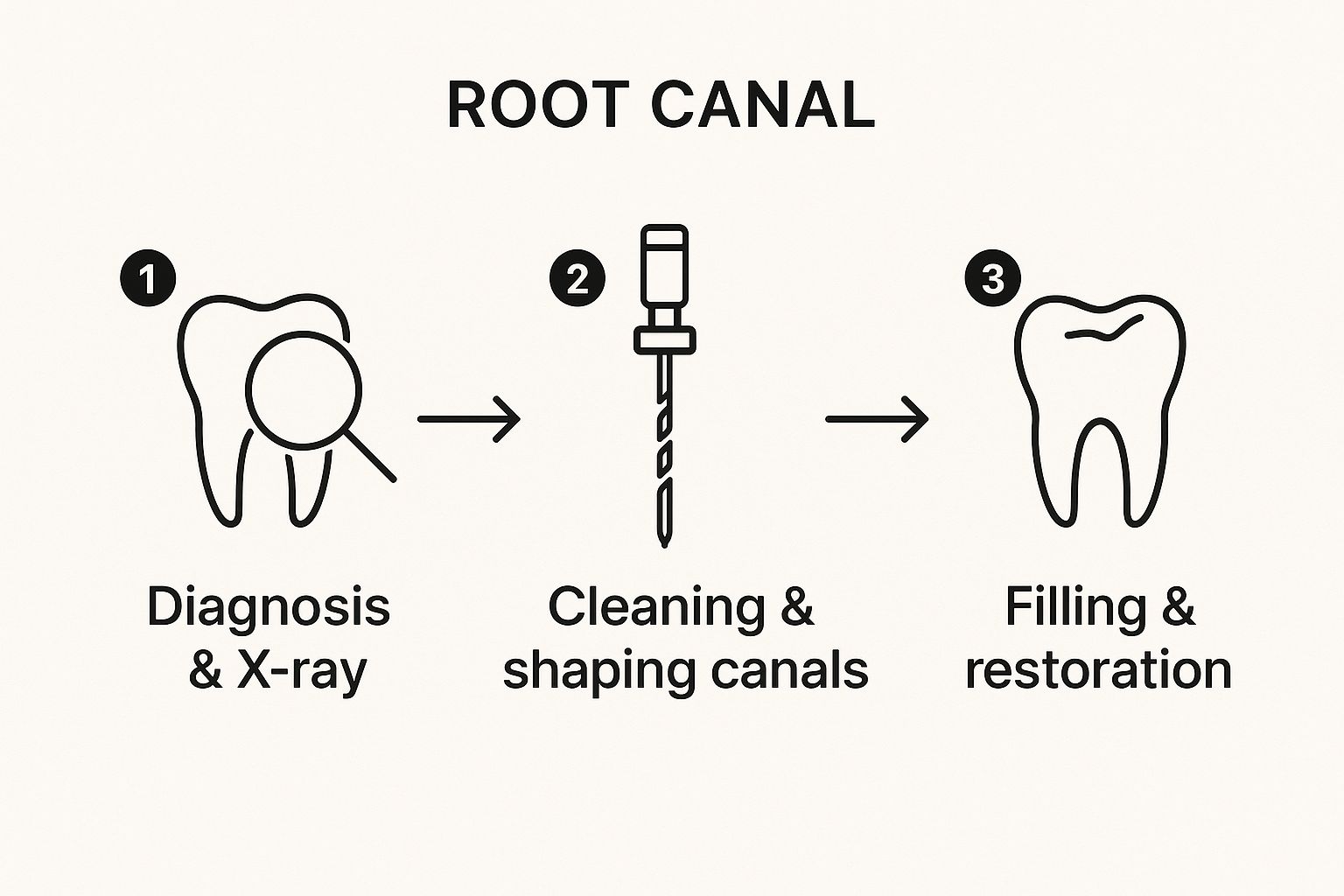
Seeing the process laid out like this really helps demystify the treatment. It shows how a root canal is a meticulous procedure designed to clean and save your natural tooth, steering you clear of an extraction. Understanding these key stages can make you feel much more confident about the care you’re about to receive.
Why You Might Need an Endodontist

While your trusted general dentist can handle many root canals with expertise, sometimes a situation calls for a specialist's touch. That’s where an endodontist comes in. These are dentists who have dedicated an extra two to three years of intensive training specifically to diagnosing complex tooth pain and performing advanced root canal therapy.
You can think of it like seeing a cardiologist for a heart issue instead of your general family doctor. Both are incredible physicians, but the specialist has a much deeper well of experience with a very specific set of problems.
When Specialist Care Makes a Difference
An endodontist’s focused knowledge becomes a game-changer in certain scenarios. Their advanced training gives them the tools and experience to manage tricky cases that might fall outside the scope of a general dental practice.
Your dentist might refer you to an endodontist if your case involves:
- A Complex Tooth: Molars with lots of tiny, curved, or narrow canals can be incredibly difficult to treat completely.
- Hard-to-Pinpoint Pain: If the exact source of your discomfort is a mystery, endodontists use advanced diagnostic tools like CBCT (Cone Beam Computed Tomography) to get a detailed 3D look at your tooth and jaw.
- A Previously Treated Tooth: A tooth that needs a root canal re-treatment requires a unique skillset to navigate and clean the original work effectively.
- Traumatic Dental Injuries: Complicated cracks or teeth that have been knocked loose often need an endodontist's precision care.
Endodontists are the true experts in saving natural teeth. Because they focus exclusively on this work, they perform root canals every single day, giving them an unmatched level of skill and familiarity with every possible complication.
The need for this specialized procedure is undeniable. Across the country, dentists and endodontists perform more than 15 million root canals each year, showing just how vital this treatment is for saving teeth that would otherwise be lost. (American Association of Endodontists)
If you're wondering whether your symptoms point to a root canal, it helps to be informed. You can learn more about the specific signs you may need a root canal in our detailed guide. This background knowledge will help you have a much more productive conversation when you find the right root canal dentist in Scottsdale.
How to Vet a Top Scottsdale Root Canal Specialist
Once you have a few names on your list, it's time to dig a little deeper. Moving past a basic map search and really vetting a dentist’s credentials is what separates a decent experience from an exceptional one. When you need a root canal dentist in Scottsdale, you want someone with the right qualifications and the modern tools to get the job done right.
A great place to start is with their professional background. While many general dentists can and do perform root canals, an endodontist is a specialist who has completed at least two additional years of intensive training focused only on this type of procedure. Check the "About Us" or "Meet the Doctor" page on their website for details on their education, board certifications, and memberships in key organizations like the American Association of Endodontists.
Technology and Technique Make a Difference
The equipment a dentist invests in says a lot about their commitment to top-tier care. Let's be honest, old-school methods just can't compete with the precision and comfort offered by today's dental technology.
When you're checking out a practice, keep an eye out for these game-changers:
- Surgical Operating Microscopes: These aren't just magnifying glasses. They are powerful microscopes that allow the endodontist to see the incredibly tiny and complex anatomy inside your tooth's root. This is the gold standard for making sure the canal is thoroughly cleaned and sealed, which is critical for success.
- 3D Cone Beam Imaging (CBCT): Think of this as a super-powered X-ray. It creates a detailed, three-dimensional picture of your tooth, its roots, and the surrounding bone. For tricky cases, it’s an invaluable tool that helps the dentist plan the treatment with absolute precision before they even start.
The right technology isn’t just about having flashy new equipment—it directly translates to a higher success rate, less time in the chair, and a much more comfortable experience for you.
As you search for a root canal dentist in Scottsdale, you'll notice that the best providers have fully embraced this blend of advanced tech and patient-first care. Many leading local practices, for instance, offer comprehensive services that use state-of-the-art tools like Digital X-Rays as a baseline. It's this commitment that really sets the standard for quality care in our community.
Understanding why this level of care matters is a huge part of taking charge of your oral health. If you're curious to learn more, you might find our guide on why dental care is important for your well-being helpful.
Assessing The Patient Experience And Practice Atmosphere

Technical skills and fancy tools are obviously critical, but let's be honest—the human element is just as vital. When you're already stressed about a potential root canal, a genuinely welcoming and communicative dental office can make all the difference in the world.
The best way to get a feel for this is to read between the lines of online reviews. Don't just glance at the star rating. Dig into the comments and look for specifics about the dentist's communication style, how the front office staff treats people, and the clinic's overall environment. Words like "calm," "reassuring," and "patient" are gold.
What To Listen For During Your First Call
That first phone call is your sneak peek into how the practice operates. You can learn a lot by paying close attention to how the team member on the other end speaks with you. Are they rushed and dismissive, or do they actually take a moment to listen to your concerns?
When you call a potential root canal dentist in Scottsdale, it helps to have a few questions ready. This isn't just about getting information; it's about seeing how they respond.
- Pain Management: "Can you tell me about your practice's approach to making sure patients are comfortable and pain-free during a root canal?"
- Patient Communication: "How do you typically keep patients in the loop about what's happening during the actual procedure?"
- Comfort Amenities: "Do you happen to offer anything to help anxious patients relax, like headphones or blankets?"
Your comfort and peace of mind should be a top priority. A truly patient-first practice will welcome these questions. They'll give you reassuring, detailed answers that make you feel heard and respected right from the start.
Ultimately, the goal is to find a specialist who nails both the clinical skills and the patient care. For a deeper dive, our guide on how to tell if your dentist is good offers even more practical tips on spotting a top-tier provider.
Understanding the Costs and Insurance Coverage
Let’s be honest—one of the first questions on anyone's mind when they hear "root canal" is, "How much is this going to cost?" It's a valid concern, but it should never be the reason you put off saving a tooth. Getting a handle on the financial side of endodontic care in Scottsdale is a lot less intimidating once you know what to expect.
The final price tag for a root canal isn't one-size-fits-all. A few key things will influence the cost. For example, working on a front tooth is usually more straightforward and, therefore, less expensive than treating a molar, which has a more complex system of roots and canals. The specific details of your case will always play a part in the total investment.
Breaking Down Your Financial Options
Your best first move is always to chat with the office's financial coordinator. Think of them as your guide—they know the ins and outs of dental benefits and can walk you through your specific costs, payment options, and how to get the most out of your insurance plan.
When you have that conversation, here are a few key things to ask:
- Is the practice in-network or out-of-network with my insurance? This is a big one, as it directly affects what you'll pay out-of-pocket.
- What percentage of a root canal does my plan cover? Always ask for a pre-treatment estimate. No one likes financial surprises.
- Do I have a deductible or an annual maximum to think about? Knowing this upfront helps you budget for the entire expense.
A good, transparent dental office will be more than happy to break down your insurance benefits and any potential costs before your treatment even starts. Their goal is to help you get the care you need without adding financial stress to the situation.
Many practices in the area work hard to make treatment accessible. You'll find that many accept major insurance providers like Aetna, Cigna, and Delta Dental to help more patients get the care they need. Some Scottsdale dental offices even offer things like seasonal discounts to make root canal therapy more affordable. You can learn more about these affordable options and see how they help patients in the community.
Finally, don't forget to ask about financing. Many offices partner with plans like CareCredit or have their own in-house payment options to spread out the cost. Getting a clear picture of the financials beforehand lets you focus on what really matters: a smooth and easy recovery. Speaking of which, you can learn more by checking out our guide on what to expect after a root canal.
Why Choose Trinity Dental Care for Your Root Canal?

When you need a root canal, you aren't just looking for a technician with a steady hand. You're looking for a compassionate partner in your dental health journey. That philosophy is at the very heart of what we do here at Trinity Dental Care. Dr. Christine Ann Fink combines her advanced clinical skills with a genuinely patient-first approach.
We’ve worked hard to bring together all the crucial elements for a successful and comfortable experience. This means investing in modern technology, insisting on clear and honest communication, and creating an environment where our patients can feel truly relaxed.
Instead of spending more time searching, we invite you to come in and experience the difference for yourself. We're committed to showing you why so many Scottsdale residents trust us with their smiles and their peace of mind.
Your Partner in Dental Health
Finding the right provider is a massive step in your treatment, and we believe that exceptional care starts with building a real, trusting relationship.
Our entire team takes the time to listen to your concerns, answer every single question you have, and make sure you feel completely informed and at ease—before, during, and after your procedure. To see how we blend this expertise with genuine care, you can explore our dedicated services for a root canal dentist in Scottsdale.
Frequently Asked Questions About Root Canal Treatment
It’s completely normal to have questions when you’re facing a root canal. In fact, most of our patients in Scottsdale come in with a few of the same concerns. Let's walk through some of the most common ones so you can feel more at ease.
1. How painful is a root canal, really?
This is, without a doubt, the number one question on everyone’s mind. Let’s clear the air: thanks to modern anesthetics and advanced techniques, the root canal procedure itself shouldn’t feel any more intense than getting a routine filling. The whole point of a root canal is to relieve the awful pain you're feeling, not to cause more of it. That throbbing pain is the infection before the treatment; the procedure removes the source of that agony.
2. What is recovery like?
You’ll probably be surprised by how straightforward recovery is. Most people find it’s much faster and easier than they imagined. A root canal can often be completed in just one or two visits. Afterward, you might feel some mild sensitivity for a few days, but that's typically it. You can get back to your normal routine very quickly. For a closer look at the process, you can learn more about the root canal procedure.
3. How long does the procedure take?
The time you’ll spend in the chair really depends on which tooth needs attention and how complex its structure is. A front tooth, which usually has just one simple canal, might take about 60-90 minutes. On the other hand, a molar with multiple, tricky-to-reach canals might take a bit longer or even require a second visit to make sure everything is perfectly cleaned and sealed.
4. How successful is a root canal?
Root canal treatment is highly successful, with studies showing success rates of over 95%. (AAE) A tooth that has been properly treated and restored with a crown can last a lifetime, just like any of your other natural teeth.
5. Will I need a crown after my root canal?
Most of the time, yes. A tooth that requires a root canal has often been weakened by extensive decay or a large filling. Placing a crown over the tooth after the procedure is crucial for protecting it from fracture and restoring its full function.
Conclusion: Take the Next Step for a Pain-Free Smile
Finding the right root canal dentist in Scottsdale doesn't have to be overwhelming. By understanding the difference between a general dentist and an endodontist, vetting a provider's technology and patient reviews, and clarifying costs upfront, you can confidently choose the best care. Your comfort, health, and peace of mind are the top priorities.
At Trinity Dental Care, we believe that an informed patient is a comfortable patient. Dr. Christine Ann Fink and our entire team are dedicated to providing expert, compassionate root canal therapy right here in Scottsdale. If you have questions or are ready to get out of pain, we are here to help.