
Digital dental x-rays are a modern diagnostic tool that uses electronic sensors instead of traditional film to capture incredibly detailed images of your teeth and jaw. This technology gives us instant, high-resolution pictures with significantly less radiation, making your dental visit quicker and diagnoses more accurate.
Why Your Dentist Prefers Digital X-Rays

At Trinity Dental Care, we know that exceptional patient care starts with superior diagnostic tools. That’s why we’ve fully embraced digital dental x-rays, moving beyond older, film-based methods.
Think of it like upgrading from a classic film camera to a high-definition digital one—the difference in clarity, speed, and what we can do with the images is truly remarkable. This technology has become a cornerstone of modern dentistry, giving our Scottsdale team a crystal-clear view of what’s happening below the surface of your smile.
A Clearer Picture for Better Diagnoses
The biggest advantage of digital x-rays is the incredible image quality. These detailed pictures allow Dr. Fink to spot issues that are completely invisible to the naked eye.
This clarity is a game-changer for:
- Early Cavity Detection: We can find tooth decay in its earliest stages, long before it would show up during a regular visual exam.
- Assessing Bone Health: Evaluating the bone levels around your teeth is crucial for diagnosing and managing gum disease.
- Viewing Tooth Roots and Nerves: It lets us check the health of the delicate tissues inside and around your teeth.
With such precise images, we can develop much more effective and personalized treatment plans. This level of diagnostic accuracy is vital not just for routine check-ups but also for ensuring the long-term success of all our dental work. You can learn more about how this integrates with our preventive approach by reading about why teeth cleanings are so important.
Your Digital X-Ray Appointment Step-by-Step
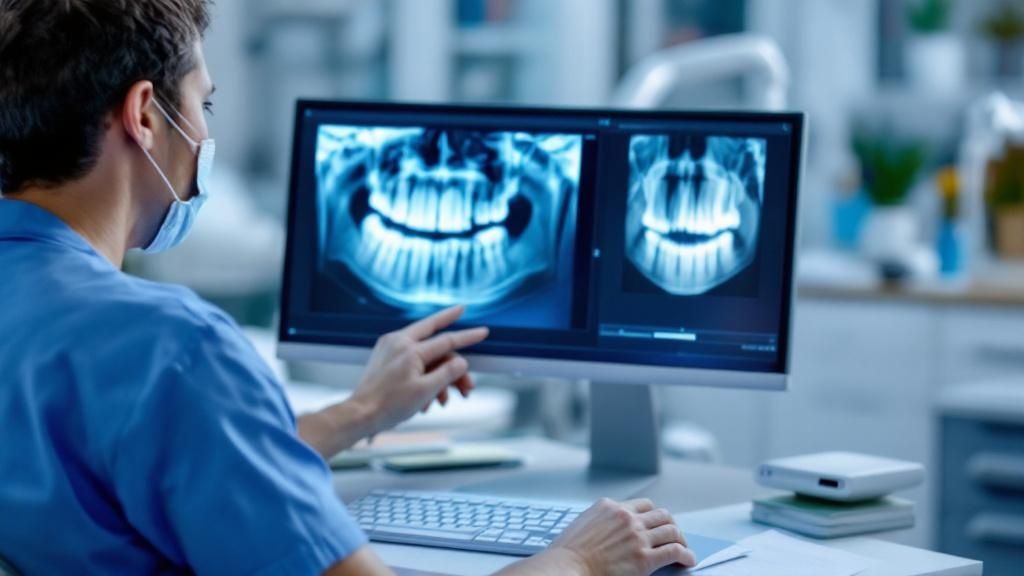
We get it—visiting the dentist can be a source of anxiety for many people. Knowing exactly what to expect during your appointment can make a world of difference. At Trinity Dental Care, we’ve designed our digital x-ray process to be quick, completely painless, and transparent from start to finish.
Let's walk through what happens from the moment you settle into the chair. First, one of our friendly dental assistants will get you situated and place a protective lead apron over your chest and lap. This is a standard safety measure that shields your body from the tiny amount of radiation used.
Next comes the imaging itself. Instead of those clunky, sharp-edged film packets from the old days, we use a small, smooth device called a digital sensor. We’ll gently position this sensor inside your mouth for just a few seconds.
The Capture and Instant Review Process
Once the sensor is in the right spot, the x-ray machine is aimed, and the image is taken in a flash. The exposure itself lasts for just a fraction of a second.
Because everything is digital, a high-resolution picture of your tooth pops up on the computer monitor right next to you almost instantly. This ability to instantly view your x-rays transforms your appointment into a collaborative experience, allowing for a clear and educational conversation about your oral health.
This immediate feedback loop means you're no longer just a passive patient; you become an active partner in your own dental care. We can go over the images together, step-by-step, so you understand exactly what we're seeing.
What You'll Experience During the Review:
- Magnification: We can zoom in on tiny areas of a tooth to get an incredibly detailed look at potential issues.
- Contrast Adjustments: With a click, we can change the brightness and contrast to better highlight different structures, like the enamel, dentin, and underlying bone.
- Clear Communication: Dr. Fink will use the image as a visual guide to point out any areas of concern, explain what they mean, and discuss potential treatment options with you.
This collaborative review really takes the mystery out of dental diagnostics. The entire process for a full set of digital dental x-rays is incredibly efficient, getting you back to your day in no time.
Comparing Digital and Traditional X-Rays
When it comes to your dental care, the technology your dentist uses makes a huge difference in your experience and safety. The jump from old-school traditional film to modern digital x-rays is one of the biggest leaps forward in dentistry.
Traditional x-rays were a lot like old-fashioned photography, using film that had to be developed with chemicals in a darkroom. Digital x-rays, on the other hand, use a small electronic sensor that sends a razor-sharp image straight to a computer screen in seconds.
Safety and Radiation Exposure
One of the first questions patients ask about x-rays is about radiation. While traditional dental x-rays have always been considered safe, digital technology has made an already safe procedure even safer.
Digital sensors are incredibly sensitive, which means they can capture a perfect image using up to 90% less radiation according to the American Dental Association (ADA). This commitment to safety follows the ALARA principle, which stands for "As Low As Reasonably Achievable."
That massive reduction provides incredible peace of mind, especially for patients who need regular images to monitor their oral health. It makes digital dental x-rays an exceptionally safe diagnostic tool for every member of the family.
Speed and Appointment Efficiency
Let's be honest—no one likes spending more time in the dental chair than necessary. Digital x-rays completely get rid of the long wait for film to develop, which makes your appointment flow much more smoothly and quickly.
This infographic breaks down some of the key differences, especially how much faster image capture and processing have become.
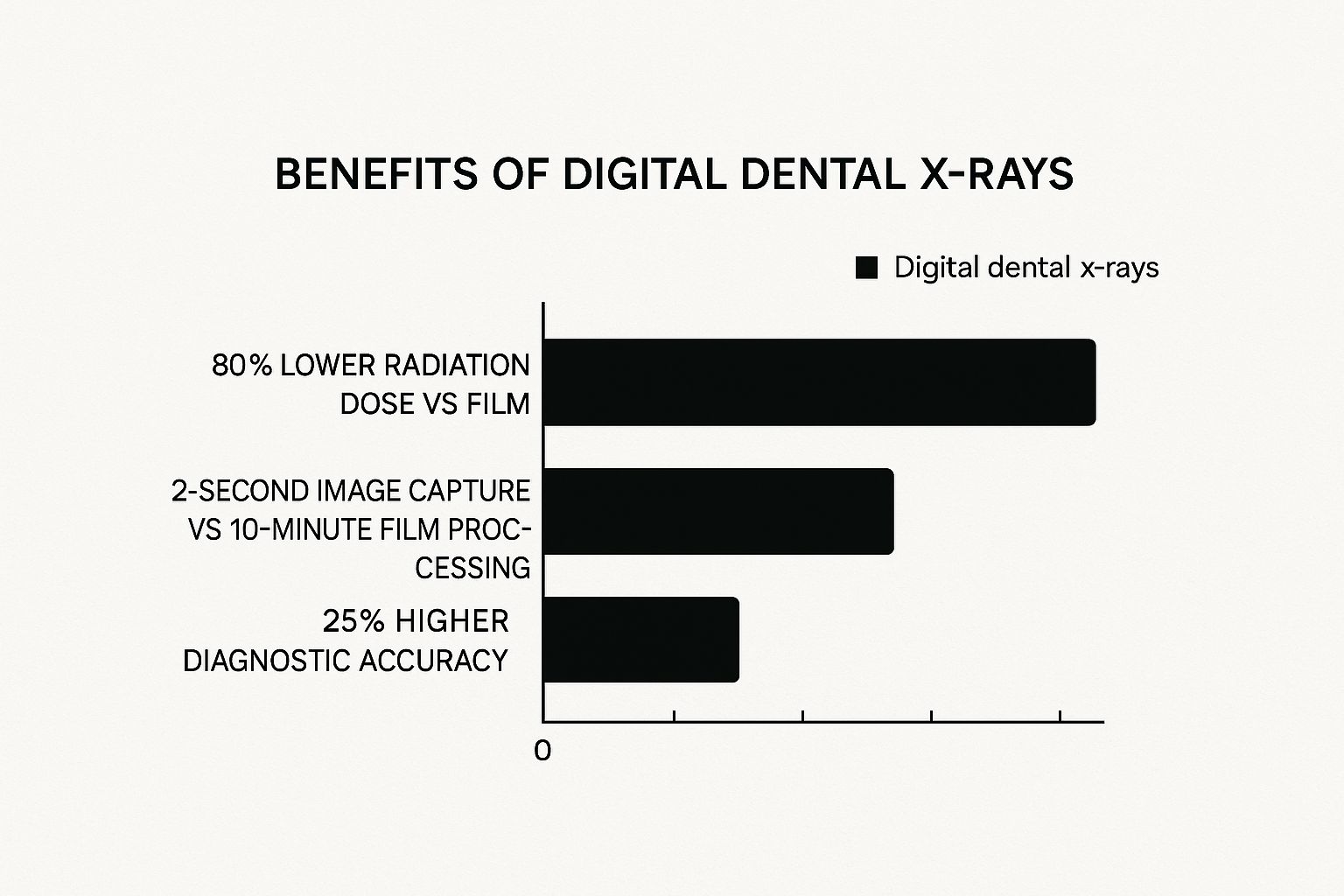
As you can see, getting images in a matter of seconds instead of minutes means you spend less time waiting and more time talking with Dr. Fink about your results.
Digital X-Rays vs Traditional Film X-Rays
| Feature | Digital Dental X-Rays | Traditional Film X-Rays |
|---|---|---|
| Radiation Exposure | Up to 90% less radiation | Higher, yet still safe levels |
| Image Speed | Instantly available on-screen | Requires minutes for chemical developing |
| Image Quality | High-resolution, can be enlarged/enhanced | Static, lower resolution, prone to errors |
| Patient Comfort | Smaller, smoother sensors | Bulky and rigid film packets |
| Diagnosis Time | Immediate discussion with your dentist | Delayed until film is processed |
| Environmental Impact | No chemical waste, eco-friendly | Uses toxic chemicals and creates waste |
It's clear that the move to digital isn't just about new gadgets; it's about providing a fundamentally better, safer, and more efficient experience for you.
Diagnostic Accuracy and Environmental Impact
The benefits don’t stop at speed and safety. Digital imaging directly leads to more precise diagnoses. We can zoom in on tiny areas, adjust the contrast, and see details that were often missed on small, static film x-rays.
Plus, going digital is a big win for the environment. By eliminating the need for toxic developer and fixer solutions, we cut down on our Scottsdale clinic’s waste and environmental footprint. This combination of better safety and higher-quality images leads to better health outcomes, helping you learn more about how seeing the dentist saves you money in the long run.
The Top 5 Benefits for Dental Patients
Beyond the impressive tech, what do digital dental x-rays actually mean for your visit here at Trinity Dental Care? This shift brings a wave of practical advantages that directly boost your safety, comfort, and quality of care.
Dramatically Reduced Radiation Exposure
Your safety is our absolute priority, which is why we invested in digital x-ray technology. One of its most important benefits is the massive reduction in radiation exposure—up to 90% less than what was needed for traditional film x-rays.
The highly sensitive digital sensors capture a perfect image with just a tiny fraction of the energy. This makes digital dental x-rays an incredibly safe diagnostic tool for your entire family, giving you peace of mind during every check-up.
Pinpoint-Accurate Diagnoses
Imagine trying to spot a tiny crack in an old, small photograph versus seeing it on a high-definition screen where you can zoom in. That’s the kind of difference digital imaging makes for us.
These crystal-clear images allow Dr. Fink to spot problems like tiny cavities, early bone loss, or hairline fractures that would be completely invisible on a conventional film. This evolution has significantly improved diagnostic capabilities, allowing for earlier and more accurate detection of dental issues. You can read more about these technological advancements in dentistry to see why they are so widely adopted.
Shorter and More Efficient Appointments
We know your time is valuable. Digital x-rays get rid of the slow chemical development process of film, making your appointments significantly shorter and more efficient.
Instead of waiting for film to process, your images appear on our chairside monitor instantly. This lets us move right from diagnosis to discussing your results, getting you back to your busy day that much faster. It's just one of the many reasons to visit the dentist regularly for streamlined, effective care.
A Greener, Eco-Friendly Process
Choosing digital technology is also a choice to protect our local Scottsdale environment. The old x-ray process involved several harmful elements that are now completely gone from our office.
By going digital, we eliminate toxic chemical developers and physical waste from film packets. This helps us minimize our environmental footprint while still providing you with top-tier care.
Better Patient Education and Collaboration
Perhaps the most empowering benefit is how digital x-rays change your role in your own dental health. It puts you in the driver's seat.
With your x-rays displayed on a large screen, you can see exactly what Dr. Fink sees. We can zoom in together, highlight areas of concern, and walk you through our findings with clear visual proof. This collaborative approach takes the mystery out of diagnostics and helps you make truly informed decisions about your treatment.
Understanding Digital X-Ray Safety

It’s completely normal to have questions about the safety of any medical procedure, including dental x-rays. Here at Trinity Dental Care, we want you to feel confident and secure every time you sit in our chair. The great news is that modern digital dental x-rays are designed with your safety as the top priority.
To put it into perspective, the radiation from a full set of digital dental x-rays is often less than what you’d get from your everyday environment. The National Council on Radiation Protection and Measurements (NCRP) notes the dose is comparable to the background radiation from a short airplane flight.
Our Commitment to the ALARA Principle
In the dental world, we live by a crucial safety standard known as the ALARA principle. This stands for "As Low As Reasonably Achievable," a commitment that guides everything we do. It simply means we take every possible step to minimize your radiation exposure while still getting the crystal-clear images needed for an accurate diagnosis.
This isn’t just a recommendation; it’s a core part of our philosophy. We only take x-rays when they are absolutely necessary for your care, making sure you get the maximum benefit with the minimum exposure.
Proactive Safety Measures in Our Office
Beyond just using low-dose technology, we take several other steps to protect you during every x-ray. These protocols are standard practice in our Scottsdale office because your safety is non-negotiable.
Here’s what you can expect:
- Lead Aprons and Thyroid Collars: We will always cover you with a protective lead apron and a thyroid collar to shield sensitive areas.
- Focused X-Ray Beams: Our modern equipment uses a very narrow, targeted beam aimed only at the specific tooth we need to see, which minimizes scatter.
- Skilled Technicians: Our team is expertly trained to capture the perfect image on the first try, so there’s no need for retakes.
These measures, combined with the low-dose technology itself, make digital imaging a very safe part of your dental care. The detailed information we gain is vital for preventing serious health problems like advanced gum disease. You can learn more in our guide on how to prevent gum disease.
Frequently Asked Questions About Digital Dental X-Rays
Even with all the benefits of modern technology, it's completely normal to have a few questions about procedures like digital dental x-rays. Here at Trinity Dental Care, we believe an informed patient is an empowered one.
1. How often do I really need dental X-rays?
The frequency of dental x-rays is tailored specifically to your oral health. According to the American Dental Association (ADA), new patients typically receive a full set to establish a baseline. For routine check-ups, bitewing x-rays are often recommended every 12 to 24 months, depending on your risk for cavities and gum disease.
2. Are digital X-rays safe if I am pregnant?
Your health and your baby’s health are our top priorities. While the radiation from digital x-rays is incredibly low, we generally postpone routine imaging during pregnancy as a proactive safety measure. If a dental emergency occurs, x-rays can be taken safely with a protective lead apron and thyroid collar to shield you and your baby.
3. What can digital X-rays find besides cavities?
Digital x-rays are remarkably versatile tools that see far more than just tooth decay. Some of the conditions we can spot include:
- Bone loss from gum disease
- Impacted wisdom teeth
- Cysts, abscesses, or other abnormalities in the jawbone
- Infections at the root of a tooth
- Issues with the development of permanent teeth in children
4. Does getting a digital X-ray hurt?
Not at all. The entire process of taking digital x-rays is completely painless. The only thing you'll feel is the small, smooth sensor being gently placed inside your mouth for a few seconds. Modern sensors have rounded, soft edges designed for comfort, making the experience quick and easy.
5. What is the difference between intraoral and extraoral X-rays?
These terms simply refer to where the imaging sensor is placed.
- Intraoral X-Rays: The sensor is placed inside your mouth to capture a highly detailed view of a few teeth at a time. This is perfect for spotting cavities and checking bone levels.
- Extraoral X-Rays: The sensor is outside your mouth. A panoramic x-ray is a common example, giving us a single, sweeping image of your entire jaw, teeth, and sinuses.
If you have more questions, we encourage you to check out our extensive dental care FAQ page for more information.
Conclusion: Schedule Your Appointment Today
Digital dental x-rays are a cornerstone of modern, patient-focused dentistry. By offering reduced radiation, instant and highly accurate images, and a more comfortable experience, this technology allows Dr. Fink and the Trinity Dental Care team to provide the highest standard of care. It empowers you to be a partner in your own health, ensuring you understand every aspect of your treatment.
Ready to experience the comfort and precision of modern dentistry in Scottsdale, AZ? The team at Trinity Dental Care is here to provide you and your family with exceptional care in a welcoming environment. Call us today or book online to schedule your appointment with Dr. Fink.