
Direct Answer: A cosmetic touch-up improves one thing — shade, a chip, a gap. A smile transformation addresses multiple issues together so the result looks natural and lasts.
Most people don’t walk into a dental office asking for a “smile transformation.” They come in wanting one thing fixed — the staining from years of morning coffee, the chipped tooth they’ve been hiding in photos, the gap they’ve thought about since high school. That’s a completely reasonable place to start.
But sometimes a single fix doesn’t get people where they actually want to go. And for a lot of patients we see in North Scottsdale — many coming from neighborhoods like McCormick Ranch, the Shea Corridor, or up near Taliesin West — the confusion isn’t about budget or commitment. It’s about not knowing which path is actually right for their situation.
This article breaks that down honestly. We’ll explain what a cosmetic touch-up actually covers, what a full smile makeover involves, and how to figure out which one matches what you’re trying to accomplish.
What a Cosmetic Touch-Up Actually Covers
A cosmetic touch-up is exactly what it sounds like — a targeted fix for a specific, isolated issue. These are relatively quick treatments that address one problem without reworking the overall appearance of your smile.
Common touch-up treatments include:
- Professional teeth whitening — in-office treatments typically brighten teeth by 6 to 10 shades in about an hour; take-home trays work more gradually over 2 to 3 weeks
- Tooth bonding — a tooth-colored resin applied to a chip, crack, or small gap; completed in a single visit, usually $150 to $400 per tooth depending on complexity
- A single veneer — used when one tooth is discolored or shaped differently than its neighbors
- Replacement of an old filling — swapping a visible silver filling for a tooth-colored one on a front or side tooth
These treatments work well when the underlying issue is truly isolated. If your teeth are in good structural shape, your bite is healthy, and only one or two cosmetic details are bothering you, a touch-up is often all you need.
But if whitening your teeth makes you more aware of a shape problem — or fixing one tooth makes the surrounding ones look worse by comparison — that’s usually a sign the situation calls for a bigger-picture approach. We talked more about this in our article on whether you can actually fix a smile you’ve been embarrassed about for years.
What a Real Smile Transformation Involves
A smile makeover is a coordinated plan — not a single procedure but a sequence of treatments designed to work together. The goal is a result that looks natural across your whole smile, not just improved in one spot.
What typically goes into a full smile transformation:
- Porcelain veneers — ultra-thin shells bonded to the front of teeth to correct color, shape, size, and minor alignment; most commonly done across 6 to 10 teeth for a cohesive look
- Dental crowns — when a tooth has structural damage that veneers can’t address, a crown restores both appearance and function; if you’re wondering whether you actually need a crown or have other options, that’s worth reading before your consultation
- Gum contouring — reshaping uneven or excessive gum tissue so the teeth appear more proportional
- Tooth replacement — if missing teeth are part of the picture, implants or other restorations get planned as part of the overall result, not as a separate afterthought
- Whitening as a baseline — often done first to establish the shade the other restorations will be matched to
A smile makeover typically takes 2 to 4 appointments spread over 4 to 8 weeks, depending on how many procedures are involved and whether any lab work is needed.
The price range in North Scottsdale for a full makeover involving veneers and supporting work generally runs $5,000 to $20,000 or more, depending on how many teeth are included and what combination of treatments is used. That’s a wide range — because the scope varies significantly from one patient to the next.
Touch-Up vs. Transformation: A Quick Visual Guide
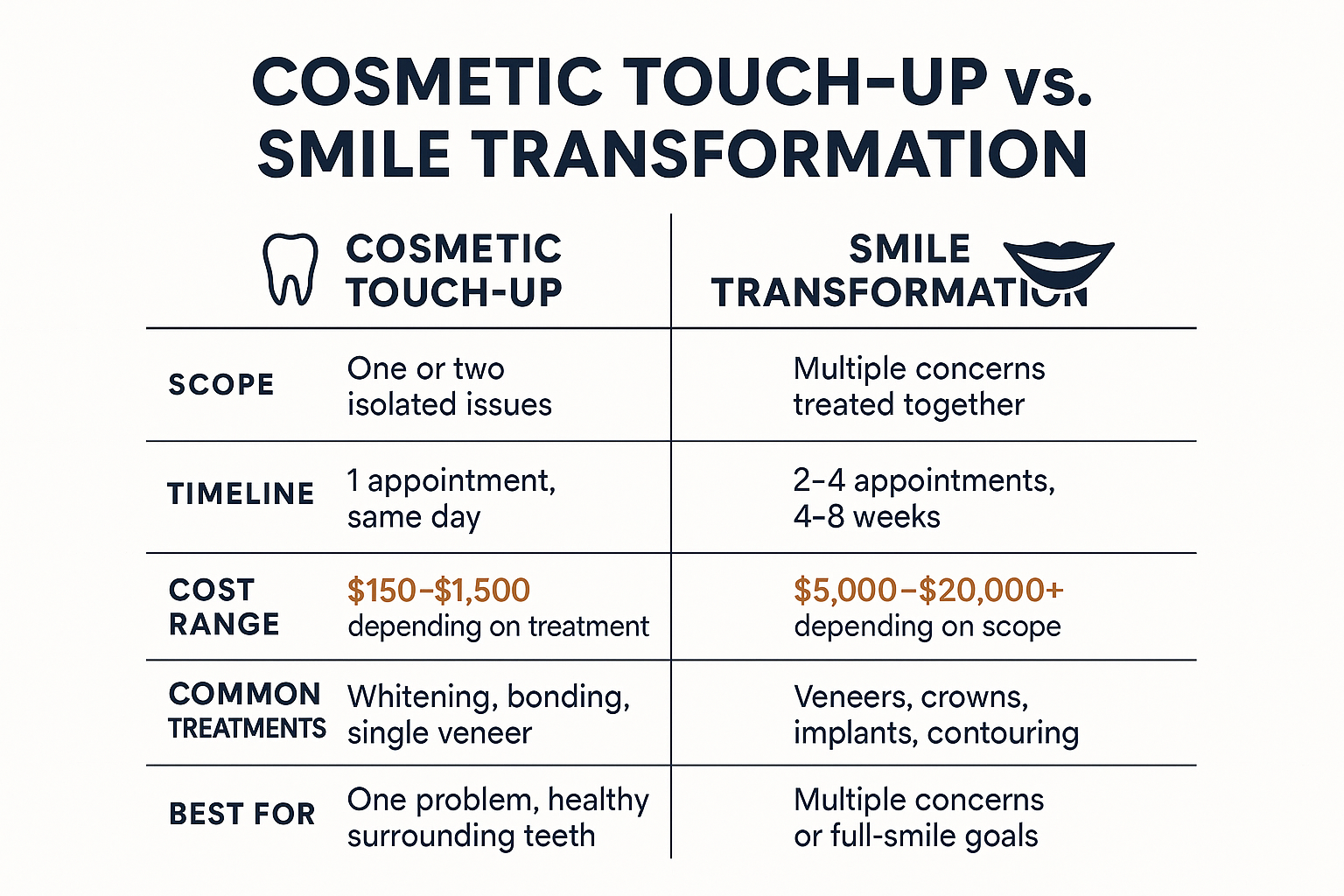
This side-by-side breakdown shows the key differences between a cosmetic touch-up and a full smile makeover across five decision points.
The Questions That Tell You Which Path Is Right
Most patients don’t know which approach they need until someone asks them the right questions. These are the ones we find most useful in a consultation.
“What would have to change for you to feel good about your smile?”
If the answer is one specific thing — color, one tooth, one visible flaw — a touch-up is probably the right conversation. If the answer takes a while and covers several things, that’s a makeover conversation.
“Does your answer change when you smile in a photo versus in person?”
Photos reveal things that mirrors don’t. Patients who are uncomfortable in photos but feel okay looking straight-on often have shape or proportion issues that whitening alone won’t fix.
“Are any of these problems getting worse?”
Some issues are purely cosmetic and stable — a long-standing gap, a tooth that’s always been slightly smaller. Others are progressing — wear from grinding, a crack that’s spreading, gum recession. When cosmetic concerns are layered on top of functional ones, the treatment plan has to address both. Our overview of routine dental cleanings and why they matter explains why catching these issues early affects what your options are later.
“How long do you want the result to last?”
Bonding can last 5 to 7 years with care. Porcelain veneers typically last 10 to 20 years. If you’re investing in a significant change, the longevity of the materials matters as much as the upfront cost.
Common Treatments: What They Fix and What They Don’t
Before deciding on a path, it helps to know exactly what each treatment can — and can’t — accomplish on its own.
| Treatment | What It Fixes | What It Won’t Fix |
|---|---|---|
| Professional Whitening | Surface staining, yellowing, dullness | Shape, size, chips, cracks, or deep intrinsic staining |
| Tooth Bonding | Small chips, minor gaps, mild discoloration on one tooth | Severe discoloration, structural damage, or multiple teeth at once |
| Porcelain Veneers | Color, shape, size, minor crowding appearance | Missing teeth, bite problems, or gum disease |
| Dental Crown | Damaged or weakened tooth structure plus appearance | Cosmetic issues on otherwise healthy teeth (overkill) |
| Dental Implant | Missing tooth — function and appearance | Cosmetic issues with existing teeth |
Why the Sequence of Treatments Matters More Than Most People Realize
One of the most common mistakes we see — and it’s not the patient’s fault — is doing cosmetic work in the wrong order. Someone gets whitening, then realizes a veneer they had done years ago doesn’t match anymore. Or they get a single veneer placed without thinking about how it will look next to teeth that will continue to age and stain naturally.
In a planned makeover, sequence matters a lot:
1. Health first — any decay, gum disease, or structural issues get addressed before cosmetic work starts
2. Shade baseline — whitening is done before restorations so crowns and veneers can be matched to the new, brighter shade
3. Structural work — crowns and implants come before veneers, since they affect the surrounding teeth
4. Veneers and bonding last — these are the finishing layer, placed once everything structural is stable
If you’re choosing a provider for veneer work specifically, the guide to picking the right veneers dentist is worth reading — it covers what to look for beyond before-and-after photos.
Skipping steps or doing things out of order doesn’t just create aesthetic problems. It can mean redoing work that shouldn’t need to be redone, which adds both cost and time.
Frequently Asked Questions About Smile Makeovers and Touch-Ups
Can I start with whitening and add veneers later if I want more?
Yes, but plan for it from the beginning. If there’s any chance you’ll want veneers later, let your dentist know before you whiten — because veneers get matched to the shade your teeth are at the time they’re made. Whitening after veneers are placed won’t change the veneer color, which can create a mismatch. Doing it in the right order from the start saves you from that problem.
How do I know if my situation is a touch-up or a full makeover without paying for a consultation first?
A rough rule: if you can describe what bothers you about your smile in one sentence, it’s probably a touch-up. If it takes a paragraph — or if you’re not sure what’s actually wrong, just that something is — it’s worth sitting down with a dentist for a proper look. Many practices, including ours, offer new patient consultations specifically for this kind of conversation.
Do veneers look fake?
They don’t have to. Older porcelain or poorly matched veneers can look opaque and artificial. Modern porcelain veneers, when placed by an experienced provider and matched carefully to your natural features, look like very good teeth — not a Hollywood costume. The key is choosing a provider who treats the surrounding teeth as part of the equation, not just the ones getting covered.
What if I have dental anxiety? Is a smile makeover realistic for me?
Absolutely. A lot of patients who come in for cosmetic consultations have been avoiding dentistry for years because of anxiety. Spreading the work across multiple shorter appointments, communicating clearly about what to expect at each step, and working with a dentist you actually trust makes a significant difference. Comfort-focused care isn’t just about sedation options — it’s about how the whole experience is managed.
Will dental insurance cover any of this?
Cosmetic procedures — whitening, veneers, bonding for purely aesthetic reasons — are generally not covered by dental insurance. But if a crown or implant is needed because of structural damage or tooth loss, insurance may cover part of that portion. It depends on your specific plan. We recommend calling your insurance provider before your consultation so you walk in with a clear picture of what your benefits apply to.
Ready to Figure Out Which Path Fits Your Smile?
If you’ve been sitting on the fence — not sure if whitening is enough or if you need something more — the best next step is a conversation, not more research. At Trinity Dental Care, we see patients from across North Scottsdale and the surrounding area who come in with exactly that question, and we’re happy to walk through what’s actually going on and what your realistic options are. Call us at 480-621-4040 or visit trinitydentalcares.com to schedule a consultation with Dr. Fink.